Alex Polizzi made a return to our TV screens and helped a family transform their budget bed and breakfast
The Hotel Inspector’s Alex Polizzi was quick to issue an ultimatum to some hotel owners as she spotted a big problem. During Thursday’s (March 19) episode of the Channel 5 hit show, Alex was in the sprawling commuter town of Horley, to check into Gatwick Turret.
Advertisement
The budget bed and breakfast is run by 62-year-old Ram, 61-year-old Anj and their 37-year-old son, Rai. The 10-bedroomed Victorian guest house is just a mile down the road from Gatwick Airport, where over 250,000 flights carry up to 46 million passengers every year.
It seems like a great location for a hotel as a lot of people will be needing somewhere to stay before or after their getaways. However there is a lot of competition as Gatwick Turret is one of over 100 hotels, including big chain brands, fiercely vying for their business.
As the hotel owners wrestle with high overheads in a highly competitive market, the family have no choice but to run the hotel almost single-handedly to keep staffing costs down.
And Rai has a lot on his hands as the running of the hotel has recently been passed down to him and it’s all on him to turn things around for Mum and Dad and find a way of making a profit.
Alex knew she had a lot to do to help transform the hotel as she found mismatched décor and too many running costs. And before she could even get stuck in she was quick to spot a problem as she discovered that despite their hard work, the business is barely breaking even and the family are struggling to pay themselves.
Alex asked: “Tell me about what it cost you to put on a room?” Rai explained: “Each room costs around £4.20 for the linen. The tea, coffee tray, a bottle of water…”
Before he could finish his sentence, Alex jumped in: “It’s expensive water. I wouldn’t put a very expensive bottle of water in the room. So what does it cost?” Rai continued: “£3.20.”
Advertisement
Alex explained: “Adding to cost per room are roughly £6 on housekeeping, £9 towards the £350,000 pound mortgage, £24 on utilities and taxes and £9 commission for those pesky online booking sites.”
She continued: “So, the grand total of that, my dears, is £56. Lucky lucky you, all this work and all this headache and you’re making a profit of about £4 a night per year – not quite enough for retirement.”
Alex admitted: “There is obviously a problem.” She then asked: “Do you pay yourselves? Rai revealed: “A £1,000 each.” It was clear Alex was stunned as she gasped: “A £1,000 each a month. Gosh darling, I mean, I’m surprised the government allows it, you’re not even making minimum wage.”
Advertisement
Alex gave the owners an ultimatum as she later added: “So we either need to make more money or sell it off.”
After an intense few days of renovations and small changes, Alex managed to help the family turn things around and business seems to be heading in the right direction as Rai revealed that they are now making an extra £140 a week with their breakfast room and they managed to get some positive press.
Rylan Clark has had various presenting roles on This Morning since 2013, one year after he came fifth on The X Factor, which for some time was a direct rival to Strictly Come Dancing
It is believed Rylan, 37, would be “a ratings winner” for the BBC programme, which is looking for two new presenters to replace Tess Daly and Claudia Winkleman. The duo left at the end of the last series, following 21-year and 15-year stints respectively, and speculation has swirled about their replacements.
Now, it is thought Rylan is likely to waltz into one of their places, having enjoyed a successful career in presenting since 2013 when he had is first role on This Morning. He first gave gossip from The X Factor on the ITV programme, and then had a relief presenter post before becoming more regular.
An insider said: “He has so many loyal fans. If he gets the job they will most certainly tune in to Strictly. He will be a ratings winner and the BBC know it.”
“Rylan has a long-standing association with the show, and Angela has been a contestant. The main thing is they’d be a totally new pairing – no baggage, no former shows, uniquely Strictly. On top of that, they want to be sure that an all-female presenting line-up isn’t replaced by an old-fashioned male-female duo where the man takes on a dominant role,” one insider told the Daily Mail.
Another source told the outlet: “For Rylan it is his dream job. He loved It Takes Two and the viewers loved him. It would be a no-brainer.”
Advertisement
Rylan, who grew up in Stepney, east London, has already anchored Eurovision coverage for the BBC. The media personality is said to be “very keen” to be paired with Angela, who was a contestant on Strictly in 2023. She was the ninth contestant to be eliminated after dancing with Carlos Gu.
It is believed Rylan still faces screen tests in April so producers can assess his chemistry with any possible co-stars, including Irish broadcaster Angela. Rylan fronted It Takes Two between 2019 and 2023, and he has hosted his own Rylan On Saturday show on Radio 2.
But other names in the frame are One Show host Alex Jones, Zoe Ball and Bradley Walsh, presenter of The Chase. Speculation has already linked the current professional dancer Johannes Radebe to the presenting gig.
David Skaith, the elected Labour mayor, has responded to criticism from Conservative councillors who said he “hasn’t shown his face at all” regarding a pilot scheme that could force businesses in Scarborough to let out their vacant properties.
The “carrot and stick” pilot project in Scarborough was approved by North Yorkshire Council’s executive committee this week, and could see it use compulsory purchase orders to address the “blight of empty and increasingly derelict properties” on high streets.
A spokesperson for David Skaith said it was “disappointing” that he “has never been approached about this programme”.
Advertisement
At a meeting of NYC’s executive committee in Malton on Tuesday, Conservative councillor Richard Foster, executive member for managing the environment, said: “The mayor is supposed to be the man of economic development and he doesn’t appear to be anywhere, or taking on the liability or the costings, and I find that a bit strange.
“It’s a Labour policy and I thought the Labour mayor would have been all over this, but he hasn’t shown his face at all, which I find poor. After all, he’s the mayor of York and North Yorkshire, and that includes Scarborough.”
Fellow executive member, Cllr Mark Crane, said: “I completely agree with you about David Skaith.”
A spokesperson for Mr Skaith said: “Scarborough is prime for development and town centre renewal, the mayor stands ready to support North Yorkshire Council and others to deliver this.
Advertisement
“The mayor has never been approached about this programme, which given his investments in high street projects in Scarborough and beyond, is disappointing and a missed opportunity by the council to align funding and support.“
Scarborough has the highest town centre vacancy rate in the county at 18.6 per cent, followed by Malton at 17.1 per cent, while Whitby has a vacancy rate of just 7.6 per cent, according to a North Yorkshire Council report.
NYC said its previous strategies, including offering fully funded vinyl wraps for vacant properties, had failed.
The scheme will see the introduction of new powers that allow local authorities to require landlords to rent out “persistently vacant commercial properties to new tenants such as local businesses or community groups”.
Advertisement
Properties that have been vacant for more than 366 days in the past two years would be eligible if they are deemed suitable for high street use, such as retail, offices, public services, hospitality, entertainment, or light industry.
The council said that the properties would also need to be considered beneficial to the local economy, society, or environment if occupied.
Labour councillor Liz Colling, chair of Scarborough and Whitby Area Committee, said: “It’s a marvellous opportunity and there are plenty of places that are vacant.”
Nic Harne, NYC’s corporate director for community development, said: “These are very new powers and just by bringing this in, we can bring landlords to the table.”
Advertisement
A report prepared for the executive committee meeting stated: “Increasingly, the condition of the town centre of Scarborough, in particular Huntriss Row, where there is a concentration of vacant premises, is being raised with the council.
“Given the lack of impact of earlier initiatives, the limits of existing powers and the local imperative to tackle the issue, it is proposed the council pilots the use of the new high street rental auction (HSRA) powers to compel landlords to improve the vacant premises and secure new tenants.”
While the Europa League will continue to offer respite from an otherwise difficult season for Forest, the additional games present challenges.
Forest will take on Porto in the quarter-final on 9 and 16 April, welcome Aston Villa to the City Ground in between the two legs and then host Burnley the following weekend.
Winning games means positive momentum and that can only be a help when it comes to fighting to stay in the league.
But it also means more games and Pereira, who is set to take charge in his first European quarter-final, must find the balance between keeping his side in the top flight and managing the demands of competing in Europe.
Advertisement
“When we win it’s different,” Pereira said.
“The spirit is different, the energy is different and the boys deserve it because they are a fantastic group, very good players and with team spirit, character – we showed everything today.
“I don’t have any doubt that we have the quality and we will compete to achieve our targets.”
Yates added: “That winning feeling is special, you want to keep that momentum going.
Advertisement
“Momentum at this stage of the season is huge. We’re not going to get ahead of ourselves. Recover now, focus on Tottenham now and keep building, keep getting those wins.
When a gym owner in a small Himalayan town faced off a Hindu mob targeting a Muslim shopkeeper earlier this year, he quickly turned into an unlikely national figure – and the inspiration for a series of small acts of kindness and solidarity that many would come to regard as a turning of the tide against sectarian hatred in India.
Deepak Kumar’s intervention in the confrontation between members of the Hindu nationalist group Bajrang Dal and the Muslim shopkeeper in Kotdwar, in the northern state of Uttarakhand, took place on 26 January.
The Bajrang Dal is one of the prominent groups in the Hindu nationalist network informally known as the Sangh Parivar. Prime minister Narendra Modi’s BJP party is part of the same ecosystem.
The Bajrang Dal mob had confronted Vakeel Ahmed, an elderly clothing shop owner, demanding that he remove the word “Baba” from the name of his store, Baba School Dress and Matching Centre.
Advertisement
They claimed that “Baba” referred to Siddhabali Baba, a local temple dedicated to the Hindu deity Hanuman, and that a Muslim should not use it.
Kumar stepped in after noticing a crowd gathering outside Ahmed’s shop.
“I did not like these young men talking so rudely with an elderly man. They were targeting him because of his religion. They were targeting Muslims,” he later told the BBC.
When the mob asked his name during the confrontation, he responded with what would soon become an internet phenomenon: Mohammad Deepak.
Advertisement
Mohammad is a Muslim name, Deepak typically Hindu.
“By identifying myself as Mohammad Deepak, I wanted to tell them that I’m an Indian,” he told the broadcaster. “That this is India and everyone has the right to stay here, regardless of their religion.”
Almost a month later, when a dispute over religious practice emerged in Lucknow, similar images of solidarity circulated on social media.
It was the early days of Ramadan, the Muslim fasting month, and students at Lucknow University had arrived to pray at the campus mosque, only to find it locked and police stationed nearby. The students said they were given no explanation or warning that the mosque was to be closed.
Advertisement
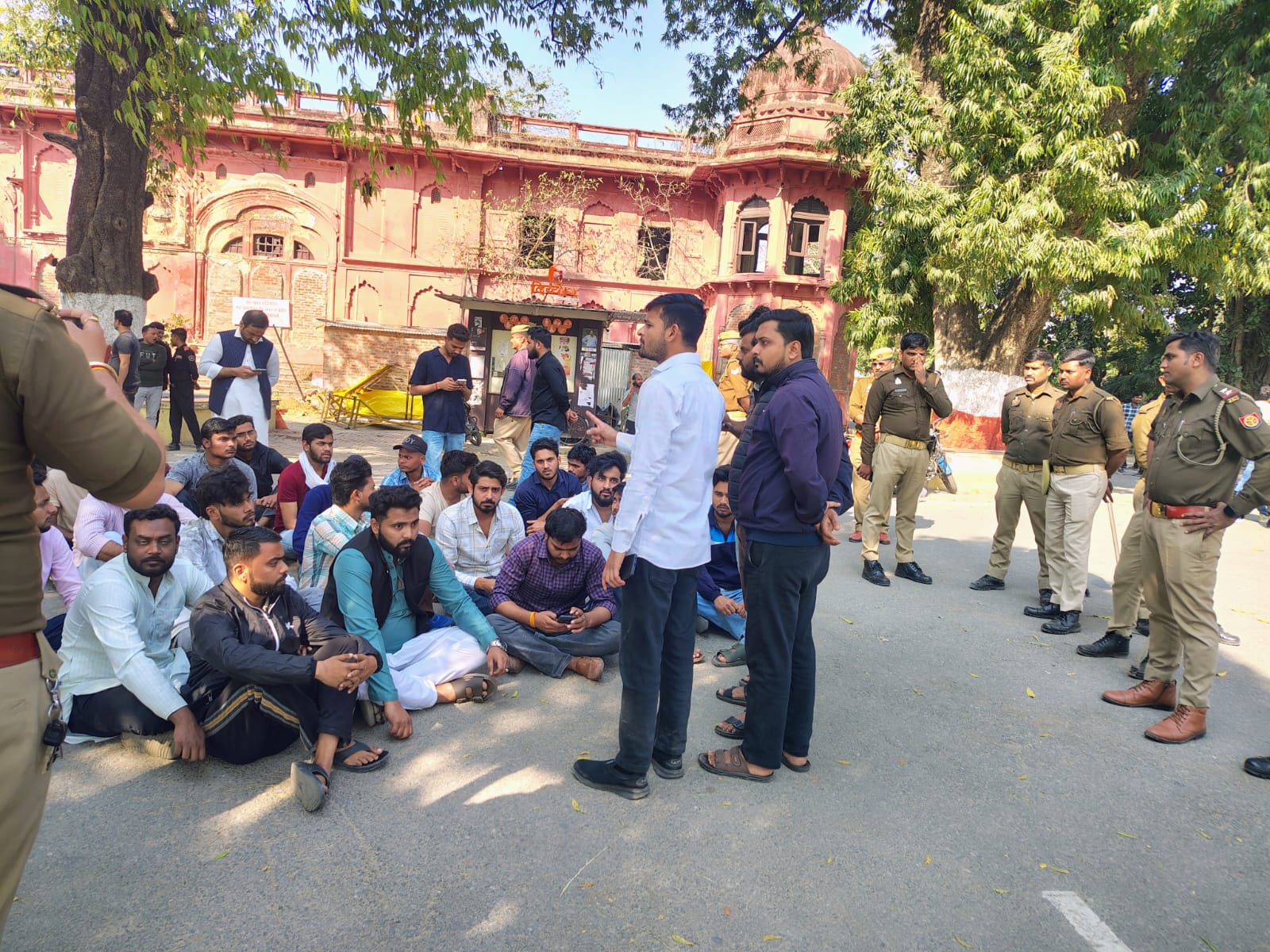
So, on 22 February, a group of students started an unusual protest right outside the mosque: a few Muslim students stood in prayer as their non-Muslim classmates formed a protective human chain around them. A video of the prayer-protest spread on social media and the incident came to be celebrated as the latest example of ordinary citizens defying sectarian fissures in India.
Many observers quickly traced this act of religious solidarity to the confrontation involving the gym owner in Uttarakhand.
Students protest outside Lal Baradari at the Lucknow University (Supplied)
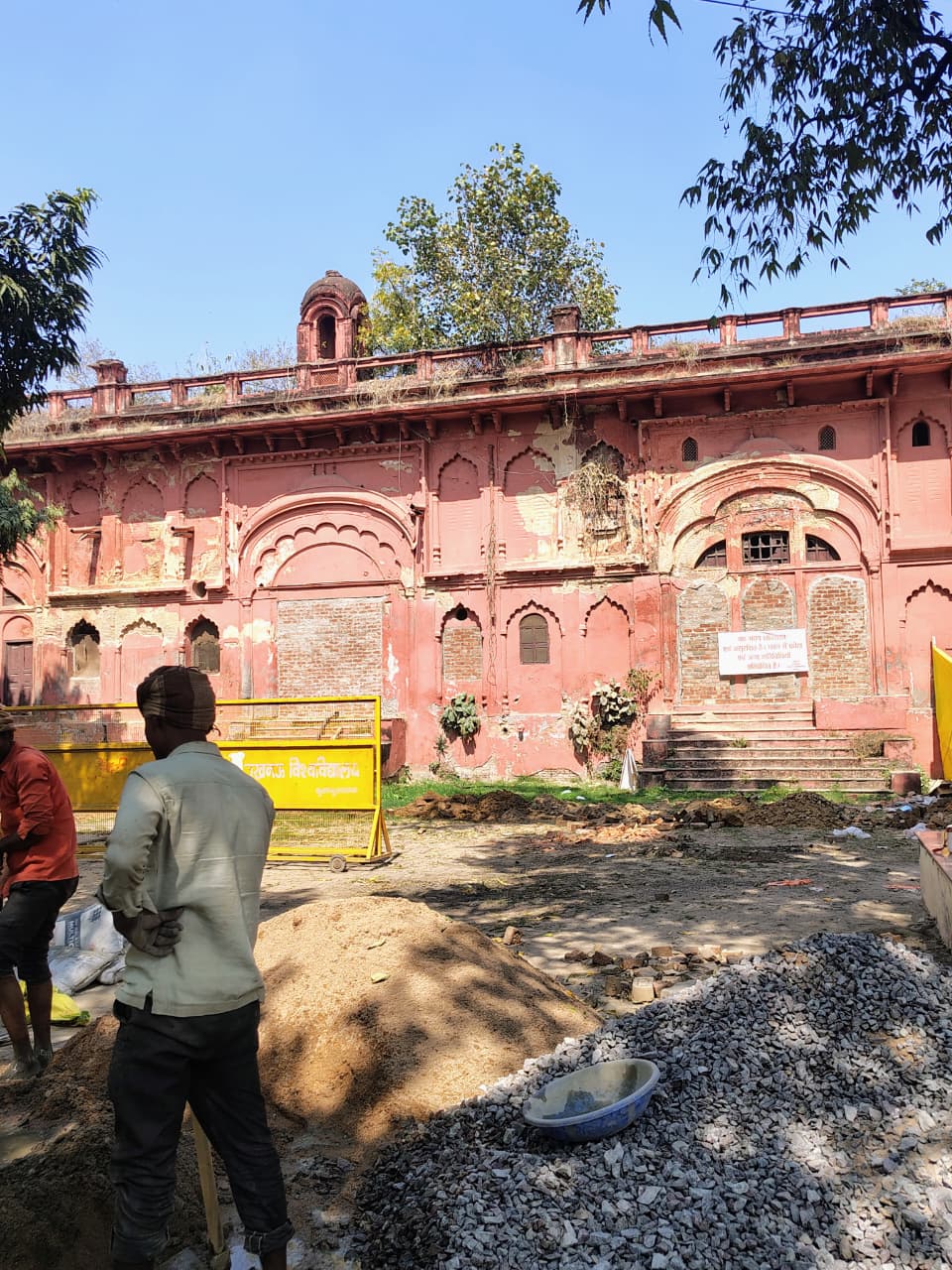
University officials said the Lal Baradari mosque was fenced off for safety reasons, the Indian Express reported. They claimed the medieval site was dilapidated and that fencing was installed to prevent people entering a potentially unsafe building.
However, students pointed out the mosque was fenced off soon after a visit to the university by Mohan Bhagwat, leader of the RSS, the mothership of the Sangh Parivar, and Pankaj Chaudhary, state president of the BJP.
“The building was sealed shut days after their visit without any executive order, illegally,” claims Shantam Nidhi, a master’s student. “This is totally ideological and RSS is targeting Muslims. The entire politics of RSS and BJP is hate politics.”
Advertisement
The Independent has reached out to the RSS, BJP and Bajrang Dal, as well as the university’s proctor, for comment.
“When I asked a professor why it had been sealed, he said he had no idea. By then police had come. I kept asking but no one told me anything. So I sat on a protest there. And I said if you have any notice to close it, then show it to me,” Taukeel Gazi, another student, says. “But the administration has so far not shown any such thing.”
Gazi had been praying at the mosque since 2020 and the practice predated him by decades. “I have completed my graduation and post-graduation from this university and, for about five years, I have been offering namaz here,” he says. “For about 100 years, people have been offering namaz here.”
Lal Baradari mosque (Supplied)
That evening, Muslim students gathered outside the mosque to offer prayers. “Out of a lack of options, I had to offer Namaz outside. And the Hindu friends formed a human chain,” Gazi says.
Among those present was former Lucknow University student Shubham Kumar. “The Lal Baradari mosque is under the Archaeological Survey of India and not the university. For several years, our Muslim friends had been offering namaz there,” Kumar, who is now the state secretary of the National Students Union of India, an affiliate of the main opposition Congress party, tells The Independent.
Advertisement
“We were concerned that if our brothers read namaz outside the mosque, then police might charge them with batons and the right-wing groups might also assault them. So we thought that if there was an attack, then at least it would be first on us – those forming the human chain – and hopefully our friends offering namaz would not be assaulted while in prayer.”
Tensions flared when members of a student organisation affiliated with the RSS arrived at the site and shouted slogans. Police were then deployed on the campus to prevent clashes.
Students eventually ended the protest after submitting a memorandum to university authorities, though notices summoning participants to appear before a magistrate were subsequently issued. The mosque remains shut.
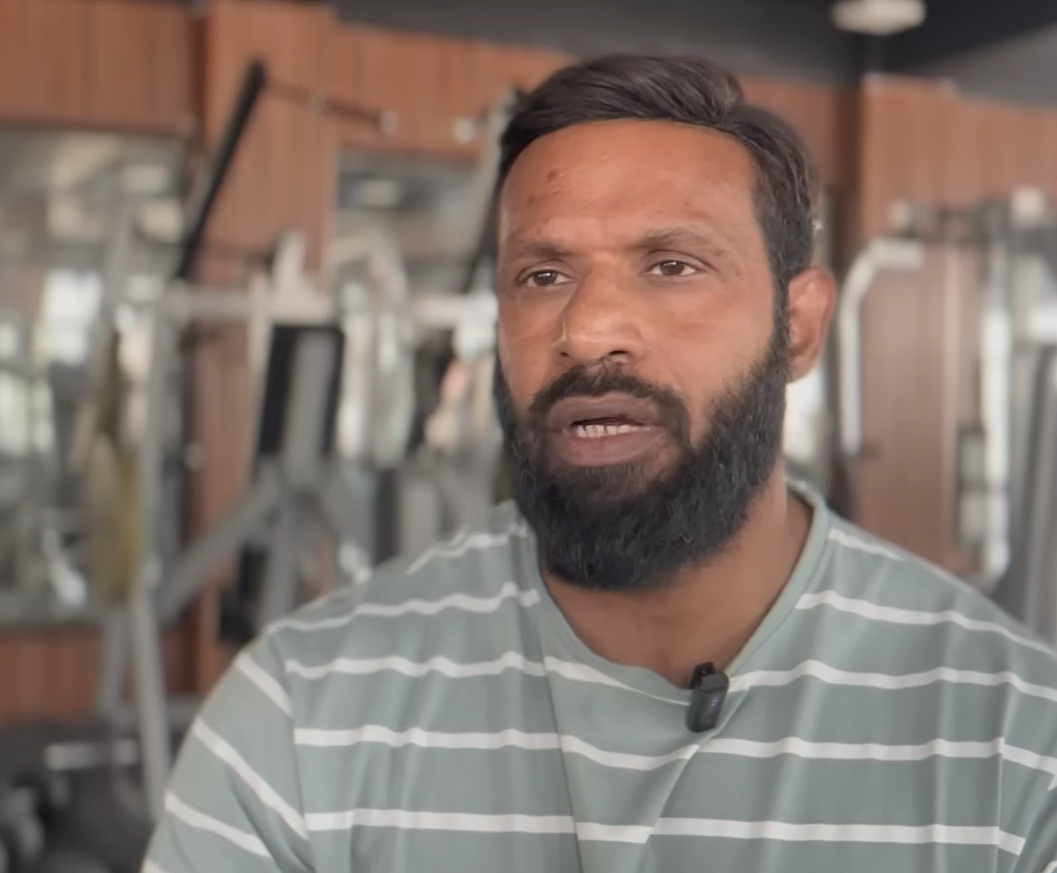
Deepak Kumar, a gym trainer in India who stood up for a Muslim shopkeeper in Uttarakhand, has become a national ‘hero’ (BBC News Hindi/YouTube)
The Lucknow University protest is being seen as just one in a series of incidents where ordinary citizens stand up for others in their community, regardless of their respective religions.
Another took place in the western state of Rajasthan when villagers publicly challenged what they saw as the discriminatory conduct of a former ruling party lawmaker.
Advertisement
Former BJP parliamentarian Sukhbir Singh Jaunapuria arrived in the village of Kareda Buzurg in February to distribute blankets, only to deny them to Muslim women.
According to local media reports, the women were asked their names before blankets were handed out. Any who gave names likely to identify them as Muslims were reportedly told to move aside.
One of the women, Shakuran Bano, in her 60s, told The Print she felt humiliated. “I didn’t want any blanket. But there was no need for this humiliation,” she said. “It was humiliating. He simply said he will not give blankets to Muslims.”
Bano says she attended the event at the urging of a neighbour and didn’t know that blankets would be distributed.
Advertisement
She says the organisers told the Muslim women to sit separately and Jaunapuria allegedly remarked that “those who abuse Modi have no right” to receive blankets, apparently referring to India’s prime minister. “Why would I abuse Modi? When did he hear me abuse him?” Bano asked.
What made the episode notable, however, was the reaction from the Hindu villagers.
Many reporteldy confronted the former lawmaker, asking why Muslim women had been singled out.
“More than Muslims, it is Hindus who are angry,” Hanuman Chaudhary, whose wife is the elected village head, told the Indian Express.
Advertisement
The villagers later burned Jaunapuria’s effigy in protest.
Badrilal Jaat, a village elder, told The Print the community had long maintained religious harmony.
“There is no discord between Hindus and Muslims in our village, never happened in generations,” he told the outlet.
“When an outside person comes and tries to sow such seeds, we have to come forward to protest. We celebrate Diwali, Holi and Eid together. We don’t differentiate.”
Advertisement
Jaunapuria has spoken out to defend his conduct, saying the blankets were part of a personal initiative for his party’s workers.
“We had made a list of about 200 women party workers and had not invited them,” he said, referring to the Muslim women who attended.
“These people were taking blankets meant for us and our people,” he added, denying the decision was motivated by communal discrimination.
Heartening as scattered acts of solidarity like these are in a country struggling with incidents of religious disharmony and at times violence, Indian scholars say they should be seen in a larger context.
Advertisement
“I would still treat them as exceptions,” Apoorvanand, a professor at Delhi University, tells The Independent. “It requires extraordinary courage to stand before a group of goons.”
Fear of violence or retaliation often deters intervention, he adds. “If you’ve three or four goons before you, you normally don’t want to get in trouble,” he says. “If people think that police is with them [those doing the discriminating], then it becomes very difficult to take a stand because they will have to pay a very heavy price.”
He argues the apparent rise in incidents of solidarity of late may partly reflect social media visibility rather than a deeper shift.
“I think that’s a social media virality factor. I still don’t think that we can describe it as early signs of a turning tide,” he says.
Advertisement
What will make a difference, he says, is common people feeling confident that police will stand with them in such instances.
For the students who stood outside Lal Baradari during the mosque protest, the consequences feel immediate.
Shubham Kumar says the episode has already altered the campus atmosphere. “From a place where one goes to study,” he says, “the campus has become a religious battleground.”
The UK experiences some of its largest diurnal temperature ranges in early spring due to a combination of factors.
By March and April the sun is much higher in the sky and the days are lengthening, allowing more energy to be delivered and more efficiently. After the long winter, however, the ground and lower atmosphere remain chilly allowing rapid overnight cooling.
Clear skies underneath a spring high pressure systems can increase this contrast further.
At night heat is lost quickly and until the spring equilux, the nights are still longer than the days, all leading to cold mornings.
Advertisement
During the day as the sun rises, those same now sunny skies allow rapid warming as the sun is more directly overhead, leading to warm afternoons.
Dry air heats and cools more quickly than humid air and this can further widen the temperature gap.
These factors combine to increase our diurnal temperature range during the early stages of spring, especially during settled, sunny spells with light winds.
Kings Meadow Estate in Gorebridge, Midlothian, was sold as a dream location for young families to settle down and call home.
Families in a small Scots village have slammed a property developer over a raft of ‘failed promises.’
Advertisement
Kings Meadow Estate in Gorebridge, Midlothian, was sold as a dream location for young families to settle down and call home.
However, as reported by Edinburgh Live, it soon turned into a nightmare. Those moving to the area claimed they were sold the promise of an accessible enclosed play park at the heart of the scheme alongside a football pitch – but homeowners say Persimmon have failed to deliver.
Residents also claim to have been plagued with various road issues with images showing the area filled with potholes. Locals also claimed they were promised traffic lights at this entrance junction years ago and these have yet to be fitted.
Persimmon bosses have accepted ‘outstanding works are yet to be delivered’ and have vowed to take action and have apologised to residents.
Advertisement
Mum-of-four Laura D’Arcy, 37, who bought a house on Limefield Gardens six years ago, described being ‘abandoned’ and ‘ignored’ by the developer. She said: “It feels like once the homes were built, Persimmon just upped and left, and that was it. They left us with an unusable park and roads; this is not what we were promised.
“The park is a couple of sticks with some rope sticking out of the ground. The site isn’t safe, there are sheets of metal lying around and boulders sticking out of the ground.
“My oldest kids were nine and seven when we moved in. Now they are 15 and 13, they have never had a park for their childhood. On a beautiful day there are no children playing there. Parents and kids know the site is dangerous.
Advertisement
“For the past six years we have also been fighting for Persimmon to fix the roads. At first they said the roads were Midlothian Council’s responsibility, but the council claimed it was up to Persimmon – we have been passed from pillar to post.
“No one is listening to us. Cars are being damaged and there have been so many near accidents close to the primary school due to the state of the road.
“I’ve had to have several tires replaced. There are multiple potholes and the surface of the road is crumbling.
“We were also promised traffic lights at the entrance junction because it is so hard to get in and out. If the state of the roads don’t get your car then there is every chance you get hit trying to leave the estate.”
Advertisement
Laura, who works in hospitality, explained that when she bought her home in the area, properties ranged between £180,000 and £370,000. She feels those who bought homes at Kings Meadow have not had value for money.
Plans for the development of the estate have been shared with Edinburgh Live, and they depict spaces for a football pitch and a play area. No football pitch has been fitted and a play area is in place however residents argue it falls well below the standards they were originally promised.
Sean Hanlon, 39, stays at Kings Meadow with his family, he spent years leading a campaign for residents to see improvements in the area. He said: “This is the second Persimmon home we have bought.
Advertisement
“The first was just across the road and there were a lot of issues. But we saw on the news they had made lots of changes, so we thought it can’t be as bad this time?
“But we were wrong. When we moved in it was absolutely dreadful, they have got worse, not better.”
A Persimmon Homes spokesperson said: “We recognise that there are outstanding works required at our Kings Meadow development and would like to apologise to residents for the inconvenience this is causing. We recently met with Midlothian Council to review the site in detail and are currently developing a coordinated plan to address the concerns that have been raised.
“Road surfacing works at the site entrance are due to begin next week and once the full plan has been finalised, we will update residents on the actions being taken and the expected timelines for completion.”
A Midlothian Council spokesman said: “The roads and pavements in the Persimmon Homes Kings Meadow development in Gorebridge have not yet been adopted by Midlothian Council. As is standard practice, the developer remains legally responsible for completing all required infrastructure works before adoption can take place.
“Persimmon Homes has committed to delivering improvements to the junction and surrounding areas, including installing traffic lights and pedestrian crossing facilities. The timing and completion of these works are entirely the responsibility of Persimmon Homes and are outwith the control of the council.
“In the meantime, the council continues to carry out temporary repairs on the sections of road that fall under our ownership until they are resurfaced as part of Persimmon’s capital works. The area where vandalism has occurred lies solely within Persimmon Homes’ responsibility.”
Advertisement
Get more Daily Record exclusives by signing up for free to Google’s preferred sources. Click HERE.
Nearly 4 million people receiving Personal Independence Payment are being urged to share their views
Millions of benefit recipients are being encouraged to voice their opinions on the future of Personal Independence Payment (PIP), as ministers kick off a significant review with a strict deadline for responses.
Advertisement
The Department for Work and Pensions (DWP) has confirmed that the initial phase of the Timms Review is now in progress, with a nationwide “call for evidence” open until May 28, 2026. In a post on X, the DWP said: “The Timms Review steering group wants to hear your views on the future of PIP. The first step in the group’s engagement – a Call for Evidence – is now open.”
Nearly 4 million claimants could be impacted
The review could have extensive implications, as PIP currently assists nearly 4 million individuals in England and Wales with additional disability-related costs. Ministers assert that the exercise aims to ensure the benefit remains “fair and fit for the future” as demand continues to escalate.
The call for evidence is open to a broad audience – including disabled individuals, carers, clinicians, charities and MPs – with the Government eager to collect as much feedback as possible before formulating recommendations.
Content cannot be displayed without consent
What ministers are scrutinising
The review will investigate whether PIP is still functioning as intended over a decade after its introduction in 2013.
Advertisement
Key areas under consideration include:
Whether PIP is fulfilling its primary objective
If assessments offer fair access to support
Variations in claimant experiences among groups
How societal and workplace changes have influenced eligibility
These themes underpin the review, which is set to report back in the autumn.
Sir Stephen Timms, Minister for Social Security and Disability, called on people to participate, saying: “It is vital that as many people as possible have the chance to contribute.”
He further urged: “I encourage anyone with experience of the PIP system… to submit their views.”
Advertisement
Co-chair Dr Clenton Farquharson highlighted that the benefit has a “profound impact” on individuals’ daily lives, independence and dignity.
Review co-chair, Sharon Brennan, said: “It is essential for the success of this review that we hear frank and honest views from as many disabled people, carers, advocates and others as wish to participate. That’s why this Call for Evidence is just the start of our engagement plans, which will be wide and varied to ensure people can offer their views in a way that works for them.”
Deadline set for responses
The consultation concludes at 11.59pm on May 28, 2026, after which submissions will be scrutinised by the review’s steering group. Officials indicate this is merely the first phase, with additional opportunities to contribute anticipated as the work advances.
Advertisement
Why it matters
For millions of households, PIP payments serve as a crucial financial lifeline, assisting with extra costs associated with long-term health conditions.
As claimant numbers keep rising and the system faces mounting scrutiny, the review’s findings could determine the direction of disability benefits for years ahead.
The largest category of classified concerns relates to potential fraud or maladministration
Northern Ireland bodies have made “notable progress” in handling whistleblowers but there “remains scope for improving culture”, the head of the NI Audit Office has said.
Advertisement
A new report has evaluated mechanisms put in place by organisations including central government departments, local councils and health trusts to deal with concerns raised.
The Comptroller and Auditor General Dorinnia Carville’s report on Raising Concerns in the Northern Ireland Public Sector follows a number of high-profile cases associated with raising concerns in recent years.
The report released on Friday notes that more than 700 concerns have been raised across the public sector in the last five years.
The largest category of classified concerns relates to potential fraud or maladministration. In cases where investigations were completed, only 10% of the concerns raised were upheld.
Advertisement
All government departments now have updated policies and a designated officer in place to deal with whistleblowing, which was seen as positive.
However, areas for improvement were also identified, including the need for development of specialised, investigative skills, to ensure that all concerns are appropriately treated.
The report also calls for more sharing of good practice and reflection on what works between organisations, and stronger leadership across public sector organisations on raising concerns.
The report highlights that in many government departments ‘speak up champions’ are not in place, despite this being a requirement of the 2023 framework.
Advertisement
Commenting on the report’s findings, Ms Carville said a “healthy and positive culture around raising concerns is essential to ensure transparency, integrity and accountability within the public sector”.
“It helps organisations detect issues early, avoid costly mistakes, and improve service delivery for the public,” she said.
“The 2023 NI Departments’ Raising a Concern Policy Framework was a very significant and welcome step forward.
“However, public sector leaders should continue to treat this as a priority and ensure their staff are informed, skilled and supported to raise concerns they have as well as manage those they receive.
Advertisement
“Alongside this report today, I am delighted to publish an updated Good Practice Guide on Raising Concerns to support public sector bodies and their employees.
“This guide, together with the recommendations in my report, will help central and local government assess their current arrangements and create the environment where raising concerns is encouraged, welcomed and managed effectively.”





















































You must be logged in to post a comment Login