The town is only 30 minutes from from Cambridge on the train
Spring is nearly here and there is one town that’s an easy train ride from Cambridge with beautiful lavender fields to explore. With the warmer weather getting closer, you may be looking for some pretty places to walk to admire what spring has to offer.
Advertisement
The Hertfordshire town of Hitchin – only a 30-minute train ride from Cambridge – has large fields of lavender that make it unique. Hitchin’s Lavender is set on the rolling slopes of Wilbury Hills.
It has become known for its stunning views and picturesque walks in the warmer weather. For people who love the camera, the fields are also the perfect place for a photo opportunity.
As well as walking through the fields, there is a tearoom and dining area to enjoy a snack and drink. Hitchin has a lot of other things on offer as well as its landmark lavender fields.
It is a quaint market town with lots of history at its doorstep, as the town dates back to around the seventh century. It also has strong royal links, as the late Queen Mother was born in nearby St Paul’s Walden.
Advertisement
One of the town’s best features is its market. Hitchin market is one of the largest outdoor markets in the region, and features over 150 stalls. It is held on several days of the week.
Buildings throughout the town are made up of stunning architecture that is fine to admire. The old market square is made up of Italianate-style buildings.
The town’s church, St Mary’s Church, is majorly formed of materials from the 14th and 15th century. Hitchin also offers a great shopping experience, with a wide range of independent shops and boutiques in the town.
There are also a number of popular high street brands to shop at. After a long day of shopping, there is also every cuisine you can think of on offer in Hitchin to enjoy a bite to eat and drink at.
Global oil prices have surged and stock futures have plunged following US-Israel military strikes on Iran that killed Supreme Leader Ayatollah Ali Khamenei, sparking retaliatory attacks
00:14, 02 Mar 2026Updated 00:32, 02 Mar 2026
Global oil prices have already climbed following strikes across the Middle East after the US and Israel launched attacks on Iran over the weekend.
Roughly 15 million barrels of crude oil per day — about 20% of the world’s oil — are shipped through the Strait of Hormuz, making it the world’s most critical oil chokepoint, according to Rystad Energy. Tankers traveling through the strait, which is bordered in the north by Iran, carry oil and gas from Saudi Arabia, Kuwait, Iraq, Qatar, Bahrain, the UAE and Iran.
West Texas Intermediate, the light, sweet crude oil produced in the United States, was selling for about $72 a barrel Sunday night, up around 8% from its trading price of about $67 on Friday, according to data from CME group.
Advertisement
A barrel of Brent crude, the international standard, was trading at around $79 per barrel Sunday night, according to FactSet, up about 8% from its trading price of $72.87 on Friday, which had been a seven-month high at the time.
Ensure our latest headlines always appear at the top of your Google Search by making us a Preferred Source. Click here to activate or add us as your Preferred Source in your Google search settings.
The price spike happened almost instantly after the military action as stock futures tumbled in overnight trading, raising alarm among equity investors. Futures on the Dow fell 517 points, roughly 1%, with comparable figures recorded across the S&P and NASDAQ, whilst gold futures jumped 2% in reaction to the oil price surge.
It comes as Iran continues retaliatory strikes in response to US and Israeli strikes which led to the death of Ayatollah Ali Khamenei on Saturday. At least three civilians have been killed in the UAE.
US President Donald Trump announced Saturday that the US and Israel carried out a joint military operation targeting Iran overnight, which resulted in the death of Iran’s Supreme Leader Ayatollah Ali Khamenei.
Advertisement
Iran launched retaliatory strikes on Israel and US military bases throughout the Middle East in response to the attack, in which several dozen, including more than 50 primary school children, were killed.
Trump urged the Iranian people to seize this rare opportunity to overthrow its religious fundamentalist regime as the Iranian government pledged to unleash devastating attacks for what they described as a criminal assault, reports the Express US.
In a video statement on Truth Social, President Trump vowed to “avenge” US military deaths and “deliver the most punishing blow the terrorists who have waged a war against basically civilisation”.
Advertisement
“Combat operations continue in full force and will continue until all of our objectives are achieved,” he said in the six-minute clip upon his arrival back to Washington this evening.
The president continued to say that “sadly there will likely be more” US casualties, adding: “That’s the way it is.”
Follow our live blog for the latest updates by clicking here.
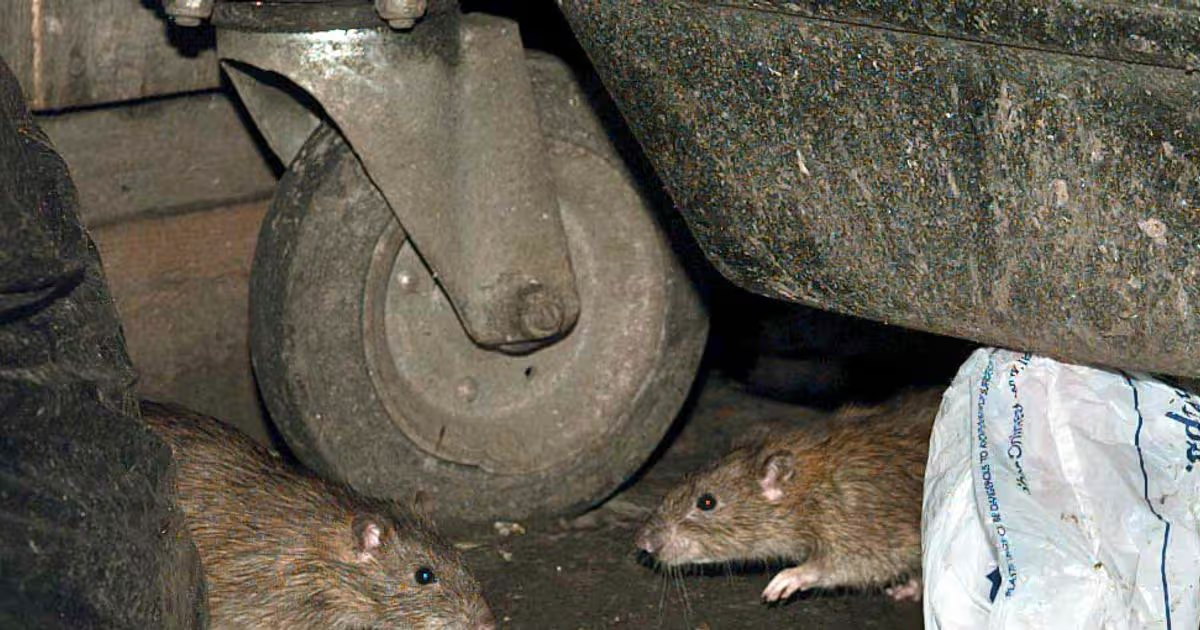
Experts have revealed that rat activity has significantly increased over the last year and it’s thought to be due to a record hot summer and exacerbated by recent wet weather.
Advertisement
Rentokil Pest Control said it had recorded a 10% year-on-year increase in confirmed rodent activity, with large regional spikes in Northern Ireland and northern England.
Northern Ireland recorded the largest increase of 26%, followed by Yorkshire (20%) and north-west England (19%).
Several other regions, including the West Midlands (16%) and Scotland (14%), also had double-digit rises.
Advertisement
Rentokil said longer-term climate patterns could be contributing to the increase, including 2025 being the UK’s warmest year on record.
It said milder weather could increase rat reproduction by extending their breeding season and leading to larger populations.
Rentokil warned that the record-breaking wet start to 2026 across the UK could also lead to higher levels of rat activity.
Sustained heavy rain can flood burrow systems and drainage networks, displacing rats and increasing the likelihood of infestations as they seek higher, drier shelter, it said.
Advertisement
Paul Blackhurst, from Rentokil, said: “Rats are highly capable swimmers. They can navigate strong currents, enter exposed pipes and sewers, and swim considerable distances in open water.
“However, what they cannot tolerate is prolonged submersion. When burrow systems and sewer networks flood, rats are forced to seek higher, drier ground, increasing the risk of infestations in properties.
“With northern regions already reporting notable increases in reported activity, continued wet weather may push more rats into properties. Early prevention and professional support are key.
“Simple steps such as proofing entry points, managing waste effectively and responding quickly to early signs of activity can make a significant difference. If a problem does become unmanageable, professional pest control experts are always on hand to provide safe and effective solutions.”
Advertisement
After periods of heavy rain, storms and flooding, property owners are advised to take proactive steps to reduce the risk of rodent activity, including:
Clearing debris promptly by removing fallen branches, leaves and other items that may have accumulated around the property, as these create ideal hiding and nesting spots for rats.
Sealing potential entry points.
Inspecting the walls and foundations of the property for gaps, as rats can squeeze through “surprisingly small” openings
Removing sources of food by ensuring outdoor bins are sturdy, fitted with tight lids and positioned away from building walls where possible.
Want to see more of the stories you love from Belfast Live? Making us your preferred source on Googlemeans you’ll get more of our exclusives, top stories and must-read content straight away. To add Belfast Live as a preferred source, simply click here.
DEIR AL-BALAH, Gaza Strip (AP) — Some Palestinians say they fear the widening war sparked by U.S. and Israeli attacks against Iran could overshadow the fragile situation in Gaza, just over a week after U.S. President Donald Trump rallied billions of dollars in pledges for the territory’s reconstruction and tried to nudge a ceasefire forward.
Residents say they are scared of neglect and deprivation, with Israel in the wake of the weekend strikes closing all crossings into their shattered territory of over 2 million people.
Palestinians told The Associated Press they were rushing to markets, haunted by memories of painful food scarcity last year under months of Israel’s blockade. Part of Gaza, around Gaza City, was found to be in famine.
“When the crossings shut down, everything was suspended from the market,” said Osamda Hanoda from Khan Younis. “The prices go up, and people live in misery.”
Advertisement
Reports show prices of goods rising sharply
The shaky Israel-Hamas ceasefire had led to more humanitarian aid and other supplies entering Gaza, even as the United Nations and aid partners say more of everything from basic medical supplies to fuel is needed.
Now, Palestinians are hoarding again, with reports of prices rising sharply for basic goods such as bags of flour.
“We are afraid of not finding milk” and diapers for the kids, or food and water, said Hassan Zanoun, who was displaced from Rafah.
COGAT, the Israeli military body overseeing civilian affairs in Gaza, did not respond to a request for comment Sunday. In its announcement of the closings, it asserted that the food supply inside the territory “is expected to suffice for an extended period.” It added that the rotation of humanitarian workers in and out of Gaza is postponed.
Advertisement
It was not clear when any crossing might reopen. Israeli authorities focused on Iran, and citizens dashed repeatedly for shelter as sirens wailed.
The war in Gaza began with the Hamas-led attack on Israel on Oct. 7, 2023, and it’s been marked from the start by restrictions on people and supplies being allowed into the territory — and terrified people, including medical evacuees in need of treatment, getting out.
A month ago, Gaza’s main Rafah border crossing with the outside world — its only crossing not with Israel — reopened, allowing a small and tightly controlled flow of Palestinian traffic in both directions. No cargo was allowed through.
Advertisement
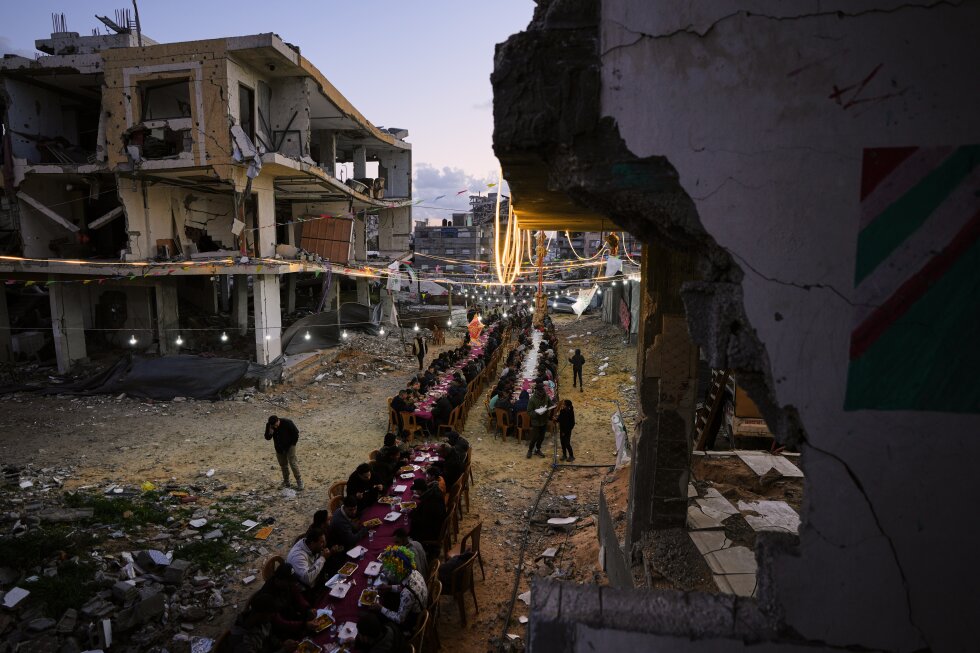
Now all crossings are closed again in the middle of the holy Muslim fasting month of Ramadan, a time of chosen deprivation, evening feasts and prayer. Images have shown Palestinians lined up at long tables in the middle of bombed-out debris.
The strikes on Iran shook that routine.
“All the people rushed to markets, and they all wanted to shop and hide,” said Abeer Awwad, who was displaced from Gaza City, as word of the explosions in Tehran began to spread.
Under the Oct. 10 U.S.-brokered ceasefire, the heaviest fighting has subsided, though regular Israeli fire continues in Gaza. The U.N. World Food Program has noted progress in the enclave but said in its latest food security analysis last week that hunger remains.
Advertisement
“Households reported an average of two meals per day in February 2026, compared to one meal in July,” it said. “Still, one in five households consumed only one meal daily.”
A challenge for aid groups and others
Refocusing the world’s attention on Gaza is a challenge for aid groups and others as Iran scrambles for new leadership and explosions continue in Tehran, Israel and around the Middle East.
Trump has said bombing in Iran could continue through the week or longer, and warned Tehran of “A FORCE THAT HAS NEVER BEEN SEEN BEFORE!” if it escalates attacks.
It’s a dramatic turn from Trump’s launch less than two weeks ago of his new Board of Peace, a gathering of world leaders that is aimed at ending the war in Gaza but has ambitions of resolving conflicts elsewhere.
Advertisement
Even with that bump in momentum on Gaza, major challenges remain for the ceasefire. They include disarming Hamas, assembling and deploying an international stabilization force, and getting a newly appointed Palestinian committee meant to govern Gaza into the territory.
As the Middle East turns to another war, some Palestinians see a benefit: Israel’s military is distracted.
“The good thing is that the sound of booms and demolitions is rare now near the yellow line,” said Ahmed Abu Jahl, of Gaza City, speaking about the line dividing Gaza and marking out roughly half the territory controlled by Israeli forces.
“Even the drones, they are still flying overhead, but their number has gone down.”
Advertisement
___
Ezzidin reported from Cairo and Anna from Lowville, New York.
Hydrolysis, also known as water cremation, has been dubbed “boil-in-the-bag” funerals by some and has been effectively banned in the UK until now
“Boil-in-the-bag” funerals are coming to the UK, it has been announced. Hydrolysis provides an eco-friendly option to conventional cremations or burials.
Advertisement
Formally called water cremation, the process has been labelled “boil-in-the-bag” funerals by some observers. Until now the method has been essentially prohibited in the UK, though it’s already established in Ireland, Canada and the United States.
Scotland has now become the first nation within the UK to adopt the technique following regulations introduced by the Scottish Government, which gained approval from the Scottish Parliament. In confirming the development, officials said it would provide choice for those seeking alternatives to burial or cremation for the first time in over a century.
Public Health Minister Jenni Minto said: “The choices people make about their remains prior to death are deeply personal, shaped by individual values, beliefs and the wishes of their families. Hydrolysis offers a new, environmentally friendly alternative to burial or cremation, responding to significant public support for greater choice, and it will be the first new option available for over 120 years.
“The process will be subject to the same assurances and regulatory requirements as existing methods, giving bereaved families confidence that their loved ones are treated with care, dignity and respect.”, reports the Mirror.
Advertisement
Hydrolysis sees the body wrapped in a silk or woollen shroud, or alternative biodegradable fabric, before being positioned in a vessel containing heated water and chemical solutions, accelerating the decomposition process. The remains can be given back to relatives, much like ashes after traditional cremation.
According to cremation.green the advantages include eliminating fossil fuel usage, lowering carbon dioxide emissions and, when compared to conventional burial, it’s considerably quicker. The website states that traditional burial methods require up to 25 years for complete human decomposition, whilst water-based cremation can be completed in merely two to three hours.
Already operating across 30 American states, plus Canada and South Africa, Europe’s inaugural water cremation centre, or resomation facility, launched in early 2023 in Navan, Co Meath, Ireland. The initial procedures in Scotland are anticipated to commence this summer once all required permissions are secured.
Ensure our latest headlines always appear at the top of your Google Search by making us a Preferred Source. Click here to activate or add us as your Preferred Source in your Google search settings.
What’s the plan Mr President? The clamour for an explanation for what comes next is building. Anxious allies across the region are demanding the Trump team shows it has a strategy.
With Americans already killed in this war, with oil prices spiking, and with the toll on US allies and their economies around the Gulf mounting, so pressure is building on President Trump.
The publicly stated strategy is unconvincing. Donald Trump has urged the Iranian people to rise up and seize control, and Iranians with guns to hand them in.
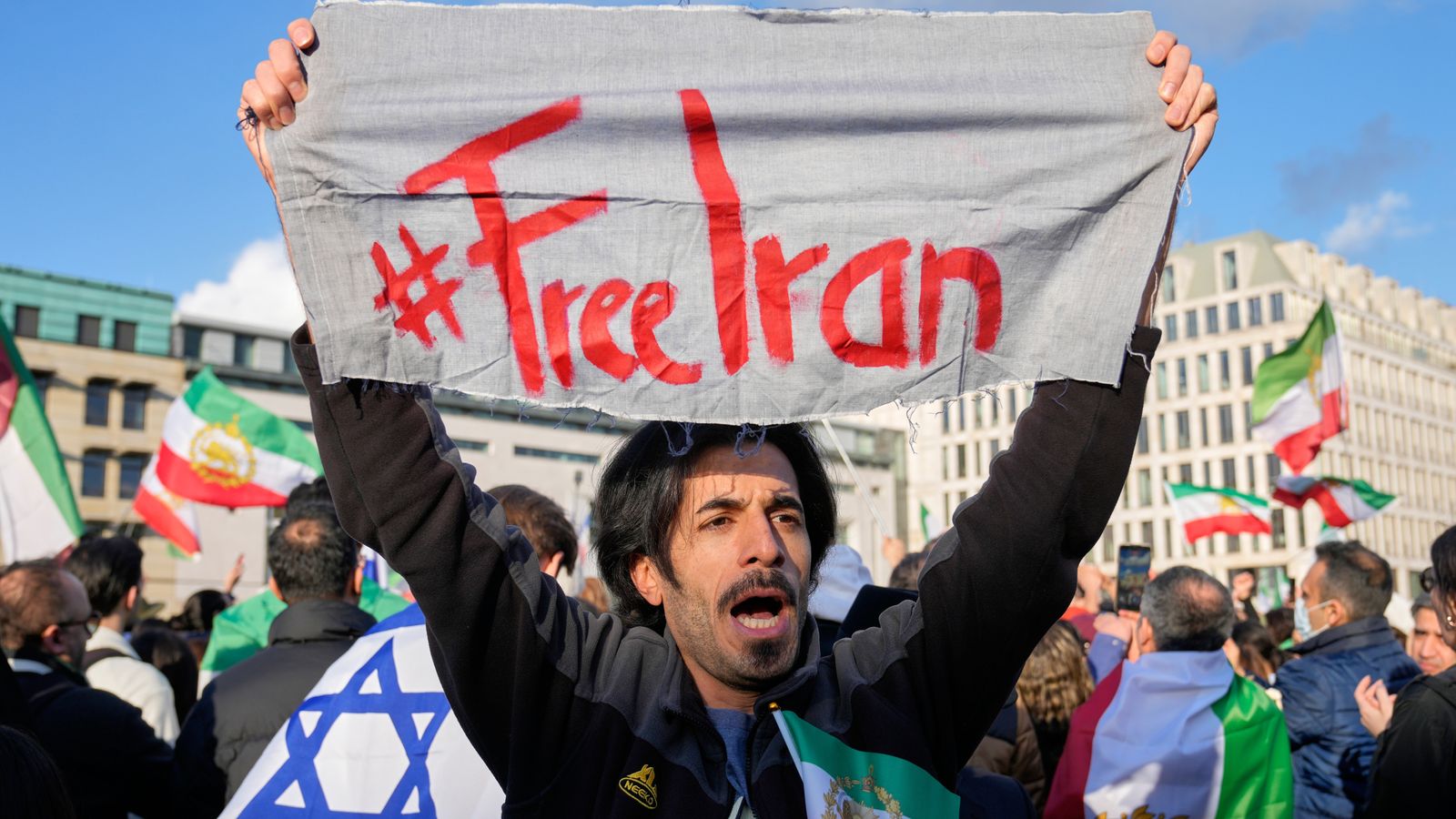
Image: Iranian people in Berlin at a demonstration in support of the US and Israeli strikes on Iran. Pic: AP
So far, the opposite has happened – far from surrendering their weapons, Iran‘s security forces have used them to shoot more Iranians for daring to celebrate the death of their despised dictator.
By the end of day two, unnamed sources within the US administration were insisting there is a more cunning plan. Not to topple the regime so much as to split it.
With supreme leader Ayatollah Ali Khamenei dead, the hope is that more moderate elements will step forward, stabilise the country and negotiate more pragmatically.
That would be the Venezuela model. Decapitate and co-opt. There, the Trump administration seized the dictator and claimed to find more amenable elements in Nicolas Maduro’s regime.
Advertisement
It is too early to gauge the success of that strategy, but the Trump team may well hope to repeat something similar in Iran.
In his Truth Social post, President Trump hinted that it may already be working in Iran. Some members of Iran’s security forces, he said, are giving up the fight.
How is Iran hitting back after strikes?
Iran, though, is not Venezuela. The regime is more coherent and much larger than Maduro’s. More than 200,000 armed men are thought to be on the payroll. They are in it together.
Advertisement
What is not known is what is happening on the ground. Israeli intelligence appears to have penetrated the country and almost certainly will be trying to compromise the integrity of that regime. There will be efforts, both diplomatic and covert to co-opt elements within its leadership.
We have no idea what efforts have been under way to seduce figures in Iran’s government in return for sparing their lives.
For now, it is far from clear what the plan is and if it is working. In the absence of one emerging, the future looks extremely uncertain for Iran and the region.
US President Donald Trump warned “there will likely be more” US casualties during operations in Iran in a statement posted on Truth Social. This comes as US Central Command (Centcom) said three US service members have been killed in action and five “seriously wounded”.
In Israel, nine people have been killed after a missile strike in the city of Beit Shemesh, according to medical services.
Meanwhile Iranian officials say at least 153 people including children were killed after a reported strike hit a school on Saturday, according to Iranian officials. Iran has blamed the US and Israel. Centcom said it was looking into reports of the incident, while Israel’s military said it was “not aware” of any IDF operations in the area.
The UAE has said three people have been killed by Iranian attacks since Saturday, while in Kuwait, one person has reportedly been killed.
Sajni Shah, a money expert at Compare the Market, said: “For many first-time buyers, help from the bank of mum and dad can be the difference between getting on the property ladder or missing out altogether – but these findings show that the support often comes with emotional and practical trade-offs.
A formal declaration of war has not been made but it looks and sounds like war in central Tehran.
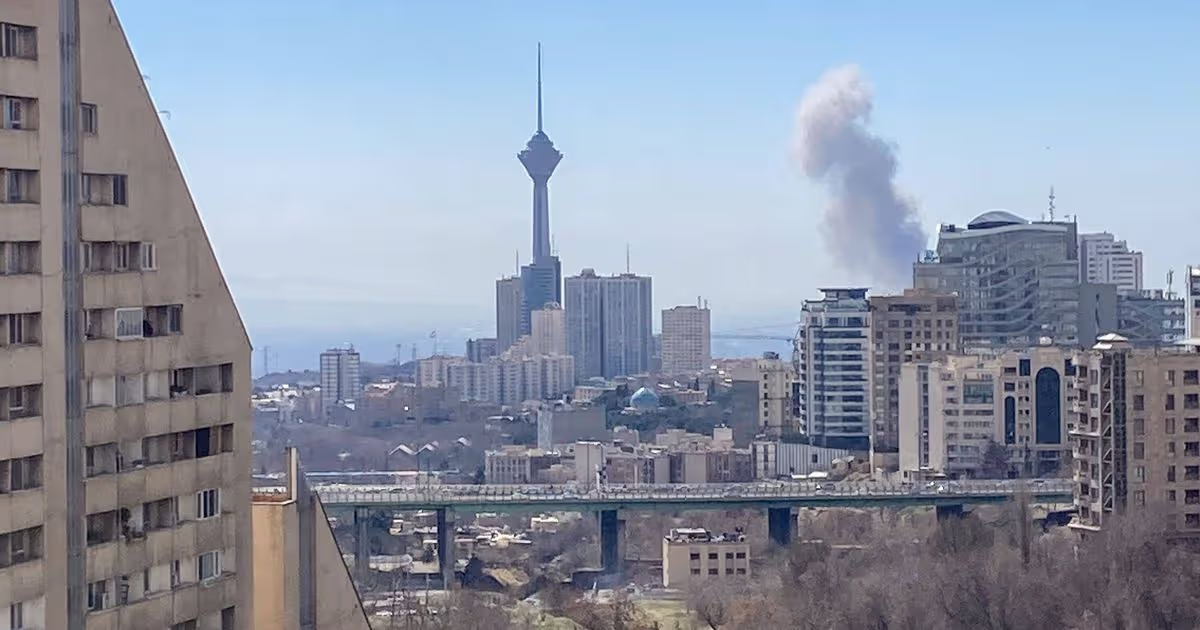
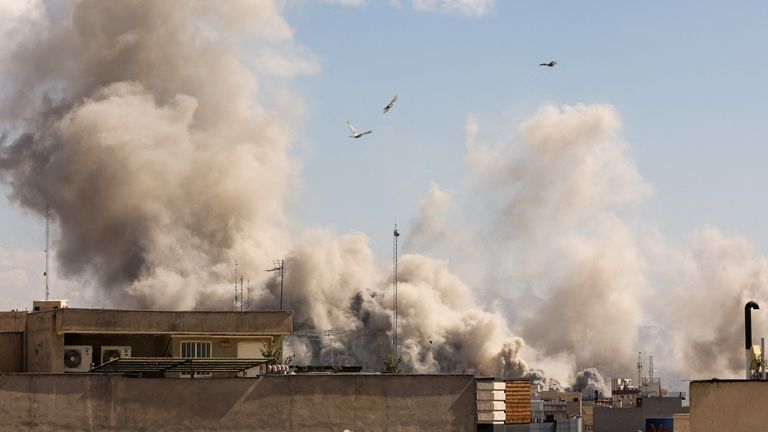
Clouds of smoke and the crack of high explosives rupture the air as the Americans and the Israelis bring their operation to the heart of the capital city.
And if the elimination of the senior Iranian leaders was their chief objective, it seems they have achieved their goal.
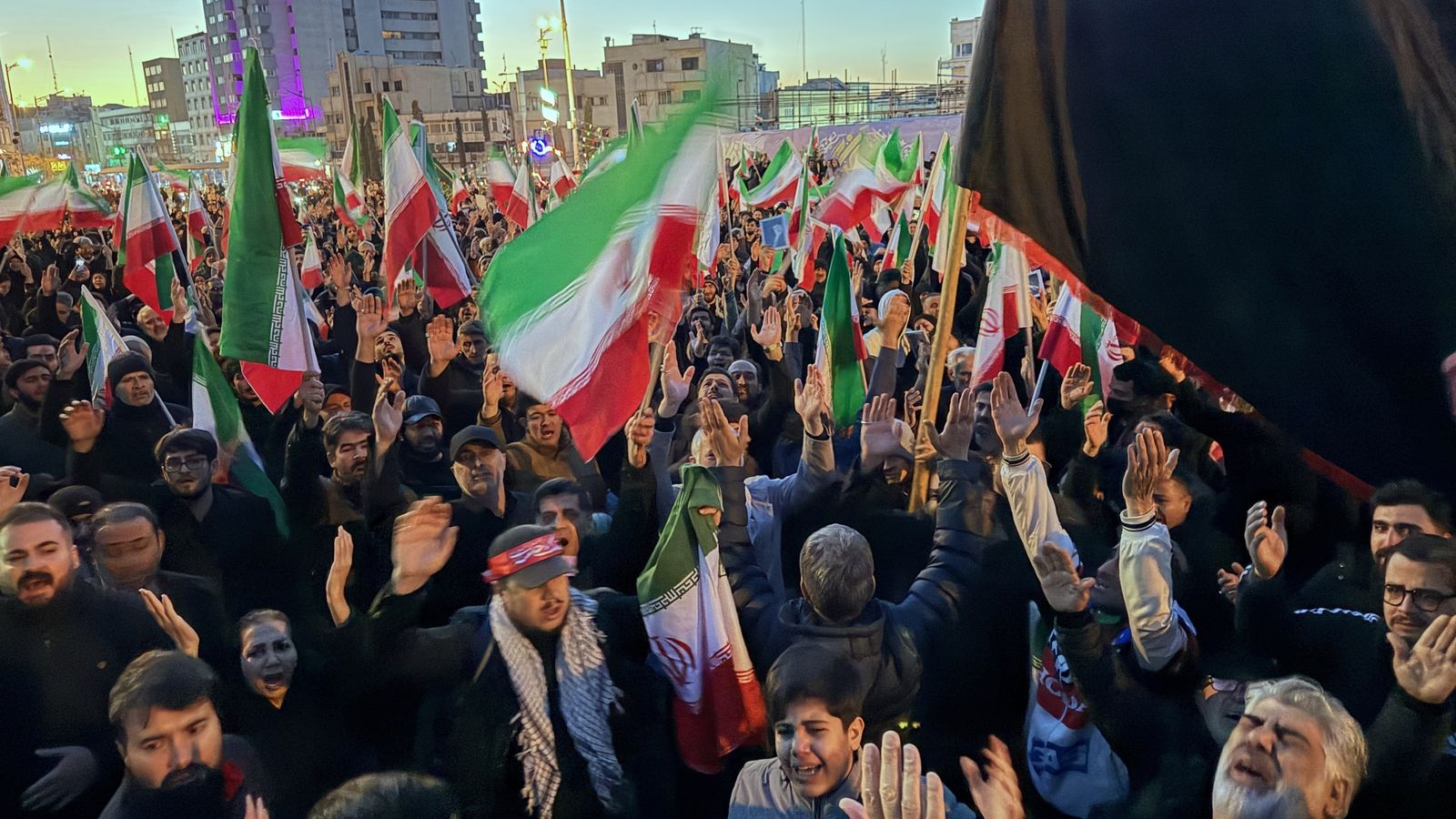
Image: Government supporters gather in mourning the death of Ayatollah Ali Khamenei in Tehran. Pic: AP
The death of the Supreme Leader, Ayatollah Ali Khamenei, was acknowledged on state television at 4am on Sunday. The presenter recited a prayer for the dead – but he was barely able to finish it as he choked back the tears.
In stark contrast, the demise of the supreme leader has been met with a burst of exuberance and sheer joy in locations throughout the country.
“Congratulations on our freedom”, cried one in the back seat of a car.
“Am I dreaming? Hello to the new world!” shouted another in southern Iran, as he watched people tear down a monument to Ayatollah Khomeini, the founder of the Islamic Republic.
Advertisement
In Tehran, many cheered from the windows and lit fireworks from their balconies. Khamenei ruled Iran with an iron fist – an autocratic leader prepared to repress and kill his own people to protect the regime.
But in a deeply polarised society, he was also a revered religious figure – a man invested with the authority of the divine.
Protests after Khamenei’s death
Anger and shock among some Iranians
Advertisement
In Tehran’s Revolution Square, his supporters spoke of their anger and deep shock.
“We were saying to ourselves all night that his death must be a lie. Unfortunately, it was the truth,” said one woman, as her body shook heavily with emotion.
“We lost our dearest person, we lost our elder, we lost our master,” said another tear-stained man.
Image: Smoke rises following an explosion in Tehran, Iran. Pic: Reuters
President Trump says he has given Iranians the opportunity to take back their country but it is clear that a significant number back the existing regime.
A regime this coalition of two is now trying to destroy.
We saw the remains of the police headquarters in Tehran and the bombed-out shell of the Revolutionary Prosecutor’s Office, where many political dissidents have been sentenced to death.
One massive blast claimed the detention facilities used the feared paramilitary police or ‘Basij’.
The regime certainly looks vulnerable as the Americans and the Israelis operate with what appears to be total air superiority.
Advertisement
Yet the clerics and their supporters remain and they control the streets.
Labour MPs are among a group of more than 60 parliamentarians to have made public their opposition to the planned Rosebank oil field – with one of Sir Keir Starmer’s backbenchers urging the Government to rule against the development and take a stand “against Trump, Reform and their fossil fuel paymasters”.
Clive Lewis is one of more than 50 MPs at Westminster who have signed a pledge from campaign group Uplift to “oppose the Rosebank oil field” and instead “advocate for a properly funded just transition for oil and gas workers and communities”.
Urging the Government to reject the development, Norwich South MP Mr Lewis said: “We must stand our ground against Trump, Reform and their fossil fuel paymasters.
“Approving an enormous new oil field would mean caving in to their anti-climate, anti-renewables agenda that runs completely counter to our values and our long-term interests.”
Advertisement
Scottish Labour MP Chris Murray, another of the Labour MPs to have signed the pledge, said the decision on Rosebank was “an opportunity for the Government to change course”.
It comes as the UK Government continues to consider whether the development of the oil field can go ahead – with Labour now under mounting pressure after the loss of the Gorton and Denton by-election to the Greens on Thursday.
Rosebank, which lies about 80 miles west of Shetland, is the UK’s largest untapped field, containing up to an estimated 300 million barrels of oil.
Drilling there was approved by the Conservative government in 2023 but was then subject to a legal challenge in the wake of a Supreme Court ruling which said the emissions created from burning fossil fuels should be considered when granting permission for new sites.
Advertisement
Now the decision on whether it can proceed lies with Labour ministers – with some 16 Labour MPs having made plain their opposition to the development.
The group includes Mr Lewis, Mr Murray, former Labour shadow chancellor John McDonnell and Scottish Labour’s Brian Leishman.
Former Labour MPs Jeremy Corbyn and Diane Abbott have also signed the pledge, along with a number of Liberal Democrat and Green MPs, SNP MP Chris Law, Plaid Cymru’s Liz Saville Roberts and Paul Maskey of Sinn Fein.
In Scotland a number of Labour MSPs have signed the pledge, along with Green MSPs – including the party’s Scottish co-leader Ross Greer – and former SNP health secretary Michael Matheson.
Advertisement
While previous Scottish first ministers Nicola Sturgeon and Humza Yousaf made plain their opposition to Rosebank, First Minister John Swinney has insisted the Scottish Government takes a “case-by-case approach” to new oil and gas developments, stressing these should only proceed if found to be compatible with climate change targets.
Mr Lewis said opposing Rosebank would “show that a Labour Government will stand by the promises we made to the country”.
He added: “There are only so many times we can afford to make mistakes and then change course.
“With Rosebank, we have an opportunity to get it right the first time.”
Advertisement
Mr Murray, the Labour MP for Edinburgh East and Musselburgh, said many locals in his constituency were “deeply concerned about Rosebank and rightly so”.
He added: “Climate change is one of the reasons I came into politics, and opening new oil and gas fields is simply incompatible with our climate commitments.
“With the North Sea’s oil supply dwindling, Scotland’s energy sector must transition to clean energy, or workers risk being left behind.”
Scottish Labour MSP Mercedes Villalba, who has also signed the pledge, argued that “approving projects like Rosebank will lock us into a toxic dependence on volatile, conflict-ridden fossil fuels”.
Advertisement
This would create “another excuse to delay the urgent investment needed to create secure, well-paid jobs for Scotland’s workers”, she added.
Ms Villalba said: “In an increasingly uncertain world, where climate action is relegated in favour of fossil politics, the UK and Scotland must lead the way on the clean energy transition.”
Wera Hobhouse, Liberal Democrat MP for Bath, said people in her constituency and across the country “are already facing the consequences of an increasingly unstable climate”.
Highlighting the impact of flooding and “skyrocketing food prices”, she said that “climate impacts are now a daily reality”.
Advertisement
Ms Hobhouse said: “Extreme weather is damaging crops, putting pressure on farmers, and destroying our precious natural environment.
“We cannot ignore these warning signs.
“A massive new oil field like Rosebank would only make matters worse.
“The emissions would be enormous, locking us into decades more pollution when we should be cutting carbon and unlocking the benefits of cheap, renewable energy.”
Advertisement
Approving the Rosebank development would “make a mockery of Labour’s environmental promises”, she said.
A UK Government spokesperson said: “Our priority is to deliver a fair, orderly and prosperous transition in the North Sea in line with our climate and legal obligations, which drives our clean energy future of energy security, lower bills, and good long-term jobs.”
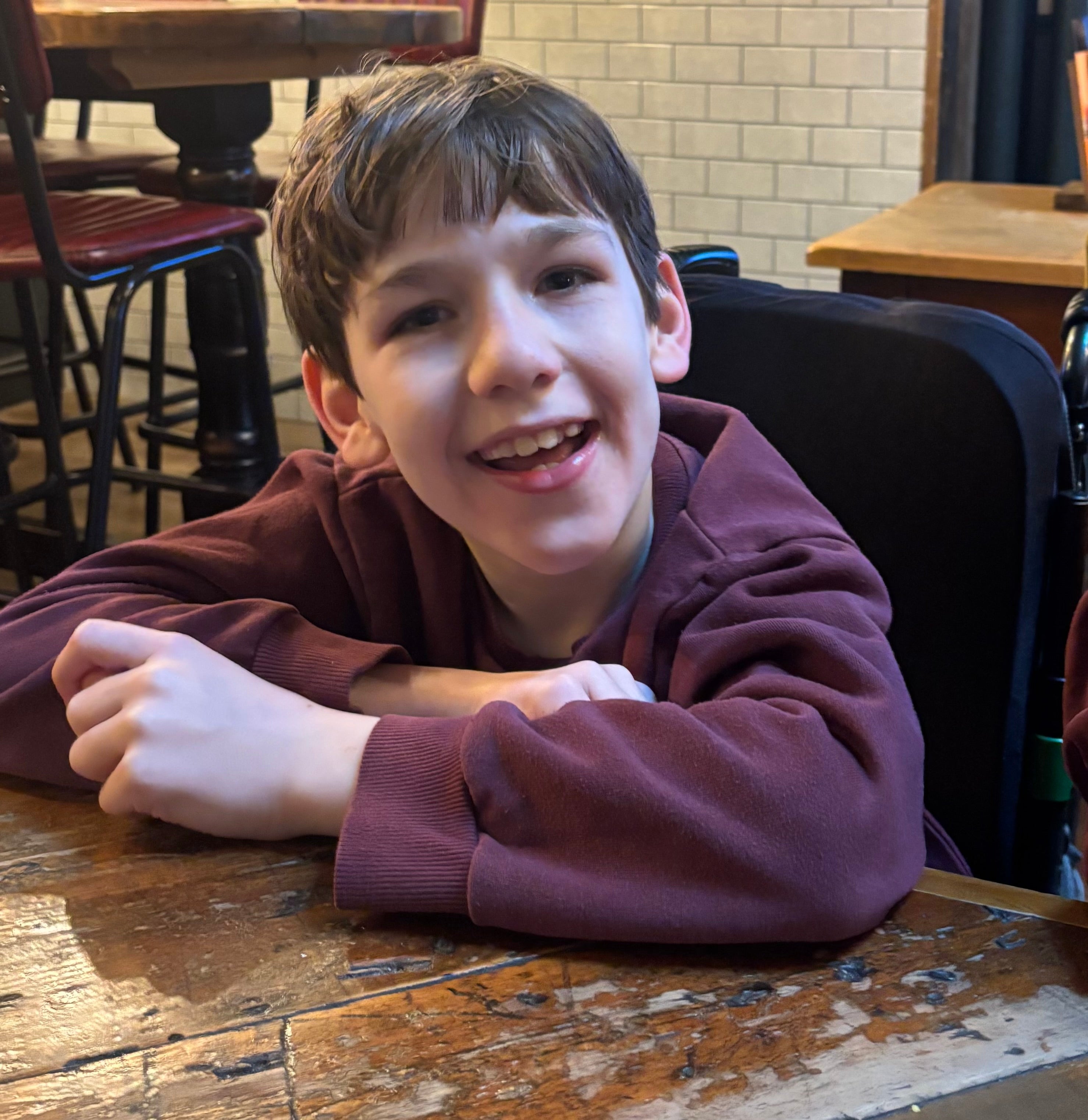
The mother of a boy with a rare genetic disorder, known to affect around 200 people worldwide, has said doctors told her “nothing can be done” and he is “unlikely to survive past his teens”.
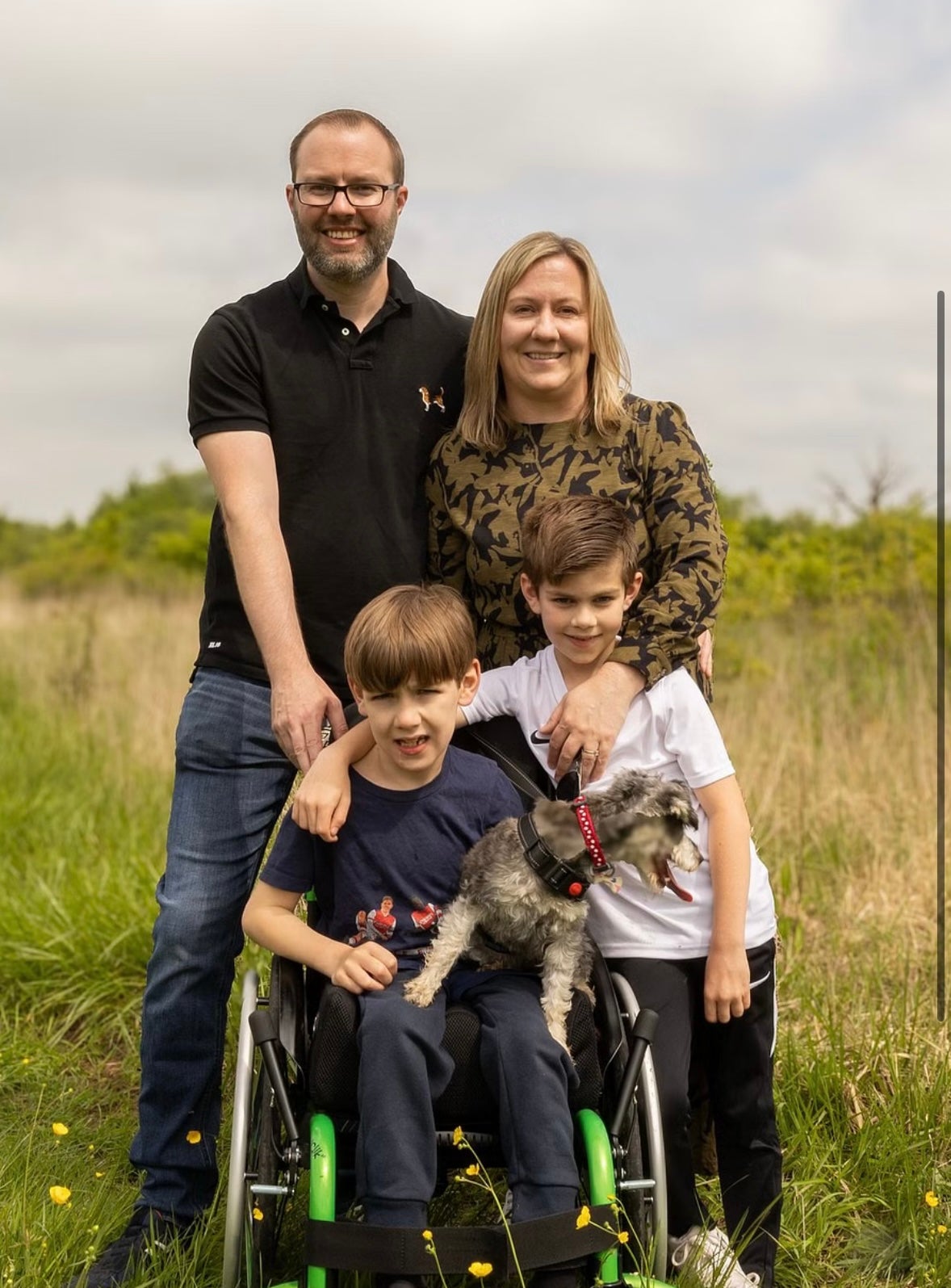
Amy Sheridan-Hill, 46, a former teacher living in Ware, Hertfordshire, said she was “shocked” for her son Frankie to be diagnosed with H-ABC, a rare genetic disorder which affects certain parts of the brain, in 2021, aged five.
Frankie, now 10, was born in 2015 after Amy said she had a normal pregnancy and planned C-section, noting “no issues from birth”.
As Frankie was her first child, Amy said she was “quite unaware of the proper development stages”, so when her son could not sit up like other children she saw around her, she initially thought it was “nothing to worry about”.
Advertisement
But by the age of two, Amy said Frankie was not walking independently, which most toddlers learn to do by 18 months, so she took him to a doctor who made a referral to a physiotherapist.
This is when Amy said she was told her son might have hypermobility, a condition of very flexible joints, but when Frankie still was not walking by four, a physiotherapist noticed “a certain way his foot went that made her think of cerebral palsy”, so he was referred to a neurologist.
Amy, her husband, Greg, and her sons, Frankie and Rory (Rachael Griffin-Kett Photography/PA Real Life)
Amy said Frankie had an MRI and then genetic testing to get his diagnosis of H-ABC – a very rare form of leukodystrophy, which is a group of genetic disorders that affect the white matter of the brain – at five years old, which came as a “massive shock” and turned their world “upside down completely”.
Advertisement
According to H-ABC Foundation UK, as of 2019, fewer than 200 documented cases of H-ABC have been identified, the majority of which are children, but that number is on the rise as patients have access to better clinical diagnoses.
“When you go to a doctor, you expect to be told what can be done,” Amy told PA Real Life.
“So I think to be told ‘nothing can be done’ is quite a shock.
“You’re told they’re going to die essentially. I think there’s still some PTSD from the diagnosis and I think a lot of parents say that it’s quite big to be given this information and sent on your way.
Advertisement
“When you google leukodystrophy, it just gives you the worst-case scenario. With some types of leukodystrophy, kids die within two years, so it is not a word you want to google if you’ve just been given that diagnosis.”
By this stage, Amy said he was behind his peers developmentally, especially with his walking ability, but also his speech and reading level.
Frankie loves playing with his ‘protective’ younger brother Rory (Rachael Griffin-Kett Photography/PA Real Life)
In the aftermath of Frankie’s diagnosis, Amy said she was “googling everything” and came across a Facebook group for H-ABC that had “less than 100 worldwide members”, so she joined it.
Advertisement
Shortly after, Michelle Teng, a fellow mum from the group based in Oxford, got in touch and told Amy about another Cotswolds-based mum named Ali Candy-Waters, so they all jumped on a Zoom call together and eventually decided to set up a charity called H-ABC Foundation UK to raise awareness for the condition.
“I think having mums who are going through what you’re going through is just really helpful,” Amy said.
“We don’t see each other that often, but we text constantly.
“I was talking to Ali this morning about the mum guilt of when you don’t put your child in his stander every day – because he should and it’s good for him – but actually getting him in the stander is really difficult.
Advertisement
“We’ve all got brilliant friends and families, but people that are going through it, they know (what it’s like) when you’re having a meltdown, so you can phone one of them.”
Through fundraising initiatives such as marathons and school bake sales, Amy said the charity has helped fund research into the disease and supported in buying other families affected by the condition wheelchairs or iPads, which can help children without speech to communicate.
Alongside this, Michelle is the co-founder of an Oxford-based company called SynaptixBio, which has recently chosen its candidate drug to take forward into clinical trials to treat H-ABC.
Advertisement
Frankie was diagnosed with H-ABC at five years old (Collect/PA Real Life)
Amy said the timeline for these trials could be within the next year or two and it would not completely cure Frankie, but it could potentially “hold the disease to stop children losing any more skills”.
Currently, there is no known cure for the condition, but treatments such as physical therapy and certain medication may alleviate symptoms and improve quality of life.
In the meantime, Amy said her family’s goal is to keep Frankie “as strong as possible” so that there is a “better starting point” if he is selected for the trial.
To do this, Amy said Frankie regularly has physio and occupational therapy and Botox to relax the muscles in his legs.
Advertisement
He uses leg splints, Lycra shorts, a stander and a walker, and will need to have X-rays and surgeries in the future because his spine will start curving.
If Frankie is not eligible for the trial, Amy said it might be a few more years before he can get access to what could be a drug that completely changes her son’s life.
For now, Amy said Frankie loves playing with his “protective” and “kind” younger brother Rory, eight, and he “loves” being in a mainstream school, where she commended his “amazing teachers” and the whole class who “just really look after him”.
“It’s really sweet to see,” Amy said.
Advertisement
“When they do assemblies, they make Frankie the centre of things and they always make sure he’s really involved in everything.
“They specialise the curriculum for him because he is delayed, so he’ll do his own work, but he just loves being part of the class.”
She added: “Frankie is a very happy child. He can read, he loves to play PlayStation, and he can use his iPad.
“If we could keep the disease static and he doesn’t decline, he’d have a great life.
Advertisement
“If we could get some form of treatment in the next two or three years, I think Frankie’s path would be quite different.
“We hope that other families don’t go through what we’ve been through.”
Ultimately, Amy said she wants to raise awareness of the disease because “there’s probably more cases out there”.
She said people need to know that there are charities like H-ABC Foundation UK “that have been set up to support families and there are doctors and scientists working on treatments”.
Advertisement
Amy said: “Now we can tell them where we are and that gives them hope, whereas when Frankie was diagnosed, there wasn’t that hope. So we’ve had to create that hope and now we can share it with other families.”
To find out more about H-ABC Foundation UK, visit its website: www.h-abcfoundation.org.