The RAF base is also where Glenn Miller flew from before he went missing over the English Channel
Cambridgeshire is home to a wide range of historic RAF bases including Duxford, which was transformed into an Imperial War Museum, and RAF Alconbury that has now made way for new homes to be built. However, there are also a range of RAF bases found just outside of the county that also played an important role in the First and Second World Wars.
Advertisement
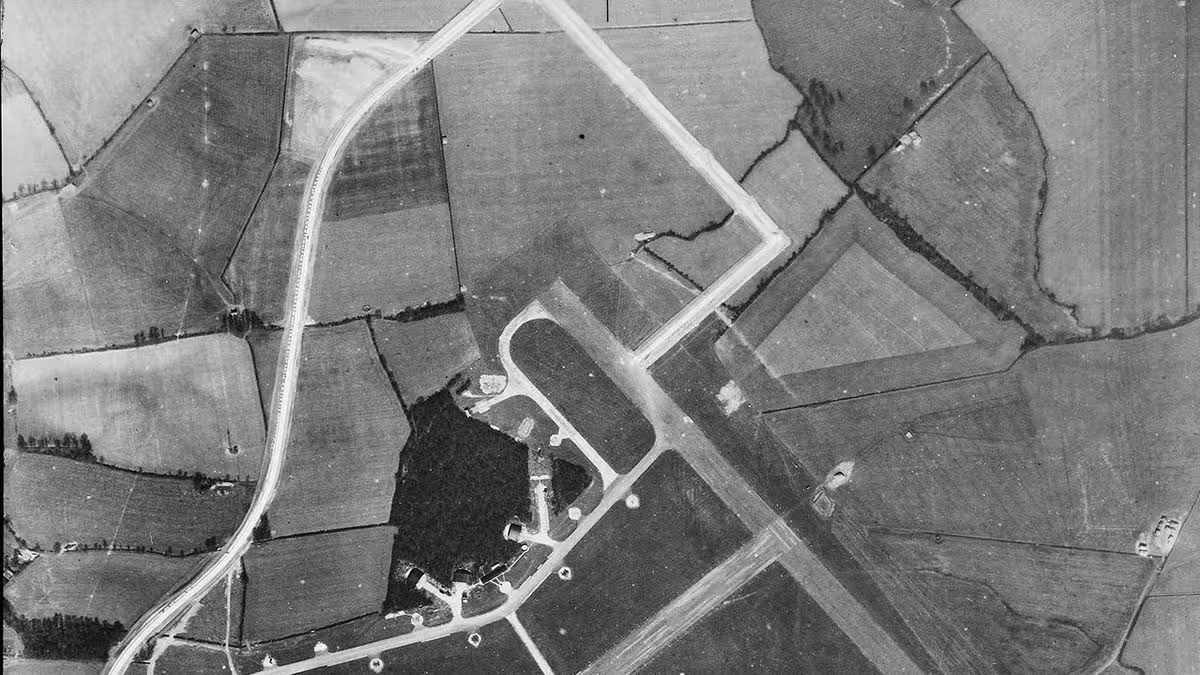
RAF Twinwood Farm can be found close to the Cambridgeshire border, just north of Bedford. It first opened in mid-1941 when the RAF began using the grassed field and was home to RAF night fighters.
By April 1942, the RAF base had three concrete runways and additional temporary buildings. Throughout the war, the base was used by a range of different units including the Bristol Blenheims, the Douglas Bostons, and Bristol Beauforts.
In 1944, the airfield was transferred to the US Eighth Air Force and was operated alongside the nearby RAF Thurleigh. During the US Army’s time at the base and around Bedford, Glenn Miller, a famous composer and big-band conductor, was deployed to Europe and stationed in the county, at the request of General Eisenhower, for radio broadcasting and personal appearances.
In December 1944, Glenn Miller’s unit was being moved to France but his scheduled flights from Bovingdon were cancelled due to bad weather. Miller decided to fly with Lt. Col. Norman Baessell on his UC-64 piloted by Flight Officer Stuart Morgan.
Advertisement
Miller didn’t tell anyone he was flying with them and boarded the plane with Baessell and Miller before it took off at 1.55pm on December 15. The plane and its occupants were never seen again.
An inquiry into the disappearance determined the aeroplane went down over the English Channel due to a range of factors including human error, mechanical failure, and weather. No remains of the UC-64 were ever found and Glenn Miller is still Missing In Action to this day.
Nowadays, RAF Twinwood Farm is home to the Twinwood Arena, which is a large natural amphitheatre that hosts various music events. Every year, the arena is used for a the Twinwood Festival which showcases vintage music and dance.
A collection of the buildings around the base also house a range of historical displays to create the Twinwood Airfield Museum. The restored control tower, now called the Glenn Miller Museum, features displays about Glenn Miller, the base’s history, and the Second World War.
Advertisement
Some of the other buildings including a recreation of a German bunker, rooms of a 1940s family home, and displays of military vehicles. The group of museums are open seasonally for visitors.
With its spectacular 100-mile coastline, there’s no better way to discover this island than on a high-speed RIB ride
12:35, 04 Apr 2026
Advertisement
Ynys Môn, or Anglesey, is no ordinary island. Off the wild north coast of Wales, the largest of the Welsh Isles brims with maritime legends and pulses with ancient Celtic spirit.
Once the sacred stronghold of Druids and the final refuge of the Celts, Anglesey feels like an ancient corner of Wales.
Standing stones and Iron Age forts rise from wildflower meadows, while Neolithic tombs sit among storm-lashed cliffs, windswept dunes, and secret coves that beg to be explored.
With its spectacular 100-mile coastline, there’s no better way to uncover its dramatic beauty than on a high-speed RIB ride, skimming past rugged headlands, remote beaches, and eerie sea caves.
Advertisement
If you think you’ve seen Anglesey’s best bits from land, you haven’t truly experienced the island. The only way to grasp the scale of its raw, rugged beauty is from the sea. And that’s exactly what I did, spending almost an entire day racing across the waves on a high-speed RIB with Ribride.
This full-day tour costs £138.00 per person and lasts over six hours. During this epic voyage of the coastline, we visited sea caves, lighthouses, and deserted coves, and saw something unbelievable – seals, puffins, seabirds and dolphins, right here in Wales.
Our trip began at St George’s Pier, where we were strapped into life jackets and given a safety briefing by our salty skipper, Captain Charles, before boarding our Explorer RIB.
Advertisement
With a jolt from the jetty, we surged into the Menai Strait, wind stinging my cheeks as the mainland faded into the distance.
Our confident captain promised a day-long odyssey through the Swellies, past Plas Newydd and Y Felinheli, with glimpses of Caernarfon Castle, Ynys Llanddwyn, and the towering South Stack Lighthouse.
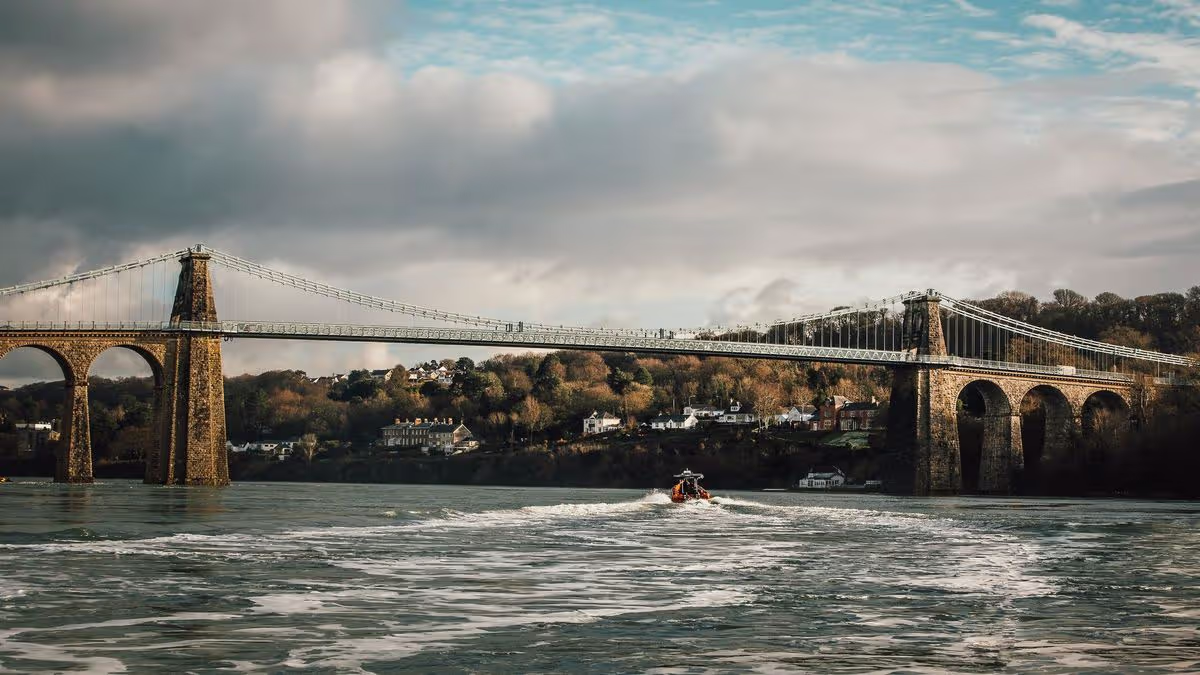
Few moments rival the thrill of bouncing over the Swellies, the Menai Strait’s most infamous waters. Passing beneath Telford’s grand suspension bridge, this stretch of water is infamous for racing tides and shipwreck legends.
Advertisement
Here, the tide charges in from both directions, clashing over a seabed riddled with unseen rocks. The ghostly remains of shipwrecks below remind us that these dangerous waters have claimed many before us.
As we threaded our way between whirlpools and racing currents, our skipper explained how, centuries ago, tall ships had to navigate this treacherous channel, hoping the tide wouldn’t drag them onto the sharp rocks.
Looking down at the frothing, swirling water, I could see why so many had failed and held onto my seat a little tighter.
Beyond the Strait, the open sea awaited, and Anglesey’s dramatic coastline unfurled around us. Cliffs tumbled into the waves, exposing hidden caves and old smugglers’ haunts. Lighthouses stood sentinel on rocky spurs, guiding sailors home.
Advertisement
At one point, we slowed to a crawl as seals bobbed in the waves, lazily eyeing us up before disappearing beneath the surface.
Further on, puffins flitted above the water, their tiny wings working overtime to keep them airborne. Kittiwakes and guillemots clung to the cliffs, their cries carrying over the wind.
But Anglesey’s jaw-dropping coastline is not just about wildlife and sea views; it’s also rich in maritime history. Over the centuries, this wild stretch of water has claimed more than its fair share of ships, making it a true graveyard of the sea.
Advertisement
The area is littered with the wrecks of doomed vessels, many of which are still visible today during low tide or on calm days when the water recedes to reveal their eerie remains.
One of the most famous wrecks is that of the Royal Charter, which sank off the coast of Anglesey in 1859 during a violent storm.
The ship, which was carrying gold from Australia to London, ran aground on Penmon Point. Tragically, 459 lives were lost, and the wreckage was scattered along the coast for miles.
Anglesey once lured smugglers to its maze of coves and caves, perfect for dodging the law. These shadowy hideouts brimmed with contraband, from barrels of rum to forbidden treasures.
Smuggling flourished in Anglesey during the 18th and 19th centuries, taking advantage of its rugged coastline and secluded caves. Local lore suggests that Pirate Bay, near Holyhead, was once a well-known drop-off point for smugglers to trade goods under cover of night.
As our RIB sliced through the waves, we approached the enigmatic Ynys Llanddwyn, a small island known as well for its history and legends as for its natural beauty.
This magical spot, with its rugged shoreline and crystal-clear waters, is closely tied to the legend of Saint Dwynwen, Wales’ patron saint of lovers.
Advertisement
According to the story, Saint Dwynwen sought solace on this very island after a heart-wrenching love story of her own, and the island is a place of both romantic and spiritual significance.
The real delight was spotting seals sprawled on sun-warmed rocks, their sleek forms almost melting into the shadows. Though shy, they let us admire them before slipping below the waves.
We didn’t have time to visit the island ourselves, but the views from the boat were enough to make us feel the pull of its history and wildlife.
Advertisement
If you’re lucky enough to visit, you can walk around the picturesque island and explore its historic lighthouse, ancient church ruins and sandy bays.
Cruising the Anglesey coast, we soon glimpsed South Stack Lighthouse, perched alone on its rocky islet, just 30 metres from the mainland yet separated by swirling, perilous waters.
I could only see the lighthouse from the bobbing rib, but once you’re back on dry land, you can visit South Stack Lighthouse to get closer.
The lighthouse is accessible by descending 400 steep steps carved into the cliffside, which I can tell you now are not for the faint-hearted.
Advertisement
But when you reach the bottom, you’ll be rewarded with the chance to cross a narrow bridge that links the mainland to the lighthouse.
It’s a picture-perfect moment, and if you’re keen on learning more, you can visit the lighthouse and pick up cash-only tour tickets to explore the interior and discover the history of this landmark structure.
Close by, the RSPB South Stack Cliffs reserve is ideal for avid birdwatchers. Borrow binoculars and step onto viewing platforms to spot puffins, guillemots, and a flurry of seabirds.
Advertisement
We soon picked up speed and headed towards The Skerries, a scatter of rocky isles off Anglesey’s northwest tip, which stand out as both a dramatic landmark and a vital sanctuary for Welsh wildlife.
Managed by the RSPB, this site is home to the country’s largest breeding colony of Arctic terns, with 2,035 pairs recorded in 2005.
But it’s not just terns that make The Skerries special; the islands also host puffins, common terns, lesser black-backed gulls, herring gulls, and even the occasional roseate tern.
Advertisement
As we approached the remote islands, it became clear why the RSPB had a vested interest in protecting this site. The rocky outcrops are sparsely vegetated but teem with wildlife.
We caught sight of seals basking on the rocks as the air buzzed with seabirds. If you’re lucky, you might even glimpse a puffin or two darting in and out of their burrows.
One of the best parts of the RIB trip was undoubtedly the wildlife. As we zoomed along, we spotted grey seals lounging on the rocks, looking like they were sunbathing.
Advertisement
They gave us a curious glance before slipping silently into the water. Not far off, puffins darted above the waves, their little wings flapping furiously.
We also spotted dolphins popping up in the distance, their sleek bodies cutting through the water in playful arcs. A few porpoises joined in too, quickly and smoothly diving in and out of the waves.
The cliffs and waters were teeming with seabirds, such as black guillemots and kittiwakes, and we took some lovely photos.
Why you should do this boat trip
A boat trip around Anglesey is not just a basic boat trip; I loved how stories were interwoven into the landscapes we whizzed by and the sea caves we slowed to visit.
It’s a brilliant way of learning more about the island’s history from the bob of the waves rather than on a traditional walking tour.
The wildlife is another huge draw, with seals basking on rocky outcrops, puffins darting through the air, and dolphins playing in the distance. You’ll see these animals up close in their natural habitat, which you just can’t get on a regular land-based tour.
You’ll also visit places that are hard to reach otherwise, like The Skerries, a remote group of islands home to some of Wales’ most important bird colonies.
Advertisement
Booking the trip is easy. Go to RibRide’s booking page to see all the boat trips they offer and select your date and time online.
Fuel supplies have diminished since the start of the conflict in the Middle East. The bombing of Iran by the US has led to an effective blockade of the Strait of Hormuz, a crucial shipping route for oil and seaborne gas.
Critical fossil fuel and trading infrastructure has also been targeted in missile strikes, meaning it’s hard to re-establish supply lines.
Governments and authorities across the world are starting to put in measures to limit fuel usage. Places like Vietnam have even started urging employers to let their staff work from home, while Sri Lanka has enforced fuel rationing and a four-day working week.
Advertisement
The UK has so far encouraged people to ‘stay calm’, after reports of huge queues at petrol stations with people panic-buying fuel before prices rise further.
Chancellor Rachel Reeves has ruled out the kind of universal support offered during the last energy crisis, though she hinted at plans to give extra pots of cash to councils to help vulnerable people in the financial crisis.
But the price hikes are already hitting people’s pockets. To find out what local councils are planning if a full-blown fuel shortage should hit the UK, we’ve reached out to local authorities across Greater Manchester to ask what support is in place for local residents.
This is what they said:
Advertisement
Bolton
Bolton Council says it is closely monitoring the situation and is ready to step into action if needed.
Currently, the local authority works closely with charities to help residents struggling with the rising cost of living, as well as distributing around £24m of government money through the Crisis and Resilience Fund – previously known as the Household Support Fund.
A spokesperson for Bolton Council said: “HSF has now been replaced with the Crisis and Resilience Fund, with a new emphasis on preventing residents from experiencing financial hardship in the first place.
Advertisement
“The council’s cabinet approved the first year of CRF allocation on Monday with spending prioritised in line with Bolton’s Tackling Poverty Strategy 2024 – 2027.
“Additional support for household utility bills is available via our Local Welfare Provision programme.
“The council continues to closely monitor the situation and will bring in additional measures to address the rising cost of fuel as needed.”
Bury
Advertisement
Bury Council also says it will continue to use government funding to support those struggling with rising household costs. There are currently no plans in place to introduce fuel rationing at the council, but there are contingency plans in place should shortages begin to materialise.
A spokesperson for Bury Council said: “There is no current fuel supply shortage, and therefore no plans for fuel rationing. Should the situation change, working with the Greater Manchester Resilience Unit, all our services will invoke their Business Continuity Plans to ensure that services remain operational.
“For a number of years, we have supported residents who need help with fuel and food grants through the Household Support Fund, and will continue to do so.”
Manchester
Advertisement
Manchester established a helpline and program of wraparound services during the last energy crisis in 2022, which it uses to monitor the number of people struggling to cover their bills. A spokesperson indicated they would continue to use this service in light of the conflict.
A spokesperson for Manchester City Council, said: “Since 2022 the Council has provided a dedicated cost-of-living support line that has helped thousands of residents through this period of economic crisis. The Council is very much aware of the crisis in the Middle East and what its impact could soon have on household costs and the price of everyday essentials.
“What we want to make sure people know is that we are here for them. Whether it is additional help in getting bills paid, to putting food on the table, or just needing someone to talk to, the Council has a dedicated team of staff on hand to give people the helping hand they need.”
The free advice line number is 0800 023 2692.
Advertisement
The council’s finance boss, Coun Rabnawaz Akbar added that the council’s Corporate Energy team is constantly tracking market rates to make sure the local authority is getting the best deals.
“We have purchased our gas needs in advance into next year so the current volatility in the gas market will have little impact on our budget,” Coun Akbar explained/ “Similarly, we have also bought our electricity requirements up to the start of summer and a Power Purchase Agreement – which will see us purchase our needs directly from a new solar farm – will kick in later this year.
“While there’s little we can do to mitigate against the price of petrol from the pumps, it should be noted that a significant proportion of the Council’s fleet of vehicles, such as bin lorries, is electric and we continue to look at renewable alternatives to fossil fuels.”
Oldham
Advertisement
Oldham Council is also putting its emphasis on financial support for local residents. They added there were ‘plans in place’ in case there are fuel shortages, but did not reveal what those plans entailed.
A spokesperson for Oldham Council said: “We want to reassure people that Oldham Council has support for anyone experiencing financial crisis. Our Crisis and Resilience Fund can help low-income households who need crisis support.
“Residents don’t need to be in receipt of benefits to apply, and our priority is making sure our most vulnerable residents can get the help and support they need.
“We also want to reassure that we do have plans in place in case there are any fuel shortages caused by the conflict in the Middle East. We’ll keep checking and updating these plans as things change, but right now, there are no fuel shortages in Oldham.”
Advertisement
Rochdale
Rochdale Council did not indicate whether they had plans in place to tackle a fuel shortage, but indicated they would continue to provide support for those struggling to cover their household bills.
A Rochdale council spokesperson said: “We have a wide-range of cost-of-living support in place and in addition the council’s household support fund was recently extended for a further six months, providing additional support to residents with the greatest need. We continue to monitor the situation in Iran, in line with the government’s approach.”
Salford
Advertisement
Salford Council did not indicate whether they had plans in place to tackle a fuel shortage, but indicated they would continue to provide support for those struggling to cover their household bills.
A Salford City Council spokesperson said: “Residents can apply for the Crisis and Resilience Fund from 1 April 2026 to 31 March 2029. We have received an allocation for each of the next three years and the council is considering how best to use the funds to support residents.”
Stockport
Stockport council did not respond to a request for comment.
Advertisement
Trafford
A spokesperson for Trafford Council said: “All local authorities including Trafford Council routinely undertake emergency planning for a variety of potential scenarios. Preparations for emerging issues related to global developments are part of this area of work. We coordinate with partners at the NHS, emergency services and other agencies, and plans are regularly reviewed and updated in light of global developments. This work aligns with national, Government guidance.
“In light of the ongoing conflict, we are proactively reviewing our business contingency plans to specifically look at the impacts of potential fuel shortages and we will continue to closely monitor the situation.
“We offer support with money matters to Trafford residents for many reasons. Eligibility criteria varies, depending on the nature of the assistance available. Recent examples include setting up the Stretford and Sale West Advice Hubs to improve access to help and information, and the creation of the Money Advice Referral Tool, to help those struggling through the cost-of-living crisis. Our newly-published Trafford Poverty Strategy 2026-2030 Strategy sets out our future plans.”
Advertisement
Tameside
A Tameside Council spokesperson said: “Any significant restrictions on fuel use would be part of a national response, and we would follow government guidance on how services should be prioritised.
“All our services have robust business continuity plans, and we would work closely with partners across Greater Manchester, including the Greater Manchester Combined Authority (GMCA) civil contingencies team, to keep essential services running wherever possible.
“We’re working hard to build financial resilience in our communities to support residents. For residents struggling with the cost of living, support is available locally through our Helping Hands campaign.”
Advertisement
Wigan
A Wigan Council spokesperson said: “We know that recent news may be causing some concern about energy bills and the cost of living, but we want to assure residents that you are not alone.
“From 1 April 2026, Wigan Council will receive funding from the UK government to administer the Crisis and Resilience Fund, aiming to help low-income households who encounter a financial shock and to support activity that builds long-term financial resilience.
“Running until 31 March 2029, this funding adds to the council’s long-running Here For You campaign which helps residents in need to access benefits, learn how to save energy, and offer financial advice and budgeting support, with the campaign helping residents to access almost £17 million of unclaimed financial support.”
Australia has charged nine men over an alleged conspiracy to bring in 3.5 tonnes of cocaine and methamphetamine by sea and distribute the drugs nationwide, concluding an almost 10-month investigation by federal and state authorities.
The alleged smuggling operation came to light last May when a commercial trawler sank off the Victorian coast at Port Albert. Police officers monitoring the crew’s movements noted they had travelled out to sea in bad weather without standard fishing equipment, raising suspicion about the purpose of the voyage. In the following months, police conducted surveillance of several boat crews suspected to be linked to the syndicate.
The group allegedly made multiple attempts to reach a drop zone in Bass Strait where smaller vessels would have collected large quantities of drugs from a “mother ship” travelling through Australian waters. All attempts failed and no drugs were brought onshore.
The nine men, aged between 31 and 72, were arrested following raids in Victoria and Sydney.
Advertisement
They face charges including conspiracy to import cocaine and trafficking methamphetamine as well as firearms offences. Seven face the possibility of life in prison if convicted. The eight Victorian men are due in court on 28 July and the Sydney man on 20 May.
Four men were also charged in connection with a separate seizure of 30kg of methamphetamine in Perth last August and 41kg of cocaine in Victoria days later.
The syndicate allegedly used their connections in the trucking industry to move drugs between states.
AFP detective superintendent Ray Imbriano said at-sea drug transfers were dangerous and put both criminals and emergency workers at risk.
Advertisement
“At-sea transfers are dangerous, and criminals using this smuggling method risk both their freedom and their lives,” he said. “It also risks the lives of first responders who too often have had to save the lives of crew involved in drug retrieval.”
He said organised criminals were targeting Australia because of an “insatiable” demand for illicit drugs and the community’s willingness to pay high prices, warning that drug importations fuelled gang violence that left “innocent Australians caught in the crosshairs”.
Victoria Police superintendent Dave Cowan said Australia had become a “favourable location” for organised crime syndicates.
“The damage caused by the use of illicit substances ripples throughout the community, and it does not just affect those using the drug,” he said. Victoria Police said the investigation was ongoing and further arrests had not been ruled out.
The 53-year-old could lose another honour that was previously awarded to him (Picture: BBC/Owen Scurfield)
Scott Mills could potentially face another huge blow after being sacked from the BBC.
The 53-year-old former Radio 2 Breakfast presenter was fired by the corporation following allegations over his ‘personal conduct’, which allegedly relate to a ‘historic relationship dating back more than 10 years’.
It soon then came to light that Mills was questioned by police in 2018 over allegations of serious sexual offences involving a teenage boy under 16.
Now, however, it has been reported that the 53-year-old could lose his Honorary Doctorate of Arts from Southampton Solent University.
The academic institution, who granted him the prestigious title back in November 2009, are said to be preparing to meet to rule on the issue.
Scott Mills received an honorary degree from Southampton Solent University in 2009 (Picture: Robin Jones/Shutterstock)
The university could rescind the honorary doctorate (Picture: David Hartley/Shutterstock)
A source told the Mirror: ‘The committee will meet later this month. It will be recommended that the honorary doctorate is rescinded.’
At the time Scott was awarded the honour, he said it ‘felt amazing after not really doing any education before’.
He added: ‘I came out of school and just learned from the people I worked with and thankfully the people I worked with were good and took the time to teach me but without that, if I was working at a worse radio station I don’t think I would be doing this now.’
Advertisement
On top of the Mills’ plaque at Fleet services getting removed, the radio star was also recently replaced on Race Across The World’s spin-off by TV presenter and DJ Tyler West.
Previously, it had been announced that both he and series four’s winner Alfie Watts would co-host a podcast titled Race Across the World: The Detour.
Scott and his now-husband Sam won the second celebrity series of Race Across The World in 2024.
The BBC fired Mills following allegations over his ‘personal conduct’ (Picture: Getty)
The 53-year-old described receiving the doctorate as ‘amazing’ (Picture: Hogan/Hogan Media/Shutterstock)
Since Mills’ sudden firing, speculation has grown over who will take over his radio and hosting duties.
Mills had been one of the highest-paid presenters at the BBC, with a salary of £315,000 to £319,999 in 2025 after replacing Zoe Ball on the Breakfast Show.
Kay, 51, currently hosts the mid-morning show, having taken over from Ken Bruce in 2023.
Other names being suggested is Gary Davies, who stepped in for Mills this week and is best known as a regular presenter of Top of the Pops, along with Rylan Clark.
Got a story?
Advertisement
If you’ve got a celebrity story, video or pictures get in touch with the Metro.co.uk entertainment team by emailing us celebtips@metro.co.uk, calling 020 3615 2145 or by visiting our Submit Stuff page – we’d love to hear from you.
Lancashire Police have said that at around 9.35pm on Friday (April 3), a man fell from a bridge on the southbound carriageway at Junction 27 for Charnock Richard.
The man was struck by a heavy goods vehicle before he was struck by a second vehicle, a Vauxhall Adam.
The man was taken to hospital where he remains in a life-threatening condition.
Advertisement
The drivers of the heavy goods vehicle and Vauxhall both stopped at the scene and are being treated as witnesses to the incident, with no arrests made so far.
Due to contact Lancashire Police had with the man earlier in the day, the force has voluntarily referred itself to the Independent Office for Police Conduct as is standard practice in these circumstances.
The motorway was closed in both directions overnight before reopening this morning.
Now, police are appealing for any other witnesses to come forward as police investigate the incident.
Advertisement
Anyone who was driving in the area at the time and saw anything which could help the police investigation or has any dashcam footage is urged to contact police as soon as possible.
Members of the public can do this by emailing sciu@lancashire.police.uk or calling 101 and quoting log 1271 of 3rd April 2026.
Our Yorkshire Farm star Reuben Owen returns to Channel 5 this weekend.
Reuben Owen has been gushing over his girlfriend on social media.
Advertisement
Fans of Our Yorkshire Farm can tune in this weekend to watch Amanda Owen‘s son Reuben in a repeat episode of his documentary series, Reuben: Life in the Dales. The show chronicles young Reuben Owen’s journey as he works to expand his heavy plant machinery enterprise alongside his closest mates, Tommy and Sarah, in the picturesque Yorkshire Dales.
Tonight’s episode on Channel 5 (April 4) takes viewers back to the beginning of Reuben’s second year in business, just after he’d secured a contract to breathe new life into a disused fishing pond at an impressive country estate in County Durham.
His venture has flourished remarkably, and devoted viewers are eager to discover more about the rising star’s life beyond what cameras capture. Here’s the lowdown on Reuben, covering everything from his age to his romantic history.
Reuben Owen’s age
As the second-eldest among the Owen children, Reuben follows his older sister Raven. Born in November 2003, he’s presently 22 years old and will mark his 23rd birthday later this year. His siblings include Raven, 24, Miles, 18, Edith, 15, Violet, 15, Sid, 14, Annas, 12, Clemmie, 10 and Nancy, nine.
Remarkably young to be helming such an operation, the television personality runs Reuben Owen Ltd, a thriving five-star business that tackles various projects from muck shifting to drainage and landscaping work. Through the company’s Facebook page, he regularly posts updates about his daily activities and ventures.
His latest update revealed: “Some pictures of the team putting in a new water supply last week, 900m of pipe in one day over some very boggy ground.” Thousands of followers responded to the update, with numerous people commending him for his outstanding efforts.
Who is Reuben Owen’s girlfriend?
Reuben is in a relationship with Jessica Ellwood, whom he met at a Young Farmers’ convention in 2024. Jessica helps run her parents’ Brough Castle farm, which houses 400 sheep, 80 milk cows, three horses, 200 cattle, two cats and three dogs.
The duo made their relationship official in November 2024, with Reuben previously hinting that wedding bells might be approaching. In February 2026, they celebrated Valentine’s Day with a romantic escape, and Reuben shared several charming photographs from their trip on Instagram.
He posted: “A romantic weekend away with my love @jessica.ellwood1 for valentines day #loveyousomuch #mylove.” Reuben is plainly smitten with Jess, declaring in another update: “My darling @jessica.ellwood1 love working with you #lovemygirlfriend.”
Jess, who maintains her own Instagram presence, displays similar enthusiasm when posting pictures with her partner. The couple recently embarked on a hot air balloon adventure, with Jess posting: “What an amazing experience flying over your home in a hot air balloon.”
Advertisement
The farmer had previously been in a relationship with Sarah Dow, though Reuben confirmed she had pursued her “own way” after Life in the Dales wrapped up. The pair, who were childhood sweethearts introduced through a mutual acquaintance, called time on their romance in May 2024.
During an appearance on Lorraine Kelly’s programme, he explained: “Me and Sarah were together, we’re no longer together but we’re still very good friends. She’s kind of gone her own way and is pursuing her own career.”
Reuben: Life in the Dales airs on Channel 5 on Saturday, April 4 at 5.45pm
The champions have already lost three times in the City of Discovery this season, under three different managers, the latest a 2-0 defeat at Tannadice two weeks ago
Celtic manager Martin O’Neill senses a squad who are determined to end their dreadful record in Dundee when they run out at Dens Park on Sunday.
Advertisement
The champions have already lost three times in the City of Discovery this season, under three different managers, the latest a 2-0 defeat at Tannadice two weeks ago.
They were on the end of the same scoreline along the road in October, which was Dundee’s first home win over Celtic since Tommy Coyne netted a winner in 1988.
A fourth defeat in the same street would leave Celtic facing a major uphill struggle to retain the William Hill Premiership title and O’Neill’s players are eager to improve on their Tayside record.
“The non-international players got a few days off and then we’ve been training all week,” he said.
Advertisement
“It’s the training, the manner in which they’ve trained, I think that gives you good confidence in that sense.
“Of course, I’ve seen teams who’ve trained brilliantly and then things didn’t materialise at the weekend. But overall, I’ve been really happy with the training.
“In fairness, I think that the players themselves, we’ve all had a look at it. I’m sure that the players have thought about their own individual performances and just want to try and put it right if they can.”
Dundee have eased their relegation concerns with an upturn in form since late December but manager Steven Pressley is braced for the possibility that things could yet become fraught in the weeks ahead.
Advertisement
“As long as we focus on doing what’s required and performing and improving then hopefully we can get over the line, but if it takes to the last game of the season, that’s what it takes, and we have to be aware of that,” he said.
“My time in football tells me that anything meaningful that you ever achieve, you’ll never get there without struggle, without uncertainty, without difficulty.
“It’s never plain sailing and we just have to be ready for the challenges that the coming weeks provide us with.”
Dundee now have the chance to make it back-to-back home wins over Celtic in the league for the first time since 1972.
Advertisement
“I like throwing statistics at the players,” said Pressley. “It’s like ammunition for myself and I think the players like that, they like the challenges that we put in front of them. The reason we’ve improved a lot as a club is the attitude of the players has been terrific over the period.
“The Hearts result (a 1-0 defeat before the international break) was our first defeat in six games.
“I think it was the longest period the club had gone for some years in the Premiership without defeat, so that says a lot about the players.”
Pupils as young as 7 have been caught taking blades to class in shocking new figures that lay bare the true scale of the UK’s knife crisis in schools.
As the government opens a national centre aimed at combating knife crime, The Independent can reveal more than 700 knife crimes, including threats and attacks, were recorded by police at schools in England and Wales last year.
The mother of Harvey Willgoose, who was murdered by another pupil in 2025, called the number of incidents an “emergency” and accused schools of failing to face up to the issue as she reissued her call for metal detectors, otherwise known as “knife arches”.
Advertisement
Tory shadow ministers say a “zero tolerance” approach is needed and children excluded after being caught with knives should be thrown out of mainstream education, while school leaders claim there is a limit to what headteachers can do and call for a society-wide response to tackle the crisis.
There were 748 recorded offences involving knives or sharp objects in schools in 2025, including attacks and threats, according to the data requests from 26 of the 42 forces that responded. This marked a slight increase from 735 in 2024, and a fall from a five-year peak of 879 in 2022.
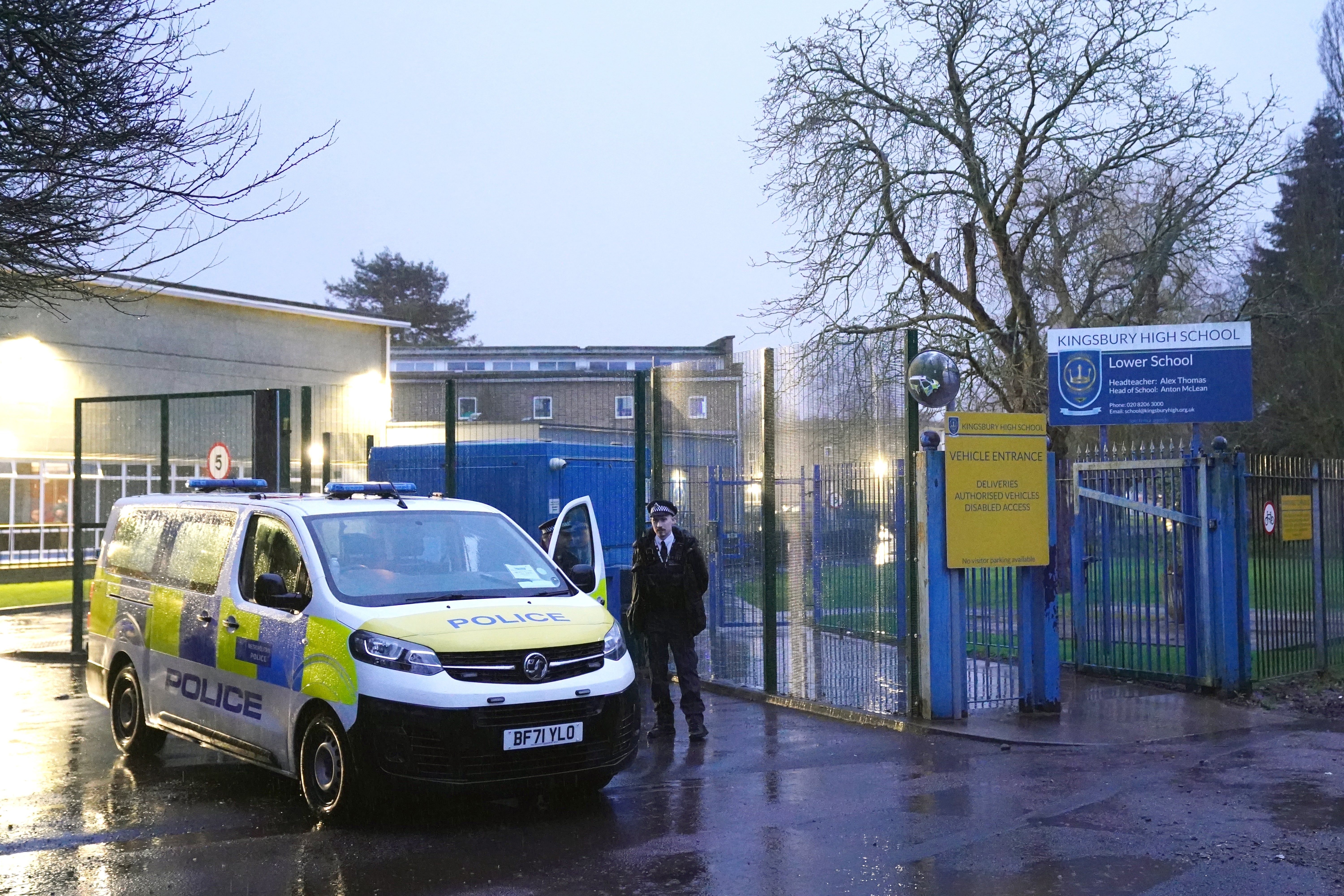
Two boys were stabbed at Kingsbury High School earlier this year, as figures obtained by The Independent show the extent of knife crime at schools in England and Wales (Ben Whitley/PA) (PA Wire)
Twelve of the forces provided information on the age of suspects, which showed that, shockingly, 33 were aged 10 or under.
They included West Mercia Police recording the suspect in a knife possession offence as a seven-year-old boy. West Yorkshire Police recorded two offences for possession of a knife or sharp instrument where the suspect was an eight-year-old boy. The offences included 118 incidents of violence and 29 threats.
Some forces said their knife crime figures could include incidents involving other weapons, such as screwdrivers or needles. And for some, the data may include incidents at colleges or sites where the school is recorded as the nearest location.
Advertisement
Caroline Willgoose, whose son Harvey was stabbed through the heart with a hunting knife at All Saints Catholic High School, said the figures were deeply concerning, but not a surprise.
Caroline Willgoose has been campaigning against knife crime in schools since her son’s death (Supplied)
“It’s an emergency, and there needs to be change,” Mrs Willgoose said. “I’ve got hundreds of messages from parents that has said someone in their school, mostly primary schools, has taken a knife in and nothing’s been done about it, or they’ve been sent to another school.
“There needs to be serious consequences for knives being found in schools, and not just shoved under the carpet.”
Earlier this year, the family lawyers claimed an independent report found “several missed opportunities” before the 15-year-old was murdered, including alleged failures by the school to adequately investigate concerns his killer, Mohammed Umar Khan, also 15 at the time, carried weapons. The school has since implemented “robust measures”, the managing trust said in February.
Mrs Willgoose said schools should install knife arches to ensure children were protected, but said many schools had not been supportive. “They are more worried about reputation and not scaring the parents,” she added.
Advertisement
Meanwhile, teachers have said they feel under threat, including former physics teacher Vincent Uzomah, who gave up the profession 10 years ago when he was stabbed in the stomach by a pupil at school in Bradford.
Mr Uzomah, who is now a lecturer at the University of Salford, said: “These are incidents that don’t happen in every school, and it doesn’t happen regularly, but when it happens, they have an enormous impact. For me, it nearly ended my life, and I get a shudder when I see a new case on the news.”
He added: “There needs to be a greater focus on the attitude from home, the attitude in society, and then not isolating these kinds of kids, but to put in place measures to safeguard the lives of teachers and other students to ensure that it is a safe environment for all.”
Advertisement
The knife offences in schools come at a time when knife crime overall fell nine per cent in the year to September 2025, according to Office for National Statistics Figures. Labour has set a target of reducing knife crime by 50 per cent.
On Thursday, a new National Knife Crime Centre was opened in London, where policing experts will tackle offenders who sell and distribute weapons online, often referred to as the “grey market”.
Following the attacks on two boys at Kingsbury High School in Brent in February, education minister Georgia Gould said ministers would look at security in schools.
Department for Education (DfE) guidance states CCTV and systems that detect intrusion, such as alarm systems, strong perimeter fencing, and security lighting, can help prevent attacks.
Advertisement
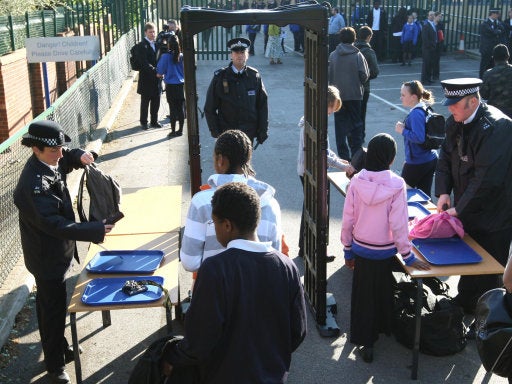
Knife arches are used in some schools to deter and detect knifes from the classroom (PA)
In the West Midlands, Dudley Academies Trust spent around £50,000 on knife arches for its four secondary schools. Chief executive Jo Higgins said schools that didn’t take appropriate measures were “vulnerable” to violence.
Pepe Di’Iasio, general secretary of the Association of School and College Leaders, said there had been a number of “appalling and tragic events involving knives”, but tackling it needed “a more concerted, society-wide response”.
He said schools already conducted searches and taught about the dangers of knife crime, and when a pupil was found in possession of a knife, it was treated “very seriously”.
But he cautioned: “There is a limit to what schools can be expected to do. They are part of their communities, not fortresses, and teachers are teachers, not security guards. Moreover, schools have very limited budgets and extending on-site security would require significant investment.”
Tory shadow home secretary Chris Philp said he would introduce a stronger approach to violence and poor behaviour in schools if in government, including sending pupils excluded for carrying a knife to “more appropriate settings”, such as Pupil Referral Units.
Advertisement
He said: “We need firm, early intervention backed by real consequences, so this is stopped long before it reaches the school gates.”
A government spokesperson said: “As part of the government’s mission to halve knife crime within a decade, nearly 60,000 knives have already been taken off Britain’s streets, and knife homicides have fallen by 27 per cent. “We are also working with schools, police and youth services on prevention and early intervention to identify young people most at risk.”
The storm could cause major disruption across the region and will be in place from 5pm this evening (Saturday, April 4) until 7am on Easter Sunday (April 5).
The Met Office confirmed that rail, road, air and ferry services are likely to be affected, with longer journeys and cancellations possible.
Recommended reading:
Advertisement
Strong winds may also result in the closure of roads and bridges, and result in power cuts, a warning has said.
Residents of coastal towns have also been alerted to the potential of large waves, spreading debris across the sea front and near properties and roads.
Areas affected include York, and North, East and West Yorkshire.
Temperatures will stay at 10 degrees Celsius until 1pm today in York, rising to 14 degrees at 3pm.
Advertisement
The strongest winds will be felt tonight, the Met Office said, and are expected to clear across Scotland before reaching the North Sea.
In York, these will be arrive at 11pm tonight – before gusts drop to around 13mph at 6am.
In Scarborough, winds are expected to strengthen from 7pm – building to gusts of 32mph by 12am.
In a statement, the Met Office said: “Whilst some uncertainty remains in the exact track and shape of Storm Dave, a spell of strong southwesterly winds is expected.
Advertisement
“Gusts of 50-60 mph are expected fairly widely with 60-70 mph in more exposed locations.
“The strongest winds are expected during Saturday evening where there is a small chance of gusts of 70-80 mph briefly, particularly northern England and southern Scotland.
“Large waves may lead to some dangerous conditions around windward coasts.”
The Met Office has issued the following advice:
Advertisement
Prepare to protect your property and people from injury. Check for loose items outside your home and plan how you could secure them. Items include; bins, garden furniture, trampolines, tents, sheds, and fences.
Give yourself the best chance of avoiding delays by checking road conditions if driving, or bus and train timetables, amending your travel plans if necessary.
Prepare for power cuts in advance. Gathering torches, a mobile phone power packs and other essentials.
If you are on the coast, stay safe during stormy weather by being aware of large waves. Even from the shore large breaking waves can sweep you off your feet and out to sea. Take care if walking near cliffs; know your route and keep dogs on a lead. In an emergency, call 999 and ask for the Coastguard.
Iranian state media has broadcast an extraordinary appeal offering rewards for the pilot’s capture. An anchor on a channel in Kohkilouyeh and Boyer-Ahmad province told viewers: “If you capture the enemy pilot or pilots alive and hand them over to the police, you will receive a precious prize.”


















































You must be logged in to post a comment Login