Connect with us
DAPA Banner

NewsBeat

There is a part of the Welsh coast with spring walks so epic your jaw will drop – these are three days out you won’t beat

Published

on

Wales Online

One area I particularly love to hike is the Pembrokeshire Coast National Park

Advertisement

From dramatic coastlines, heather-strewn moorlands, and steep ridges to plunging river valleys and dense pine forests, Wales has an unbeatable range of walks waiting to be discovered.

This small but mighty country is a hiker’s dream, with loads of short treks and loop walks. The best part? You don’t need to hike for days to discover Wales’ epic landscapes.

There are routes you can tackle in a single day that range in length and difficulty. While summer is obviously a brilliant time to strap on your hiking boots and explore Wales, spring is a great time for blooms and newborn lambs in fields.

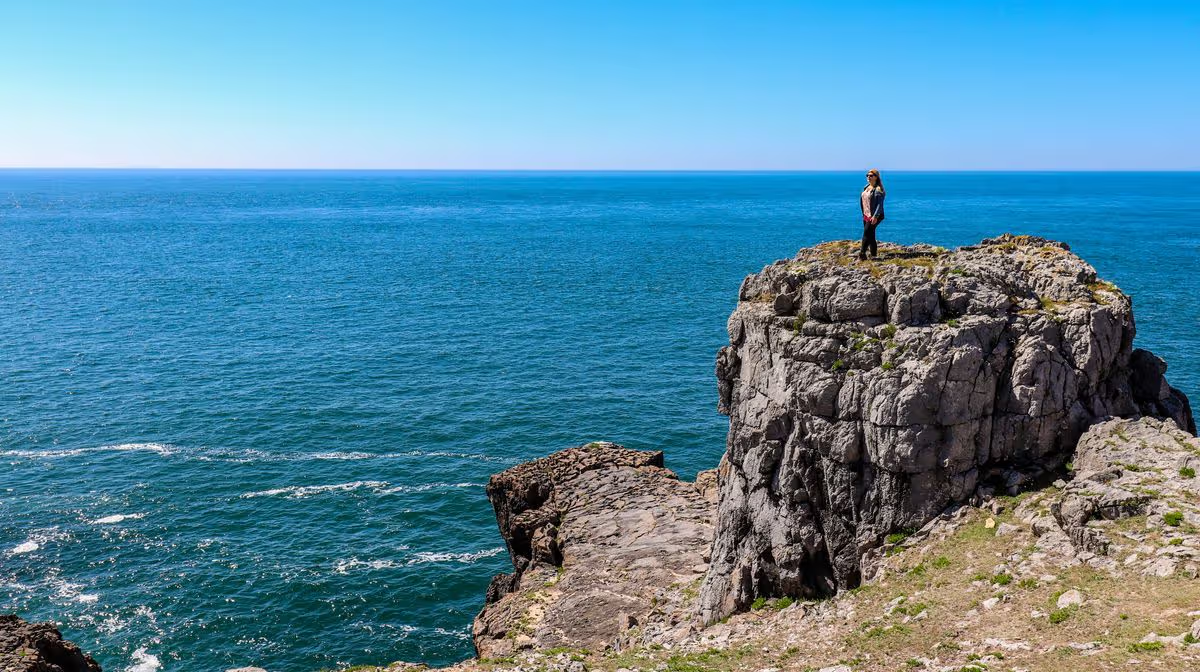
One area I particularly love to hike is the Pembrokeshire Coast National Park, which has won multiple awards and accolades for its high-quality beaches, sustainability efforts, and conservation work.

Advertisement

There are 240 spectacular square miles just waiting to be discovered here, with the Pembrokeshire Coast Path featuring 186 miles of epic coastline. You can plod the entire route or hike shorter sections and loop trails.

According to the National Park, over 200 circular walks are available, including half-day, short, and easy access walks.

Some of the most popular walks in the area include the St Davids Head circuit, the Bosherston Lily Ponds walk, and the Dinas Island circular walk.

Advertisement

Other great options are the Porthgain to Abereiddi section and the scenic circular walk from Saundersfoot to Tenby.

One of my favourite walks here is the Bosherston and St Govan’s Walk. On this easy coastal walk, you’ll also find many secluded bays, caves, arches, inlets and blow-holes.

There are also stacks that are the result of wave action on the limestone cliffs, which are great for sea birds, including ravens, martins and oystercatchers. Wildflowers abound; the squill and sea lavender are particularly beautiful.

Follow the trail to St Govan’s head to find a secluded chapel hidden on a wild and windy beach. Walking down to St Govan’s chapel today, you can still see ‘bell rock’.

Advertisement

Legend has it that if you make a wish while standing in the rock cleft, it will come true – as long as you don’t change your mind before you turn around.

Once you’ve visited the unique chapel, you can walk along the clifftop to St Govan’s Head. Two of Wales’ finest beaches, Broad Haven South and Barafundle, are nearby if you want to extend your scenic walk and stomp along the shoreline.

If you’re doing the full loop via St. Govan’s Chapel, keep going and follow the path towards Bosherston Lake and village.

Advertisement

You can refuel in Bosherston at the St. Govan’s Inn. You’ll find country pub vibes, a varied menu featuring local ingredients and home cooking, and a decent selection of well-kept cask-conditioned ales here.

Just a short drive away is the Stackpole Inn, a hangout for celebrities and an award-winning pub, restaurant and rooms. This super-popular venue is highly rated on TripAdvisor and is loved by locals and tourists. Read about this hike here.

Another of my favourite short treks in Pembrokeshire combines sea views, ruins and a lush fish and chip shop in a tiny hamlet – the Abereiddi to Porthgain walk in Pembrokeshire, which is very enjoyable in winter.

This 6.3-km out-and-back trail is well known to cliff divers and is generally considered an easy route. It’s suitable for a range of walkers, from beginners to experienced hikers, and has one of Wales’ best fish-and-chip spots along the way.

Advertisement

Your route can begin at either end, but I prefer to start at Abereiddi, which has a paid car park and toilet facilities. From the pebble-strewn car park, you’ll follow the waymarked trail over the cliffs towards Porthgain.

Along the way, you’ll pass the famous Blue Lagoon, a cliff diving hotspot that was once the main slate quarry for the St Brides Slate Company, which operated here until 1910. The leftover slate gives the water its stunning aqua-blue hue that photographers love.

Once you have passed the lagoon, keep following the cliff path that traces the craggy shoreline. The easy coast path continues over open grassland, skirting along the cliffs with gorgeous ocean views.

Advertisement

You’ll soon reach Porthgain, a fishing port described by The Guardian as “a prime spot for escaping the ills of the universe,” which once exported roadstone all over the UK and is now home to a pub, gallery and some of the best fish and chips in Wales at the Shed. For the latest restaurant news and reviews, sign up to our food and drink newsletter here

The Shed has won acclaim from Sunday Times writer Giles Coren, who called their fish and chip offering “as good as cod or haddock and chips can be”.

He added that it’s “light, fresh and crispy but not with one of those deep bronze, inedibly crunchy, stupidly show-offy batters you find in your urban gastropub.” Chef Stephen Terry has also praised the “really good fish and chips” here.

Advertisement

Bag a table and look out over the harbour while you tuck into some fresh seafood, such as monkfish and prawn curry or halibut with samphire and shallot, served with lemon and caper butter.

Another favourite of mine is a coastal walk that features a pancake shack on the beach. Situated on the south-east coast of Pembrokeshire, Saundersfoot is surrounded by the protected landscape of the National Park and lies directly on the Pembrokeshire Coast Path.

From the town, you can join the coast path and walk all the way to Tenby or do a shorter 5.1-km out-and-back trek from Saundersfoot Beach to Monkstone Point, which features some inclines through a wooded area as you trace the shore. You can follow the coast’s path signs or download the trail on the AllTrails app.

Advertisement

It starts at the coastal village of Saundersfoot. Considered a “compact version of Tenby,” the swish seaside town has a sandy beach, ranked among the best in the UK in The Times’ 2025 annual Best UK Beaches guide, and is described as a beach that “rewards explorers”.

Saundersfoot might sit in the shadow of flashy neighbour Tenby, but don’t let that fool you; this compact coastal spot has a unique charm of its own.

It has a proper sandy-blue-flag beach, harbour packed with places to eat, and cracking coastal walks leading to secluded coves and smugglers’ tunnels.

Advertisement

Start your hike at Saundersfoot Beach, head towards the harbour and follow the route past the St Brides hotel.

You’ll continue along the Glen Road from the hotel until you reach the Pembrokeshire Coast Path, which you’ll follow through the peaceful Glen Woods as it ascends over the craggy shoreline towards Monkstone Point. You can read more about this walk here.

Hiking in Wales tips

Advertisement

Serious hikers should consider using a detailed OS Explorer map to find walking routes and public rights of way in Pembrokeshire and throughout Wales. You should also download the what3words location app as an extra safety measure.

Remember to also bring water for long walks. Download the Refill Wales App to find locations to fill your reusable water bottle with tap water for free.

The weather can be wildly unpredictable here in Wales, so wherever you hike, pack waterproofs and a hot tea or coffee flask.

Advertisement

That’s especially true when hiking in a mountainous region where conditions can change rapidly. Ramblers Cymru is also an excellent resource for walking tips, routes, and details on group walks in Wales.

It’s vital to carry a range of essentials for hiking in Wales, especially in the colder months. Even experienced hikers should be prepared for the unexpected.

Do your research when comparing hiking backpacks. The general rule for outdoor bags is that the pack size you’ll need is usually linked to the length of your trip.

Typically, you want a pack between 10 and 25 litres for day hikes, but always go a bit bigger than you think you might need for an epic coast walk so that you can bring all the essentials. Gotta make sure there’s room for a family-sized bar of chocolate, right?

Advertisement

Look for high-quality hiking bags with features such as a bottom-access compartment, front and side pockets, a hip belt, inner and outer lid pockets, a walking pole attachment, and, preferably, one compatible with hydration packs.

Pack a head torch, compass, map, water bottle or hydration pack, whistle, first aid kit, mobile phone, and warm layers.


Source link

Advertisement
Continue Reading
Click to comment

You must be logged in to post a comment Login

Leave a Reply

NewsBeat

London travel news LIVE: Waterloo to Clapham Junction chaos as casualty on track closes ALL train lines

Published

on

London travel news LIVE: Waterloo to Clapham Junction chaos as casualty on track closes ALL train lines

Use the Jubilee line from Waterloo to Westminster, then change for the District line to Richmond.
The reverse route is also available via Westminster
From Richmond, take the District line to Embankment, then switch to the Bakerloo or Northern line to Waterloo.
Piccadilly line options via Hounslow, Hatton Cross or Green Park, connecting to Jubilee or Northern lines.
Northern line services also run between Battersea Power Station and Waterloo.

Source link

Continue Reading

NewsBeat

Why small discoveries (as well as big ones) have the power to inspire

Published

on

Why small discoveries (as well as big ones) have the power to inspire

This roundup of The Conversation’s environment coverage was first published in our award-winning weekly climate action newsletter, Imagine.

In 1968 a photo of the Earth was taken by the crew of Apollo 8 as they orbited the Moon.

It’s hard for us to imagine today what that would feel like for both the crew and the public who first saw the shot of Earth snapped from so far away. All those years ago this was a fantastic, and perhaps shocking, picture taken from somewhere many people would never have imagined humans could go.

That Earthrise shot from 1968, the first colour image of the Earth from space, showed our planet from a perspective we had never seen before, from the Moon in the foreground and the globe of the Earth in the distance. And for many people, it seemed more fragile than they had ever realised.

Advertisement

This image from space provoked a massive reaction, and is credited with prompting the creation of Earth Day, and a wave of environmental activism.

Nearly 60 years later we are inundated with images of space, planets and even AI-generated sci-fi stories. So it came as somewhat of a surprise to find myself caught up in the whirl of excitement and emotion around the Artemis II journey, and drawn into watching and discussing what the astronauts were seeing and saying.

Nick Dunstone, a science fellow at the Met Office, is a big fan of the Earthrise photo. He has had it stuck on his wall for years. The Artemis II mission prompted him to think about how much the climate around the Earth has changed in the decades between the Earthrise photo and the one taken by 2026’s astronauts from the dark side of the moon.

He points out that one of the legacies of the 1960s space race is a set of satellite observation platforms which have allowed us to monitor, understand and predict changes to our global climate. Unfortunately, many of these reveal worrying trends. For example, more frequent heatwaves on land and sea, loss of Arctic sea-ice, melting glaciers and sea-level rise.

Advertisement


À lire aussi :
Earthrise to Earthset: how the planet’s climate has changed since the photo that inspired the environmental movement


It can seem like nothing is getting better in these days of global upheaval and endlessly escalating conflicts. It’s easy to despair about whether any small actions that we can take will make any kind of difference.

Bee stories

I ended up in a conversation with my running buddies at the weekend about whether there is anything that can cheer us up. I talked about new research that shows that queen bumblebees can survive underwater. In what seems like a story that could be made into a Pixar film, academics at the universities of Ottawa and Guelph discovered this purely by accident.

Sometimes scientific discoveries are prompted by happenstance. In this case, some tubes were accidentally filled with water and the bees which had been assumed to have died were discovered to be still alive. Queens, it turns out, can stand submersion for up to a week. This matters because climate change is bringing more rain during winters when these bees must survive underground. And the queen’s survival is vital, for she must found a new colony the next spring. Without her, there is nothing.

Advertisement


À lire aussi :
Queen bumblebees can breathe underwater — for days. We discovered how


Then there’s the discovery by Oxford researcher Sophie Lund Rasmussen that hedgehogs can hear. Rasmussen set off to find out if there were any ways to warn hedgehogs of the dangers of crossing the road. With up to 300,000 hedgehogs killed per year on UK roads, and the same situation across Europe, this mammal which has featured fondly in many of our childhood stories, is incredibly threatened.

Research has discovered that hedgehogs can hear ultrasound.
tiberiuaduve/Shutterstock

Rasmussen’s research opens the door for ultrasound hedgehog warning systems to be put in place to try and warn hedgehogs away from roads, and potentially save thousands from a messy death.

Advertisement


À lire aussi :
Hedgehogs can hear high-frequency ultrasound – that knowledge could help save them


Moss, many people might think, is quite a dull subject. But in the past few weeks, after chatting with University of Limerick’s Pedram Vousoughi, I’ve become the biggest fan of this green stuff that we find on the sides of trees and on our garden paths. As it turns out, moss has almost magical qualities that could be a great help to humanity in the next decades.

For someone who had not paid much attention to this plant in the past, the abilities of this low-to-the-ground greenery was a revelation. Moss can absorb several times its own body weight in water and release it over time. This makes it ideal for helping the world cope with increasing rainfall and flooding, especially along busy roads.

Moss also absorbs air pollution and could play a role in increasing biodiversity along major roads. I’m now boring on about moss in various social situations – and it’s making me feel a bit more positive about the world.

Advertisement


À lire aussi :
How moss could help roads cope with heavy rain and reduce air pollution


Sun spotting

One of my favourite places is a long pebbly beach on a thin spit of land on the Suffolk coast, where you can watch the sun go down as well as the sun rise (although as a night owl I’m less likely to see the second). I have come to realise the value of sitting somewhere incredibly quiet and just looking at the sea and the sky.

That’s why the Dutch trend of dusking – coming together with friends to watch the sun go down – struck a chord with me. As Jenny Hall and Brendan Paddison from York St John University explain, watching the light of the day disappear over the horizon can be a way of connecting with nature’s rhythms and disconnecting from your worries, bringing the work day to a natural close. This also links with studies suggesting that focusing on nature can enhance feelings of wellbeing.

In these complex times, recognising small discoveries (as well as large ones) can be vital.

Advertisement

Source link

Continue Reading

NewsBeat

The top 25 Northern Ireland sport stars of all time ranked: Numbers 6-10

Published

on

Belfast Live

We are now entering the top 10, and the arguments will be even stronger for each position. Anyone at this stage could lay claim to being the greatest

On one of the busiest sporting weeks of the year, we are bringing you our list of the top 25 Northern Ireland sport stars of all time.

Advertisement

Rory McIlroy may be the talk of the sporting world right now, but that is nothing new as iconic Northern Ireland figures like George Best, Alex Higgins and AP McCoy have been houselhold names around the world.

We are now entering the top 10, and the arguments will be even stronger for each position. Anyone at this stage could lay claim to being the greatest.

On day one, we had international hockey star Katie Mullan, gymnast trailblazer Rhys McClenaghan, rugby legend Mike Gibson, GAA colossus Kieran McGeeney and Olympic gold medal winning swimmer Dan Wiffen.

At number 20, on day two, was soccer legend Pat Jennings. Former champion jockey Richard Dunwoody was in 19th, while Norman Whiteside, ex of Manchester United was in 18th. Three-time All-Ireland winner hero Sean Cavanagh was next in 17th, with boxing legend Wayne McCullough in 16th.

Advertisement

At number 15 was Paralympic legend Bethany Firth. Down GAA hero of the 1960s Sean O’Neill was 14th, while Ireland and Lions rugby icon Willie John McBride was 13th.

At number 12 was Belfast two-weight world boxing champion Carl Frampton and at number 12 was six-time World Superbike champion Jonathan Rea.

Here are numbers six to 10 on our Northern Ireland sport stars list:

6. JOEY DUNLOP

Motorcycle icon Joey Dunlop OBE is widely considered the greatest road racer in history. Dunlop began racing in 1969 and within a few years had established a reputation alongside his colleagues in the ‘Armoy Armada’, he began to win trophies at circuits and road races throughout the British Isles.

His legacy is defined by 26 Isle of Man TT wins, five Formula One World Championships, 24 Ulster Grand Prix triumphs, and 13 North West 200 wins.

In 2015, the Ballymoney man was voted Northern Ireland’s greatest-ever sports star in a Belfast Telegraph poll.

His record of 26 Isle of Man TT wins stood for a remarkable 24 years, until his nephew Michael surpassed the longstanding Mountain Course benchmark.

Advertisement

He died in an accident in Estonia in July 2000, at the age of 48.

7. JACK KYLE

Born and educated in Belfast, John (Jack) Kyle was a central figure in Irish rugby’s post-war resurgence and played a pivotal role in Ireland’s historic Grand Slam victory of 1948, secured at Ravenhill.

Renowned for his instinctive brilliance, pace and vision, he went on to win 46 caps for Ireland and tour with the British & Irish Lions in 1950, captivating crowds in Australia and New Zealand with a style of play that marked him out as one of the game’s true greats.

Advertisement

In 1950, Kyle was declared one of the six players of the year by the New Zealand Rugby Almanac.

He is a member of the International Rugby Hall of Fame and was inducted into the IRB Hall of Fame. He was named the Greatest Ever Irish Rugby Player by the Irish Rugby Football Union in 2002.

8. PETER CANAVAN

The Errigal Ciaran man is one of the most decorated Northern Ireland-based players in Gaelic Football history.

Advertisement

The diminutive Tyrone attacker won two All-Ireland Senior Football titles, six All Stars Awards (more than any other Ulster player), four Ulster titles and two National Leagues. He represented Ireland in the International Rules Series on several occasions.

While Tyrone lost the All-Ireland final in 1995, early in Canavan’s career, he scored 11 of their 12 points in the decider. He did claim Celtic Crosses in 2003 and again in 2005.

He led the line while Tyrone were far from a powerhouse, but ultimately helped them reach the promised land of All-Ireland senior glory and was known as ‘God’ or ‘Peter the Great’ by fans before the end of a legendary career.

9. DANNY BLANCHFLOWER

Northern Ireland’s captain when they reached the quarter-finals of the 1958 World Cup, so immense was Danny Blanchflower during his illustrious career that he received three Ballon d’Or nominations.

The closest he came to winning it was in 1957 when he finished 14th in a very tight field behind runaway winner Alfredo Di Stefano.

A First Division winner with Tottenham, Blanchflower also won a European Cup Winners’ Cup and two FA Cups, and in his 56 caps for Northern Ireland he scored twice.

He was the first Northern Ireland player to pass a half-century of appearances for his country.

Advertisement

10. MARY PETERS

An Olympic icon, who built a lasting legacy through her 1972 Munich pentathlon gold medal win and decades of supporting athletes in Northern Ireland.

She established The Mary Peters Trust in 1975, helping hundreds of young sporting stars.

In the 45th pentathlon of her career, the veteran of Spartan Ladies AC achieved the ultimate success by winning an Olympic title with a new world record. English-born Peters spent much of her life in Ireland and her first pentathlon competition was at Ballymena in 1955.

Advertisement

In the 17 years leading up to her Olympic triumph, she won seven WAAA pentathlon titles as well as the gold medal at the Commonwealth Games in 1970, and finished fourth in the 1964 Olympics and ninth in 1968. She also won the WAAA shot put title twice and was the Commonwealth Games champion in 1970.

****

Tomorrow we unveil numbers 1-5 in our top 25 Northern Ireland sport stars of all time.

Click here to sign up to our sport newsletter, bringing you the latest sports news, headlines and top stories

Advertisement

Source link

Continue Reading

NewsBeat

NATO’s Mark Rutte faces Trump over US-Israel war on Iran

Published

on

NATO's Mark Rutte faces Trump over US-Israel war on Iran

BRUSSELS (AP) — NATO Secretary-General Mark Rutte has weathered a fresh ordeal with President Donald Trump, this time over the U.S.-Israel war on Iran, a conflict that does not even involve the world’s biggest military alliance and one it was never consulted about.

Since launching the war, Trump has derided U.S. allies as “cowards,” slammed NATO as “a paper tiger” and compared U.K. Prime Minister Keir Starmer to Neville Chamberlain, who is probably best remembered for a policy of appeasement toward Nazi Germany.

That comes on top of Trump’s repeated threats to seize control of Greenland, which have deeply strained relations with U.S. allies in NATO and raised fears that doing by force could spell the end of the organization.

In recent days, the man who is as good as chairman of the NATO board suggested that the U.S. might leave the trans-Atlantic alliance. Trump already threatened to walk out in 2018 during his first term. His complaint now is that some allies ignored his call to help as Iran effectively shut the Strait of Hormuz, a vital trade waterway.

Advertisement

After talks with Rutte on Wednesday, the alliance’s most powerful leader took to social media to show his annoyance. “NATO WASN’T THERE WHEN WE NEEDED THEM, AND THEY WON’T BE THERE IF WE NEED THEM AGAIN,” Trump posted.

Peppered with questions later on CNN about whether Trump intended to take America out of NATO, Rutte said: “He is clearly disappointed with many NATO allies, and I can see his point.”

Keeping America in

Rutte has earned a reputation as a “Trump whisperer,” notably helping to draw up a plan that has seen European allies and Canada buy U.S. weapons for Ukraine, and keep the administration involved in Europe’s biggest war in decades.

Indeed, one of his most demanding tasks since taking office in 2024 has been to keep the mercurial U.S. leader engaged in NATO, particularly as America has set its sights on security challenges elsewhere, in the Indo-Pacific, Venezuela, and most recently Iran.

Advertisement

Rutte has used flattery, praising Trump for forcing allies to spend more on defense. He has congratulated the U.S. leader over the war and refrained from criticizing Trump’s warning that “a whole civilization will die” should Iran not reopen the strait.

“This was a very frank, very open discussion but also a discussion between two good friends,” Rutte told CNN. He declined to confirm reports that Trump is considering moving U.S. troops out of European countries that do not support the war.

Asked whether the world is safer thanks to the U.S.-Israel war, Rutte said: “Absolutely.”

War launched by a NATO member, not at one

The striking thing about the war on Iran is that NATO has no role to play there. As a defensive alliance it has protected ally Turkey when Iranian missiles were fired in retaliation at its territory, but the war was launched by a NATO member, not at one.

Advertisement

Rutte himself has said that NATO would not join the war, and there is no public confirmation that the U.S. had even raised the issue at the organization’s Brussels headquarters, although it cannot be ruled out that the administration made a request on Wednesday for that to happen.

NATO declined to say whether security for the strait has been officially discussed and referred questions to the United Kingdom, which is leading an effort outside the alliance to make the trade route safe for shipping once the ceasefire is working.

Estonian Foreign Minister Margus Tsahkna said Thursday that his country is always ready to consider providing support through NATO to partners who request it there.

“If the U.S. or any other NATO ally is asking (for) our support, we are always read to discuss it,” he told broadcaster CNBC. “But for that, we need of course the official ask to discuss then what is the mission, what is the goal?”

If allies “need our support, then we need to plan together,” he said.

NATO trying to stay out

Rutte himself insists that the alliance will only defend itself, and not become involved in another conflict outside of NATO territory, which is considered to be much of Europe and North America.

Advertisement

“This is Iran, this is the Gulf, this is outside NATO territory,” he said.

NATO has operated outside of the Euro-Atlantic area in the past, notably in Libya and Afghanistan. But there is no appetite to do so again given its chaotic U.S.-led exit from Afghanistan in 2021, which former NATO chief Jens Stoltenberg described as a “defeat.”

Trump’s ire seems most directed at Spain and France, rather than NATO itself. Spain has closed its airspace to U.S. planes involved in the Iran war and has refused U.S. forces the use of jointly operated military bases.

After the two-week ceasefire was announced, Spanish Prime Minister Pedro Sánchez posted on X that his government “will not applaud those who set the world on fire just because they show up with a bucket.”

Advertisement

“What’s needed now: diplomacy, international legality, and PEACE,” he added.

France has been critical, insisting that the war was launched without respecting international law and that Paris was never consulted about it. No blanket restrictions were placed on the use of joint bases or its airspace, but French authorities have said they’re making such decisions on a case by case basis.

Advertisement

Source link

Continue Reading

NewsBeat

Northern Irish passport holder shows reality of new EES system at popular Spanish spot

Published

on

Belfast Live

Wendy Smyth travelled from Northern Ireland to Malaga, Spain, where she showcased the European Union’s new Entry/Exit System (EES) in full operation, highlighting the contrast for EU and non-EU citizens

A British national has showcased the “reality” of the new Entry/Exit System (EES) that applies to everyone travelling to a destination within the Schengen area of the European Union. The system, which has been operational since October in some locations, is gradually being rolled out across the continent.

The EES is an automated IT system for registering non-EU nationals travelling for a short stay, each time they cross the external borders of these countries and they will gradually replace passport stamps with a digital system that records when travellers enter and exit, making border checks faster and helping staff to work more efficiently.

Advertisement
Content cannot be displayed without consent

Wendy Smyth, who hails from Northern Ireland, recently put the EES to the test as she travelled to Malaga. She took to TikTok, where she showcased a very crowded airport in the Spanish hotspot.

“Before you reach Passport Control, if you’re a UK national, you will need to register your biometrics on the system,” she explained. “There’s plenty of staff around to help you do this, and it involves taking your picture, taking your fingerprints and other information.”

Wendy went on to advise the EES is expected to be fully operational across the entire Schengen region from tomorrow (April 10). “There’s plenty of signage around Malaga Airport,” she continued, before highlighting how travellers are then split into two lanes ahead of Passport Control – comprising EU and non-EU citizens.

“If you’re unsure, there is a map beforehand, which will show you if you are a ‘blue country’ or not, what lane you should go in and likewise for ‘brown countries’,” Wendy said.

Advertisement

The lanes made for harrowing viewing meanwhile. The left – for Brits – appeared incredibly long, while EU citizens were able to stroll down their lane with ease.

“You’re held in this queue before you get to the ramp to go through into Passport Control,” Wendy advised. “This is what may greet you whenever you go through those glass doors.”

“If you’re an EU citizen you are able to walk down past everyone on the ramp and go to this empty space where the E-Gates are now operational – so be prepared – you may have to wait some time before you get through Passport Control.”

Writing in response, one TikTok user exclaimed in shock: “I think this will put a lot of people off travelling.”

Advertisement

A second person shared their frustration: “I had my fingerprints and photo taken in Poland but arrived in Spain today and it didn’t recognise my passport.”

Then a third fumed: “Bet you lot who voted from Brexit back in the day are happy, this is what we need to deal with now.”

While a fourth shared their experience of Malaga: “We went through Malaga on Tuesday and was through passport control in 15 mins. Seen the queues on TikTok and we had nothing!”

The countries in the Schengen area are:

Austria, Belgium, Bulgaria, Croatia, Czechia, Denmark, Estonia, Finland, France, Germany, Greece, Hungary, Iceland, Italy, Latvia, Liechtenstein, Lithuania, Luxembourg, Malta, Netherlands, Norway, Poland, Portugal, Romania, Slovakia, Slovenia, Spain, Sweden, and Switzerland.

Advertisement

The Republic of Ireland and Cyprus are not within the Schengen area, and therefore EES is not applicable when travelling to either of these countries.

For all the latest news, visit the Belfast Live homepage here and sign up to our daily newsletter here.

Source link

Advertisement
Continue Reading

NewsBeat

Under-fire Stirling bus service praised – despite local reliability questions

Published

on

Daily Record

The X10 service has come in for criticism from locals over the reliability of the fleet and late cancellations – but a report from the Bus Users UK group has been hailed by the service’s operators.

An under-fire bus route has been praised in a new independent report from a passenger watchdog – despite criticism over unreliability.

Advertisement

A monitoring exercise from the Bus Users UK group focused on the X10 and X10A route which connects Stirling and Glasgow through Milngavie.

The bus is also a vital lifeline for passengers in rural Stirling, with the service making its way through villages such as Strathblane, Balfron and Kippen.

The service was found to have a 97 per cent punctuality rate, with all scheduled journeys successfully operated from the 183 monitored.

Inspectors also highlighted the “consistently high” standard of vehicles on the route and noted their clean and comfortable ride for passengers.

Advertisement

Greig MacKay, Director for Scotland, Bus Users UK, said: “Following a recent monitoring exercise concerning the X10/X10A routes that connect rural Stirling villages to Glasgow and Stirling.

“Bus Users UK recorded an overall punctuality score of 97 per cent.

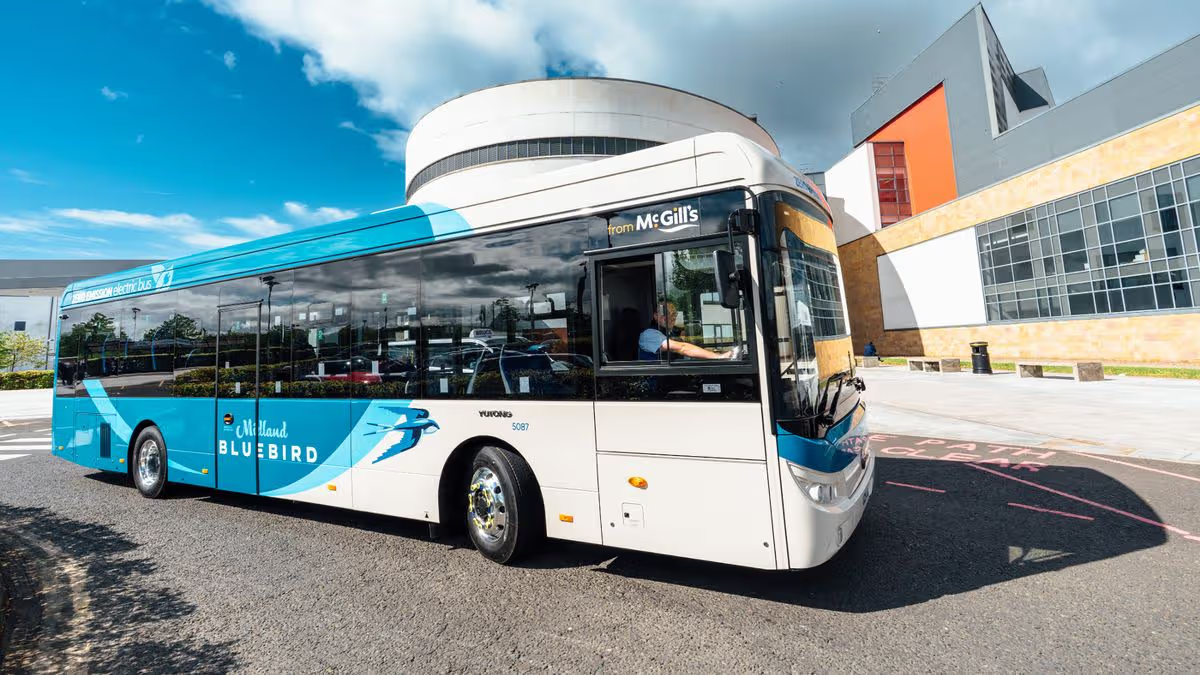
“This represents a significant improvement in punctuality standards for these two lifeline services. Passengers have also benefited from new investment by McGill’s Midland Bluebird which has contributed to more reliable services for the passengers who use them.”

The state of the X10 has been a running complaint for local bus passengers, with Buchlyvie resident Iain Smith one of those left frustrated by inconsistent arrival times.

Advertisement

Mr Smith wrote to McGill’s Group CEO Tony Williamson in February following a case where he and several other passengers were left out in the cold waiting for an X10 bus at Stirling bus station, with Mr Williamson eventually forced to fork out for a taxi to get home.

The reliability of the fleet operating the route has also come in for criticism after a recent incident where an X10 bus was pictured at the side of the road near Cambusbarron with smoke pouring from the back as traffic built up around the bus.

A spokesman for Midland Bluebird blamed the incident on a “coolant leak” with the issue resolved.

Reacting to the report, officials from McGill’s – who run Midland Bluebird – said it worked as justification for the hard work on making improvements to the X10 offering.

Advertisement

Colin Napier, Group Service Delivery Director for McGill’s Group, said: “This is a strong endorsement of the X10 and X10A services and the effort our drivers and operational teams put in every day, particularly given the level of disruption on the network.

“We’re seeing around 90 per cent satisfaction from our own passenger surveys and a steady five per cent increase in footfall, which shows that customers value the service we’re providing. In the areas where we can continue to improve, we will strive to ensure we do that.

“To build on this progress, we need continued support from local authorities and partners.

“Investment in better infrastructure – such as improved shelters with real-time information, high-access kerbs, traffic light priority and dedicated bus lanes into and out of Glasgow – would make a real difference for passengers and help us deliver even more reliable services.”

Advertisement

Graeme Leslie, Area Director of Midland Bluebird, added: “We’ve made a real effort to listen to the communities along the X10 and X10A corridor.

“The feedback we gathered at our drop-in sessions in Balfron and Milngavie has helped shape practical improvements to the service, and it’s great to see that reflected in both performance figures and independent recognition.

“We’re committed to building on that progress and continuing to deliver a service that people can rely on.”

Source link

Advertisement
Continue Reading

NewsBeat

Tyson Fury vs Anthony Joshua mooted for September in Dublin

Published

on

Fabio Wardley faces off with Daniel Dubois

Tyson Fury and Anthony Joshua could fight at Croke Park in September, with talks under way to stage the long-awaited heavyweight bout in Dublin.

The event is being targeted for the 80,000-seat stadium – the iconic home of Gaelic games – but the bout depends on Fury winning his comeback fight on Saturday and Joshua not taking a warm-up this summer.

Fury takes on Russian Arslanbek Makhmudov in London this weekend while Joshua has only just returned to training after he was injured in a car accident in Nigeria that killed two of his close friends, Sina Ghami and Latif Ayodele.

Fury has not fought since December 2024 while Joshua’s last bout was against Jake Paul last December.

Advertisement

Should Joshua decide to take a warm-up fight before meeting Fury, the event will be targeted for the end of the year – potentially in the UK.

Speaking to BBC Sport, Croke Park stadium chief executive Peter McKenna said a Fury-Joshua fight in Dublin could mean Katie Taylor finally realised her dream of fighting in the stadium.

“The real hope is that we will get Tyson Fury here later on in the year. That would be such a world-billing event that we would be able to facilitate a Katie Taylor fight here,” he said.

“A lot of stars need to align. Katie’s manager needs to agree, Katie’s promoter needs to agree, Tyson Fury’s promoter needs to agree.

Advertisement

“I am very confident that all three are coming to the sense that this is one of Ireland’s greatest sporting athletes and it would be such a ‘wow’ to have her here and for her to finish her career here.”

Source link

Continue Reading

NewsBeat

Police investigating sudden death of man after body found in Co Tyrone field

Published

on

Belfast Live

Sinn Féin MLA Colm Gildernew said the community is shocked and saddened to learn of the man’s death.

Police are investigating the sudden death of a man in Co Tyrone after reports of a body being discovered in a field.

The incident occurred in the Mill Road area of Aughnacloy on Wednesday, April 8.

Sinn Féin MLA Colm Gildernew said the community is shocked and saddened to learn of the man’s death.

Advertisement

The Fermanagh South Tyrone MLA said: “The community is shocked and saddened to learn that a man has lost his life in Aughnacloy.

“I want to express my sympathies and thoughts with the man’s loved ones as they come to terms with this heartbreaking news.

“Police are investigating the circumstances of his death, and I would call on the public to avoid speculation while the investigation is ongoing.

“I would also urge anyone with information to contact the police.”

Advertisement

A PSNI spokesperson said: “Detectives are investigating the circumstances surrounding the sudden death of a man in the Mill Road area of Aughnacloy on Wednesday, 8th April.

“A post-mortem examination will be carried out to determine the cause of death. There is no further information at this stage.”

For all the latest news, visit the Belfast Live homepage here and sign up to our daily newsletter here.

Source link

Advertisement
Continue Reading

NewsBeat

How AI’s language barrier limits climate disaster responses

Published

on

How AI’s language barrier limits climate disaster responses

A message appears online during heavy flooding: “This rain no be small o, everywhere don red.” Someone unfamiliar with the phrasing might hesitate. But for people in Nigeria, this message is immediate and clear: the flooding is severe and worsening.

Moments like this happen all the time on digital platforms. People don’t write in perfect, standard English sentences. They share warnings and reactions on platforms like X, WhatsApp and Facebook using the language of everyday life. This means sometimes mixing English with local expressions, slang and expressive language shaped by their communities.

Artificial intelligence systems can understand language and tackle a wide range of problems. Governments and organisations are increasingly using AI to scan social media, summarise public conversations, and even respond to environmental and climate issues.

But many of these tools struggle to make sense of the way people actually communicate. Local expressions and slang can confuse AI, so important messages are sometimes misunderstood or missed entirely.

Advertisement

When people talk about language barriers, they often mean translation between different languages. But the problem is more subtle. Around the world, people mix languages and local expressions online, a phenomenon that linguists call “code switching”.

Climate journalism has increasingly moved online, but there are fewer climate reporters in the developing world. This limits the depth and availability of information for a huge proportion of the global population, and shapes how climate issues are discussed and understood across different regions.

For instance, a UK social media post might raise an environmental concern using expressions like: “Are roads flooding already? Chuffed to know the council taking the piss.” Most AI tools can pick up the sarcasm and frustration aimed at local authorities.

In a country such as Nigeria, people may describe unfolding concerns differently: “Abeg is it October wey rain dey fall like this, but you say the climate no change?” or “River don near our house o! Abeg help, e fit spoil everything!”

Advertisement

Here, slang and Pidgin express immediate danger and an urgent call for help. Yet AI models often diminish this to casual commentary, entirely missing the urgency and emotion that is being conveyed.

This matters because most AI systems are taught on large western-centric text, mainly from North America and Europe. ChatGPT, for example, is instructed on huge amounts of internet text. It doesn’t have beliefs, feelings or awareness. Instead, it generates responses based on patterns it has seen online.

AI reflects the dominant culture in its training data, so carries a “cultural fingerprint”. It imitates normal ways of expressing ideas from the societies that produced the texts it has learned from. AI models trained on predominantly English-language texts show a hidden bias that favour western cultural values, particularly when asked in English.

Advertisement

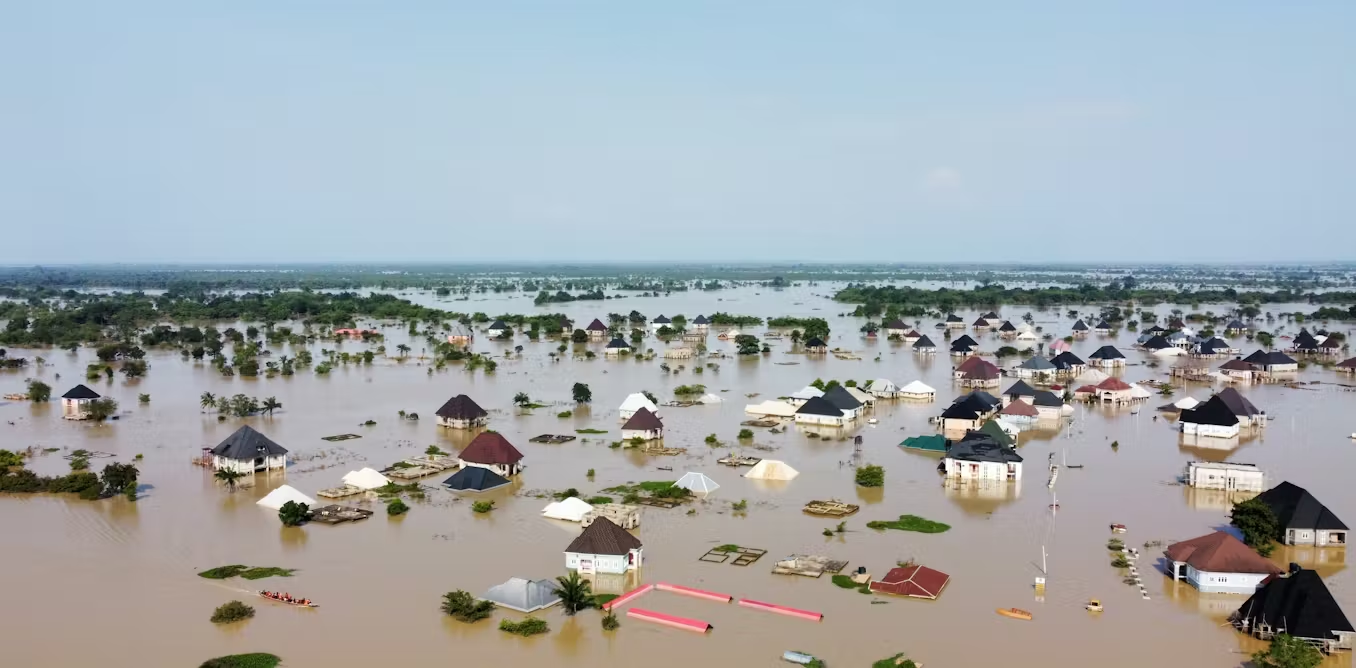
Flash floods in Wawa, a communtiy in south-western Nigeria followed heavy torrential rainfall in 2019.
Oluwafemi Dawodu/Shutterstock

One major reason AI can produce biased outcomes is that it reflects the societal inequalities including differences in race, gender and region that show up in the data it learns from. So, underrepresented voices from communities in developing countries with non-Anglocentric varieties of English are often diminished or ignored.

This bias can have real consequences. In climate crises like floods, heatwaves or other extreme weather, misinterpreted messages could put property and lives at risk.

AI systems that rely on past patterns are easy to interpret when language fits expected standards, but posts that don’t conform with the presence of local slang or urgency cues can be misinterpreted.

Improving climate disaster responses

Solving this problem involves designing systems that actually reflect the way people communicate. AI systems need to be trained to understand regional expressions and recognise that meaning often depends on cultural context, not just literal words.

Advertisement

AI should be tested on real online posts, not formal western-centric English, to capture urgency and local references. Automated systems can process huge volumes of information, but human judgment must remain in the loop – especially when people’s safety is at stake.

AI tools can help communities respond to floods, heatwaves and other climate emergencies – but only once trained to interpret the nuance of everyday language, so that warnings and calls for help get through.

Source link

Advertisement
Continue Reading

NewsBeat

Al Jazeera condemns killing of journalist in Israeli strike in Gaza

Published

on

Al Jazeera condemns killing of journalist in Israeli strike in Gaza

The CPJ also said on Wednesday that two other journalists had been killed in separate Israeli strikes in Lebanon this week – Ghada Dayekh, a presenter with privately-owned radio station Sawt al-Farah, and Suzan Khalil, a reporter and presenter on Al-Manar TV, which is affiliated with the armed group Hezbollah.

Source link

Continue Reading

Trending

Copyright © 2025