You can check vaccination rates in your area and see how many cases have been confirmed using our interactive map
A disease that had been eliminated in the UK is returning. The Victorian illness had been eradicated thanks to a vaccination programme by public health leaders, but it has now reappeared in 50 council areas.
A new map has highlighted the low vaccine-rate areas where it is spreading quickly. Measles infections have now been confirmed by lab tests in every region of England, the UK Health Security Agency (UKHSA) has confirmed, mainly among children under 10.
The figures come as one health chief has warned: “Measles is a serious disease that can cause pneumonia, meningitis, blindness, seizures and, tragically, death… Measles is one of the most infectious diseases known, and it will find those who are unvaccinated.”
Get MEN Premium now for just £1 HERE – or get involved in our WhatsApp group by clicking HERE. And don’t miss out on our brilliant selection of newsletters HERE.
It comes after the WHO stripped the UK of its measles elimination status in January, following sustained circulation of the disease for more than a year. The UK was first declared measles-free in 2017, but lost its status two years later, only to regain it in 2021. However, that was mainly thanks to social distancing during the pandemic.
Outbreaks began in 2023 and intensified throughout 2024. In England alone, there were 2,911 laboratory-confirmed cases of measles in 2024. That was the highest number since 2012.
On that basis, WHO and the UK Health Security Agency said that the virus had re-established endemic transmission, costing the UK its measles elimination status.
The most recent figures show that measles cases have fallen since the 2024 peak. However, cases remain high. Last year, there were 957 laboratory-confirmed cases of measles. As of March 9, this year, there have been 235 cases.
Most of these infections have been in unvaccinated children under the age of 10.
Enfield, in London, appears to be the epicentre of the current outbreak, with 80 confirmed measles cases so far this year. That includes 35 new cases since the last update in February.
Enfield also has one of the lowest vaccination rates in the country, with around one in three children unprotected by the MMR (measles, mumps and rubella) vaccine. The latest data shows only 64.3% of children in Enfield had received both MMR jabs needed for full protection by their fifth birthday.
The target vaccine coverage rate is 95%. Although the UKHSA has confirmed that 50 separate council areas have had at least one confirmed infection, it only publishes case numbers for areas with at least 10 cases.
So far, three council areas have met that threshold – all with low vaccine coverage rates. Apart from Enfield, there have been 43 cases so far in Birmingham, including 19 since February, and 15 in the London borough of Haringey, which neighbours Enfield.
In Birmingham, 75.5% of five-year-olds have received both MMR jabs, and in Haringey, just 65.0% of under-fives are fully protected.
The UKHSA has blamed the resurgence of measles on falling vaccination rates, after uptake of the MMR jab slumped to its lowest in a decade. As of last summer, 91.8% of five-year-olds in England had received one dose of the MMR jab, and 83.7% were protected by both doses.
In many areas, such as Enfield, Birmingham and Haringey, vaccine uptake is much lower. WHO says a vaccine coverage rate of 95% is needed to achieve “herd immunity”, which prevents transmissible diseases like measles from circulating.
From this year, the MMR jab has been replaced by the MMRV vaccine, which offers the same protection as MMR but also covers chickenpox.
You can check the vaccination rates in your area and see how many measles cases have been confirmed since 2024, using our interactive map.
Dr Yimmy Chow, UK Health Security Agency’s London Region Deputy Director said: “We continue to see measles cases in north London, and while children remain unvaccinated, the risk of further spread is very real.
“Measles is a serious disease that can cause pneumonia, meningitis, blindness, seizures and, tragically, death. Children and adults who get measles can end up in hospital suffering needlessly, sometimes with long-term consequences that stay with them for life.
“Measles is one of the most infectious diseases known, and it will find those who are unvaccinated. Two doses of the MMR vaccine provide vital protection. If your child has missed any vaccinations, or you are unsure whether they are up to date, please contact your GP surgery as soon as possible — it is never too late to catch up.”
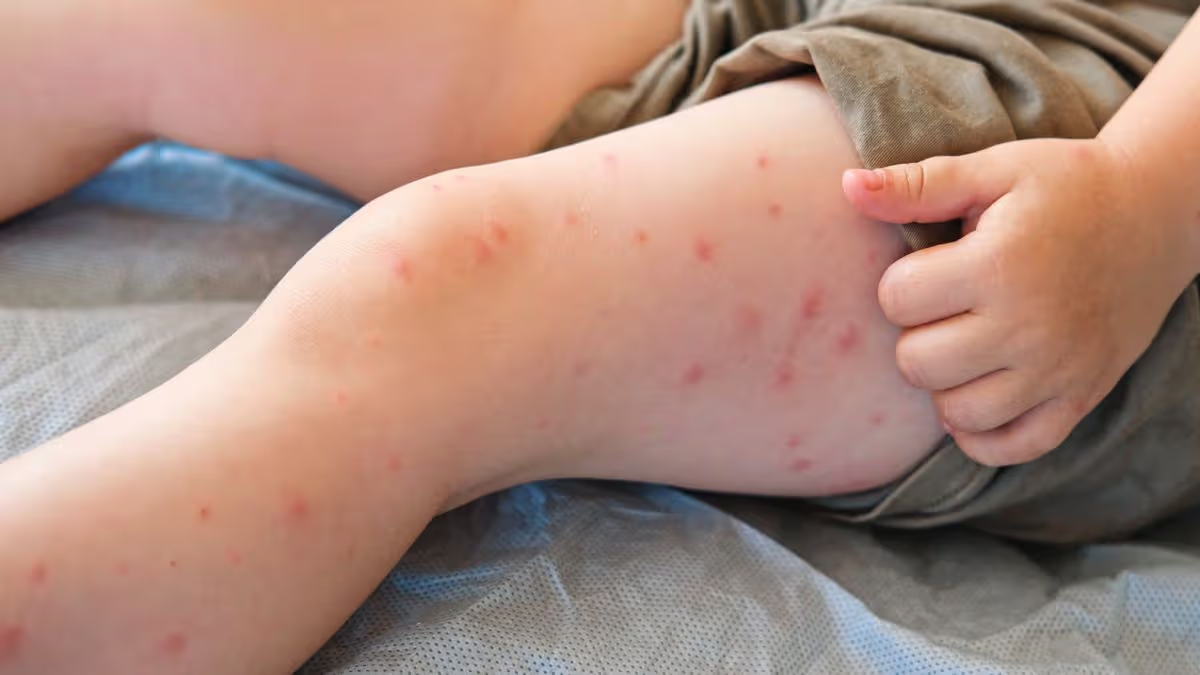
The key symptoms of measles include a high fever, coughing, sneezing, red and sore watery eyes, and a rash that usually appears after the initial symptoms.
Measles usually starts to get better after a week. However, it can lead to serious problems if it spreads to other parts of the body, such as the lungs or brain. Babies and people with weakened immune systems are more at risk from measles.
















![BITCOIN IS DUMPING!!! [WATCH ASAP]](https://wordupnews.com/wp-content/uploads/2026/03/1773435502_maxresdefault-80x80.jpg)