Connect with us
DAPA Banner

NewsBeat

this fresh take on Pride and Prejudice transforms the overlooked Mary

Published

on

this fresh take on Pride and Prejudice transforms the overlooked Mary

When Lizzy Bennet, the witty sister in Jane Austen’s Pride and Prejudice (1813), asks: “What are men to rocks and mountains?” she is thinking about ways of understanding self and world through the notion of the sublime.

The sublime was one of the key 18th-century philosophical ideas of Romanticism, balancing our physical insignificance next to something majestic like a mountain, with our imaginative capacity to conceptualise it. Lizzy is trying to get over her own and her sister Jane’s heartbreak by thinking beyond herself to the wider world of nature around her.

The philosopher Sianne Ngai claims that the notion of the sublime no longer holds any force. Instead, today’s culture replaces the idea with concepts that have a weaker emotional impact on us, such as the “zany”, the “cute” and the “interesting”.


Harvard University Press

For big hits, social media demands zany personalities and cute images. And to say something is “interesting” might actually indicate that you find the topic boring. In her book Our Aesthetic Categories, Ngai basically argues that 21st-century capitalist society has no time for the ecstatic experience of the sublime.

Advertisement

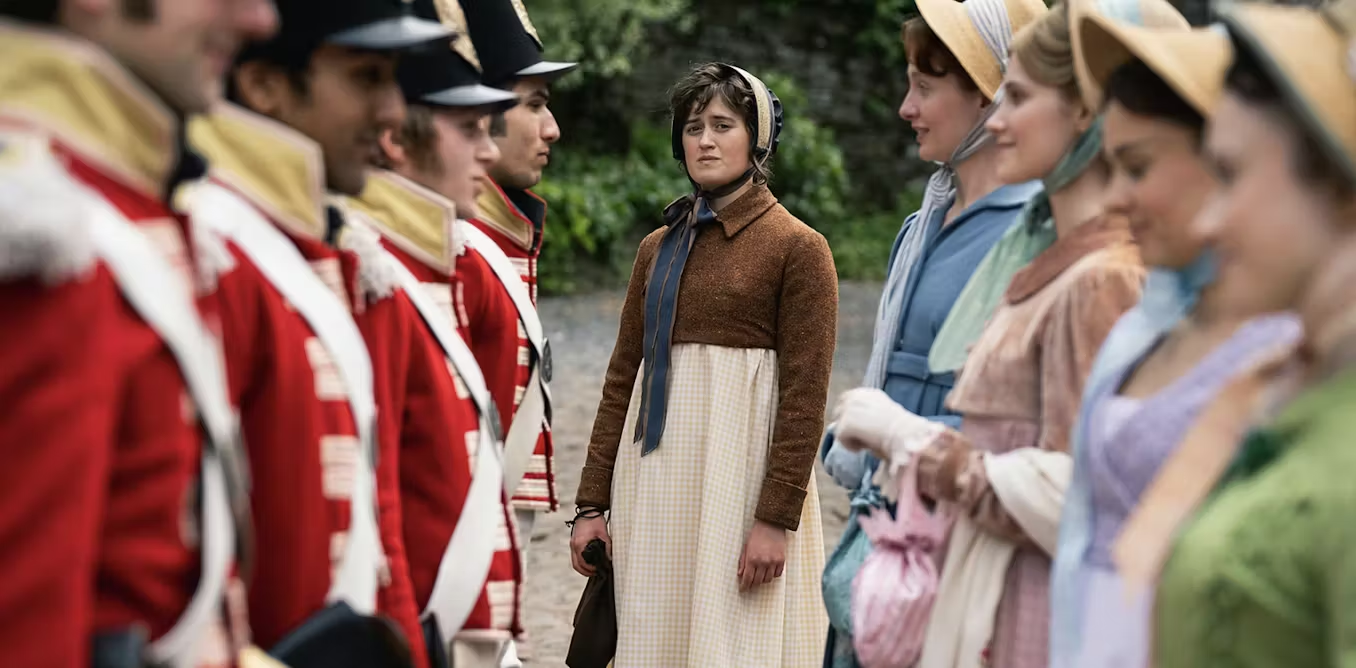
Although the new BBC TV series The Other Bennet Sister – adapted from Janice Hadlow’s 2020 novel – is a development and continuation of Austen’s novel, the programme steers clear of the sublime and the beautiful and focuses especially on the “cute”.

The Other Bennet Sister starts where Pride and Prejudice also begins. The local grand house Netherfield Park is being let at last, causing much excitement over the identity of the new tenant and the potential opportunities for socialising they may provide.

Focusing on Mary Bennet, the mousy pedantic sister who remains unmarried at the end of Austen’s novel, the TV drama quickly dispatches with the plot of Pride and Prejudice in the first two episodes. Mary is left standing with her mother and father as the rest of her sisters get married.

Advertisement

But Mr Bennet (Richard E. Grant) dies and the sisters’ cousin Mr Collins (Ryan Sampson) and his wife descend on Longbourn to claim the Bennet family home as their own. So Mary is sent to London to stay with her aunt and uncle, the kindly Gardiners in Gracechurch Street.

In London, Mary begins to to enjoy herself and have her own adventures, and crucially, find out who she is – if she’s not the witty one (Lizzy), the beautiful one (Jane), the good-humoured one (Kitty), or the lively one (Lydia). In this BBC incarnation, Mary is the cute, endearing one.

A different perspective

The first episode rewrites Austen’s novel from Mary’s perspective, with her cutting a lonely and drab figure next to the pastel couples of Lizzy and Jane, and Kitty and Lydia. Ruth Jones’s Mrs Bennet is transformed from a character beset by nerves to a woman with nerves of steel. She forbids Mary a cute romance with her optician, or from flirting with Mr Collins as the formidable matriarch has set her sights on him marrying Lizzy (who, of course, will not have the pompous bore).

The Other Bennet Sister makes Mary’s sisters seem distant and shallow, and focuses on her struggles with self-esteem in response to their lack of notice. Like Hill, the Bennet servant you can tell likes Mary best, you just want to give her a hug. In a neat twist, Hill is played by Lucy Briers, who played Mary herself in the BBC’s famous 1995 Pride and Prejudice series.

Advertisement

In London, Mary starts to overcome her awkwardness and self-consciousness under the care of the Mr and Mrs Gardiner, played with verve by Richard Coyle and Indira Varma. She nervously begins a romance with Mr Tom Hayward (Dónal Finn) only to discover he is already engaged.
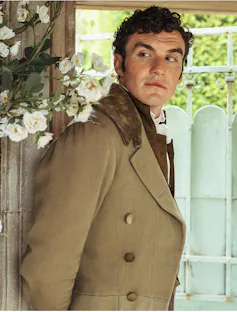
A young man in Regency dress.
The handsome Mr Hayward, in whom Mary is interested.
BBC/Bad Wolf/James Pardon

The show hints heavily that this engagement has faded in intensity like Sense and Sensibility’s Edward Ferrars with Lucy Steele, though Amy Baxter, played by Doctor Who’s Varada Sethu, is far nicer than the two-faced Lucy. By the end of the fifth episode, before she is called away to look after her ailing mother, Mary has found herself in a love triangle.

Throughout the series, Mary wonders just who she is. The audience, along with sensitive characters like Mrs Gardiner, already know: she is kind, funny, caring and thoughtful. In today’s parlance, she’s cute.

There is a sublime moment when Tom tries to cheer Mary up from one of her bouts of self-doubt. He arranges for Mr and Mrs Gardiner and Mary to enter a secret garden, where he reads Wordsworth’s poem Composed Upon Westminster Bridge:

Earth has not any thing to show more fair:

Dull would he be of soul who could pass by

Advertisement

A sight so touching in its majesty:

This City now doth, like a garment, wear

The beauty of the morning; silent, bare,

Ships, towers, domes, theatres, and temples lie

Advertisement

Open unto the fields, and to the sky;

All bright and glittering in the smokeless air.

Mary is moved to tears and it is clear to the audience, if not Mary or even Tom, that when he uses Wordsworth’s words to describe London, he is also describing Mary. Again, for the viewer, this is cute.

It’s clear The Other Bennet Sister is shaping up to be a classic reimagining of Pride and Prejudice, transforming the overlooked Mary Bennet into something and somebody else: as bright and glittering as the Thames in Wordsworth’s poem.

Advertisement

This article features references to books that have been included for editorial reasons, and may contain links to bookshop.org; if you click on one of the links and go on to buy something, The Conversation UK may earn a commission.

Source link

Advertisement
Continue Reading
Click to comment

You must be logged in to post a comment Login

Leave a Reply

NewsBeat

A glistening night to celebrate LGBTQ+ trailblazers against ‘rise of far right’

Published

on

Manchester Evening News

Manchester legend DJ Paulette took home an award for her decades of contributions to LGBTQ+ nightlife, as Coronation Street brought home their trophy for their harrowing portrayal of the gay domestic abuse storyline involving Todd and Theo.

Another glistening celeb-studded night was held in Manchester city centre to celebrate LGBTQ+ trailblazers against a ‘rise of the far right’.

Advertisement

For it’s fourth year, the Gaydio Awards returned to the Manchester Deansgate Hotel, transforming the venue into a dazzling spectacle to commend and champion LGBTQ+ charities, organisations and individuals who dedicate their lives to make a difference to the community.

Emotions were high as Manchester’s own legendary DJ Paulette and trans activist and Married at First Sight star Ella Morgan took to the stage for awards speeches, among other grassroots organisations who raise the flag to better LGBTQ+ lives in Manchester and beyond.

Get MEN Premium now for just £1 HERE – or get involved in our WhatsApp group by clicking HERE. And don’t miss out on our brilliant selection of newsletters HERE.

There were 16 winners recognised across the evening, including Village Manchester FC, which was awarded the Sports Club of the Year for almost thirty years as a trans-inclusive and welcoming space for LGBTQ+ footballers, Grounded Mcr for the Enterprise Award, and also Coronation Street for the Outstanding Entertainment Contribution, for their harrowing domestic abuse storyline involving gay couple Todd and Theo.

Advertisement

Once again, stars from across TV, radio, politics and influencers walked the carpet, including soap legend Annie Wallace, who was the first transgender person to portray a trans character in soap opera history on Hollyoaks, Corrie’s James Cartwright, Farrel Hegarty and Julia Goulding, Traitor’s stars Reece and Amanda, trans activist and reality star Ella Morgan, Drag Race UK finalists, Manchester legend DJ Paulette and former Lord Mayor and LGBTQ+ advisor to Andy Burnham, Carl Austin-Behan.

Amid a night of joyous celebration, messages of defiance in the face of growing ignorance and the stripping of LGBTQ+ rights were firmly on the agenda. Those stepping out on the purple carpet spoke about the ‘rise of the far right’

Advertisement

Speaking to the Manchester Evening News, DJ Paulette, who was handed the Lifetime Achievement Award to honour her decades of creating safe, celebratory spaces for LGBTQ+ people through her contributions to queer nightlife, said LGBTQ+ rights are being ‘encroached on’.

“It’s perfectly clear that we need to make a point to the community that we are not alone,” she said. “There are people around us who really care, love us and will make sure that whatever rights are encroached on, we will make noise.

“We are seeing trans rights encroached upon and taken away. But if it starts with trans rights, then it becomes all of us. We have to be really clear and sure that if one minority is not safe, then all minorities are not safe. In that, we are all the same. And we have to be aware it’s all of us at risk.

Advertisement

“In terms of queer culture, we [in Manchester] are at the forefront and always have been of whatever is happening. When we were doing Flesh at the Hacienda in ’92, there wasn’t the same bar scene, so what we see along Canal Street was just starting then and there weren’t big huge events. It wasn’t even ok to walk down the street with your partner or gay friend.

“But in Manchester, we are great. We have such a flourishing scene because this is a place where anything is possible, even without very much, and we are fiercely creative. It’s a place of pioneers. There are many firsts here in Manchester and we keep making them.

“Now you can have queer nights wherever you want, but even though there’s been a lot of change there is still a long way to go.”

Hollyoaks’ Annie Wallace, who made history as the first transgender person to portray a transgender character on a British soap had a defiant message against the far right while championing Manchester as a ‘welcoming’ space for all.

Advertisement

“There’s a lot of LGBTQ+ awards in London, but Manchester has always been very queer-supportive, and awards like this highlights the city, but also the groups that don’t get the credit they deserve,” she said. “They work very hard against horrible Government policies and the rise of the far right, which never seems to stop rising. I wish they would take a lift back downstairs. It seems constant.

“I have always felt there’s no point in having recognition or ‘celebrity’ if you can’t use it to help and pay attention the causes for which you care. In the queer community, and especially the trans community, it feels like they are coming for everybody now. This is what we have to keep fighting. They are all coming from the same playbook, and that’s why we need to remain united as a community.

“Manchester is endlessly creative and changing all the time. It’s bucking the trend of the country. You only need to look at the thriving Canal Street. It’s always been welcoming. When I came down in ’99 to do work for Coronation Street, I instantly felt its embrace.”

Advertisement

Carl Austin-Behan, the city’s former Lord Mayor and LGBTQ+ advisor to Andy Burnham is one of the founding board members of the new Manchester Village Pride CIC. He was ousted from the Royal Air Force in the late ’90s for being gay at a time when it was illegal to be gay in the RAF. He told the M.E.N: “Nights like this remind people of why supporting and fighting for our rights is so important.

“Over the years, our rights have been eroded because of what’s going on here and across the pond. We need to make sure we keep promoting what LGBTQ+ people do, what they can bring to the table, and to be their true authentic selves to become a better society.

“These awards send out a strong message about how important it is to keep fighting for our rights, but to also make sure we are part of the mainstream and not hidden away in our closets. It’s about we are front facing, open and transparent in ourselves to make sure people can see us and our voices are always heard.”

Advertisement

And on the night there were dazzling performances from X Factor winner Louisa Johnson, up and coming ‘Fabulous’ hitmaker Meek and local drag comedy legend Bailey J Mills.

This year’s awards is the fourth hosted by Gaydio, the UK’s LGBTQ+ station which first emerged in Manchester in 2006. At last year’s ceremony, emotional and poignant tributes were played out in memory of drag star The Vivienne who tragically died aged just 32, remembering the performer as a ‘trailblazer’.

And TV legend Russell T Davies last year took the opportunity when winning his Icon award to issue a moving and emotional speech to crowds on HIV, taking a stand against global hatred and Elon Musk.

Advertisement

Kriss Herbert, Network Content Director at Gaydio said: “Four years on, the Gaydio Awards continue to uncover the incredible work happening in communities across the UK that might otherwise go unrecognised. This year’s winners – from volunteer organisers to pioneering charities, grassroots media to inclusive sports clubs – represent the best of what happens when the community comes together to create change.”

Source link

Continue Reading

NewsBeat

I went to a Georgian mansion in the Welsh countryside for a completely bonkers murder mystery night

Published

on

Wales Online

I’m absolutely up for another murder mystery. I’ll see you in the billiards room with a candlestick

As a devoted watcher of The Traitors you might assume I’d leap at the chance to attend a murder mystery. Former theatre kid, deeply susceptible to drama, the whole thing feels uncomfortably on brand.

Advertisement

And yet I’ve always strangely resisted. It falls into the category of what I would call organised fun which I distrust on a frankly cellular level.

I prefer a day that happily meanders along rather than one with a comprehensive schedule or any forced fun activities. Group sing-alongs, hen dos with themes and a financially ruinous ‘kitty’, karaoke in any form. All best avoided. The phrase “ice-breaker” has me scanning for exits and locating the nearest pub.

So when I was invited to a murder mystery evening at the swish Ty Penbryn in Carmarthenshire I was a little hesitant. But as I live to serve the readers I thought it best to get my big girl pants on (£3 on Vinted) and go and investigate, both as a journalist and as a pretend detective for the evening.

My knowledge of murder mysteries is largely second-hand. Childhood games of Cluedo mostly. Google helpfully confirmed they come in various formats. Some are dinner shows, usually held in hotels or restaurants, where professional actors perform while you eat and pepper them with questions to find out whodunnit.

Others involve at-home kits where you and your friends take on all the roles, which sounds like a fast track to at least one drunken row.

There are also virtual versions conducted over platforms like Zoom which feels like a particularly bleak way to accuse someone of fictional murder.

A typical murder mystery night is an interactive, social role-playing event where you and other guests work together (or compete) to solve a fictional crime. It is essentially a live-action version of Cluedo.

Advertisement

For this excursion I recruited my friend Lottie, a former police officer now working in a key role in financial services. Her exact job remains unclear. A transponster, perhaps. Together we set off for a countryside weekend, ready to live out our Sherlock fantasies with a boot full of snacks and vino.

The evening was held in a grade II listed Georgian mansion near Carmarthen, once home to Welsh poet Sir Lewis Morris. It is exactly the sort of house where a dramatic murder feels not only plausible but almost expected. There was a distinct Saltburn energy, only hopefully with fewer gross-out scenes.

Upon arrival I was struck by the sheer scale of the property. The house can sleep up to 24 guests across nine bedrooms (all with en suite bathrooms) in the main house and a further two bedrooms in an adapted ground floor annex.

Advertisement

The Georgian wing offers king and super king beds, while the Victorian side provides a mix of twins and doubles, catering to every possible sleeping arrangement and potential disagreement.

The ground floor annex has a double and a single, a bathroom with grab handles and a built-in seat, and a separate living area and small kitchen.

The living spaces are extensive. In the main house there is a large kitchen, fully equipped for all your needs, as well as a smaller kitchen with ample cookware and appliances for large groups.

Advertisement

The separate dining room seats up to 24. There’s a games room, music room and billiards room, and the entrance hall has a jukebox, karaoke and a disco ball.

Upstairs is a cinema room with a 100-inch television and a separate office in case you feel compelled to answer emails mid-murder. The leisure wing includes an indoor pool, sauna, steam room, jacuzzi and heated loungers, which feel unnecessarily luxurious when you are meant to be solving a crime.

Outside you’ll find 1.8 acres of beautifully landscaped gardens. There’s a multi-use games area, for activities like pickleball and football, and a pirate ship play area for younger guests.

Advertisement

With fizz in hand we wandered the grounds to watch an epic sunset while we waited for murder most foul to begin.

The organisers kept the details of the evening under wraps so I was left pondering if we would be assigned characters. Should I have dressed up? Was this a feather boa situation? Who exactly was I meant to be during the event? A countess felt achievable. A scullery maid? Also within range. I like to be prepared.

The format was only revealed once we were seated and halfway through an exceptionally tender beef dinner served by the Strawberry Carmarthenshire company, Shortcake catering.

Advertisement

Our event, it seemed, was to be a murder-mystery dinner show, provided by the Welsh company Dying To Meet You Murder Mystery Company.

No running around the house accusing people in the library, rather the action would unfold in front of us. It wasn’t what I expected at all but I was willing to go along with it.

Founded by Rebecca Tredeger, the company began after she found traditional boxed games unsuitable for larger groups. She wrote her own scripts and brought in actors, allowing guests to sit back while still feeling involved. It has been running since 2015 and has even won awards.

Advertisement

While I do enjoy a show I was surprised we wouldn’t be assigned characters and made to hunt for clues, as the house clearly lends itself to a Miss Scarlett in the drawing room set-up, but I suppose at least the other guests would be spared from my theatrics.

The format involved a small cast performing the story while we ate and drank, with breaks for interrogation. Our role was to observe, question, and attempt to determine the culprit while wine flowed.

Without giving too much away, the cast of one woman and three men made a dramatic entrance and quickly established a 1920s Carmarthenshire murder by poisoning. A lead detective outlined the crime and each suspect presented their version of events, all entirely innocent of course.

Advertisement

Our role, as such, was to ask questions to try to figure out whodunnit, while not gulping down too much merlot and blowing the investigation.

This quickly became the most entertaining part of the evening. Give a group of British adults booze and a vague sense of authority and they will begin interrogating with surprising intensity and very little restraint.

It’s incredible how quickly you can get swept up in the drama, with some taking it way more seriously than others and taking extensive notes.

Questions ranged from the reasonable to the deeply unhelpful. Who had not had an affair with whom? Comfort levels around poison.

The location of a mysterious Lady GoGo. Who is in a situationship? At some point it became clear that several people had forgotten this was not a real murder and they were not, in fact, Hercule Poirot.

It is remarkably easy to get swept up in it. While watching The Traitors I often wondered why contestants become so consumed by the game.

It appears the faithful exist in a near-constant state of paranoia, scanning for lies in every conversation, while the traitors are forced into a round-the-clock performance.

Sustained deception at that level is exhausting and often ends in a minor breakdown. Criminal barrister-turned-crime-writer Harriet Tyce from last season springs to mind. Now that was an epic meltdown.

Having now experienced even a diluted, wine-assisted version of events, it makes far more sense. It is very easy to get swept along, particularly when there is something at stake. No cash in our case, but pride, perhaps.

Add in a few well-observed quirks of human behaviour and things unravel quickly. Groupthink settles in without much resistance and herd mentality takes over.

Once a theory gathers momentum, disagreeing with it becomes socially inconvenient. It is far easier to nod along and feel safe than to point out the obvious flaw. Before long the entire group is confidently wrong together.

Our table remained civilised, which felt like a small victory, but there were still moments where certain participants leaned into the role with surprising intensity, attempting to trip up the actors and interrogate them in a style not entirely unlike The Sweeney.

Credit to the cast who stayed in character while fielding increasingly absurd, wine-fuelled questions, several of which were from me. Sorry about that.

Advertisement

Answering rapid-fire questions from a room full of enthusiastic adults while adapting your responses in real time is no small feat.

Rebecca and the team handled it with impressive composure, never breaking, even when the line of questioning drifted into the completely absurd.

After several rounds it became clear we were no closer to solving anything. At one point I wondered whether there was a specific phrase we were meant to say, or a hidden mechanism that would unlock the truth if we simply asked the right question in the right tone.

Advertisement

As it turns out the pacing is entirely in the hands of the cast who decide when to bring things to a close. I imagine once empty bottles of wine outnumber the full ones.

That was perhaps the only slight drawback. It would have been satisfying to feel that we had genuinely solved the case ourselves, rather than having the solution handed to us. That said, given the direction our far-reaching theories were heading, this was probably for the best.

Even so, it was an excellent performance and it was easy to see how it could elevate a birthday, anniversary, or corporate event into something far more memorable and full of camaraderie.

What I particularly loved was that it felt like a finale to a beloved series. Once our show had ended it was time for the fan theories and debates to begin. We gathered to swap theories and debate what clues we should have looked for and how we could have been better detectives.

The location lends itself very well to a post-murder-mystery debriefing session, with a music room, plush sitting rooms, a fabulous pool, and moonlit gardens featuring a pizza oven.

I can fully see the appeal of booking a property like this and gathering family and friends for a murder mystery night in a wildly fitting setting where you can live your best traitor’s life.

I’m absolutely up for another murder mystery. I’ll see you in the billiards room with a candlestick.

Advertisement

For bookings and more information, get in touch with Finest Retreats. From superstar gigs to cosy pubs, find out What’s On in Wales by signing up to our newsletter here

Source link

Continue Reading

NewsBeat

DWP launches major PIP review and claimants urged to come forward

Published

on

DWP launches major PIP review and claimants urged to come forward

The Department for Work and Pensions (DWP) has launched a 10-week “Call for Evidence” as part of the Timms Review, a wide-ranging examination of how the disability benefit works.

The review will look at some of the most controversial aspects of PIP, including who qualifies, how decisions are made, and what it’s like to go through the claims process.

In a joint statement, the review’s co-chairs said work had already begun and would be guided heavily by real-world experiences.

Advertisement

They said they had been “struck by the insight, care and ambition” brought by members so far, and stressed the importance of lived experience in shaping reforms.

What the PIP review will look at

The review is focusing on four key areas:

  1. The purpose of PIP
  2. Eligibility and fairness in awards
  3. The experience of claiming
  4. How wider changes are affecting the benefit

This means everything from assessment rules to application experiences could come under scrutiny.

Claimants and carers urged to take part

Anyone can submit evidence, but the review is particularly targeting disabled people, carers, charities and professionals with direct experience of the system.

“The purpose of the Call for Evidence is to gather evidence and hear views that will strengthen our understanding of the challenges with PIP,” the co-chairs said.

Advertisement

They added: “We have heard clearly how important it is that disabled people have a genuine opportunity to shape this Review, and we agree.”

Submissions can be made anonymously, and responses will be analysed by the DWP to help inform recommendations.

Ways to respond

Respond online

or

Advertisement

Email to:

timmsreview.callforevidence@dwp.gov.uk

Write to:

The Timms Review
Disability and Health Strategy Directorate 
Department for Work and Pensions
Floor Two 
Caxton House 
London
SW1H 9NA


Recommended reading


“The broader the range of views we hear, the stronger the foundation for the Review’s work will be,” the co-chairs said.

Advertisement

The consultation runs until 28 May 2026, with further engagement planned across the UK.

No final decisions on changes to PIP have been made yet, but the findings of the review are expected to influence future disability benefit policy.

Source link

Advertisement
Continue Reading

NewsBeat

JD Wetherspoon plans to open up to 35 new pubs across the UK

Published

on

JD Wetherspoon plans to open up to 35 new pubs across the UK

The pub titans revealed their interim report with one big announcement hidden among their worrying figures.

Stats for the 26 weeks to January 25 this year detail JD Wetherspoon’s pre-tax profits slipped 31.9% despite sales increasing by 4.8%.

Revenues increased by 5.7% from £1.29 billion in 2025 to £1.87 billion but operating profit was down 18.4% to £52.9 million.

Advertisement


Despite this, the report claims they plan to establish 15 new ‘managed’ pubs in the current financial year.

They also aim to open a further 15 to 20 franchised pubs in the same timeframe, bringing the total number of new premises to a possible 35.

JD Wetherspoon currently manages 794 pubs and has 16 franchise locations but they had 85 more pubs in the pre-covid 2019 financial year.

The report notes the costs of energy (+80.0%) and wages (+61.1%) have all risen faster than sales in the reported period.

Advertisement

Tim Martin blames the hospitality industry’s higher taxes, wages and energy costs for profits being ‘slightly below current market expectations’.

Tim said: “As previously indicated, increases in national insurance and labour rates will result in cost increases of approximately £60 million per annum, and non-commodity energy costs will add £7 million.

“The ‘Extended Producer Responsibility’ tax, a levy on packaging will cost £2.4 million in the current year, an increase of £1.6 million.

“These cost increases will undoubtedly add to underlying inflation in the UK economy, although Wetherspoon, as always, will endeavour to keep price increases to a minimum.

Advertisement

“There is clearly considerable pressure on consumer finances, combined with higher taxes, wages and energy costs for the hospitality industry.

“This may result in profits that are slightly below current market expectations. The forecast for year-end net debt remains unchanged.”

Source link

Advertisement
Continue Reading

NewsBeat

M74 crash between vehicle and horseman sees man arrested

Published

on

Daily Record

A collision near Junction 8, Larkhall, caused traffic chaos on Sunday.

A man has been arrested following a crash between a vehicle and a horsebox on the a busy Scots motorway on Sunday morning.

Advertisement

The crash happened on the M74 northbound near Junction 8, close to Larkhall, at around 10.50am, partially blocking the motorway in both directions, reports GlasgowLive.

Traffic Scotland confirmed queues were forming as of 1.30pm, with restrictions still in place northbound.

A Police Scotland spokesperson said: “Around 10.50am on Sunday, 22 March, 2026, we received a report of a crash involving a vehicle and horsebox on the M74. One driver has been arrested. Enquiries are ongoing.”

Traffic Scotland warned drivers to approach the area with caution, adding that while the northbound carriageway remains partially blocked, the southbound side is fully open.

Advertisement

Get more Daily Record exclusives by signing up for free to Google’s preferred sources. Click HERE

Source link

Continue Reading

NewsBeat

Ollie Watkins ends goal drought as Villa strengthen Champions League grip

Published

on

Ollie Watkins ends goal drought as Villa strengthen Champions League grip

Villa spurned a glorious chance to double their lead when Watkins and Morgan Rogers exchanged passes in the box only for the left leg of Mads Hermansen to deny Watkins from 10 yards.

Paul Tierney awarded Villa a penalty on 27 minutes following a challenge by Konstantinos Mavropanos on Watkins in the box after both Rogers and McGinn failed to capitalise on the advantage played.

However, VAR Stuart Attwell sent Tierney to the pitch-side monitor and the referee overturned his original decision with it deemed Mavropanos had played the ball.

Advertisement

Mavropanos came to West Ham’s rescue again moments later when he somehow managed to head Rogers’s point-blank volley off the line.

Villa eventually doubled their lead after the break as Hermansen could only parry Rogers’s shot into the path of Watkins, who slid to turn the ball home for his first goal at Villa Park since January.

Source link

Advertisement
Continue Reading

NewsBeat

Cacti may help explain a centuries-old mystery of evolution

Published

on

Cacti may help explain a centuries-old mystery of evolution

This question of why some branches of the tree of life explode into thousands of species, while others remain small, has shaped evolutionary biology since Charles Darwin.

My colleague and I have published a new study of cactus flowers which may help explain the conundrum.

For more than a century, scientists have seen flowers that are specialised to a particular pollinator or environment as drivers of the evolution of new diversity. Our new research challenges that idea, which could change how scientists think about the forces that create biodiversity across the plant world.


Advertisement

Many people think of plants as nice-looking greens. Essential for clean air, yes, but simple organisms. A step change in research is shaking up the way scientists think about plants: they are far more complex and more like us than you might imagine. This blossoming field of science is too delightful to do it justice in one or two stories.
This article is part of a series, Plant Curious, exploring scientific studies that challenge the way you view plantlife.


The cactus family, exceptionally diverse and among the most threatened plant groups worldwide, offers a striking example of how some evolutionary lineages thrive while others struggle.

Cacti are icons of slow growth. A towering saguaro may take a decade to reach an inch tall and the psychedelic peyote takes decades to mature. Yet the cactus family is one of the fastest-evolving plant groups on Earth. Over the past 20 to 35 million years, around 1,850 cacti species have come into existence. Although this sounds slow, in geological time it is the blink of an eye. By comparison, about a quarter of the 415 other flowering plant families have five or fewer species. These plant families never branched rapidly like cacti did.

Deserts are often imagined as unchanging and unforgiving landscapes, yet they can be arenas of rapid evolutionary innovation.

Advertisement

Scientists have linked the large number of cactus species with pollinator specialisation, where cactus flowers adapt to particular pollinators, such as bees, moths or hummingbirds. Another idea attributes the evolutionary success of cacti to the expansion of deserts over the last 30 million years, as much of the Americas became drier and more open.

Cacti growing in the Arizona desert.
Dulcey Lima/Unsplash


À lire aussi :
Cacti are surprisingly fragile – and five other intriguing facts about these spiky wonders


Cacti seemed to fit this idea perfectly. Their flowers vary from small, understated blooms to large, night-opening blossoms. Some are pollinated by bees, others by hummingbirds, moths or bats.

Cactus flowers are fleeting and beautiful, often lasting only days, and are eagerly anticipated by devoted “plant parents”. Shorter flowers are typically linked to bee pollination, while longer, tubular forms have evolved repeatedly for bats, hummingbirds and moths.

Advertisement

Orange cactus flowers.
Morgan Newnham/Unsplash

However, my 2024 study which sampled many more species than previous studies, found that neither aridity nor pollination – the two main hypotheses for cactus diversity – was a strong explanation. This challenged a long-standing idea dating back to Darwin, who suggested that specialised flowers could promote the formation of new plant species.

My colleagues and I recently published the Cactus Ecological Database (CactEcoDB), which provides trait data and family trees for cacti, to help researchers understand their origins and future. When we analysed this data in a recent article in the journal Biology Letters, we found an unexpected pattern. We compiled flower length data for more than 750 cacti species, revealing an extraordinary range, from two millimetre blooms to flowers the size of a large dinner plate. This variation reflects adaptation to very different pollinators.

When we analysed the cactus family tree, we found that the speed at which flower size evolves drives the formation of new species, across both recent and deep evolutionary timescales. Natural selection does not seem to favour any particular flower size. Nevertheless it caused repeated bursts of rapid change across the cactus evolutionary tree towards different sizes.

Advertisement

The cactus family tree. Species are coloured by the rates of species formation.
Jamie Thompson et al., Nature Communications (2024)

What this means is simple but powerful. It is not the presence of a particular flower type or pollinator that drives cactus evolution. It is the speed at which the evolution of flower types occurs, regardless of the outcome. Species with smaller and larger flowers can quickly split into new species, as long as they changed quickly throughout their evolution.

Why this matters

This insight has implications for conservation. Our study suggests that a plant’s capacity for evolutionary change, important for surviving periods of environmental change and extinctions – like the one Earth is currently experiencing – matters more than any specific adaptation.

Protecting biodiversity is not just about saving the species we see today, but also about preserving the evolutionary potential that allows new species to arise. Some species may seem stable or unremarkable now, yet hold great future potential.

Nearly a third of cactus species are threatened with extinction. This is among the highest proportions for any plant group and we risk losing entire evolutionary lineages of cacti, not just species.

Protecting cacti, and nature more widely, means protecting an ongoing evolutionary process, one that allows life to thrive in some of the harshest environments on Earth.

Advertisement

Source link

Continue Reading

NewsBeat

DeChambeau makes it 2 in a row on LIV with playoff win over Rahm in South Africa

Published

on

DeChambeau makes it 2 in a row on LIV with playoff win over Rahm in South Africa

MIDRAND, South Africa (AP) — Bryson DeChambeau won for the second straight week by saving par on the final hole for a 6-under 65 and blistering a 3-wood from a wet lie in the rough on the par-5 18th in a playoff to set up birdie and defeat Jon Rahm at LIV Golf South Africa on Sunday.

DeChambeau’s final start before the Masters brought out some of his best work in winning his fifth overall LIV title. He won last week in Singapore.

The large gallery began singing the national anthem as DeChambeau was just off the 18th green, needing to get up-and-down to force a playoff with Rahm (63), and to give his Crushers the team title over the South African-based Southern Guard.

He did that to finish at 26-under 258 and join Rahm in the playoff.

Advertisement

Returning to the par-5 18th, DeChambeau pulled his drive into the mud and muck left of the fairway on the rain-soaked course. He was given free relief and eventually allowed to place the golf ball. Keeping his feet stable, he ripped 3-wood onto the green to 12 feet.

Rahm from the fairway went into a bunker, blasted out to just beyond 12 feet and misread his birdie putt. That gave DeChambeau two putts for the win, and he left the eagle putt inches short.

DeChambeau is the third player with at least five LIV wins, joining Joaquin Niemann (seven) and Brooks Koepka (five), who is now back on the PGA Tour.

___

Advertisement

AP golf: https://apnews.com/hub/golf

Source link

Advertisement
Continue Reading

NewsBeat

Do drivers with high blood pressure have to inform DVLA?

Published

on

Do drivers with high blood pressure have to inform DVLA?

According to the Government website, malignant hypertension, a sudden rise in your blood pressure also known as accelerated hypertension, could land drivers with a £1,000 fine and prosecution if not reported to the Driver and Vehicle Licensing Agency (DVLA), according to the gov.uk website.

However, car and motorbike drivers have been reassured that they do not need to tell the DVLA if they have ‘generic’ high blood pressure.

You must stop driving if a doctor says you have malignant hypertension (a sudden rise in your blood pressure, also known as accelerated hypertension) and can only resume once a doctor confirms their condition is under control.

Advertisement

The rules differ slightly for bus, coach, or lorry licence holders. They must inform the DVLA if they have high blood pressure, that is consistently above 180/100mmHg.

Similarly, if a doctor diagnoses these drivers with malignant hypertension, the DVLA must be informed.

Individuals can resume driving once a doctor verifies their condition is well-managed.

There are different forms you must fill in on the DVLA website depending on the type of high blood pressure you have.

Advertisement

High blood pressure tends to be symptomless, making it hard to detect without regular monitoring.

The NHS reports this condition is “common” and more prevalent among older adults.

Risk factors include advanced age, family history of hypertension, certain ethnic backgrounds, an unhealthy, high-salt diet, being overweight, smoking, excessive alcohol consumption, and chronic stress.

According to the latest NHS health survey, in 2024, 30 per cent of adults had been diagnosed with hypertension which is approximately one in three individuals.

Advertisement

Men are statistically more prone to hypertension, with a prevalence of 32 per cent compared to 27 per cent in women.

Untreated hypertension increased with age, with prevalence highest among those aged 75 and over (18 per cent).

For those with low blood pressure, there is no need to report to the DVLA unless the condition presents symptoms such as dizziness or fainting, which could impact driving ability.

A government spokesperson said: “You can be fined up to £1,000 if you do not tell DVLA about a medical condition that affects your driving. You may be prosecuted if you’re involved in an accident as a result.”

Advertisement

Further details on when and how to report health conditions to the DVLA can be found at gov.uk/health-conditions-and-driving.

Source link

Advertisement
Continue Reading

NewsBeat

William ‘committed to the Church of England’ even if not a regular churchgoer

Published

on

William ‘committed to the Church of England’ even if not a regular churchgoer

“At a time when institutions can be seen simply through a social or cultural lens, he understands that the Church’s role goes beyond this. It is not only part of the nation’s heritage, but a living expression of faith, rooted in prayer, compassion and a belief in grace and redemption.”

Source link

Continue Reading

Trending

Copyright © 2025