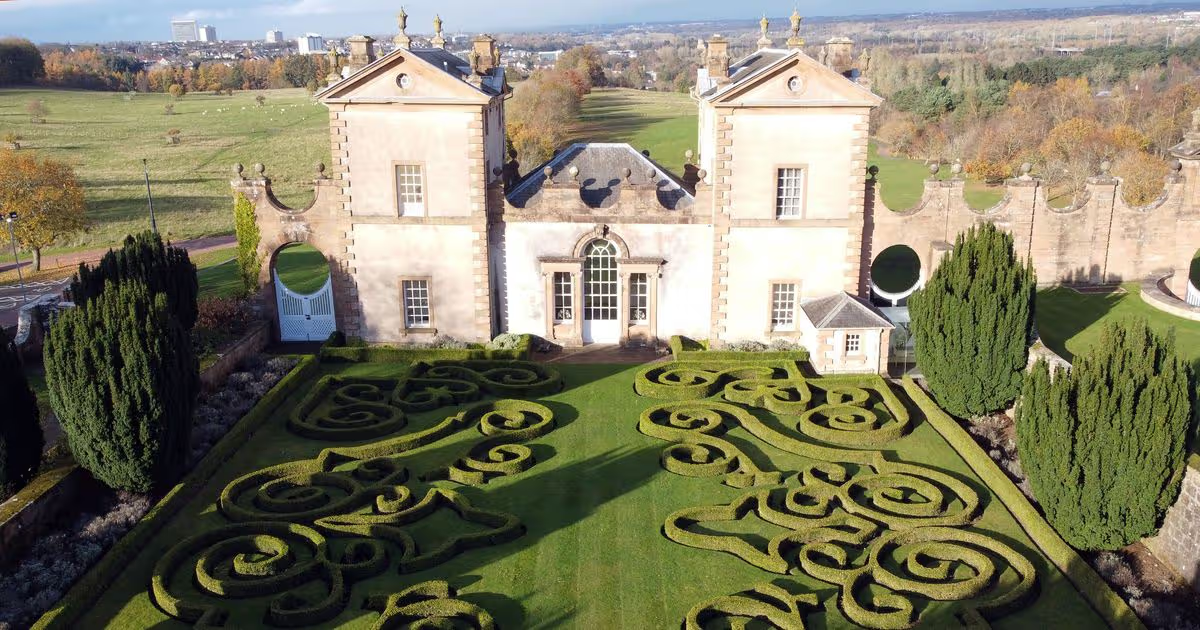
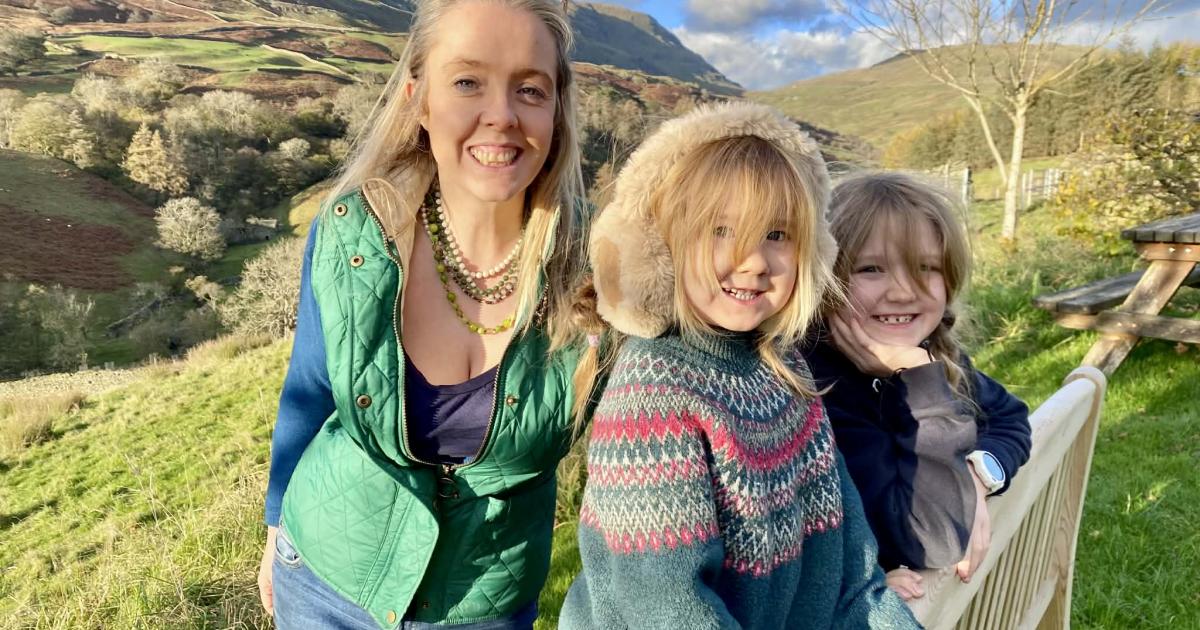
We found it at the end of a private drive just outside Ambleside, where four converted Lakeland barns sit quietly in Stock Valley, looking out across some of the most cinematic views in the Lake District.
Grove Cottages are luxurious – soft throws, polished kitchens, generous windows framing the fells – but it wasn’t the interiors that changed the rhythm of our family weekend. It was the decision to turn our phones off.
No tablets. No streaming. No “just five minutes.”
![]() Molly and Emily were big fans of Grove Cottages (Image: Jade Wright)
Molly and Emily were big fans of Grove Cottages (Image: Jade Wright)
We brought Molly and Emily, our ever-enthusiastic dogs, along for the adventure. And our two daughters – aged nine and three – initially less enthusiastic about the digital detox than the dogs.
The experiment began as we passed Stockghyll Force on the way in, the waterfall thundering through ancient woodland as if to drown out any lingering resistance. Bea looked at her blank kindle screen. “So… what are we actually going to do?”
It turns out: quite a lot.
![]() Bea and Lizzie (Image: Jade Wright)
Bea and Lizzie (Image: Jade Wright)
Space to roam (for two legs and four)
Grove Farm Cottages, thoughtfully converted from traditional Lakeland barns, sit within a working hill farm that places conservation at its heart. Instead of tightly grazed fields, there’s a softness to the land – native cattle in the distance, the possibility of roe deer at dusk, birds lifting suddenly from hedgerows.
For Molly and Emily, it was instant bliss: new scents, open ground, streams to investigate.
For our daughters, the dogs became willing accomplices in freedom. Within an hour, they were racing across grass, building dens from fallen branches, and inventing elaborate games.
Wellies were abandoned at the door. Leads were looped over hooks, only to be grabbed again minutes later. Without screens, time lengthened.
Morning coffee stretched into mid-morning while the girls sketched the valley from the cottage windows, attempting to capture the layered greens of the fells.
Afternoons meant walking – not forced hikes, but exploratory wanders towards the sound of water or the promise of a better view. Having dogs in tow set the pace perfectly: energetic bursts followed by grassy pauses. The girls learned how to read the map properly, how to look for waymarkers, how to judge distance by landscape rather than battery life.
And always, the valley held us quietly in place.
![]() A screen free adventure (Image: Jade Wright)
A screen free adventure (Image: Jade Wright)
The walk that earns its cake at the café you can only reach on foot
On our second day, we set out with purpose: cake at the end of a climb.
The path wound once more past Stockghyll Force before taking us into bustling Ambleside. There are no roads here, no easy shortcuts. Just a well-trodden track, two chatty daughters, and two enthusiastic dogs pulling optimistically ahead.
Then, on our way back to the cottages, Grove Barn Cafe came into view.
Accessible only on foot, Grove Barn Café feels like a reward rather than a convenience. The restored barn sits within a 160-acre hill farm, blending seamlessly into its surroundings.
![]() Grove Barn Cafe (Image: Jade Wright)
Grove Barn Cafe (Image: Jade Wright)
Run by Anna Gervasoni – a Langdale Valley resident with years of hospitality experience – the café marries Cumbrian produce with Italian heritage.
The menu is generous and thoughtful: homemade focaccia, velvety gelato, spare ribs from a treasured family recipe, alongside classic café comforts.
Arriving on foot changes everything. The girls immediately claimed a cosy table by the logburner, cupcakes in hand. Molly and Emily collapsed contentedly under the table. We ordered coffee and sat back, looking out across the folds of the valley.
Without screens, the moment expanded. There was no rush to document it, no distraction. Just fresh air, good food, and the simple satisfaction of having earned both.
The walk back uphill was quieter – pleasantly tired daughters, slower dogs, sunlight stretching across the hills.
![]() Grove Barn Cafe (Image: Jade Wright)
Grove Barn Cafe (Image: Jade Wright)
Evenings without blue light
Back at the cottage, muddy boots lined up beside well-used dog leads. The absence of screens had stopped feeling like deprivation and started to feel like relief.
Evenings revolved around the farmhouse table. The girls played fiercely competitive board games. We joined them for Scrabble and chess.
We cooked together in the generous self-catering kitchen while Molly and Emily dozed nearby, exhausted from the day’s exploring.
![]() null (Image: Jade Wright)
null (Image: Jade Wright)
One night, we stepped outside as the sky turned violet above the valley. Our daughters lay back on the grass, identifying shapes in the clouds before darkness settled fully. No one reached for a camera. No one checked the time.
Sleep came easily – for humans and hounds alike. Mornings arrived softly, mist drifting between the fells, the cottage windows framing a scene that felt almost painted.
The proximity to Ambleside offers reassurance – shops, cafés, the gentle hum of a Lakeland town – yet the cottages themselves feel entirely removed. It’s a rare balance: seclusion without isolation, comfort without clutter.
![]() The view from our room at the cottage (Image: Jade Wright)
The view from our room at the cottage (Image: Jade Wright)
The luxury of less
There is real luxury here: beautifully finished interiors, thoughtful touches, panoramic views from every angle. But the deeper indulgence lies elsewhere.
It is watching your daughters negotiate stepping stones across a stream rather than swipe across glass.
It is following your dogs along a winding path instead of following notifications.
It is walking to lunch rather than driving.
It is earning your gelato.
In a culture of constant connection, a digital detox offers something quieter and more enduring: the luxury of attention.
By the time we drove away, looping once more past Stockghyll Force towards Ambleside, the kindles flickered back to life. Our phones beeped as messages poured in.
But something had shifted.
Our daughters were already discussing their next den-building plans. They wanted to walk back to the barn café. They wanted to return in autumn to see the valley change colour.
Molly and Emily, sprawled happily in the back of the car, seemed to agree.
For a few precious days in the lakes, the fells had proved more compelling than any feed.
And that, perhaps, is the most restorative escape of all.
Screen-Free Reward Walk
- Distance from cottages: manageable family ramble
- Landmark: Stockghyll Force
- End point: Grove Barn Café
- Must-try: Homemade focaccia, gelato, spare ribs
- Best enjoyed: Phone on airplane mode