


Connect with us
DAPA Banner
DAPA Coin
DAPA
COIN PAYMENT ASSET
PRIVACY · BLOCKDAG · HOMOMORPHIC ENCRYPTION · RUST
ElGamal Encrypted MINE DAPA
🚫 GENESIS SOLD OUT
DAPAPAY COMING

NewsBeat

Transfer news LIVE: Arsenal FC learn Kroupi fee; Alvarez bid; Wharton to Man Utd; Chelsea, Liverpool latest

Published

on

Transfer news LIVE: Arsenal FC learn Kroupi fee; Alvarez bid; Wharton to Man Utd; Chelsea, Liverpool latest

The summer window is fast approaching as Arsenal, Chelsea, Liverpool, Manchester United and Tottenham all look to get transfer business complete before the World Cup begins this week. Arsenal have their eyes on Bournemouth striker Eli Junior Kroupi, who took the Premier League by storm in his debut season. The Gunners also hold interest in Sandro Tonali, while talks continue for wonderkid Jeremy Monga.

Source link

Continue Reading
Click to comment

You must be logged in to post a comment Login

Leave a Reply

NewsBeat

Andy Burnham reveals details of first phone call with Donald Trump

Published

on

Andy Burnham reveals details of first phone call with Donald Trump

They spoke over the phone on Monday, within an hour of Mr Burnham arriving in Downing Street.

Speaking to the BBC’s Laura Kuenssberg, Mr Burnham said: “I can’t at any point say that I won’t take a different opinion from him [Donald Trump], that I will need to voice a different idea that is right for Britain.”

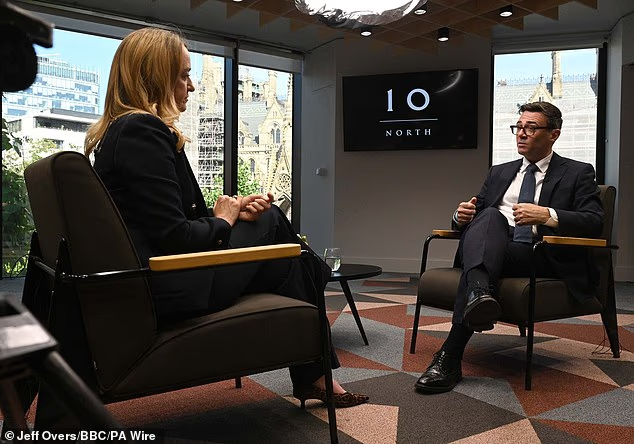
Prime Minister Andy Burnham appearing on the BBC 1 current affairs programme, Sunday With Laura Kuenssberg, recorded in No 10 North at Heron House in Manchester (Image: Jeff Overs/BBC/PA Wire)

The new Prime Minister said he would publicly disagree with Mr Trump if necessary, adding: “You have to defend your own national interest before anything else. That’s what you’re required to do if you’re to do this job properly.”

After the call, Mr Trump stated in a post on Truth Social that Mr Burnham “has got a big job ahead of him, but he will be able to do it” and pledged that the US “will be there to help”.

Advertisement

Downing Street described the 20-minute conversation as “extremely warm”.

Relations between Washington and Sir Keir Starmer’s government became increasingly fractious over the Iran conflict.

New Defence Secretary Wes Streeting is seeking to improve the relationship and by working with the US to reopen the Strait of Hormuz and promising to invest in the UK military.

A source close to Mr Streeting said he shared a “very warm conversation” with his US counterpart Pete Hegseth, in which they brainstormed ideas for an international conference which allies of the UK and US would attend, but have not yet firmed up the details of a summit.

Advertisement

Mr Streeting told Sunday Morning With Trevor Phillips on Sky News of the meeting: “I was clear that we’ve not supported offensive action in Iran and we won’t support offensive action in Iran, but there are plenty of things that we can and should do together when it comes to securing the Strait of Hormuz, in making sure that Iran doesn’t develop nuclear weapons, in terms of investing in our capability and Nato’s capability.”

But, he conceded “it’s hard to undertake that work … while hostilities continue, and that’s why every effort is being made, particularly by allies in the regions, to try and bring about the conditions where we can achieve that”.

He also said “you don’t suck up” to Mr Trump’s administration, while declining to say whether he trusts the US president.

“I don’t know him, but I do trust the United States.”

Advertisement

President Donald Trump speaks at the White House Correspondents’ Association dinner at the Waldorf Astoria Washington DC, Friday, July 24, 2026, in Washington (Image: Mark Schiefelbein)

Questioned on defence policy, Mr Burnham refused to be drawn on a timetable for increasing spending to 3% of GDP.

Mr Burnham said he was “very aware” of Chancellor John Healey’s resignation as Sir Keir’s defence secretary, citing a lack of commitment to spending that amount by 2030.

He said: “The first challenge facing us both is to ensure that the defence investment plan is fully funded and that’s the thing that’s right in front of us and we need to work that through as we go towards the budget later this year.”

Mr Healey had accused the former chancellor, Rachel Reeves, and Sir Keir, of putting the country’s security at risk with a disagreement over the long-awaited defence investment plan.

Advertisement

The former prime minister had said he would increase defence spending by £15 billion.

This would put the UK on a trajectory for defence spending to hit 3% of GDP in the next parliament, according to Sir Keir, but this would still be below the Nato target of 3.5% by 2035.

Mr Burnham told reporters on Wednesday that he and Mr Healey wanted to “honour” the UK’s Nato commitments.

Mr Streeting said “it’s for the Chancellor to set out” at the budget how to hit the Nato target, as he noted it was not just about securing more funds for defence but also reforming.

Advertisement

The Defence Secretary said that “one of the reasons the Prime Minister’s asked me to do this job is because I’m a moderniser” as he vowed to “spend money wisely”.

Elsewhere in his interview with the public broadcaster, Mr Burnham ruled out an early general election, saying Britain had “voted for a manifesto” in 2024.

“There’s no early general election. I don’t think people want it,” he said.

He added: “I just think what I most need to do is get Britain focused on getting the country back where it should be.”

Advertisement

Source link

Continue Reading

NewsBeat

Photos from second day of North Yorkshire Deer Shed Festival

Published

on

Photos from second day of North Yorkshire Deer Shed Festival

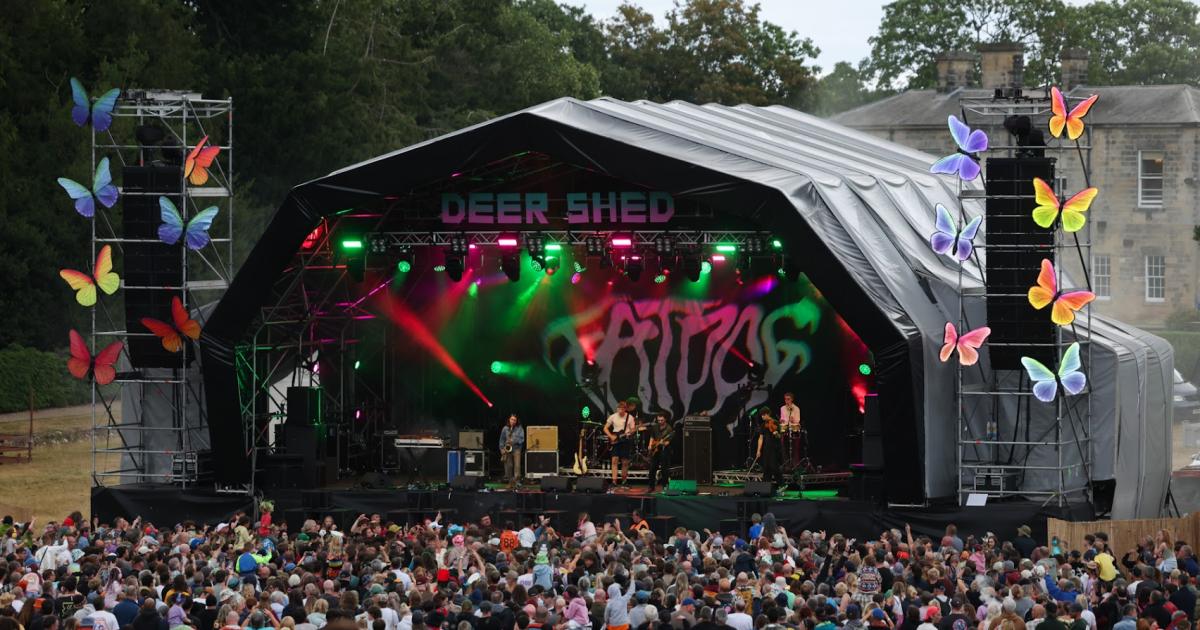
Saturday (July 25) at Deer Shed Festival brought another packed programme of live music, workshops, and family activities as crowds returned to Baldersby Park.

The 16th annual festival, themed “Into the Labyrinth,” continued with a busy schedule across its stages and activity areas, attracting visitors from across the region.

Here are some photos from the second day:

Deer Shed Festival takes place at Baldersby Park, North Yorkshire. (Image: CHRIS BOOTH)

Deer Shed Festival takes place at Baldersby Park, North Yorkshire. Fat Dog perform on the Main Stage. (Image: CHRIS BOOTH)

Deer Shed Festival takes place at Baldersby Park, North Yorkshire. Gans perform on the In The Dock Stage. (Image: CHRIS BOOTH)

Deer Shed Festival takes place at Baldersby Park, North Yorkshire. (Image: CHRIS BOOTH)

Deer Shed Festival takes place at Baldersby Park, North Yorkshire.Deer Shed Festival takes place at Baldersby Park, North Yorkshire. (Image: CHRIS BOOTH)

The Main Stage hosted performances from Gretel, Life, OneDa, and Jasmine 4.T before Fat Dog took to the stage ahead of Saturday night’s headline performance from Sleaford Mods.

Advertisement

Deer Shed Festival takes place at Baldersby Park, North Yorkshire. Working Men’s Club perform on the In The Dock Stage. (Image: CHRIS BOOTH)

Deer Shed Festival takes place at Baldersby Park, North Yorkshire. Sleaford Mods perform on the Main Stage. (Image: CHRIS BOOTH)

Deer Shed Festival takes place at Baldersby Park, North Yorkshire. Oneda performs on the Main Stage. (Image: CHRIS BOOTH)

Deer Shed Festival takes place at Baldersby Park, North Yorkshire. Jasmine.4.T perform on the Main Stage. (Image: CHRIS BOOTH)

Deer Shed Festival takes place at Baldersby Park, North Yorkshire. Panic Shack perform on the In The Dock Stage. (Image: CHRIS BOOTH)

Over on The Dock Stage, festivalgoers watched sets from Loula Yorke, Plantoid, Gans, and Working Men’s Club, with a surprise secret afternoon performance from Lamb proving one of the day’s standout moments.

The Lodge Stage featured performances from Natalie Wildgoose, Tessa Rose Jackson, and Seamus Fogerty.

Away from the music, visitors explored the festival’s expanded Wilderwild Retreat, which offered outdoor nature sessions, wild swimming, and hands-on activities throughout the day.

The popular Synth Shed gave festivalgoers the chance to build their own 808 drum machine circuits, while live podcast recordings added another dimension to the weekend’s programme.

Advertisement

Food and drink remained a major attraction, with craft beer tasting workshops hosted by Brass Castle Brewery at The Arbor Inn alongside Yorkshire coffee traders and a range of local food vendors.

Source link

Advertisement
Continue Reading

NewsBeat

Brits urged to check passport rules for holiday trips

Published

on

Brits urged to check passport rules for holiday trips

Many popular destinations require only three months of validity, causing confusion and resulting in some travellers being caught out.

The warning comes after a mother and her daughter were denied boarding for a £6,500 family holiday to Egypt due to an overlooked passport rule.

Family devastated after being caught out by passport rules

Victoria Vigors was travelling with her nine-year-old daughter, Roxie and discovered at the airport that Roxie’s passport did not meet Egypt’s six-month validity requirement.

Although Roxie’s passport was valid until January 4, 2027, it fell short of the minimum six months needed from the date of arrival in Egypt, leaving her unable to board the flight.

Advertisement

She shared an emotional video explaining the situation that went viral on social media.

“My stomach dropped and I felt like I’d been kicked in the stomach,” she told creatorzine.com.

“The kids crumpled and I burst into tears.

“I begged the staff but there was nothing they could do.

Advertisement

“We had to be escorted back to get our luggage off the flight – it was so embarrassing.”

She added: “I wasn’t aware of the rules.

“For people like me who don’t always travel and it’s the first time with my children, I wasn’t to know.

“I would have thought when I put her passport details in to check in that it would tell me it wasn’t valid.

Advertisement

“That would be a simple system to install so save this agony and heartbreak.”

What are the passport rules for Egypt?

Egypt’s entry rules differ from many other countries, requiring British visitors to have at least six months’ validity on their passport from the date of arrival and at least one blank page for entry stamps.

Brits planning trips to Red Sea resorts and other Egyptian destinations this summer are being reminded to check their documents before travelling.

Depending on the length and location of stay, entry visas may also be required.

Advertisement

Recommended reading:


For example, travellers staying for less than 15 days at a resort in Sharm El Sheikh do not need a visa, but those visiting other areas such as Hurghada will need one.

Visas can be obtained on arrival or applied for online through Egypt’s e-visa portal, but online applications must be submitted a minimum of seven days.

Passengers are encouraged to review their passports well in advance of travel to avoid disappointment at the airport.

Advertisement

Have you ever had any passport issues when travelling? Let us know in the comments.

Source link

Advertisement
Continue Reading

NewsBeat

What the sudden demise of the UK’s department of science means for the future of research

Published

on

What the sudden demise of the UK’s department of science means for the future of research

The obituaries were being written before the body was cold. Within hours of Prime Minister Andy Burnham confirming that Whitehall’s responsibilities for science and technology would be absorbed into a new Department for Business, Innovation, Science and Trade (DBIST), Sir Paul Nurse, president of the Royal Society, was on Radio 4 warning that “science isn’t a slave to business”. The trade association TechUK declared it “the wrong change at the wrong time”.

You might imagine that something ancient, ineffable and essential to British science had been ripped away. In fact, the Department for Science, Innovation and Technology (DSIT) was only born in February 2023 – a surprise late tweak to the machinery of government under Rishi Sunak’s faltering premiership.

Science has never enjoyed a settled home in Whitehall. For most of the period from 1995 to 2023, it sat precisely where Burnham has put it now: inside a business super-department. Notably, the single most important protection UK science secured in that era – a ring-fenced budget through the George Osborne austerity years – was won from inside the Business, Innovation and Science department, under then-business secretary Vince Cable.

The historian David Edgerton has long argued that Britain’s fondness for tinkering with the machinery of government is a form of displacement activity. What actually shapes the fortunes of research is money, people and demand for what they produce, not the nameplates on London’s Victoria Street.

Advertisement

On that test, the outlook for science is far calmer than some reactions to this latest move would suggest. Under plans published last October, the UK’s total research and development budget is locked in at £58.5 billion over the four-year spending review to 2030 – a real-terms increase.

Machinery changes move budget lines across departments; they don’t unravel them. As yet, nothing we’ve heard from the Burnham government suggests the settlement for UK Research and Innovation (UKRI) is at risk.

A US wrecking ball

If we want to be reminded what real damage to a science system looks like, we only need to glance across the Atlantic. While London rearranges the departmental furniture and dishes out new email addresses, Washington is taking a wrecking ball to the foundations of its public science system.

A 2027 budget request will halve the size of the US National Science Foundation, if passed. A draft White House rule, due to take effect in October, will hand political appointees the power to vet federal research grants against “the president’s priorities” and terminate awards mid-stream.

Advertisement

A predictable exodus has begun. The Nobel laureate Omar Yaghi has just left the University of California, Berkeley for Tsinghua University in China.

Top researchers consider leaving US amid funding cuts. Report: PBS NewsHour.

Set against political commissars patrolling the borders of knowledge, the UK’s science soap opera feels deeply provincial – a debate about which secretary of state sponsors oversight of a gradually swelling budget.

And the institutional layer beneath this is in better shape than doomsayers allow. UKRI’s new strategy has set a clear five-year path: priority programmes in AI, quantum and clean energy, faster funding decisions, and a welcome seriousness about experimentation with the modes and means by which we manage public investment in research.

Advertisement

Not everyone is happy with UKRI’s approach to prioritisation. But a funder with a published strategy, agreed budget and hard targets is a more durable asset than a three-year-old ministry. The research councils have outlasted every department that ruled over them, and UKRI will outlast this too.

Nor should the science community be spooked by closer proximity to business. When I leave my office at UCL and stroll down the Euston Road through London’s Knowledge Quarter – dubbed “the new square mile” – I pass by the Wellcome Trust, the Crick and Turing institutes, the British Library, Anthropic and Google DeepMind. Day in, day out, this dense weave of labs, firms and cultural institutions delivers what the triple helix of government, industry and academia is all about.

And we can find versions of the same story unfolding in Manchester, Sheffield, Cambridge and Glasgow. Rather than science being subordinate or “enslaved”, the UK’s world-leading universities have spent the past decade aligning themselves with agendas for regional growth and frontier technologies.

But there’s a harder truth lurking here too. Public money accounts for less than a third of UK research and development investment. The rest is financed and largely performed by the private sector.

Advertisement

UK science’s chronic weakness has never been the quality of publicly funded research. It is the R&D intensity of UK firms, and their ability to convert discoveries into products, services and revenue streams generated and owned in the UK.

If yoking science to industrial strategy in a single department reminds Whitehall to treat these as a single problem, some good may come of Burnham’s reorganisation.

AI policy concerns

With DSIT’s disappearance, a particular source of concern has been the future of AI policy. This at a time when the radical possibilities and risks of AI frontier models, fluctuating US export controls, and the latest “Sputnik moment” jolt from China’s Kimi K-3 demand sustained and technically fluent policy attention.

We are also seeing a sharp acceleration in the ways AI is transforming science itself – whether by cracking mathematical problems that stumped humans for the past 87 years, or collapsing decades-old models of grant writing and peer review.

Advertisement

Splitting AI from science just as they converge in practice would have been the least defensible element of this reorganisation. So it is reassuring that cross-government oversight of AI, including the AI Security Institute and AI public sector adoption, is moving to a new “AI taskforce” in the Cabinet Office – alongside the promotion of Kanishka Narayan to the status of AI minister attending Cabinet. Much now rests on his shoulders.

Government departments come and go. Those of us who have long advocated for research policies built on evidence rather than gut can allow ourselves a wry smile at the fuss created by this latest reorganisation – and then get back to work.

DSIT is dead, but UK science will be fine. Keep your eyes on the AI prize – and be thankful we are arguing about organograms, not survival.
Advertisement

Source link

Continue Reading

NewsBeat

Ryan Gosling to join Marvel Cinematic Universe as Ghost Rider

Published

on

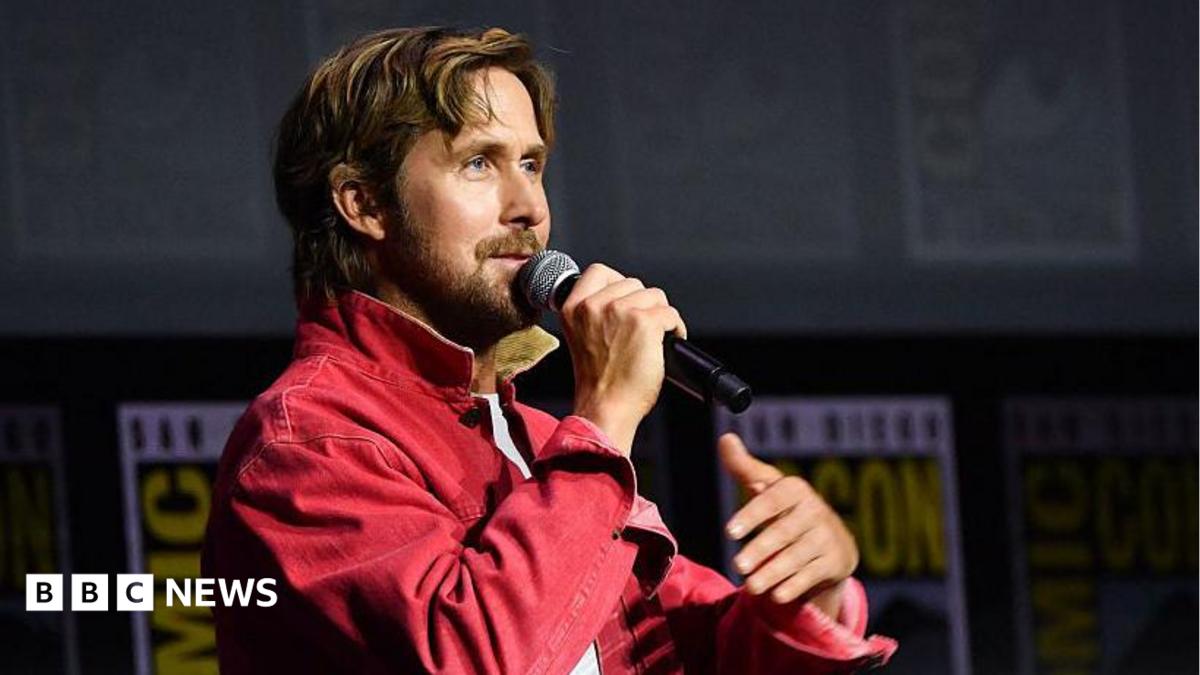
Ryan Gosling speaking into microphone on stage at San Diego Comic-Con

Actor Ryan Gosling will join the Marvel Cinematic Universe (MCU) as the titular character in a new Ghost Rider film, the company has announced.

Speaking during the surprise announcement at San Diego Comic-Con on Saturday, Gosling said it is a character he has “wanted to play for a very long time”.

The film is due to be released in 2028, and will be the third about the motorcycle-riding anti-hero.

It will follow the 2007 film of the same name starring Nicolas Cage, and its follow-up, 2011’s Ghost Rider: Spirit of Vengeance.

Advertisement

Before making the big reveal on stage at San Diego Comic-Con, Marvel Studios President Kevin Feige said he had often been asked when Gosling would join the MCU.

Shortly after, the lights turned off. When they returned, the actor appeared on stage to cheers from screaming fans.

Speaking about the role, Gosling said: “Wow, is this really happening?”

He has previously spoken about his desire to take on the role. Appearing on Josh Horowitz’s Happy Sad Confused podcast in March, he confirmed he was in discussions with Marvel.

Advertisement

Ghost Rider is the anti-hero identity of motorcycle stuntman Johnny Blaze.

The character’s story begins when he becomes bound to the Spirit of Vengeance Zarathos after making a deal with villain Mephisto to spare his surrogate father, giving him superpowers.

The film will be directed by Shawn Levy, who Gosling described as the “only” director for the project.

Levy has previously directed Deadpool & Wolverine in the MCU, and is currently working with Gosling on Star Wars: Starfighter, which is due to be released next year.

Advertisement

Levy told the crowd that he and Gosling spent a lot of their downtime on set daydreaming about Ghost Rider and swapping ideas.

The director said: “As Ryan started talking about his vision for this character, we started riffing, and I finally said, ‘bro, let’s ride’, so guys, we’ll see you in 2028.”

Source link

Advertisement
Continue Reading

NewsBeat

Burnham rules out early election and refuses to commit to date on boosting defence spending to 3% of GDP – even though his Chancellor quit over Starmer’s dithering

Published

on

Speaking to Laura Kuenssberg, Andy Burnham ruled out the possibility of an early election as he stated that the public did not want to go to the polls

Advertisement

Andy Burnham has ruled out an early general election as he insisted he would stick to Labour‘s manifesto.

In his first interview from Number 10 North, the new Prime Minister said that he had the support of his colleagues in Parliament.

But asked whether he would give the UK electorate of 48million a say, he said that the public did not want to go to the polls.

Speaking to Laura Kuenssberg, in his first major media interview since becoming PM, he said: ‘There is no general election and the thing I would say to you is 20 plus – however many million people you just mentioned – voted for a manifesto.

Advertisement

‘We’re in a parliamentary democracy so that is what people voted for and I will honour that manifesto.

‘And obviously I have faced the public in Makerfield. At the time, I stood forward in the by-election people said: “Oh my goodness, that constituency voted Reform in May – that’s a risk”.

‘I went and faced the public – I went out on to those doorsteps. So I have done that. I’ve got the support of colleagues in Parliament and it’s a parliamentary democracy that we’re in.’

Asked if he would rule it out, he said: ‘I’m going to rule it out, yeah. There’s no early general election. I don’t think people want it.

Advertisement

Speaking to Laura Kuenssberg, Andy Burnham ruled out the possibility of an early election as he stated that the public did not want to go to the polls

On the wall of Burnham's office at No 10 North is a framed gold disc for The Queen Is Dead by Manchester indie rock band The Smiths

On the wall of Burnham’s office at No 10 North is a framed gold disc for The Queen Is Dead by Manchester indie rock band The Smiths 

‘Well, the opinion polls say some people do, some people don’t. But the thing is, I just think what I most need to do is get Britain focused on getting the country back where it should be, getting it working.’

Advertisement

Mr Burnham is facing calls for a general election from Reform UK after he took power from Sir Keir Starmer in a bloodless coup.

The new PM has experienced a bounce in the polls and opposition parties have speculated that he will seek a new mandate this autumn or next year.

But sources close to him have ruled out a general election in 2027. One must be held by 2029.

A fresh mandate would give him the power to deliver a more ambitious policy platform and buy him five years rather than three.

Advertisement

But it is a huge risk as Reform is still riding high in the polls and is level pegging with Labour despite a bounce since Mr Burnham took over.

He has insisted he will abide by the party’s manifesto and stick to the fiscal rules though has already made several commitments that do not appear to be fully funded.

This means that he will be unable to increase income tax, national insurance or VAT as set out by Sir Keir’s government.

The new PM has announced that he will end rough sleeping – a £340m pledge over five years that he said would come from ‘uncommitted’ budgets in the housing department.

Advertisement

He also said he would cut VAT on electricity bills by using money from the digital ID scheme that he said he would scrap – though former ministers pointed out that this was unfunded.

He also lowered the cap on bus fares in England from £3 to £2 at a cost of £500m using a complicated method of borrowing.

Funding for his cut to business rates for pubs – which will cost the Treasury £100m a year – is yet to be announced.

Claims that his new Number 10 North base would not cost taxpayers additional money have been questioned.

Advertisement

A survey by Public First this month found that 51 per cent of the public believed that Mr Burnham should ‘call and try to win an election to give his government legitimacy‘, versus 34 per cent who believed he did not need to.

Advertisement

Source link

Advertisement
Continue Reading

NewsBeat

Commonwealth Games 2026: England 47-66 Australia in Pool A

Published

on

Anti-doping test kit

England captain Fran Williams said her team were “far from our best” in a heavy defeat by defending Commonwealth champions Australia.

The Roses opened their campaign in Pool A with a 83-34 victory over Northern Ireland on Saturday.

But they were outplayed on Sunday as Australia cruised to a 66-47 win at The Hydro in Glasgow.

“That’s not the result we came for and not the performance,” Williams told BBC Radio 5 Live.

Advertisement

“We didn’t cope well with their physicality. It’s really tough when a game blows out like that.”

Australia started strongly, racing into an 18-11 lead after the first quarter and extending their advantage to 56-35 by the end of the third.

Sophie Garbin scored 41 goals from 42 attempts for Australia, while Olivia Tchine was England’s highest scorer with 23 from 25.

England face Malawi at 14:00 BST on Monday.

Advertisement

Earlier on Sunday, Scotland picked up their first win in Pool B with a 56-47 victory over Wales.

England, who won gold in 2018, failed to make the podium at Birmingham 2022.

Only two of the 12 players in the squad – Eleanor Cardwell and Imogen Allison – have experience in the Commonwealth Games after injuries to gold medallists Helen Housby and Natalie Metcalf, who withdrew with a calf injury on Monday.

Jess Thirlby stepped down as head coach in March for family reasons, leaving assistant Anna Stembridge – head coach from 2011 to 2015 – in interim charge.

Advertisement

Source link

Continue Reading

NewsBeat

Full list of Manchester Airport delayed and cancelled flights today, Sunday July 26

Published

on

Manchester Evening News

Manchester Airport is expecting its busiest summer on record

This weekend thousands of passengers will be jetting off from Manchester Airport to destinations across the globe, including families making the most of the school holidays.

Advertisement

More than 120,000 passengers are expected to pass through the travel hub each day this summer. In fact this year is set to be a record-breaking summer for the airport as it anticipates welcoming 5.7million passengers from July 17 until the end of the holidays on September 1.

Those who are due to fly in the coming weeks are urged to prepare for their journey. One key area to remember is making sure you’ve packed your hand luggage correctly so it complies with the rules.

Click here to get the biggest stories straight to your inbox in our Daily Newsletter

This week the travel hub released images of nearly 100 items seized at security in one single morning. These included gun-shaped toys, yoghurts and 12 pairs of scissors. Travellers are reminded to follow the Civil Aviation Authority’s rules for hand luggage which includes a 100ml limit for liquids, no sharp objects or blades with a length of more than 6cm (2.3in), and anything designed to look like a firearm.

Advertisement

Passengers who are planning on using public transport to get to the airport are warned of extensive metrolink maintenance work, which is taking place until August 2. There are no trams running through the city centre, and no trams operating on the Altrincham, Eccles and Trafford Park lines, while the East Didsbury and Airport lines terminate at Firswood.

Bus replacement services will be in place instead. Trams will operate between Exchange Square and Rochdale, between Bury and Piccadilly, and between Piccadilly and Ashton-under-Lyne.

If you’re flying soon it’s important to monitor the status of your flight. Below are delayed flights (by more than 30 minutes) and cancelled flights from Manchester Airport on Sunday July 26, according to Flight Radar 24, as of 1.15pm.

Advertisement

Delayed flights

  • 1.50pm Vueling flight VY8747 to Barcelona, estimated departure 3pm
  • 1.55pm Jet2 flight LS979 to Lanzarote, estimated departure 4.09pm
  • 1.55pm easyJet flight U22105 to Paris, estimated departure 2.44pm
  • 2pm Virgin Atlantic flight VS75 to Orlando, estimated departure 2.40pm
  • 2.05pm airBaltic flight LX395 to Zurich, estimated departure 3pm
  • 3.05pm easyJet flight U22255 to Hurghada, estimated departure 4.08pm
  • 3.50pm easyJet flight U22123 to Rome, estimated departure 4.43pm
  • 3.55pm easyJet flight U22009 to Tenerife, estimated departure 4.38pm
  • 4.05pm Jet2 flight LS905 to Heraklion, estimated departure 4.37pm
  • 4.20pm Jet2 flight LS1787 to Malta, estimated departure 5.18pm
  • 4.25pm Jet2 flight LS923 to Dalaman, estimated departure 5pm
  • 4.35pm Jet2 flight LS957 to Alicante, estimated departure 5.30pm
  • 4.40pm Jet2 flight LS949 to Krakow, estimated departure 8.10pm
  • 5.45pm easyJet flight U22103 to Nice, estimated departure 6.52pm
  • 5.50pm Ryanair flight FR1593 to Cologne, estimated departure 7.25pm
  • 5.55pm easyJet flight U22035 to Barcelona, estimated departure 6.47pm
  • 6.05pm easyJet flight U22111 to Bordeaux, estimated departure 6.45pm
  • 8.50pm easyJet flight U27266 to Palma de Mallorca, estimated departure 9.55pm
  • 10.25pm easyJet flight U290 to Belfast, estimated departure 12.38am

Cancelled flights

  • There are no cancelled flights from Manchester Airport today so far.

For more of today’s top stories, click here.

Source link

Continue Reading

NewsBeat

Police Probe Donations To Reform From Richard Tices Company

Published

on

Police Probe Donations To Reform From Richard Tices Company

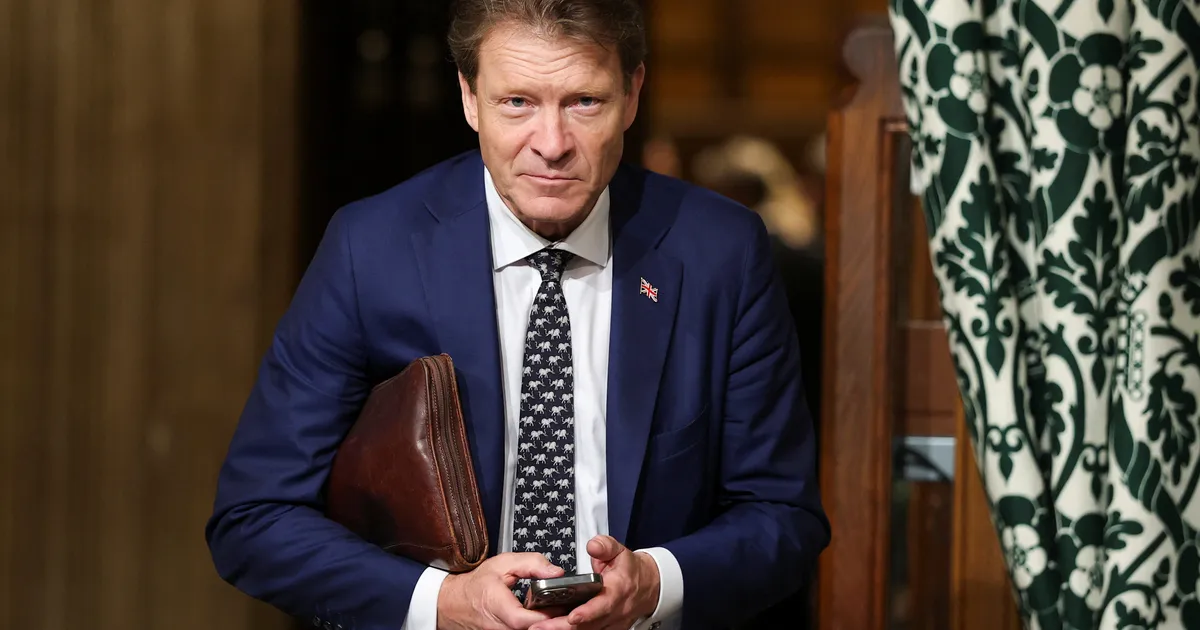
Police are investigating donations to Reform UK by a company controlled by the party’s deputy leader Richard Tice.

Britain Means Business – a fundraising vehicle – gave Reform two donations of £250,000 in the run-up to the 2024 general election, according to The Times.

The money was paid to his company by Reform donor Fiona Cottrell, Tice has previously said.

She is said to have given £1 million to Britain Means Business in June 2024, and half of that money was then given to Reform.

Advertisement

The BBC revealed that Metropolitan Police detectives are examining the donations from Tice’s company.

Fiona Cottrell is the mother of George Cottrell, a convicted criminal who provided funding for Nigel Farage’s security and staffing in the year before he was elected.

The Times reported that Reform’s bank account was frozen during the last election after the donations.

Tice said: “The BBC article is the first I have heard of it – if true why are the Met Police briefing the BBC before contacting interested parties?

Advertisement

“Is the Met leadership now engaged in the widespread politically motivated smear campaign against Reform and its leaders?

“Please remember the National Crime Agency is now having to investigate its own potential criminal offences against Reform leaders.”

A Reform UK spokesman said: “Reform takes pride in its stringent vetting of donations and always ensures that the Electoral Commission guidelines on donations, as set out in the Political Parties, Elections and Referendums Act 2000, are strictly followed, as has been the case with donations so far.”

The Met said two people have so far been interviewed under caution.

Advertisement

A spokesperson continued: “An investigation was launched in February 2025 after a referral was made to the Metropolitan Police by the Electoral Commission relating to donations made to a political party ahead of the 2024 UK general election.

“Detectives from the Met’s Special Enquiry Team are investigating alleged offences under Section 61 of the Political Parties, Elections and Referendums Act 2000.

“Early investigative advice has been sought from the Crown Prosecution Service and two people have so far been interviewed under caution. No arrests have been made.

“An offence under this section is not one that the Electoral Commission can investigate and, as such, it is a matter for the police.”

Advertisement

A Labour Party spokesperson said: “The allegations of sleaze and donation scandals just continue to pile up for Reform.

“Richard Tice can’t dismiss these troubling developments as a ‘smear campaign’. Police are now probing half a million pounds in donations to his party, and Reform’s bank account was frozen after suspected suspicious activity. This is extremely serious.

“From Nigel Farage’s secret £5 million ‘gift’ from a crypto billionaire, to alleged hidden donations from a convicted fraudster, to Tice’s company’s avoidance of £600,000 of corporation tax – and now more police investigations into Reform’s finances – it’s clear that Reform think rules are for other people.”

Reform has been dogged by questions about its funding in recent weeks.

Advertisement

Farage quit as MP for Clacton to trigger a by-election after questions mounted about a separate £5 million gift he received from crypto-billionaire and Reform donor Christopher Harborne.

The party leader has billed the by-election, likely to take place on August 13, as a “people versus the establishment” contest.

Listen to Commons People, the podcast that makes politics easy. Every week, Kevin Schofield and Kate Nicholson unpack the week’s biggest stories to keep you informed. Join us for straightforward analysis of what’s going on at Westminster.

Advertisement

Source link

Continue Reading

NewsBeat

ancient monsoons created a spectacular dinosaur fossil site

Published

on

ancient monsoons created a spectacular dinosaur fossil site

Around 80 million years ago, a stretch of tropical coastline in what is now north-eastern Italy was lashed by monsoon rains and tropical cyclones. Those storms swept dinosaur carcasses, crocodiles, plants and river mud onto a tidal flat, where the tides and a film of microbes sealed everything away with extraordinary preservation.

My colleagues and I have published a new study that reconstructs the violent tropical climate behind the Villaggio del Pescatore Lagerstätte near Trieste and reveals it preserves just four decades of life, recorded almost day by day.

The Villaggio del Pescatore site near Trieste is one of the most important Late Cretaceous fossil localities in the Mediterranean. It is the only known site in the region to preserve large land animals, including dinosaurs such as Tethyshadros insularis, from the final 15 million years or so of the age of dinosaurs.

Advertisement

Palaeoenvironmental reconstruction of Villaggio del Pescatore.
Davide Bonadonna, Author provided (no reuse)

Tethyshadros insularis was a plant-eating, duck-billed dinosaur that lived in what is now north-eastern Italy around 80 million years ago. It was initially interpreted as a dwarf island species, shaped by the “island rule” – that large animals evolve smaller bodies in environments with limited space and resources.

However, the discovery of larger specimens challenged this idea. Up to 11 individuals are potentially preserved in this succession of rocks, with at least three other fairly complete skeletons still waiting to be extracted from the hard (and expensive to cut) limestone rock. Geological evidence has also revealed that the site was about 10 million years older than previously thought and was not part of a tiny, isolated island. Instead, it lay near a larger landmass connected through the ancient Mediterranean region.

Photo of a dinosaur skeleton encased in rock

Reconstruction of a Tethyshadros insularis skeleton, nicknamed Antonio, near his finding site.
Tiziana Brazzatti, CC BY-ND

The fossils of tiny crocodilians named Acynodon (with shorter muzzles than modern crocodilians) have also been found at this site.

After years of research, Professor Federico Fanti of the University of Bologna and I led a multidisciplinary team of palaeontologists, physicists and geologists to determine exactly how this fossil treasure trove formed. Our findings overturn decades of competing interpretations.

Advertisement

In a study published in Global and Planetary Change, we show that the site was not a quiet, isolated lake or sinkhole, as previously suggested. Our results suggest it was a storm-battered tidal flatland at the edge of a tropical sea.

Villaggio del Pescatore is not simply a place where fossils happen to be beautifully preserved. It is also a record of the weather that shaped the site. We can identify individual storms and floods in the rocks, almost day by day. Very few fossil sites on Earth allow us to do that.

Reading the rock like a calendar

The fossils at Villaggio del Pescatore are concentrated in a finely layered carbonate rock, marked by thousands of paper-thin light and dark bands. For years these were interpreted as annual layers (like tree rings) laid down season by season.

Our new analysis tells a different story. Using high-resolution X-ray scans at the Elettra Synchrotron in Trieste, alongside detailed geochemical and microscopic analyses, we showed that the bands were not annual but daily. A synchrotron accelerates electrons (particles with a negative charge) to almost the speed of light. This produces powerful X-rays that can penetrate dense materials such as rock. This allowed us to examine structures inside the rocks and bones at a resolution of fractions of a millimetre.

Advertisement

The scans revealed that the layers were deposited by ocean tides, two pairs each day. These tides varied according to the familiar fortnightly cycle of stronger and weaker tides that still happen today. We could count these tidal layers, thanks to this unparalleled resolution.

Four rectangles showing layers of carbonate mud and sediment
Rock sections from Villaggio del Pescatore under the microscope. The lighter layers are mainly carbonate mud, while the darker ones contain more sediment washed in from land.
Alfio Alessandro Chiarenza, Author provided (no reuse)

The entire fossil-bearing rock pile, our results calculate, accumulated in only about 40 years, a single human lifetime, frozen in stone. Most fossil deposits containing several individuals average together thousands or millions of years. Here, we’re looking at a few decades.

Monsoons, cyclones and microbes

To explain why storms were so central to the preservation of the fossils, the team ran climate simulations. The models consistently placed the site at around 29° north, inside a powerful, summer-dominated monsoon belt. This was a tropical regime of intensely wet summers and recurring tropical cyclones, sustained by the greenhouse climate of the age.

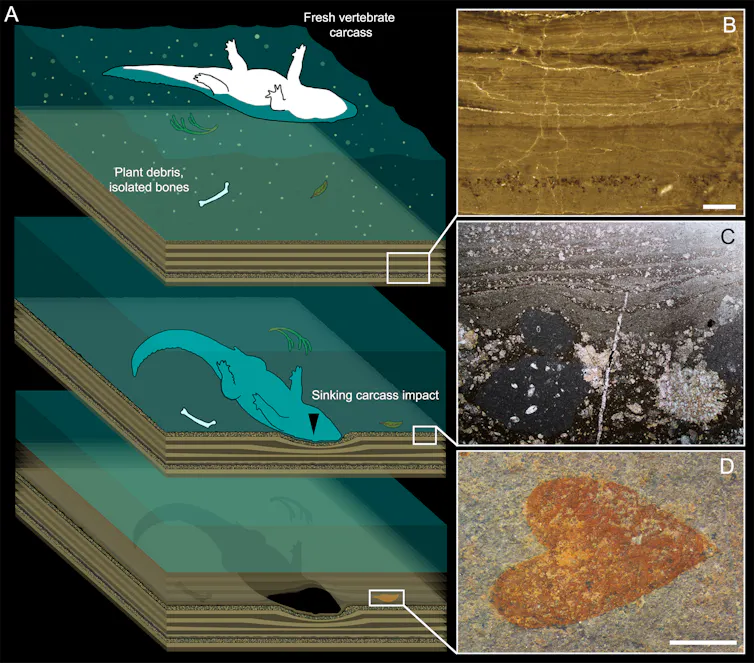
Monsoon-driven floods and cyclone surges created pulses of sediment, nutrients, plant debris and animal carcasses onto the tidal flat. The tides trapped this material, and mats of microbes rapidly stabilised it. This encouraged the sediment to harden right after the carcass was deposited, before it started rotting or predators could scavenge its dead tissues. These storms were the main agents behind this preservation.

Diagram showing extinct crocodile gradually buried in tidal layers.
As normal tidal conditions returned, thin layers of sediment gradually buried bones and articulated carcasses (like the Acynodon croc in the drawing, A), sometimes preserving soft tissues. The photographs show undisturbed tidal layers (B), a storm deposit covered by microbial mats (C), and a plant leaf washed in from inland (D).
Alfio Alessandro Chiarenza, Author provided (no reuse)

The site’s three most important Tethyshadros insularis dinosaurs show a range of fates: one buried so quickly that soft-tissue outlines survive, another bearing the cracked, sun-dried bones of a carcass that lay exposed inland before being washed in by a flood. Crocodilians such as Acynodon adriaticus, fish and shrimps were also local residents, entombed close to where they lived and died.

We propose that this combination of “ingredients”, monsoon floods, tidal trapping and microbial sealing, represents a recipe for creating exceptionally preserved fossil sites in hot, tropical greenhouse climates – precisely the kind of setting in which rapid decay would normally destroy organic remains.

Advertisement

The study also offers an ancient perspective on how intensifying monsoons and cyclones can reshape coastlines, ecosystems and what becomes preserved along tropical shores.

Villaggio del Pescatore has been studied for more than four decades, yet it still has new stories to tell. Understanding how extreme storms transformed this ancient coastline may also help us think about how modern coasts could respond to a warmer and more turbulent climate fuelled by high levels of CO₂.

Source link

Advertisement
Continue Reading

Trending

Copyright © 2025