Connect with us

NewsBeat

TransPennine Express reveals oddest no-ticket excuses

Published

on

TransPennine Express reveals oddest no-ticket excuses

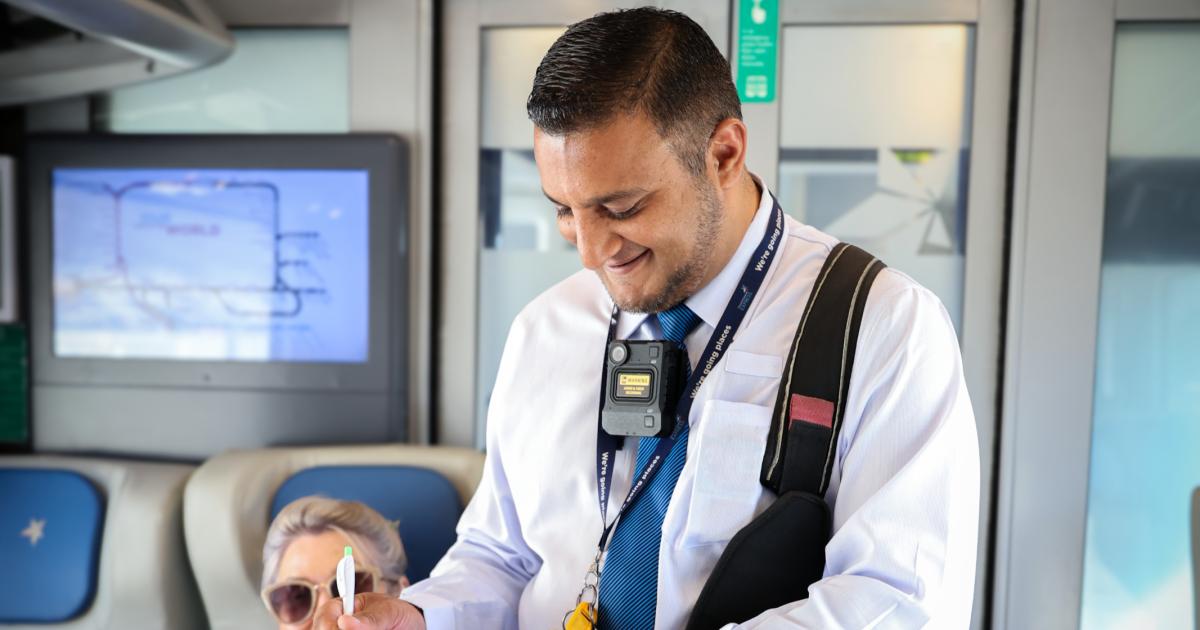
TransPennine Express, which runs services between York and Manchester, said the customer was caught using a child ticket for the second time and replied: “It wasn’t me, it was my twin brother.”

Another TransPennine Express customer ate their ticket in front of a member of the team so it could not be used as evidence – “much to the shock of onboard staff”, the rail firm said.

A company spokesperson said other explanations included people claiming: “I’ve got no battery on my phone”, “I was running late and didn’t have time to buy a ticket”, “I haven’t got any money” and even “do I need to buy a ticket?”

Advertisement

They said the excuses “can raise a smile” but urged customers that they “should buy a ticket before boarding where facilities are available”.

It comes after TransPennine Express said more than 20 million ticket checks were carried out on its services and at automatic ticket gates between April 2025 and April 2026.


Read next:


Of those checked, around 75,000 customers were found travelling without a valid ticket, with approximately 6,000 penalty fares issued.

Advertisement

The rail firm said ticketless travel continues to be an issue, with around 2.5 per cent of journeys made without a valid ticket in both 2024 and 2025.

Ian Humphreys, head of retail strategy at TransPennine Express, urged customers to “buy before you board”.

“We appreciate that the vast majority of our customers do the right thing and buy the correct ticket for their journey,” he said.

“But for those who don’t, our message is simple – buy before you board.

Advertisement

“Our revenue protection teams carry out checks across our trains and stations every day, and while they might hear some memorable excuses along the way, it’s important that everyone has a valid ticket for their journey.”

Source link

Advertisement
Continue Reading
Click to comment

You must be logged in to post a comment Login

Leave a Reply

NewsBeat

Bothwell art club set to stage annual exhibition

Published

on

Daily Record

The event takes place at Bothwell parish church centre on September 12 and 13

Talented Lanarkshire artists are getting set for their popular annual exhibition.

Advertisement

Members of Bothwell art club will showcase their works at a two-day display in September, taking place at the town’s parish church centre on Main Street.

It will allow visitors to see original art by the club’s members, with many of their pieces available for sale during the weekend event.

The art show takes place on September 12 and 13, opening at 10am on Saturday and 11.30am on Sunday, running until 5pm on each day.

It will be hosted at Bothwell parish church centre on Main Street, and admission is free.

Advertisement

All are welcome to attend, and more details about the club including examples of the talented members’ creations is available on Facebook, Instagram and Tiktok.

* Don’t miss the latest headlines from around Lanarkshire. Sign up to our newsletters here.

And did you know Lanarkshire Live is on Facebook? Head on over and give us a like and share!

Source link

Advertisement
Continue Reading

NewsBeat

Iran ‘plotted to kill Trump with a sniper, shoot down his plane or have someone stab him at a public event’

Published

on

Iran 'plotted to kill Trump with a sniper, shoot down his plane or have someone stab him at a public event'

The U.S. has received several warnings from Israel over the past year that Iran intended to assassinate President Donald Trump.

The warnings, passed to U.S. intelligence agencies and in some cases relayed directly by Israeli officials to senior White House officials, included possible plots to shoot Trump with a sniper or recruit someone to attack him with a knife at a large public event, the sources said.

The tips began in the lead-up to the 12-day war in June 2025 and intensified before the U.S. decision to go to war in Iran in February, the sources said.

Advertisement

The most detailed warning came ahead of the NATO summit in Ankara in July, the U.S. official and the other person familiar with the matter said. 

Israeli officials briefed the White House about intelligence that indicated Iran may try to kill Trump, potentially with a shoulder-launched missile, while he travelled on Air Force One for the summit, the officials said.

The U.S. intelligence community has long assessed that Iran wants to retaliate for Trump’s killing of Iranian military commander Qassem Soleimani in 2020. 

But the Central Intelligence Agency has not been able to corroborate some of the specific threats against Trump’s life shared by Israeli intelligence since early last year, the officials said.

Advertisement

In the case of the NATO episode, a Turkish official said the country’s intelligence agencies also did not have any evidence to corroborate the Israeli claim about the threat to Trump’s life, an assessment the host country shared with Americans.

Despite the lack of verification, White House officials and the Secret Service have taken steps to mitigate the threats out of an abundance of caution, including an extraordinary deception operation during the Turkey trip that involved moving Trump from Air Force One to a different aircraft for his flight out of the country.

That episode underscores how Israeli intelligence is influencing the Trump administration’s decision-making about Iran at a time of heightened tensions with Tehran – and broader disagreement between U.S. and Israeli intelligence assessments on Iran’s threat overall.

Earlier this year, American intelligence agencies assessed that Iran was not actively building a nuclear weapon, even as Israel argued Tehran posed an urgent threat.

Advertisement

Despite the reports from the U.S. intelligence community, Trump moved forward with strikes in Iran in February. 

Trump also took into consideration intelligence shared by Israel that Tehran had tried to assassinate him before launching the military campaign, Reuters previously reported.

A spokesperson for the Israeli embassy disputed that Israel was using its intelligence to influence U.S. policy on Iran.

‘The same people who claim that Israel is trying to influence U.S. policy through alleged intelligence sharing would just as soon accuse Israel of concealing critical information if it benefited their own agenda,’ the spokesperson said.

Advertisement

Secret Service spokesman Anthony Guglielmi declined to discuss specific intelligence matters but said the agency remains focused on Trump’s security amid recent assassination attempts and an increase in threats against the president. 

‘The U.S. Secret Service continuously analyses a wide range of information to guide our protective operations in real time and across every location we secure,’ he said.

The U.S. has long relied heavily on Israeli intelligence on Middle East matters, particularly as they relate to Iran.

The current and former officials said Israeli intelligence on Iran typically flows to the CIA or the National Security Agency through formal channels and is subsequently analysed, two former U.S. officials said.

Advertisement

The U.S. intelligence agencies often cannot verify Israeli intelligence but will use other forms of information to make judgment calls on its authenticity and accuracy, the officials said.

In several instances over the course of the two U.S. military offensives in Iran, the CIA assessed it had ‘low confidence’ in the Israeli intelligence about the threats posed by Iran, including any plans to assassinate Trump, according to one former official and another person familiar with the matter.

It is unclear how widely those assessments have been circulated inside the administration.

Two of the former U.S. officials described to Reuters several instances in which senior Israeli officials and representatives over the last year called the White House, including in the Situation Room, to brief senior Trump officials on Iranian threats directly.

Advertisement

The direct engagement comes amid a breakdown in U.S. intelligence sharing inside the Trump administration.

Last year, amid increased tension with the Office of the Director of National Intelligence, the CIA stopped working on joint assessments with the National Intelligence Council, the former officials said.

The council is the U.S. intelligence community’s elite analytical group overseen by ODNI to turn out reports reflecting the view of the broader intelligence community, with the CIA being the largest contributor to its assessments.

Fewer recent Iran assessments by the NIC have stemmed partly from recent layoffs at ODNI, the officials and another person familiar with the matter added.

Advertisement

Source link

Continue Reading

NewsBeat

I was on the train that derailed near Lewes… there was a ‘violent jolt’ then people went flying

Published

on

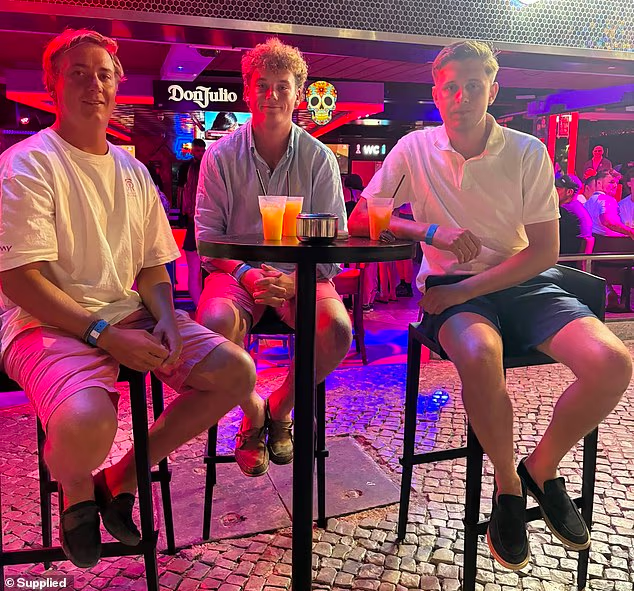
Teddy Birkbeck, 18 (centre), with his cousin Charlie Hobden (left) and their friend were making their way home from a lads' holiday in Albufeira, Portugal

A passenger on the train that derailed in East Sussex has described how people and gadgets sailed through the air after a ‘violent jolt’, before passengers broke out ‘screaming’.

Twenty people were hospitalised after the Southern Rail train carrying 150 people came off the tracks near Lewes station just before 4pm on Thursday, including two with ‘severe’ injuries.

The rear three carriages were thrown on to their sides after apparently hitting a section of badly buckled track, leaving around 40 passengers trapped inside.

Teddy Birkbeck, 18, boarded the train from London Victoria at Gatwick after flying back from a lads’ holiday in Albufeira, Portugal, with his cousin and friend.

Advertisement

He said the train had already been delayed in its journey to the airport, with officials explaining over the intercom that it was ‘due to the heat’.

Mr Birkbeck, a farmer from Sussex, told the Daily Mail: ‘It felt like there was something wrong from the start. There were two sudden jolts soon after we left Gatwick. My mate even joked, “That hurt!”

‘Then it was all smooth going – until we got near Lewes.’

The trio were among eight people travelling in the rear carriage, which ultimately careered furthest down the bank.

Advertisement

Teddy Birkbeck, 18 (centre), with his cousin Charlie Hobden (left) and their friend were making their way home from a lads’ holiday in Albufeira, Portugal

Mr Birkbeck described people and gadgets sailing through the air

Mr Birkbeck described people and gadgets sailing through the air 

The rear three carriages overturned and fell off the rail track

The rear three carriages overturned and fell off the rail track

Advertisement
Images appeared to show a section of badly buckled track just behind the train, with experts suggesting this may have happened due to the extreme heat

Images appeared to show a section of badly buckled track just behind the train, with experts suggesting this may have happened due to the extreme heat 

Mr Birkbeck was watching TikToks on his phone, nursing a ‘slight hangover’ from the holiday, when he felt a ‘violent jolt’. 

He said: ‘The train suddenly started to lean from side to side, and things were floating around the carriage in slow motion, like we were in space.

‘I saw my mate’s laptop go through the air, and a bottle of water as well. Then we slammed down on our side.

Advertisement

‘I screwed my eyes shut, but it felt like we were in a car that was drifting after the brakes had been slammed on. I thought to myself: “I am going to be seriously hurt here.”

‘We were sitting on the left of the carriage, so it wasn’t too bad in the end, but people on the right flew from their seats and fell down on to our side.

‘Everyone was silent for about 30 seconds – though it felt like an hour – and then people started screaming. Some were really panicking. It was difficult to know which way was up or down.

‘I had smacked my head on something, and saw that some people were bleeding.’

Advertisement

Charlie Hobden, Mr Birkbeck’s cousin, said it felt like they were ‘in a washing machine’ when the carriage tumbled over onto the embankment.

The rear carriage, in which Mr Birkbeck and his friends were travelling, skidded furthest down the embankment

The rear carriage, in which Mr Birkbeck and his friends were travelling, skidded furthest down the embankment

Some passengers were able to clamber through the emergency doors onto the sides of the overturned carriages

Some passengers were able to clamber through the emergency doors onto the sides of the overturned carriages

Mr Birkbeck's view from the track after being helped out of the carriage by emergency workers

Mr Birkbeck’s view from the track after being helped out of the carriage by emergency workers

Advertisement

Images from the scene show that the rear carriage slid around ten metres down the slope to the left of the track, bulldozing trees and coming to rest in the adjacent field.

Three of the carriages whipped over, while the front five remained upright. Behind the stricken rear carriage could be seen a section of track that looked to have buckled severely, with several sharp swerves along it. 

James MacCleary, the Lewes MP, said concerns had been raised about the condition of tracks in the area due to the sustained heatwaves.

He told Times Radio: ‘I had a meeting literally last week with [Greater Thameslink Railway], who are the parent company of Southern Rail, and we did discuss the track and the fact that it has been a bit bumpier in recent months, which is possibly a result of the incredibly hot weather we’ve had recently.’

Advertisement

A temperature of 38.1C was recorded at Kew Gardens in west London on Thursday, making it officially the hottest day of the year.

Mr Birkbeck continued: ‘Another passenger eventually managed to get the emergency exit open so people could climb out on top, but we decided to stay inside because it was actually cooler to begin with.

‘There were also a couple of elderly ladies who were distressed, so we wanted to stay and help them.

‘I had to force the door into the driver’s compartment at the back of the carriage to get the first aid kit.’

Advertisement

South East Coast Ambulance Service said around 150 people were on board the train, and 20 were injured. It said two people were rushed to the major trauma centre with ‘severe’ injuries, while a further 18 patients were also in hospital. 

Three air ambulances and at least 20 other emergency vehicles raced to the scene, while a number of passengers who did not require hospital treatment were taken to a local community centre to be triaged and supported.

People had to readjust their bearings inside the carriages that had completely turned onto their sides

People had to readjust their bearings inside the carriages that had completely turned onto their sides

Emergency workers used a stretcher to transport a passenger away from the train

Emergency workers used a stretcher to transport a passenger away from the train

Three air ambulances took off from the scene at around 6pm, evacuating the last of the passengers rescued from the train

Three air ambulances took off from the scene at around 6pm, evacuating the last of the passengers rescued from the train

Advertisement

Josh Babarinde, MP for Eastbourne, the train’s destination, said that one of his constituents had suffered a broken rib, while other passengers described seeing people bloodied and with head wounds. 

Photographs from the scene show emergency workers stretchering off wounded passengers and guiding others by the hand down the tracks.

The air ambulances took off at around 6pm, carrying the last of the passengers rescued from the carriages.

Of the emergency responders, Mr Birkbeck said he ‘couldn’t credit them enough’.

Advertisement

He told us: ‘They were absolutely brilliant. They put ladders down inside the carriage so we could climb up onto the train’s side, and then helped us down onto the ground.

‘All the passengers were in total bewilderment; everyone was quite quiet. But the ambulance crews and police were amazing at keeping us calm.

‘It’s all such a blur. I am still shaking hours after getting back from the adrenaline.’

Another passenger, father-of-two Liton Miah from Eastbourne, travelling with his wife and daughters, said he had noticed going past a warning sign at the side of the track.

Advertisement

He said: ‘I saw on the big board there was a problem with the track. I don’t know why they didn’t take any precautions. I saved my family and tried to help another couple. The guy was bleeding heavily and there was not much I could do to help him.’

Rob Bradley, who was travelling from London Victoria to Eastbourne with his six-year-old daughter Mabel when the crash happened, said they were in the carriage next to those that overturned.

He said his daughter had been dancing between the carriages just 30 seconds before the derailment.

Mr Bradley told the BBC: ‘As she sat down we felt the train speeding up and started to rock. Then our carriage jumped vertically upwards and we could tell it was a derailment.

Advertisement

‘The emergency brakes went on the train and everything got thrown forward.

‘The train skidded for quite a while before it stopped. We turned around and we saw the whole back of the train was open and smoke and dust were pouring into the carriage and we saw the fifth carriage had gone on its side.

‘We are doing okay. We were very lucky.’

The cause of the derailment has not yet been confirmed

The cause of the derailment has not yet been confirmed

Advertisement
A huge emergency response including ten fire engines descended on the scene near Lewes station

A huge emergency response including ten fire engines descended on the scene near Lewes station

A passenger dragging her luggage across a field after evacuating the stricken train

A passenger dragging her luggage across a field after evacuating the stricken train

The cause of the derailment has not been confirmed but transport experts have raised the possibility that the exceptional heat contributed to the crash by causing the rails to buckle or the dry ground beneath them to collapse. 

One suggestion from transport expert Christian Wolmar was that the prolonged heat and drought could have caused the ground beneath the train to dry out and crack, causing part of that bank to give way, leaving the rails without proper support.

Advertisement

He told the Daily Mail: ‘Well, there are two possible reasons this has happened.

‘Obviously, the train track might have buckled before the train arrived. But because the first carriages didn’t derail, it might be that the dryness from the heat has led to the embankment collapsing, and then the train made the rails buckle rather than the other way round.

‘I noticed yesterday when I was out on Hampstead Heath for the eclipse. There’s just great big fissures in [the ground], big openings like there’s been an earthquake, and that must be happening in many places.

‘So it could be that there’s something like that that caused the embankment to partially collapse, and then the rails buckled under the weight of the train because the rails were unsupported. Which could be the more likely explanation given that the first four carriages didn’t go down.’

Advertisement

Transport Secretary Heidi Alexander said she was ‘deeply concerned’ following the incident.

She wrote on X: ‘Grateful to emergency services who are on the scene supporting those impacted. We are working quickly with the rail industry and local partners to assist passengers.’

Network Rail said it had launched an investigation into the cause of the derailment.

Southern Railway said all lines through Lewes had been closed to allow emergency services to reach the scene and warned passengers to expect major disruption until 10pm.

Advertisement

The operator said: ‘A train has derailed in the Lewes area. This has closed all lines running through this station.

‘As a result of this, trains are currently unable to run through the area to allow the emergency services to attend the incident.

‘Major disruption is expected until 10pm.’

The Rail Accident Investigation Branch deployed investigators to establish how the Southern service came off the tracks.

Advertisement

Source link

Continue Reading

NewsBeat

Sex claims are no fantasy, says former schoolboy who accuses chemistry teacher of sleeping with him up to 30 times when he was 14

Published

on

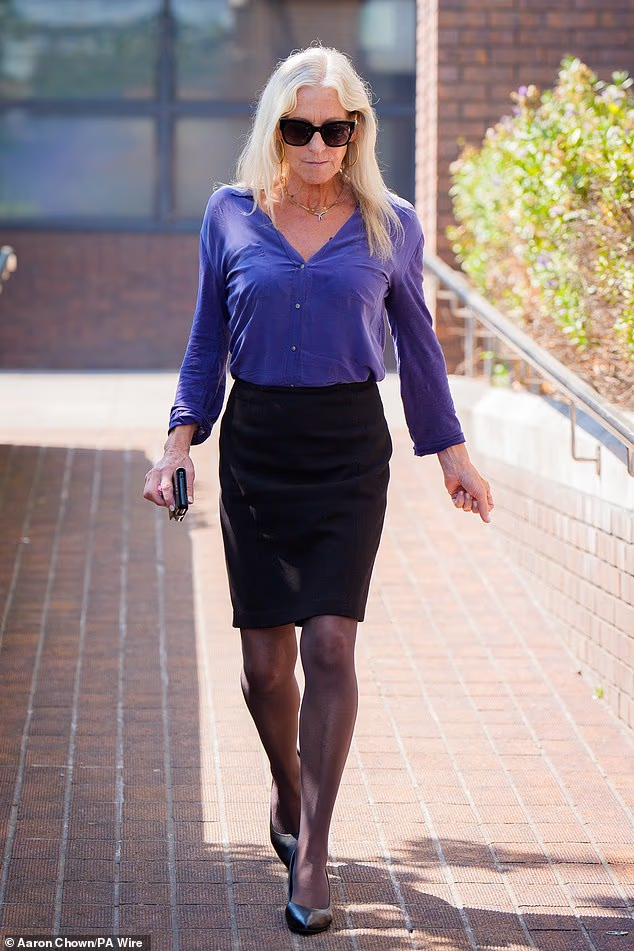
Sally-Anne Bowen, 65, is on trial at Harrow Crown Court accused of eight counts of indecent assault against two boys, who cannot be named for legal reasons

A former schoolboy who has accused a teacher of having had a sexual relationship with him from the age of 14 has told a court he is not a ‘fantasist’ who made up the allegations.

Sally-Anne Bowen, 65, is on trial at Harrow Crown Court accused of eight counts of indecent assault against two boys, who cannot be named for legal reasons.

She is alleged to have had sexual relationships with both boys in the late 1980s, when they were around 14 to 15 and she was in her mid-20s, the court previously heard.

Jurors were told one of the complainants said he had sex with Bowen, who was then a teacher at Christ’s College school in Finchley, north London, ‘about 20 or 30 times’.

Advertisement

Bowen denies all the charges, with jurors previously being told she claims to have had a medical condition at the time that made having sex all but ‘impossible’. 

Giving evidence on Thursday, the complainant told the court he had not invented the allegations against the teacher.

Asked by Bowen’s defence barrister Mark Kimsey whether he knows what a fantasist is, the complainant replied that he did.

‘I believe it’s someone that indulges in fantasies,’ the complainant said.

Advertisement

Sally-Anne Bowen, 65, is on trial at Harrow Crown Court accused of eight counts of indecent assault against two boys, who cannot be named for legal reasons

Asked whether he would agree that a fantasist is someone who has ‘unrealistic ideas’ and blurs the lines of reality with fantasy, he replied: ‘I think the question’s quite insulting.’ 

Mr Kimsey said: ‘Just to make clear, so you know, Miss Bowen’s case from the start is that she doesn’t accept, at all, engaging in any form of sexual activity.’

Advertisement

‘Well then, that is the definition of a fantasist,’ the complainant replied.

He told the court that some of the sexual acts Bowen asked him to participate in were ‘perverse’, adding: ‘I’m a “fantasist”, right? That’s not a part of anyone’s fantasy, to be involved in perversion.’

The court previously heard that Bowen maintained a sexual relationship with the complainant for several months, and he often visited her home.

He told jurors he felt compelled to ‘protect’ the teacher, who had ‘drummed it’ into him that he was not allowed to tell anyone about their relationship.

Advertisement

The complainant said: ‘In the months I was having sex with her… I never spoke to any other schoolboy about the fact I was having sex with her.

‘I never, ever spoke to anyone about it. I was always really aware, she drummed it into me.

Jurors were told one of the complainants said he had sex with Bowen, who was then a teacher at Christ's College school in Finchley, north London , 'about 20 or 30 times'

Jurors were told one of the complainants said he had sex with Bowen, who was then a teacher at Christ’s College school in Finchley, north London , ‘about 20 or 30 times’

‘To indoctrinate a 14-year-old child is one thing, to have sex with a 14-year-old child is another thing… to remain silent to everyone.

Advertisement

‘I had this secret I couldn’t speak to anyone. I spoke to one person who was my best friend who didn’t go to this school.’

He added: ‘Years she got to teach, because I remained silent.’

In a police interview played to the jury, the complainant said that when Bowen worked at the school, she dressed in a way which was ‘sexually provocative’.

He said: ‘Sally-Anne Bowen used to wear tight Levi jeans and black skinny pants that you could see everything in, and a black mini skirt up to there.’

Advertisement

‘My introduction to the world was completely governed by Sally-Anne Bowen,’ he told police.

‘I had no experiences, so it was her experiences that laid the groundwork for the sexual interactions that we had.’

In the video, the complainant said he cannot deny that he enjoyed having sex with Bowen, the ‘games’ and ‘secrets’ she engaged him in, and the feeling of having ‘one-up’ on his teachers.

‘But for me it was the destruction of my education,’ he added.

Advertisement

The complainant told police: ‘All those aspects of me at that young age – I had no respect for authority, no self-respect. My mother never forgave me.’

He added: ‘I would like to get in a room with all those teachers, and Sally-Anne Bowen, and say, “that’s my life”, because you only get one.’

Bowen denies the charges against her and the trial continues.

Source link

Advertisement
Continue Reading

NewsBeat

Essex Police issues statement as Nigel Farage Clacton by-election count safety claims disputed

Published

on

Manchester Evening News

Reform UK’s claims have been challenged

Essex Police says there were ‘no incidents or issues’ surrounding the Clacton by-election amid a war of words fuelled by Nigel Farage’s failure to attend the count. The Reform UK leader won the by-election which he triggered by resigning as Clacton MP while facing scrutiny over donations he received from a cryptocurrency tycoon.

Advertisement

Mr Farage received 22,239 votes, a share of 62.8 per cent, with his nearest competitor Count Binface picking up 26.7 per cent. Labour, the Conservatives, the Liberal Democrats, the Green Party and Restore Britain all shunned the by-election, which was described by Labour as a ‘circus’.

While declaring he had won hours before the result was announced, Mr Farage said he would not be attending the by-election count. A Reform UK spokesman said overnight: “Essex Police advised Nigel not to attend the count tonight due to a credible threat against him.”

Click here for the latest on Greater Manchester’s politics in our newsletter

But that claim has been roundly disputed. Ian Davidson, acting returning officer and chief executive at Tendring District Council, said there was a ‘robust’ policing operation in place and that it was ‘a candidate’s decision whether or not to attend’.

Advertisement

In a new statement issued this morning (August 14), Essex Police said there were ‘no incidents or issues’ during polling day or throughout the night as votes were counted. “We have a full and robust policing operation in place around the Clacton by-election, as we do with all significant elections in our county,” a force spokesperson said.

“Throughout polling day our officers were visible right across Clacton and the Tendring district. We visited all 51 polling stations, our officers were out and visible on foot, in vehicles and our drone team patrolled by air. Our aim was to ensure the people of Clacton were able to go about their daily business, that people were able to cast their vote safely and that the count took place without issue.

“We are pleased to say all of these things happened and there were no incidents or issues throughout yesterday and into the early hours of this morning. We worked closely with Tendring District Council and their security teams throughout. We take the safety and security of our elected officials extremely seriously and, equally, we take our policing responsibilities around the democratic process seriously too.

Advertisement

“The decision of candidates to attend or not attend the election count is a decision for individuals and their security teams, our role is to make sure our policing operation is sufficiently robust to ensure the safety of all, and we are grateful to all of our officers, staff and the staff at Tendring District Council who worked through the night to ensure the safety of all.”

Mr Farage did attend a ‘Farage-fest’ in the Clacton constituency while the count was taking place. He told fans there: “I’m sad to say that after 33 years of being a candidate in active politics, I’ve been advised tonight by Essex Police that there is an organised campaign to disrupt and degrade the result that will take place in a few hours’ time. Once again it shows you the sheer intolerance, the sheer loss of fundamental democratic principles that those that went before us, fought in world wars, to fight for and preserve.”

Mr Farage added: “I’m not scared of these people, far from it. But I’m damned if I’m going to stand on a stage, having won a resounding victory, a ringing endorsement of all that I’ve tried to fight for, and you’ve tried to fight for, and be demeaned and humiliated by nobodies, and I will not sadly be attending the count.”

After the claim was disputed earlier this morning, Reform MP Lee Anderson appeared on BBC Breakfast, insisting he believed his leader over the authorities. “Sometimes some of these police forces that we’ve been dealing with recently are about as honest as you lot at the BBC,” he said.

Mr Anderson added: “I’ve not spoken to Nigel about this. I’ve not spoken to Essex Police. If Nigel gets up on stage and says that he’s been advised not to attend the event, then I believe Nigel above the police, and especially above you lot at the BBC.”

Bridget Phillipson, chair of the Labour Party, told Sky News that viewers would ‘come to their own conclusions’. She said: “Well, of course, the safety of politicians is of the utmost importance and no-one should face threats or intimidation because of who they are and the job that they’re seeking to do.

“I don’t know exactly what’s gone on here, but like you, I’ve heard what the police have had to say, that they’ve pushed back a bit on on that suggestion, and I know that Nigel Farage is facing some criticism, even from within his own ranks, that he’s not, wasn’t, prepared to be at the count.

Advertisement

“And, you know, those who are responsible for running counts and the police oversight of that, they’re used to dealing with high-profile situations. But, you know, I think people will come to their own conclusions. It’s hard to know. Nigel Farage has given one version of events and we’ve heard something a bit different from the police responsible.”

Source link

Continue Reading

NewsBeat

Nicole Kidman Reflects Divorce From Ex-Husband Keith Urban

Published

on

Nicole Kidman Reflects Divorce From Ex-Husband Keith Urban

Nicole Kidman has opened up about the period of uncertainty she faced after her split from ex-husband Keith Urban.

The Oscar-winning actor and chart-topping country singer were married for almost 20 years before it was reported in late 2025 that she had filed for divorce.

In January, the former couple’s divorce was finalised, with the Moulin Rouge! star opening up about the split during a new interview with British Vogue.

Conceding it’s not been the easiest year for her, Nicole said: “at the same time I’m like, ‘OK, I didn’t expect this. I had a different view of what my life was going to be, but this is what it is now.’ You make all these plans and you have all these ideas of what it’s all going to be like and then it’s… not. You have to adjust. You adapt.”

Advertisement

“The future, it’s completely unknown to me right now,” she then admitted, describing the feeling as a “strange” one.

She continued: “There was a point where I was very fearful and deeply vulnerable, which is exposing. And then at the same time [I’m] going, ‘Well, I can either really not confront it and just curl up, or I can just go forward with an enormous amount of hope’.”

During the interview, Nicole also offered up some suggestions as to how she could describe this time in her life, such as: “Free falling? Jumping off? Like, where am I going? And what’s next?”

In March, Variety asked Nicole if she was doing well after her split from her now-ex, to which she responded: “I am, because I’m always going to be moving toward what’s good.

Advertisement

“What I’m grateful for is my family and keeping them as is and moving forward. That’s that.”

She then noted: “Everything else I don’t discuss out of respect. I’m staying in a place of, ‘We are a family’, and that’s what we’ll continue to be. My beautiful girls, my darlings, who are suddenly women.”

Over the course of their marriage, Nicole and Keith welcomed two children, 18-year-old Sunday Rose and 15-year-old Faith Margaret.

Nicole was previously married to fellow actor Tom Cruise, with whom she adopted a son and daughter during their time together.

Advertisement

Read Nicole Kidman’s full interview in the new issue of British Vogue.

Source link

Advertisement
Continue Reading

NewsBeat

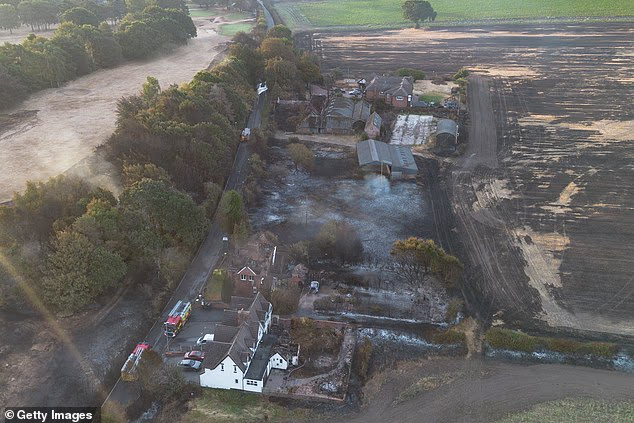
The street burned down by record heat: Charred remains of six houses consumed by ‘apocalyptic’ wildfire that started near golf course

Published

on

Charred land and burnt houses this morning following the huge wildfire in Stourbridge

Charred remains of homes burned by ‘apocalyptic’ wildfires could be seen today as drought-hit Britain continued to bake in a heatwave after the fifth warmest day ever.

Six properties were destroyed as 100 firefighters fought the blaze near a golf course at Stourbridge in the West Midlands, which spread rapidly through dry grass and woodland yesterday afternoon – setting alight homes with residents forced to flee.

A train derailment in East Sussex on a Southern service near Lewes that saw 150 people evacuated and two seriously injured may also have been a result of the heat.

Extremely hot weather will continue in south-east England, East Anglia, Lincolnshire and the Midlands today with temperatures reaching between 29C and 34C.

Advertisement

East Midlands Railway issued an ‘essential travel only’ alert for the third day in a row; while c2c, Great Western Railway and West Midlands Railway axed some services.

The UK hit 38.1C at Kew Gardens in London yesterday, making it the warmest day of 2026 so far. Yesterday was also the ninth day of 2026 when temperatures hit at least 35C, the fourth day for 36C, and the third for 37C – all three being new records.

The heatwave is set to continue into this weekend with temperatures of up to 30C in southern England, before highs slip to around 27C to 28C by the start of next week.

A UK Health Security Agency amber heat health alert remains active for all of England until 9pm tonight, which warns of increased demand on health services and a ‘rise in deaths, particularly among those aged 65 and over or with health conditions’.

Advertisement

Officials urged people to take precautions such as staying hydrated, checking in on vulnerable friends and family, and staying out of the sun at the hottest part of the day.

Charred land and burnt houses this morning following the huge wildfire in Stourbridge

A fire engine stands near a burnt-out house this morning following the fire in Stourbridge

A fire engine stands near a burnt-out house this morning following the fire in Stourbridge

Advertisement
The blaze in Stourbridge forced some people to flee after it started tearing through homes

The blaze in Stourbridge forced some people to flee after it started tearing through homes

More than 100 firefighters were sent to Stourbridge after the fire started in nearby grassland

More than 100 firefighters were sent to Stourbridge after the fire started in nearby grassland

Two people were seriously injured following a train derailment in East Sussex yesterday

Two people were seriously injured following a train derailment in East Sussex yesterday

Rail bosses will investigate whether the steel tracks expanded in the heat and started to warp

Rail bosses will investigate whether the steel tracks expanded in the heat and started to warp 

Advertisement

Advertisement

Hampshire, the Isle of Wight and West Sussex have now gone 63 days without rain as the drought intensifies, with Surrey close behind on 58 days and London on 52 days.

Some 45million people in England are now in drought-stricken areas, and 27million customers are under hosepipe bans – with many areas desperate for downpours.

The Met Office said some thunderstorms could hit central and south-eastern England tonight, but there is no meaningful rain in the forecast for the most parched areas.

Forecasters are however watching an area of low pressure which could influence UK weather from the southwest towards the end of next week and potentially bring rain.

Advertisement
TOP 12 HOTTEST DAYS IN UK HISTORY – INCLUDING THREE THIS YEAR 
1 40.3C July 19, 2022 Coningsby, Lincolnshire
2 38.7C July 25, 2019 Cambridge
3 38.5C August 10, 2003 Faversham, Kent
4 38.2C July 18, 2022 Pitsford, Northamptonshire
5 38.1C August 13, 2026 Kew Gardens, London
6 38.0C June 26, 2026 Lingwood, Norfolk
7 37.8C July 31, 2020 London Heathrow
8 37.1C August 3, 1990 Cheltenham, Gloucestershire
9= 36.7C August 9, 1911 Raunds, Northamptonshire
9= 36.7C July 1, 2015 London Heathrow
9= 36.7C June 25, 2026 Merryfield, Somerset
12 36.6C August 2, 1990 Worcester

Met Office chief forecaster Neil Armstrong said: ‘Friday will be a less hot day, with temperatures forecast to reach highs of 34C in the south-east.

‘Into the weekend temperatures could still hover over 30C in the south, with a gradual return to average over the next few days.’

Providing an outlook for rain, deputy chief forecaster Steven Keates said: ‘Many people are desperate for some rain to alleviate the impacts of the prolonged dry spell.

‘There is a chance of some thunderstorms developing in central and southeastern parts of England later on Friday into Saturday, however these are very uncertain.

Advertisement

‘A front moving south eastwards across the UK on Monday and Tuesday could bring northern areas some rain but amounts of rain in the south will be small at most and the majority will fall over Northern Ireland and Scotland.

‘The next meaningful rain forecast for these very dry areas could be towards the end of next week as an area of low pressure influences our weather from the southwest. The detail on this will become clearer over the coming days.’

It comes as a fire chief said crews were making progress tackling huge blazes in the West Midlands that led to thousands of 999 calls and caused ‘extensive’ devastation.

Chief fire officer Simon Tuhill, of West Midlands Fire Service, said one huge blaze in Stourbridge, which forced some people to flee after it started tearing through homes, was ‘one of the most significant’ incidents the region’s fire service has ever dealt with.

Advertisement

West Midlands Fire Service said this morning that crews were ‘making progress’ and ‘tactically working across several different areas of the site’.

Mr Tuhill was in touch with Prime Minister Andy Burnham, who released a statement to pay tribute to the firefighters on the ground battling the wildfires.

Advertisement

Advertisement

The Prime Minister said: ‘Awful to see homes and communities hit by fires across the country tonight as the heatwave continues.

‘My thoughts are with everyone affected, particularly those who have been injured or forced from their homes, and with the firefighters who have been taken to hospital.

‘I’m in touch with local leaders (including West Midlands Mayor Richard Parker) and will be speaking to emergency services on the ground as they continue their response.

‘Our firefighters are working in incredibly difficult conditions and putting themselves at risk to keep others safe. A huge thank you to them and everyone supporting the effort tonight.’

Advertisement

Mr Tuhill said that ‘the emergency service presence here will likely run into days’ and asked people to stay away from the area.

Nathan Hudson, from West Midlands Ambulance Service, said six people were treated by crews at the scene in the town, with two taken to hospital after suffering from smoke inhalation.

Mr Burnham has pledged to support fire and rescue services in the region with any additional resources they need, the county’s mayor Richard Parker told Sky News.

Angela Rayner, Secretary of State for housing, communities and local Government said: ‘We are working closely with the local Fire and Rescue Service and partners on the ground in Stourbridge and are being regularly updated.

Advertisement

‘I would like to thank the brave emergency services, and my thoughts are with people who have been forced to leave their homes.’

Speaking at the scene of the Stourbridge blaze, Mr Tuhill said more than 100 firefighters were sent to the scene, saying the fire is believed to have started in the grassland before spreading to homes nearby.

An investigation into how the fire in Stourbridge, West Midlands, started will now begin, the chief fire officer said.

‘Of course, we will carry out a joint investigation with police colleagues and our specialist fire investigation team,’ Mr Tuhill told a late-night press conference on Thursday.

Advertisement

‘They will be here on scene as soon as they can to start investigating the possible cause.’

Before the press conference, Mr Parker described the ‘multiple fires across our region’ as an ‘extremely worrying and fast-moving situation’.

In neighbouring Worcestershire, Hereford and Worcester Fire and Rescue Service said a number of homes had been damaged and 30 properties were evacuated in Pershore following a large fire on Lancelott Court.

The fire service said one person was treated for smoke inhalation following the incident at about 4.30pm, and about 200 homes in the area were left without power.

Advertisement

In Stoke-on-Trent in Staffordshire, another blaze hit ‘a small number of properties and gardens’ in the Goldenhill area of the city.

Severn Trent Water warned of disruption to water supply across the West Midlands as a result of the wildfires.

The company said customers in Kidsgrove, near Stoke-on-Trent, may experience lower pressure and discoloured water because firefighters needed to use hydrants.

An aerial view shows destroyed houses following the wildfire in Stourbridge yesterday

An aerial view shows destroyed houses following the wildfire in Stourbridge yesterday

Advertisement
A firefighter sprays water on burnt-out area following the grass fire in Stourbridge yesterday

A firefighter sprays water on burnt-out area following the grass fire in Stourbridge yesterday

A view of a burnt-out house today following the grass fire at Stourbridge in the West Midlands

A view of a burnt-out house today following the grass fire at Stourbridge in the West Midlands

A view of a burnt-out house today following the grass fire at Stourbridge in the West Midlands

A view of a burnt-out house today following the grass fire at Stourbridge in the West Midlands

In Warwickshire, the county’s fire and rescue service said it was responding to a ‘large fire’ in Salford Priors, Stratford-upon-Avon, which has been declared a major incident.

Advertisement

Elsewhere in the region, smoke from nearby wildfires forced the closure of the M6 northbound between junctions five and six – causing more than two hours of delays.

Explaining the closure, National Highways West Midlands said in a statement: ‘The fire keeps igniting. Fire commander at the scene not happy for M6 to be reopened until fire fully extinguished.’

Wollaston and Stourbridge Town councillor Andrew Southall said care home residents were evacuated alongside others as a result of the fire near Stourbridge golf course.

Resident Phillip Jones, who lives close to where the fire in Stourbridge took hold, told Sky News: ‘It was quite hard to breathe, actually, when we left the car, getting to the home.’

Advertisement

He added: ‘We have the golf course and then the cricket club between us and the fire.

‘So, at the moment, we have grab bags by the door, ready to leave if we have to leave, but it hasn’t come to that yet, thankfully for us.’

Footage on social media showed multiple buildings on fire and huge plumes of smoke coming from a nearby field.

The fire service said flames were spreading ‘across roads in places’, with people urged to stay indoors.

Advertisement
A fire engine stands near a burnt-out house this morning following the fire in Stourbridge

A fire engine stands near a burnt-out house this morning following the fire in Stourbridge

An aerial view shows destroyed houses following the wildfire in Stourbridge yesterday

An aerial view shows destroyed houses following the wildfire in Stourbridge yesterday

A view of a burnt-out house today following the grass fire at Stourbridge in the West Midlands

A view of a burnt-out house today following the grass fire at Stourbridge in the West Midlands

Firefighters examine the burnt-out area following the grass fire in Stourbridge yesterday

Firefighters examine the burnt-out area following the grass fire in Stourbridge yesterday

Advertisement
A fire engine stands near a burnt-out house this morning following the fire in Stourbridge

A fire engine stands near a burnt-out house this morning following the fire in Stourbridge

Drone footage published by the force showed a heat map of flames threatening to engulf homes in the area as smoke billowed across the town.

Stourbridge town hall has been set up as a rescue centre for people who have had to flee their homes.

Councillor Andrew Tromans, who represents Wollaston and Stourbridge Town on Dudley Borough Council, described the scene of the fire in Stourbridge as ‘apocalyptic’.

Advertisement

In a statement on Facebook, he said: ‘The apocalyptic scenes in Norton and across Stourbridge are sadly just a taste of what is to come if we don’t act.’

He added: ‘It is my view, and it has been for a while, that Dudley councillors must have an emergency meeting about (how) we protect our borough from the impacts of climate change.’

Elsewhere, two people were taken to major trauma centres with ‘severe’ injuries following a train derailment in East Sussex, as rail bosses announced an investigation into the cause of the incident.

A major incident was declared by British Transport Police (BTP) after three carriages derailed on their side, trapping passengers on board the Southern train near Lewes yesterday afternoon.

Advertisement

Around 150 people had been on board the service travelling from London Victoria to Eastbourne, and have since all been evacuated.

Early speculation has focused on the possibility that the steel tracks expanded in the heat and started to warp, but investigators have yet to establish what caused the train to leave the rails.

Christian Wolmar, a transport expert, told the Daily Mail: ‘Well, there are two possible reasons this has happened. Obviously, the train track might have buckled before the train arrived.

‘But because the first carriages didn’t derail, it might be that the dryness from the heat has led to the embankment collapsing, and then the train made the rails buckle rather than the other way round.

Advertisement

‘I noticed yesterday when I was out on the heath for the eclipse – there’s just great big fissures in Hampstead Heath, big openings like an earthquake, and that must be happening in many places.

‘So it could be that there’s something like that that caused the embankment to partially collapse, and then the rails buckled under the weight of the train because the rails were unsupported.

‘Which could be the more likely explanation given that the first four carriages didn’t go down.’

Norman Baker, who is a former Lewes MP and an ex-transport minister, also suggested the derailment may have been caused by a section of the track buckling in the heat.

Advertisement

He told Times Radio: ‘They’ll want to make sure that the railways are completely safe before any trains are allowed back on them and if it has been the case – that the rails have buckled – that will take considerably longer to repair.’

South East Coast Ambulance Service deputy chief paramedic officer, Michael Bradfield, said there had been a ‘mix of injuries of varied severity’ among the 20 people taken to hospital.

He told a press conference in East Sussex: ‘We have conveyed 18 people to several hospitals in the region.’

He added: ‘My colleagues said there were 20 people who went to hospital – we believe there were two who have made their own way and have self-presented at hospital.

Advertisement

‘There are a range of injuries, two of which were categorised as severe and were conveyed to a major trauma centre. The remaining are a mix of injuries of varied severity.’

He described the derailment as ‘complex and challenging to deal with’ and required ‘a carefully co-ordinated multi-agency response’.

Lucy McAuliffe, Network Rail’s route director for Sussex, said the railway between Haywards Heath and Lewes is likely to remain closed for some time as specialist teams carry out assessments.

‘I understand that people will have lots of questions about what has happened today,’ she told reporters.

Advertisement

‘I would like to reassure everyone that we are working closely with the Rail Accident Investigation Branch, who are on site to establish exactly what has happened.

‘At the moment, it would be inappropriate to comment as to the cause of this incident but more information would be provided as soon as we can.’

Outside a community centre hosting passengers nearby to the incident, Yana Ludwig, who was travelling alone on the train from London to Lewes, told reporters the experience was ‘completely terrifying’.

‘There was a banging. Everything just went topsy-turvy,’ the 56-year-old from the United States said. ‘It seemed like a really long time but it probably was 10 seconds of that before the carriage actually fell on the side.’

Advertisement

Ms Ludwig described being propped up over the top of another passenger. She added: ‘I’m pretty banged up.’

She said everyone in the train was checking their fellow passengers were OK, adding: ‘These moments everybody kind of pulls together.’

Fire engines, ambulances and police have been stationed along Landport Road in Lewes, alongside a double-decker bus, which was parked up by the community hub waiting for passengers to board.

Local resident Oriana Evans said she and her son helped casualties who were led off the train towards the community centre along the street, showing them where to go, including some passengers who were on holiday.

Advertisement

‘I walked and chatted to some of them in shock really,’ the 54-year-old jewellery maker said.

She said they told her they were alright but ‘really bruised’.

Photographs circulated online show at least two carriages of a train lying on their side, with two passengers standing on top.

On the trains today, East Midlands Railway said it was ‘advising that unless your journey is essential, you should not attempt to travel today’ because of the hot weather.

Advertisement

c2c cancelled 17 trains between London and Essex this afternoon and evening, starting with the 2.27pm service from Shoeburyness to Fenchurch Street.

Great Western Railway said a reduced service would run between London Paddington and Oxford from 1pm until 7pm; while trains in Cornwall between Truro and Falmouth were reduced to hourly; and the Okehampton branch line was replaced by buses.

On West Midlands Railway, buses replaced trains between Rugeley Trent Valley and Hednesford; and between Stourbridge Junction and Worcester Foregate Street.

It comes after the UK was gripped by extreme heat yesterday – making it the second time this year the country has seen temperatures reach 38C.

Advertisement

The high also surpassed the previous hottest day of 2026 when 38C was recorded in the late June heatwave as the UK struggled under a rare ‘red warning’ for extreme temperatures.

The only other time temperatures have reached 38C twice in a year was in 2022 when the UK recorded its hottest ever temperatures.

The intense heat has made 2026 the first year on record to see three separate days where temperatures reached the 37C threshold, as well as the first year with four days at 36C or above, and extends 2026’s record-breaking run of days above 35C.

A Met Office amber warning for extreme heat was in place yesterday for a swathe of England from London to Sheffield, parts of Cheshire and Greater Manchester, into Gloucestershire and Wiltshire in the South West and Shropshire and Herefordshire.

Advertisement

With record dry conditions in July and a dry start to August, nearly three-quarters of England and the whole of Wales are in drought, heaping pressure on water resources for households, agriculture and the environment.

England and Wales have already seen as many wildfires this year as during the whole of 2025.

Some 1,017 wildfires have been recorded in England and Wales this year, according to data shared by the National Fire Chiefs Council, the same as last year’s record-breaking total.

Crews from the Hampshire and Isle of Wight Fire and Rescue Service have continued battling a blaze which hit protected heathland in the New Forest after a van caught fire on the A31 near Ringwood on Sunday.

Advertisement

Record-breaking heatwaves in May and June led to the deaths of more than 2,800 people, while parts of the country were hit with two further heatwaves last month as England and Wales endured their driest July since records began in 1836.

A fifth heatwave of the year was declared early last week – and the Met Office has said summer 2026 is on course to be the hottest on record.

Source link

Advertisement
Continue Reading

NewsBeat

Transfer news LIVE: Arsenal FC done deal, Osimhen twist; Fernandez deadline; Chelsea, Man Utd, Liverpool latest

Published

on

Transfer news LIVE: Arsenal FC done deal, Osimhen twist; Fernandez deadline; Chelsea, Man Utd, Liverpool latest

Chelsea’s deadline for Enzo Fernandez bids is at 5pm on Friday, with Manchester City and Real Madrid both weighing up moves that will cost £120million. The Blues are also being linked with Arsenal midfielders Myles Lewis-Skelly and Martin Zubimendi, while Manchester United may have been offered a boost in their pursuit of Lewis Hall as they also target Eduardo Camavinga. Liverpool remain confident of signing Bradley Barcola, though PSG team-mate Ibrahim Mbaye has apparently been deemed as too expensive.

Source link

Continue Reading

NewsBeat

The 18th-century British artists who turned India into a picturesque fantasy

Published

on

The 18th-century British artists who turned India into a picturesque fantasy

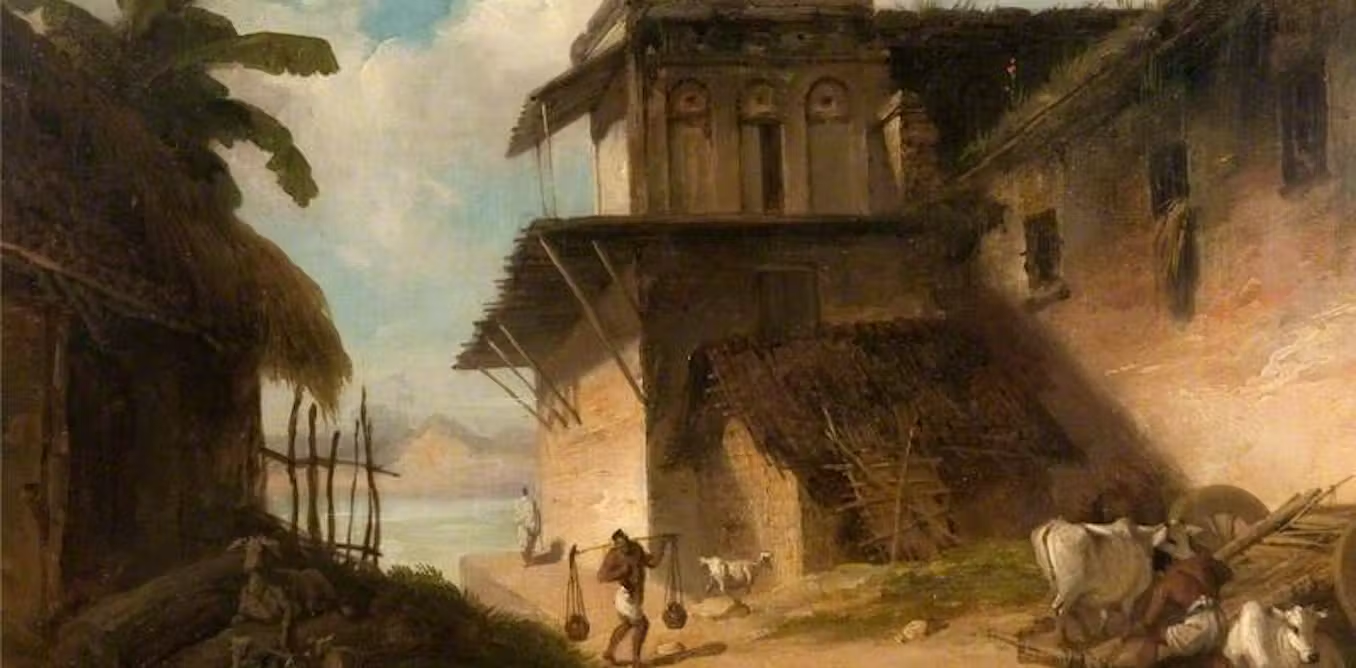
In 1825, English artist George Chinnery left Calcutta for Macau, chased away by his disgruntled wife Marianne and his creditors. He’d been based in India for the past 23 years, having previously lived in Hyderabad and Dacca.

Besides running a debt of around 30,000 rupees (£232 today), Chinnery was, according to one Dictionary of National Biography, a “penniless fornicator” and “begetter of an uncertain number of illegitimate Chinnerys white, brown and yellow”.

While he became famous as a portraitist, Indian landscapes also take pride of place in Chinnery’s legacy. His vision of an early morning in the Bengal countryside projects an image of peace and harmony far removed from the realities of colonial India under the British Empire.

From the 1760s, a number of British artists arrived in India. These men were motivated both by the economic prospects of catering to expatriate communities and portraying unique subject matter for those back home. In so doing, these artists presented India not as it was, but remade it into an exotic land ripe for colonial rule.

Advertisement

In their artistic representations, India was dangerous but also a place of opportunities. Travelling across provinces, artists’ visual documentation helped claim and appropriate Indian landscapes. As these spaces were endowed with new meanings, in turn, the question of imperial authority’s legitimacy became entangled with art.

Indian picturesque: a blot on the landscape

Besides just a few unkempt and passive human figures, the foregrounding of decayed buildings in Chinnery’s painting speaks directly to the picturesque aesthetic that rose to prominence in the late 18th century. This style focuses on asymmetrical compositions, dramatic chiaroscuro (light and shadow), rugged textures and landscapes with classical ruins and rustic life. In this, picturesque artists turned rural England into a national ideal.

The picturesque style occurred in a time when the process of enclosure was increasing. This involved taking commonly used land and dividing it into privately owned fields to the benefit of wealthy landowners, while limiting poorer people’s access to land. The picturesque helped justify social inequalities by presenting wealthy landowners and their estates as natural and idyllic parts of the landscape.

In a similar way, as wealthy imperial officers returned to Britain and invested their money in land, the picturesque also helped present Britain’s colonial power as taming and improving foreign lands.

Advertisement

In India, artists were using the picturesque to reshape colonial landscapes according to British ideas of progress and civilisation and to tell stories that celebrated colonial power.

Remains of an Ancient Building near Firoz Shah’s Cotilla, Delhi by Thomas Daniell (1795)
Wellcome Collection

In their painting of India, the British fascination with ruins became a visual trope to signify Indians’ political decadence and loss of connection with their histories and heritage. Take Thomas Daniell’s 1795 depiction of an ancient building near Feroz Shah Kotla in Delhi (above). This image fed into wider commentary on the gradual decline of Delhi as the seat of the Mughal empire.

The building is reduced to a shadow of its former eminence, the limited life in its surroundings generating an impression of neglect that might be solved by British intervention. The new colonial masters were celebrated as harbingers of modernity. Through depictions like this, travelling artists, though attracted for mercenary reasons, became a mouthpiece for burgeoning imperial power.

How a monument became a cliché

Such picturesque visions enabled Britons to understand India on their terms and it was ultimately a process of objectification. Pre-colonial cultural and religious references came to be relegated to the background.

Advertisement

Take the Taj Mahal in Charles Ramus Forrest’s 1824 painting (below), which is divested of political metaphors central to how the Mughal Empire presented its identity and power.

The Taj Mahal, in A Picturesque Tour along the Rivers Ganges and Jumna, in India by Charles Ramus Forrest (1824).
The Taj Mahal, in A Picturesque Tour along the Rivers Ganges and Jumna, in India by Charles Ramus Forrest, 1824.
Yale Center for British Art, Paul Mellon Collection.

The garden complex of the Taj is based on a quadrilateral plan, in the Mughal Charbagh style, replicating the four gardens of paradise mentioned in the Quran, symbolising divine grace and approbation. The architecture drew on Timurid traditions (1370 to 1507), as Shah Jahan, the fifth Mughal emperor, was proud of his lineage and sought to actively revive the legacy of his ancestor, Timur (Tamerlane). The building is believed by certain scholars to be a replica of the throne of God on the Day of Judgement in Islam, which consists of Allah’s throne (the Arsh) and the gardens of Paradise.

Simplifying these architectural complexities, however, Forrest reduces the Taj to an ornamental delight to be enjoyed by a European audience during their boat rides along the river Yamuna, pictured in the foreground.

Memorialisation of conquest

While visual imagery of travel made it possible for the British to control the interpretation of India’s past and insert themselves, it also facilitated the creation of imperial mythologies.

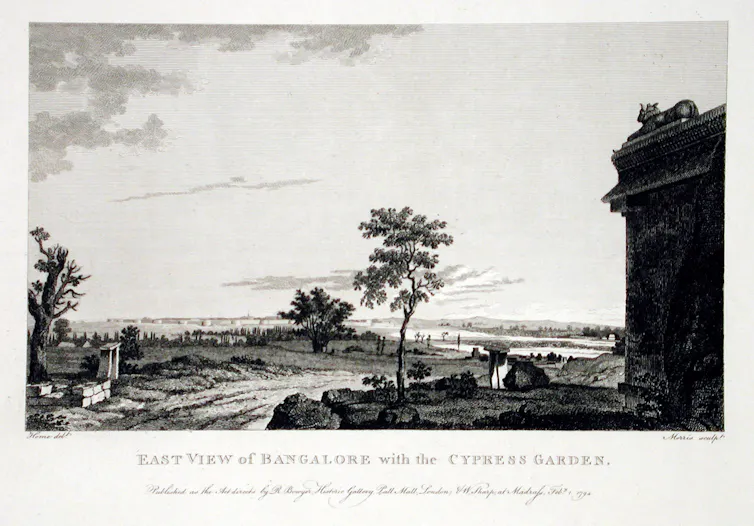
Commemorating sites of war played an important role. During the Third Anglo-Mysore war (1790 to 1792), successes against the ruler of Mysore, Tipu Sultan, led the British to envision themselves as the incumbent power. Destruction cleared the path for occupation as territories were laid bare for takeover, as evident in Robert Home’s 1794 depiction of Tipu’s gardens in Bangalore (below).

Advertisement
East View of Bangalore, with the Cypress Garden by Robert Home (1794).
Los Angeles County Museum of Art

Devoid of its vegetation and former grandeur in wartime, the once beautifully ordered landscape is turned into a picturesque scene. This ruggedness is romanticised as the remnant of a bygone era, to be discarded in favour of a new beginning.

Mysore soon evolved into a site of British personal and collective memories, embedding sacrifices for imperial cause as a matter of national pride. Previously, more tragic sites had served this memorial purpose. For instance, The Black Hole of Calcutta, a small, cramped dungeon at Fort William, where supposedly more than a hundred imprisoned Britons suffocated in 1756.

It is telling that, by the 19th century, British tourism was built around and reinforced the idea that Britain’s empire and territorial conquests were things to be proud of.

Tourists often fail to appreciate the experience of ordinary Indian people, which has influenced how destinations are marketed. These 18th-century western artists wandering across South Asia, their fortunes and, above all, their art, can tell us how this perspective surfaced.

As a place bereft of its own political identity by conquest, India was ripe for romantic projections of western might. In our age of travel, we must question these ways of seeing.

Advertisement

Source link

Continue Reading

NewsBeat

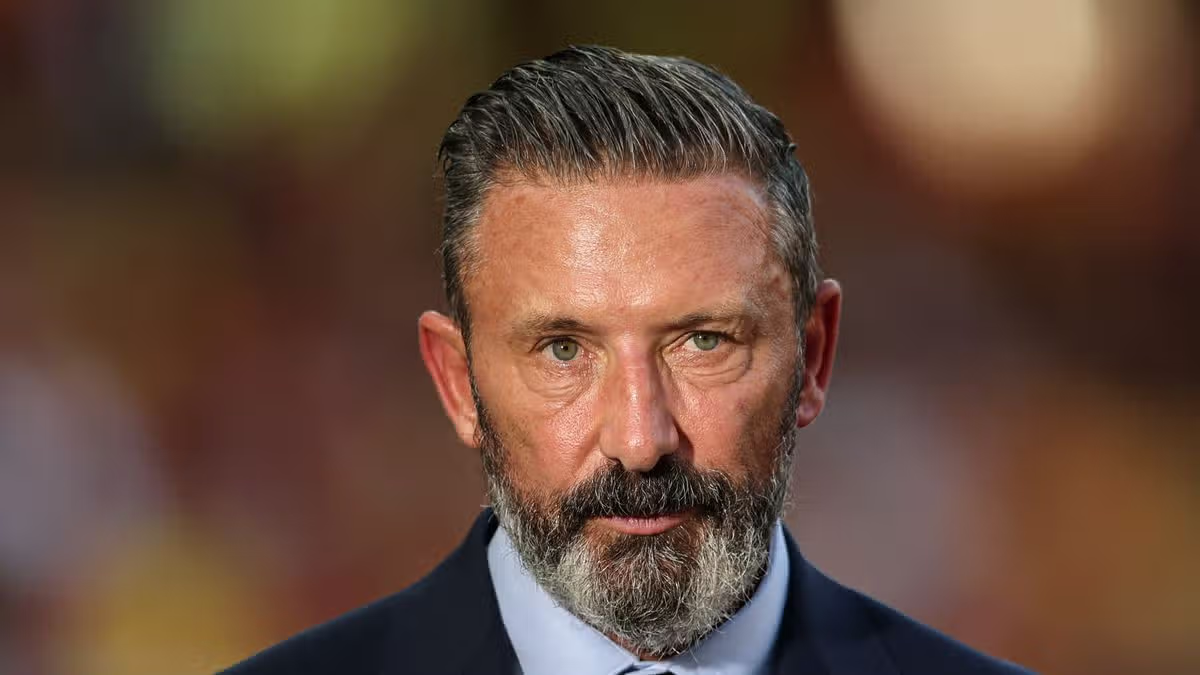
Derek McInnes makes brutal Rangers admission after historic low

Published

on

Belfast Live

Rangers are out of the Europa League and will now play in the Conference League for the first time in the club’s history

Dejected Derek McInnes has conceded his struggling Rangers squad isn’t currently equipped for Europa League competition.

Advertisement

The new Ibrox manager witnessed his team exit UEFA’s second-tier competition following a 1-1 stalemate against Jagiellonia Bialystok at home.

Lawrence Shankland’s spot-kick in the opening period had levelled the tie after the Polish side’s 2-1 advantage from the first leg last week.

However, Rangers’ tactical adjustment handed Bialystok the initiative, and Nik Prelec’s vital second-half strike secured their progression to the play-off stage.

McInnes’ charges now drop into the Conference League for the first occasion in the club’s existence, reports the Daily Record.

Advertisement

He confessed: “The club’s built for the Europa League and Champions League. And that’s the intention, to get there.

“But I’m not sure the team’s quite ready for it at the minute.

“And it pains me to say that, to be honest. It does.

“We need to get more quality. We need to try and get more confidence into the team. But there wasn’t an outcome that we wanted.”

Advertisement

Rangers’ American ownership endured tough questioning from frustrated Ibrox shareholders during this week’s shareholder meeting.

The bulk of grievances focused on the persistent transfer blunders that appear to be setting the Light Blues up for another challenging season.

Moves for PSV winger Couhib Driouech and AEK Athens defender James Penrice are believed to be nearing completion.

Yet while McInnes is eager for reinforcements, he stood by the recruitment staff tasked with delivering new signings. He commented: “Until deals are done and over the line, it’s tough for me to actually comment on that.

Advertisement

“You know, we’re actively trying to get players in. The club is working so hard. I see it first hand.

“My office is next door to the recruitment lads and to everybody else and there’s constant conversation. So everybody’s working extremely hard to get the necessary players, the type of players that we require at the club.

“We’re not just signing any players. We’re hopeful we can land a few. I know Andrew Cavenagh said at the shareholders’ meeting between three and five. So there’s still a lot to do to get that type of number in.”

It’s abundantly clear Rangers need fresh faces urgently.

Advertisement

McInnes has taken charge of four matches but remains without a win as Ibrox boss.

His team began positively in a 3-5-2 formation and took the lead when ex-Celtic defender Yuki Kobayashi handled a delivery from impressive fellow Japanese international Daisuke Yakota.

However, a tactical shift to four at the back after the interval allowed the Polish side back into the contest, and it’s Bialystok who progress to face Georgian outfit Iberia 1999 – while Rangers will now meet Czech side Jablonec.

McInnes lamented: “I think it was justified to be honest. It wasn’t good enough. What we served up throughout the second half wasn’t good enough.

Advertisement

“We’ve got to be honest with that, we’ve got to own it. I thought the game was a bit too open at times for us to happen.

“Obviously, Gassama and Yokota playing as effectively wing-backs, we were asking a lot of them at times.

“But I thought we paid dividends in terms of penalty box action, getting the goal. I thought we were good value for going in 1-0 at half-time, but I still thought that Jagiellonia had a couple of scares.

“And mostly again on when the ball was dead and on transitions. So, there was a bit of anxiety there. I thought we took Thelo Aasgaard off at half-time, just felt we wasn’t getting involved in the game enough.

Advertisement

“And we go a back four, and the reason we’d go a back four is to try and get Gassama and Yokota a wee bit more effective higher up the pitch.

” Because I think it was a lot to ask of them to do that for 90 minutes, playing in the position they were in. And by doing that, hopefully to provide the service a bit more regularly for Shankland and Ryan Naderi. We have to say, once again, it’s not another 90-minute performance.

“That’s been aimed at Rangers for a while now. Last season, I think it was aimed at strong 45 minutes. It wasn’t followed up. It’s been a continuation of that this season already.

“In the four games we’ve played, we’ve had some good moments, but it’s not been good enough. And it’s certainly not a strong enough 90-minute performance. And I just thought that, although I didn’t think we were great in the second half, I didn’t think we were creating too much.

Advertisement

“But for us to lose the goal that we do, where it’s your set play. I think the first forward pass that they play is in the bottom left-hand corner in front of Copland Road. And for it to end up scoring at the top right-hand corner in front of the Broomloan is just madness. It’s inexplicable how we don’t make a foul, how we don’t stop their flow and attack. How we don’t just sanitise that whole situation. There’s no lack of bodies.

“It’s lack of intelligence. It’s lack of doing the right thing, to be honest. Just make a foul and stop the attack.

“And I think once they equalised, it was so difficult. Because the players lost more confidence. The situation becomes a bit desperate.

“And I just thought we lost all our composure after that. That for me is not great to watch.”

Advertisement

Sign up to our free sports newsletter to get the latest headlines to your inbox.

Source link

Continue Reading

Trending

Copyright © 2025