

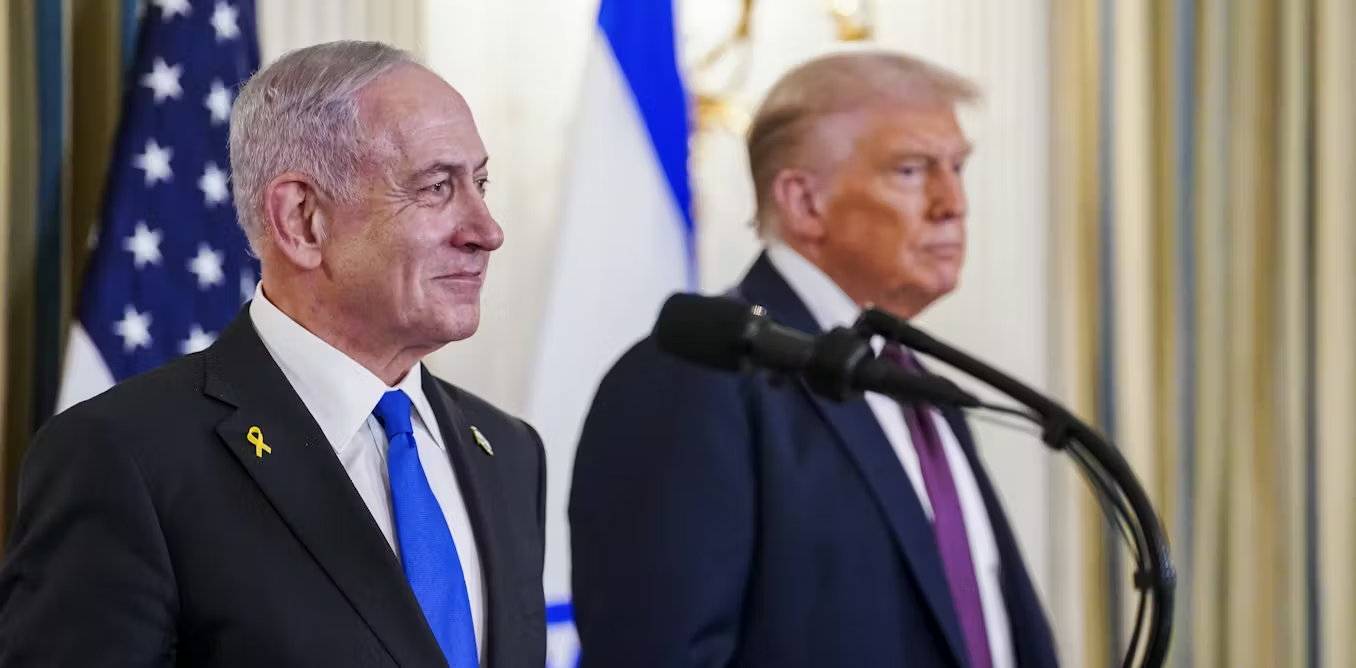
Donald Trump told reporters on board Air Force One on March 15 that his relationship with the Israeli prime minister, Benjamin Netanyahu, is “extraordinary”. Netanyahu has been rather less effusive, saying in recent days that their relationship is one of “dialogue, shared concepts, consultation and joint work”.
These comments come as reports are circulating of rifts between the two leaders over the war in Iran, which Trump has rejected as “fake news”. The reported tensions underline not only Trump and Netanyahu’s very different war aims but also the character differences that have shaped their relationship.
Writing in the Sunday Times on March 15, the UK’s former ambassador to Israel, Matthew Gould, pointed out that both men are similar in “some respects”. Like Trump, Netanyahu is a “populist making his country more divided with crude fearmongering; a huge character who sucks oxygen from the entire political scene.”
However, there are some key differences. While Trump had five deferments to avoid serving in the Vietnam war, for example, Netanyahu distinguished himself in the Israeli armed forces. This included serving five years in the elite Sayeret Matkal unit from 1967 to 1972.
Such different backgrounds count especially as Trump and Netanyahu work together in the military confrontation with Iran. Trump has often been cavalier and brags about US military strength, whereas Netanyahu is far more measured. Trump is also regularly talking to journalists, while Netanyahu has been sparing in his interactions with the media.
At the same time, the war with Iran has a very different meaning for Israel and the US. Netanyahu has made the Iranian threat to Israel the most consistent theme of his political career. Since 2019, when it became clear that Iran was enriching uranium over the 3.5% to 5% level needed for peaceful purposes (it now has over 440 tonnes of uranium enriched to over 60%), Netanyahu has seen the threat to Israel as existential.
Trump’s grounds for launching the war have shifted, from wanting to destroy Iran’s military capabilities to toppling the regime in Tehran. But Netanyahu has consistently remained focused on removing what he sees as the threefold threat from Iran: its nuclear weapons programme, ballistic missile capacity and ability to support regional proxy groups like Hamas, Hezbollah and the Houthis.
Abedin Taherkenareh / EPA
Trump knows the war is unpopular at home and among his allies and is creating instability in the world economy. Oil prices climbed to over US$100 (£75) a barrel on March 16 after Trump said the US had “totally demolished” most of Kharg Island, Iran’s most vital oil export hub. Facing midterm elections in October, he is likely to want to see the conflict end relatively soon.
Netanyahu, on the other hand, will not want to end the war without imposing a decisive defeat on Iran that ends the country’s nuclear and ballistic missile programmes at the very least. Like Trump, he faces an election in October and will want to present himself not as the leader whose watch saw the October 7 Hamas terrorist attacks in 2023, but as the victor of the war with Iran.
Ending the war
How Trump and Netanyahu manage these differences will determine both the course of the war and its duration. We do know that while the two leaders frequently pay effusive compliments to each other in public, they have a rather more fractious personal relationship.
Six months ago, Trump strong-armed Netanyahu to accept his 20-point plan for a Gaza ceasefire. This involved Netanyahu making a humiliating phone call to the Qataris to apologise for an Israeli attack on Hamas leadership in Doha. The White House even published a picture of the US president and the Israeli prime minister making the call.
And while routinely praising Trump for his support for Israel, Netanyahu appears to be wary of their relationship. In his 2022 autobiography, Bibi: My Story, Netanyahu complained that Trump was slow to act on the Israeli government’s agenda in his first term as US president. He also described his relationship with Trump as “bumpy”.
Trump’s second term has been a rather mixed experience for Netanyahu. On the one hand, he convinced the US to bomb the Iranian nuclear sites in June 2025 and since February 2026 to collaborate in a major war against Iran. But on the other hand, he (like everyone else) is having to deal Trump’s capricious and unpredictable behaviour.
The war in Iran is now in a difficult phase. Israel and the US have an overwhelming firepower advantage over Iran and have eliminated numerous high-ranking Iranian leadership figures, most recently killing security chief and de facto leader of the country Ali Larijani. Despite these serious blows, the regime is still functioning and maintains significant military capacity.
For Israel, a new development in the war is coordinated Iranian-Hezbollah missile attacks. This demonstrates the very different pressures that the US and Israeli leaderships are under. Israelis are now in their third year of war. The US will be feeling the effects of the war in terms of higher gas prices and a spike in inflation, but the lives of Americans are not punctuated by air raid sirens and military service.
These differences will play out as Trump and Netanyahu envisage the war’s end. There are reports that the US administration is talking to Iran already about ending the conflict as the war enters its third week. Netanyahu will worry where these diplomatic moves might lead.
Trump and Netanyahu may have started a war together, but they are going to have difficulty ending it together.






















































You must be logged in to post a comment Login