The US Secretary of War claimed “President Trump got the last laugh”
Carrington Walker and Tim Hanlon News Reporter
14:51, 04 Mar 2026
The head of an alleged Iranian operation to ‘kill Donald Trump’ has been ‘hunted down and killed’ according to the U.S the Secretary of War.
U.S. military action on Tuesday (March 3) located and eliminated the head of the mission, Pete Hegseth described, adding that President Donald Trump ‘got the last laugh’. “Also yesterday, the leader of the unit who attempted to assassinate President Trump has been hunted down and killed,” he told reporters.
Advertisement
“Iran tried to kill President Trump. And President Trump got the last laugh,” he added before asserting that the U.S. was winning its military operation against Iran “decisively, devastatingly and without mercy.”
Joint airstrikes conducted by the U.S. and Israel killed Iran’s Supreme Leader Ali Khamenei on Saturday (February 28) with the deceased ayatollah’s son Mojtaba Hosseini Khamenei primed to replace him. In response to the strikes, Iran has hit multiple Gulf nations, such as Saudi Arabia, Oman and the UAE.
Sec. Hegseth says more forces including jet fighters and bombers soon will arrive in the Middle East to assist U.S. operations and that the country “will take all the time we need to make sure that we succeed”. Chair of the Joint Chiefs of Staff insisted American forces have adequate munitions for ongoing operations against Iran.
Advertisement
Referring to drones Hegseth said: “We have pushed every counter-UAS system possible forward, sparing no expense or capability. Like I said, this does not mean we stop everything.” Meanwhile, Hegseth confirmed a torpedo from a US submarine sank an Iranian warship and that the Tuesday night strike was the first such attack by the U.S. on an enemy since the Second World War.
Ensure our latest stories always appear at the top of your Google Search by making us a Preferred Source. Click here to activate or add us as your Preferred Source in your Google search settings.
“An American submarine sunk an Iranian warship that thought it was safe in international waters,” Hegseth said. “Instead, it was sunk by a torpedo.”
The last wartime sinking of a ship by a submarine took place during the Falklands War when Argentine cruiser ARA General Belgrano was torpedoed by the British nuclear submarine HMS Conqueror.
Advertisement
Authorities report 32 people were rescued from the Iranian ship that was reported in distress off the coast of Sri Lanka, with 140 people believed to be missing. It was not immediately clear what happened to the ship or how many people were on board. The US military said previously it had already destroyed 17 Iranian vessels, and that its goal was sinking “the entire navy”.
Thousands have signed a petition demanding no taxpayer funding for Prince Harry and Meghan Markle’s upcoming visit to Australia – a huge blow for the A-list couple
02:45, 25 Mar 2026Updated 03:00, 25 Mar 2026
Australians are voicing fierce opposition to the idea of taxpayer funds bankrolling Prince Harry and Meghan Markle’s forthcoming visit.
A petition calling on the couple to foot their own bill has already amassed tens of thousands of signatures – even as the upmarket wellness resort Meghan is set to promote grapples with an incomplete pool, a malfunctioning spa and a shoreline littered with sewage debris.
Beyond Australia, a grassroots advocacy organisation, has launched the campaign ahead of the couple’s planned arrival next month, urging ministers to establish a firm boundary – not a single penny of public funds for security provisions, travel logistics or any other expenses the visit might incur.
Advertisement
Ensure our latest headlines always appear at the top of your Google Search by making us a Preferred Source. Click here to activate or add us as your Preferred Source in your Google search settings.
By Tuesday evening, the Change.org petition – bluntly titled No Taxpayer-Funding or Official Support for Harry & Meghan’s Private Visit to Australia – had amassed 32,715 signatures, with numbers climbing steadily.
The group stated: “The activities are private and commercial and must be treated strictly as a private visit.
Advertisement
“At a time when Australians are facing significant cost-of-living pressures, including rising grocery bills, fuel prices, mortgage stress driven by interest rate hikes, and increasing energy costs, public resources must be used responsibly and applied fairly without special treatment for high-profile individuals.”
Trip privately funded The petition surfaced amid genuine confusion, reports the Daily Mail. For several weeks, both federal and state authorities in Australia refused to clarify who would bear responsibility for the couple’s security during their visit – sparking conjecture that Australian taxpayers could be left covering the costs. It has subsequently been confirmed that the trip is being privately funded.
The last occasion the couple set foot in Australia was seven years ago, when they arrived as fully accredited working members of the Royal Family. A security team accompanied them at every public appearance, and Kirribilli House – the Governor-General’s official Sydney residence boasting renowned harbour vistas – provided their accommodation throughout.
The petition is hardly the only complication plaguing the visit. Meghan is promoted as the headline attraction at what’s been billed as an Australian “ultimate girls’ weekend” – a three-day luxury getaway nicknamed “Meg-stock” – and the event has encountered a succession of awkward setbacks.
Advertisement
Her Best Life Retreat spans three days from April 17, attracting a sold-out audience of approximately 300 to a hotel overlooking Coogee Beach. Those who purchased VIP packages will secure front-row positions and receive a group photograph with Meghan at the InterContinental Hotel gala.
The property, which touts itself as heralding “a new era of beachside elegance”, is reportedly in a mad dash to meet its own high standards, according to the report. Its main draw – a brand-new infinity pool offering unobstructed vistas of the Tasman Sea – is still under construction, it’s believed. The spa, bar, and outdoor leisure deck are also anticipated to be completed just weeks before the event.
A recent visitor to the property expressed disappointment to the Daily Mail, describing the ongoing poolside work as “a work in progress” and a “a blot on the view.”
Advertisement
Adding to the woes, the beach directly beneath the hotel has been grappling with a persistent issue. Since 2024, the shoreline has been plagued by an unsavoury occurrence: compact balls of soap residue, cooking fat, hair, chemical waste, and human faeces washing ashore with the tide, a problem that has persisted for over two years.
Despite these mounting challenges, a Sussex spokesperson confirmed a fortnight ago that the Duchess had no plans to withdraw from the event.
Sussex spokesperson hits back
The Duke and Duchess’s representative dismissed the petition with palpable disdain, as understood by the Express.
“It’s a moot point. The trip is being funded privately, so I’m not sure what this petition hopes to achieve,” the spokesperson retorted.
Advertisement
“Of course, if you wanted to dive into the ridiculousness of this petition as an agenda for spreading misinformation, then one could equally hypothesise that there are approximately 26.5 million Australians (99.98% of the population) who haven’t signed it, who must therefore agree with the tax-payer picking up the tab for their visit.
“Of course, that is another equally stupid assertion to make but hey, why let common sense get in the way of a good story…”
Former Chelsea and England captain John Terry has likened Downman to Lionel Messi, while Tuchel has refused to rule out the prospect of including the uncapped midfielder in his World Cup squad.
‘I think he is at the moment competing and obviously a fantastic talent and an outstanding talent and at his age there cannot be a doubt about it,’ Tuchel said of Dowman last week.
Advertisement
‘Everyone who tells me about Max praises him and is full of compliments about him. The reality at the moment is also that he competes for minutes, he is not a regular starter for Arsenal.
‘He’s in a fantastic environment, the best possible environment. In a competitive and stable club. In a club where teamwork is the number one rule. He’s learning from the very best, in the very best environment.
Thomas Tuchel has refused to rule out the prospect of calling up Max Dowman for England (Getty)
Your football fix
Metro‘s Head of Sport James Goldman delivers punchy analysis, transfer talk and his take on the week’s biggest stories direct to your inbox every week.
‘With these young guys, of course we know all these players. We see them as you do as well. At the moment I think he is in a good place to fight for his minutes at Arsenal. We always have the chance to call him, maybe, up for the World Cup.’
Walcott was in a similar position in 2006 when he was called up by Sven-Goran Eriksson for England’s World Cup campaign at the age of 17 and with no playing time in the Premier League.
Former Arsenal forward Walcott insists he would advise Dowman not to rush his senior debut for England and believes Arsenal are doing the right thing by ‘protecting’ the 16-year-old.
Advertisement
‘I hope he doesn’t go,’ Walcott said in an interview with The Mirror.
Theo Walcott was a surprise inclusion in England’s 2006 World Cup squad (Getty)
‘I don’t mean it in a horrible way because if I could go back in time, I would change things. I would say to myself, ‘no, no, don’t do it’, but then try telling that to a 17-year-old.
‘I do still see him and me differently as he’s playing in the Premier League but he needs to grow at his own pace, especially on the emotional side because he’s a young adult.
‘I had to grow up very fast but this team is still young and not as experienced. He’s being protected, which is important, whereas I had to get thrown in to talk to you lot [the media].
‘In time he will go, yes, but I don’t think this is the time and I think there are better players who arguably deserve to be there ahead of him.
Advertisement
‘He will eventually get there but England have wide players doing really well, there’s Bukayo [Saka], [Noni] Madueke, Jarrod Bowen and Anthony Gordon and Harvey Barnes on the other side.’
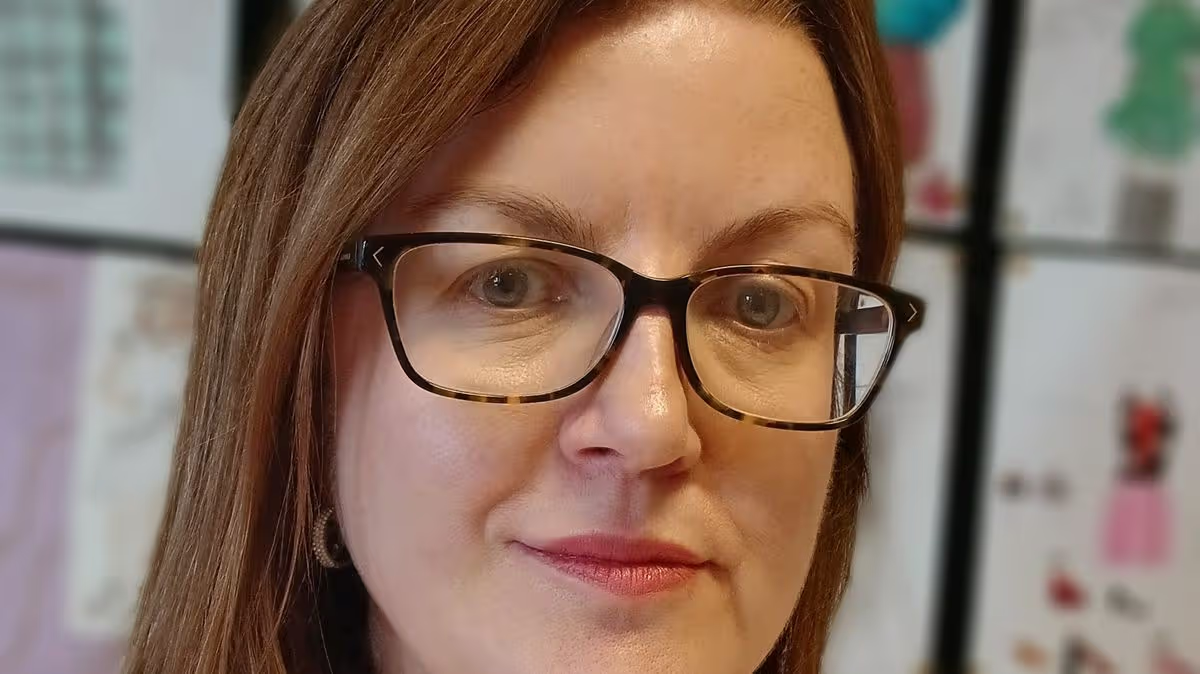
“Teaching history has always been far more than a career choice for me – it is a lifelong passion that I feel incredibly fortunate to share with my students every day.”
A Belfast teacher has been named the Northern Ireland winner of the inaugural Inspiring History Teaching Awards.
Advertisement
Elaine McPeake of St Dominic’s Grammar School was selected as the Northern Ireland winner for her outstanding creativity in the classroom and her unwavering commitment to sparking a lifelong love of history among her students.
Judges praised Elaine’s “real love for her subject,” noting that “her passion was infectious,” and highlighting her creativity and dedication to her pupils.
Created by Historic Royal Palaces (HRP), the awards, which recognise educators who bring history to life in innovative and inspiring ways, received thousands of nominations from pupils, parents and colleagues across the UK.
Advertisement
With more than 20 years at St Dominic’s Grammar School on the Falls Road in West Belfast, Elaine has inspired generations of young people through immersive and imaginative learning experiences. Her classroom regularly transforms into vivid scenes from the past – from Anne Frank’s bedroom and First World War trenches to Renaissance ‘Dragon’s Den’ challenges, where students pitch their new inventions in a bid to generate interest and investment.
Her impact extends far beyond the classroom. In 2025, Elaine worked with pupils to create a ‘museum of childhood’, where students researched toys from different eras and collected oral histories from staff. The exhibition gained widespread attention and was later showcased at the Ulster Museum, bringing students’ work to a public audience and highlighting the power of hands-on, creative history education.
Elaine also plays a leading role in extracurricular learning, running a History Club, after-school study sessions and creative workshops, as well as organising trips to significant historical sites locally and internationally. These include visits to Auschwitz as part of Holocaust studies and local landmarks such as Carrickfergus Castle, helping students connect deeply with both global and local histories.
Elaine said: “I am absolutely honoured to be named the Northern Ireland winner of the Inspiring History Teaching Awards. It is a great privilege to receive recognition for the role that history teaching plays in shaping young minds, and for a subject that I have loved since childhood.
Advertisement
“Teaching history has always been far more than a career choice for me – it is a lifelong passion that I feel incredibly fortunate to share with my students every day.
“Almost 30 years ago, I began teaching at St Dominic’s Grammar School, a Dominican school with a long and rich history in Belfast, and over that time I have had the privilege of working alongside many inspirational educators and young people.
“As a school, we are committed to encouraging our students to develop a genuine love of learning, to think independently and to ask questions, rather than simply absorbing information. That ethos has continually shaped my own approach to teaching and strengthened my determination to foster a deep appreciation of history across the school community.
“I firmly believe that history is best brought to life through creativity and hands-on experiences, and it is incredibly rewarding to see students engaging with the past in ways that spark their curiosity and imagination. This recognition means a great deal to me, and I am sincerely grateful to my colleagues, pupils and to Hillsborough Castle and Gardens for their ongoing support.”
Advertisement
Hillsborough Castle and Gardens head Caroline Walker said Elaine is a truly deserving winner whose passion for history shines through in everything she does.
She added: “Her creativity and commitment to bringing the past to life – from immersive classroom experiences to inspiring projects like the museum of childhood – demonstrate the powerful impact great teaching can have on young people.
“The Inspiring History Teaching Awards are about recognising educators who go beyond the curriculum to make history engaging, inclusive and meaningful for their pupils. At Hillsborough Castle and Gardens, we are proud to celebrate educators like Elaine who are helping students across Northern Ireland connect with their heritage, think critically, and develop a lifelong curiosity about the world around them.”
As the Northern Ireland winner of the Inspiring History Teaching Awards, Elaine will receive £500 for herself and £500 for St Dominic’s Grammar School, along with annual memberships to Historic Royal Palaces and the Historical Association. She will also have the opportunity to become a Historic Royal Palaces Teacher Champion.
Advertisement
Elaine is one of ten regional winners from across the UK and will attend a prestigious awards ceremony at the Tower of London on Saturday, June 20, where one overall winner will be announced.
The overall winner will be determined by a judging panel led by much-loved historian and broadcaster Lucy Worsley, who launched the awards in October 2025, and includes some of the UK’s most respected historians, educators and writers: Greg Jenner, Sathnam Sanghera, Dan Jones, Shalina Patel, Katie Hunter and Michael Riley.
Want to see more of the stories you love from Belfast Live? Making us your preferred source on Googlemeans you’ll get more of our exclusives, top stories and must-read content straight away. To add Belfast Live as a preferred source, simply click here.
A Cambridgeshire carer credits an NHS AI physiotherapist programme with saving her from paralysis after it flagged symptoms of cauda equina syndrome, a rare spinal condition affecting up to three in 100,000 people
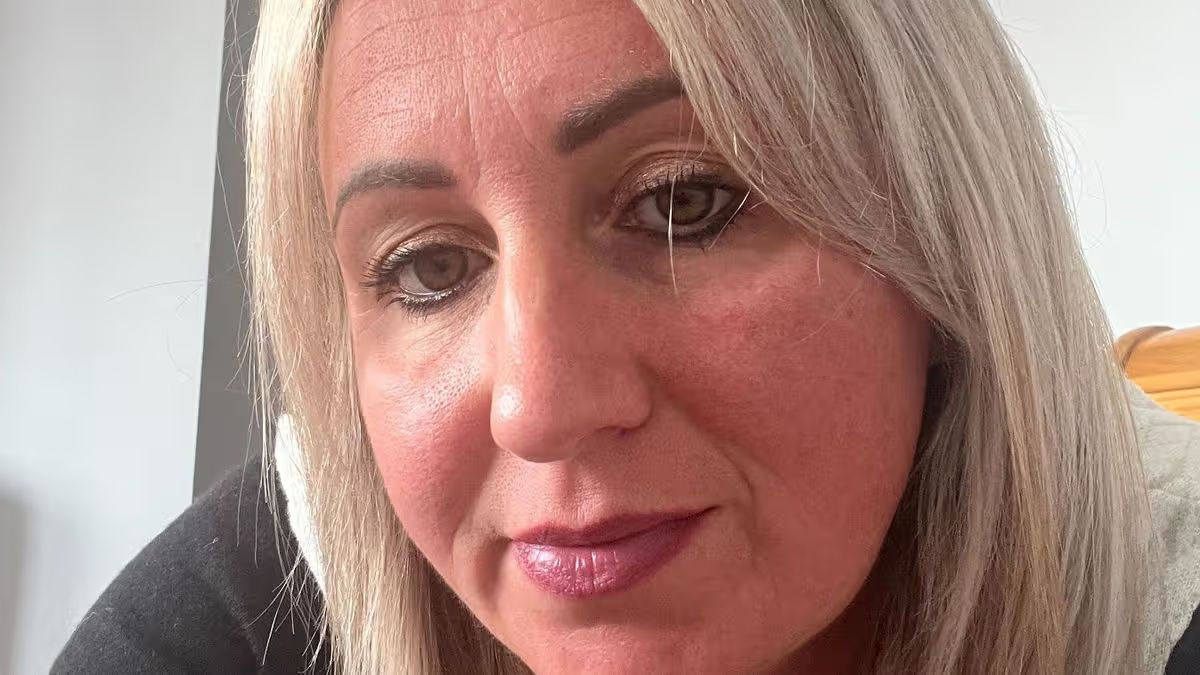
A 47-year-old woman from Cambridgeshire has spoken of the “unbearable pain” she endured – to the point where she wished someone would amputate her “leg off” – before receiving a rare diagnosis that affects up to three in 100,000 people through an AI physiotherapist.
Advertisement
Amie Smith, a carer, said she first experienced lower back pain on Sunday April 20, 2025. Initially, she tried to manage it with painkillers, but within days, the pain had escalated to “excruciatingly painful” levels and had spread down her body into her legs.
The mother of three secured an urgent GP appointment on Tuesday April 22 and was referred to an AI physiotherapist programme named Flok Health, which was being trialled by the NHS trust in her area.
Following a consultation with the AI-powered physiotherapist, Amie received a call on Monday April 28 from Kirsty Henderson, senior physiotherapist at Flok Health. Henderson suggested that Amie might be suffering from cauda equina syndrome, a condition characterised by compression of the spinal nerves at the tail end of the spinal cord. If left untreated, this can lead to paralysis and incontinence, according to the NHS.
The following day, Amie was rushed to hospital where she underwent an MRI scan and was diagnosed with the condition. This led to a five-hour emergency lumbar decompression surgery on May 1.
Advertisement
Speaking to PA Real Life, Amie said: “Initially, I thought (an AI physiotherapist) is not very personal. I felt like I was probably talking to a robot that couldn’t really help me.
“But, actually, if it wasn’t for that process, I wouldn’t have gotten the help that I did, and ultimately I would have had a lot more damage.
“I think there’s a lot of people in my generation and upwards that are very negative (about AI), but I’m really quite thankful for it,” she added.
Advertisement
Following a fibromyalgia diagnosis in 2018 – a chronic condition that causes pain throughout the body – Amie said she has lived with discomfort ever since, but what she experienced in April 2025 felt “completely different”.
Amie said: “I’ve always suffered with back pain, but this was excruciatingly painful.
“I left it for a few days thinking that if I just take pain relief and I carry on, I should be fine. But it just gradually got worse.”
Amie arranged a telephone consultation at her GP surgery on Tuesday, April 22, but she said the doctor “automatically” wanted to “blame” her new pain on her fibromyalgia, despite Amie’s insistence that it was “different” and that she was really struggling to walk by that point.
Advertisement
Amie said she was directed to the Flok Health app, which was introduced in February 2025 by Cambridgeshire Community Services NHS Trust (CCS) as a means to help reduce NHS back pain waiting lists. She didn’t initially use Flok, because she didn’t think it was “very personal”, so when her pain worsened she opted instead to request an e-consult from her GP, which she didn’t hear back from. Amie said she submitted another one the next day and when she didn’t get a response from that one too, she decided to give Flok a go on Friday, April 25.
According to Flok Health, patients receive an invitation to complete an automated video call assessment and during this consultation an AI-powered physiotherapist will evaluate their symptoms to determine the right treatment.
It was during this consultation that Amie said the AI physiotherapist flagged her symptoms and lack of movement as serious, so encouraged her to go to A&E, where she was prescribed muscle relaxants and was sent home.
By Monday, April 28, Amie said she was “beside” herself in pain and she hadn’t heard anything back from her e-consult requests, but then her phone rang around 5pm. She said she was “pleasantly surprised” to receive an hour-long telehealth appointment with Kirsty Henderson from Flok, calling to see how she had got on at the hospital.
Advertisement
Amie said: “I described everything to her and I just felt like she was able to do what nobody else had: Give me time to tell exactly how this is affecting me and what’s happening.
“Straight away, she said that I definitely needed an MRI.
“She explained to me that it could be something called cauda equina, and that getting help urgently is essential because the longer it goes on, the more damage that can be done.
Advertisement
“That was the first time out of all the people I spoke to that anybody actually told me that I was at risk,” she added.
After gaining the confidence from Kirsty to advocate for herself, Amie said she contacted her GP the next morning, but didn’t make any progress. Consequently, a friend of Amie’s took her back to A&E, where she said doctors noticed she was “extremely upset” so they checked her blood pressure and found it was “really high”.
Amie stated she was taken “straight through” to being admitted and saw a doctor who conducted some initial tests and immediately sent her for an MRI scan. Within hours, Amie said an orthopaedic doctor described it as a “really bad situation” where her discs had slipped and they were trapping the nerves – something she later discovered in her GP’s notes as cauda equina syndrome.
Half an hour later, Amie said she was in the back of an ambulance being transferred to a nearby specialist hospital, where she spent a couple of days, until she informed a doctor that the back of her leg was numb so she was rushed into a five-hour lumbar decompression surgery on May 1.
Advertisement
Since the operation, Amie said her pain has eased but she has had to make some “adaptations” because she still doesn’t have full use of her left leg, such as driving her son’s automatic car instead of her manual one. She said she also struggles to walk for extended periods.
Mike Passfield, the deputy director from Cambridgeshire Community Services NHS trust, told PA Real Life: “The new AI-assisted approach is having a significant impact in our region, enabling thousands of patients to get faster access to expert physiotherapy support.
“Not only is the technology capable of treating and discharging patients at scale, but its red flag system means patients with more serious or extremely rare conditions are identified and directed to the right human-led service quickly to get the appropriate care.
“During a pilot of Flok Health in Cambridgeshire last year, we cut waiting lists by more than half. Thousands more people are getting immediate access to support thanks to the new approach, transforming the way we deliver physiotherapy,” he added.
Advertisement
After everything settled down, Amie said: “I went back to Kirsty to really thank her because I honestly felt like she was the only person that actually listened.
“She realised the red flags, talked me through it, explained the risks and what she was concerned about, and even gave me advice on how to try to get the doctors to help me.
“Now I can see that every 24 hours that was going by, more damage was being done to my body.
“That damage is still here today to a point, but had I not spoken to Kirsty and then gone on to follow what I’ve been told to do, I probably would have been unable to walk.
Advertisement
“I feel like I owe a lot to Kirsty. She made a huge difference,” Amie said, still surprised by how it all “started” with an AI physio.
Manchester United are still aiming to have their new stadium built and ready to host the 2035 Women’s World Cup final.
It is more than a year since the club’s co-owner Sir Jim Ratcliffe unveiled grand plans for a 100,000-seater venue close to the site of their current Old Trafford home.
At the time, Ratcliffe spoke of trying to get construction down to a five-year timescale, which raised expectations about how quickly the project would begin.
However, as has been pointed out privately, at that point the club did not have the land to build on, the plans were not in place and there was no detailed business case.
Advertisement
The five years, in actuality, starts from the point at which United get the green light to put spades in the ground.
“We did say it would take between four and five years for construction,” Collette Roche, newly appointed by United as the chief executive of their New Stadium Development, told the club’s Inside Carrington podcast.
“People read that as we might have the stadium ready for 2030. But it does take one or two years to get ready for construction; to get the land assembled, to get the funds in place and to get the planning permission.
“That’s the part that we’re doing right now. We’ve not named a date for opening, but we are on track within those timescales.”
Advertisement
United sources had previously told BBC Sport the aim was to host the 2035 showpiece. That private message has now been repeated as Roche told MUTV: “Our plan is to be able to host other international sporting events and entertainment events.
“Andy Burnham, the mayor, said his ambition would be for us to host the final for the Women’s World Cup in 2035, so if we could pull that off, that would be incredible.”
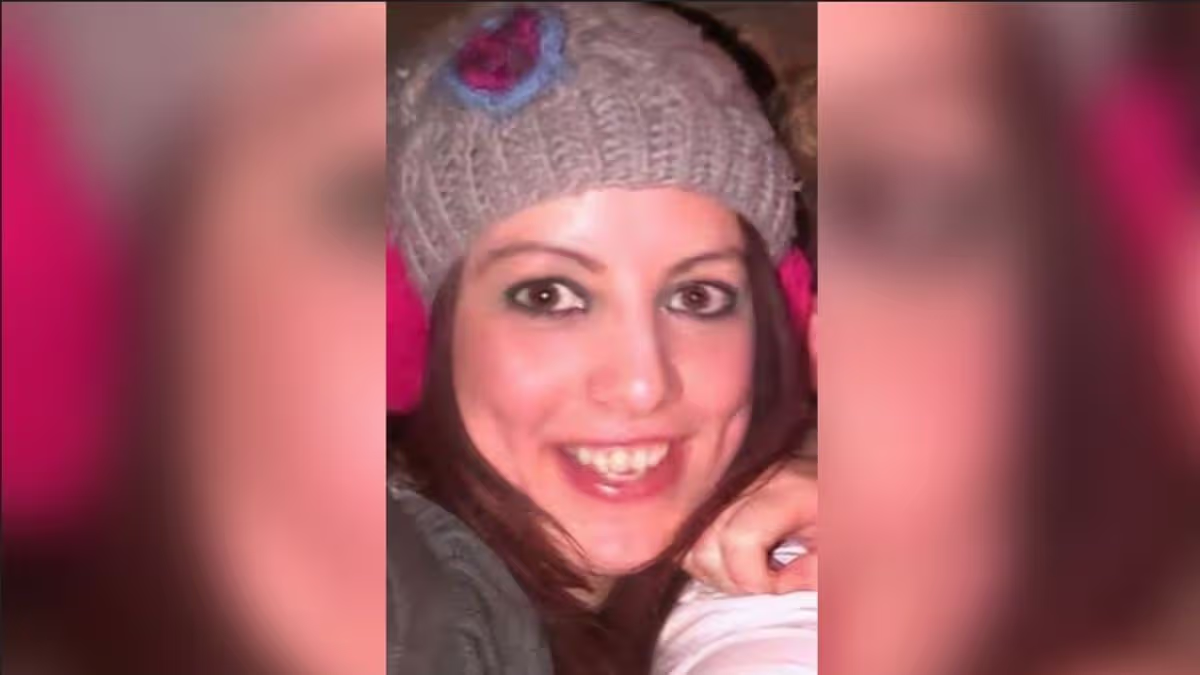
Laura Stanley was reported missing months before her body was discovered in Chorlton Water Park
Greta Simpson Senior Reporter
22:38, 24 Mar 2026Updated 22:40, 24 Mar 2026
It took a week to report her missing. Two months before her body was discovered. Another eight before anyone recognised her. A year before her name was released.
On a chilly spring morning almost exactly two years ago, a dog walker passed through a scenic park in a south Manchester suburb. Close to the water’s edge, they made the most horrible of discoveries.
A woman’s body was discovered floating in the River Mersey as it passed through Chorlton Water Park on March 21 2024.
Advertisement
She wore nothing other than a bright green Primark corset top, black New Look jeans, and distinctive dark green anti-slip socks of the type used in care facilities. There was no jewellery, no tattoo, no bank card or driving license to say who this woman might be.
For months, her identity remained a mystery. Police shared photos of the woman’s clothing in the hopes that it might jog someone’s memory, as they combed national and international databases of missing and vulnerable persons, looking for a match.
In the end, the answer lay less than five miles away.
Nottingham-born Laura Michelle Stanley was last seen at Stockport Homes’ Cornerstone offices in Stockport town centre on January 5 2024, an inquest into her death heard today (March 23).
A vulnerable woman with a history of mental health issues, Manchester City Coroner’s Court heard the 38-year-old had been taken to hospital the day before (January 4 2024) after being found in a state of distress on the M60 motorway, with drivers narrowly avoiding hitting her.
Giving evidence, Detective Chief Inspector Louise Edwards told the court that Laura was released from hospital the same day and given accommodation at Strathclyde House, temporary accommodation managed by Stockport Homes, where she spent the night.
The next day Laura met with a Stockport Council housing officer at their Cornerstones office, just off the A6, a busy road in Stockport town centre. There, she made disclosures that she had been the victim of domestic violence before Christmas, the court heard.
Advertisement
“She said she had been staying with a man she was in a relationship with,” Det Chief Insp Edwards said. “She claimed he had been physically and emotionally abusive to her.
“Laura told the officer there had been incidents involving a man strangling her. She was frightened of him and had not been taking her medication. She had been having suicidal thoughts and had tried to jump off a bridge in Stockport.”
That meeting on January 5 would be Laura’s last sighting. The housing officer was the last person to see her alive.
GMP were said to have since investigated the man for allegations of controlling and coercive behaviour, but no charges were brought.
Advertisement
It would be another week before Laura was eventually reported missing on January 12. But the court later heard that a Stockport police sergeant had ‘closed her file’ without Laura having been seen again.
“This has now been referred to police professional standards,” said Det Chief Insp Edwards. “If that had not happened, we could have identified her much more quickly.”
She was eventually retrieved from the River Mersey approximately four miles away from her last sighting on the morning of March 21, 2024. But it would be nearly a year before anyone would know her name.
Advertisement
Despite several public appeals, and extensive work by Greater Manchester Police, there were months of silence. Nobody came forward; no-one seemed to know who this woman was.
In November, eight months on, police issued another appeal. As releasing images of the woman’s clothing had born no fruit, Greater Manchester Police issued a digital reconstruction of her face.
Reporters were invited down to the spot where the body was found. Standing on a chilly bank, it became clear that the search was extending far beyond Greater Manchester.
“The River Tame travels through Tameside and the Goyt through Derbyshire and into Manchester, and both form the Mersey,” Det Insp Edwards said at the time.
Advertisement
“It could be that she entered the water somewhere else and she’s come downstream where she was discovered.”
The force were said to be looking at national and international databases, and liaising with police partners in Europe. There was even a mooted theory that this woman had been trafficked into Britain, possibly from Eastern Europe, so anonymous did she seem.
The reconstruction of her face was released to the media on November 29. Another three weeks later, it would turn up a match.
“On December 18, 2024, a Mr Collins contacted GMP to report that the reconstruction resembled his ex-sister-in-law, Laura Stanley,” said senior coroner Zack Golombeck. “We’re extremely grateful to him for his assistance.
“He provided a photo taken some years earlier and assisted in identifying her. DNA samples were also obtained from her two daughters which provided extremely strong forensic support that the deceased was their mother.”
Laura’s identity was made public in March 2025. At the inquest, the coroner asked Det Chief Inspector Edwards for her opinion on how Laura died.
“One hypothesis is that she took her own life,” she said. “But we can’t confirm that, nor whether any assault caused her death. We are just not sure.”
Advertisement
Mr Collins, who was the only representative for Laura’s family present at the inquest, then spoke up. “She suffered with mental health issues her whole life and she had suicidal thoughts,” he told the court.
“But she always sought help and never hurt herself. I think it’s unlikely that she took those steps instead of seeking help.”
He also took issue with Laura’s release from hospital the same day she was spotted on the M60. Mr Golombeck acknowledged his point but advised him to complain to the hospital trust, citing the ‘lack of evidence that [her death] was an intentional act’.
A Home Office post mortem was carried out the day after she was discovered on March 22, after police and coroners’ officers agreed that a forensic autopsy was required.
Advertisement
But pathologist Dr Phillip Lumb’s findings were inconclusive, due to the decomposition which had already taken place. Detectives believed her body to have been in the water ‘for a month or two’ when she was discovered.
“His investigations of the organs were limited,” said Mr Golombeck. “A toxicological assessment was not possible.
“There were no definite injuries to the neck muscles. There was some haemorrhaging of the soft tissue to the upper part of the larynx, which might have been related to decomposition or sustained through injuries.
Advertisement
“Pressure to the neck cannot be excluded. Signs of drowning were minimal and may have been lost due to decomposition – this cannot be excluded either.”
Mr Lumb was also unable to say whether Laura had died before entering the water, or ‘as a consequence of immersion’. The medical cause of death was recorded as unascertained.
“It cannot be said either way what happened,” Mr Golombeck remarked. “Her daughters simply do not know how their mother died and may never know.”
Giving his conclusion, and acknowledging the ‘substantial amount of work’ undertaken to identify Laura, Mr Golombeck returned an open verdict. Mr Collins said that this was ‘the conclusion he had come to himself’.
Advertisement
“There are a number of probabilities put forward, but none cross the threshold of being probable,” Mr Golombeck said.
“She had a history of mental health issues. I cannot be satisfied that she intended to take her own life, or that she went into the water by accident.
“I cannot be satisfied whether there were drugs or alcohol involved; or if there was a third party. It is a last resort, and I do not do so lightly, but I must return an open conclusion.”
As it was ‘not possible’ to say when and where she died, Mr Golombeck recorded the time and place of her death as March 21 2024 at Chorlton Water Park.
The inquest concluded with Mr Golombeck thanking Mr Collins for attending the hearing and for helping identify Laura. “Please pass my sincerest condolences to her family,” he finished.
Paying tribute to her last March, Laura’s family said: “Laura was a kind and gentle person with a great sense of fun and adventure. She was generous, thoughtful, caring and always keen to volunteer within the community.
“Laura was a proud and loving mum and she will be greatly missed by her girls and all of her friends and family who loved her dearly.”
It took less than a minute for a routine landing to spiral into a deadly crash Sunday at New York‘s LaGuardia Airport. But the collision between an Air Canada flight and a fire truck crossing the runway was the culmination of a series of events that began much earlier.
The Associated Press created this timeline based on a review of air traffic control recordings and information from the Federal Aviation Administration, publicly available flight tracking data and the National Transportation Safety Board, including information it obtained from the jet’s cockpit voice recorder.
A late departure from Montreal
10:12 p.m.: Air Canada Express Flight 8646, operated by Jazz Aviation, leaves Montréal–Trudeau International Airport, two hours and 13 minutes late. By the time the aircraft reaches New York, it is part of an influx of late-arriving flights, including some waiting extended periods for a gate.
Advertisement
Issues on the ground at LaGuardia
11:16:42 p.m.: A United aircraft, Flight 2384, aborts takeoff for a second time because of an anti-ice warning light in the cockpit.
11:20:48 p.m.: “We have an odor on the plane as well here at this time,” the United pilot reports. “We are going to be going back to the gate, request fire as well,” using shorthand for the airport’s fire rescue team.
11:21:12 p.m.: Another pilot chimes in: “If that’s a sewer smell … we smelled that too going around the terminal there.”
Advertisement
11:22:24 p.m.: A controller asks the United pilot if it is a smoke odor. He responds: “No, it was a weird odor. I don’t know exactly how to describe it,” and says he can’t get ahold of anyone to obtain a gate assignment.
11:24:49 p.m.: The controller confirms there is no gate available. He asks the pilot, “Do you still need us to send fire there?” The pilot says yes, citing the odor.
11:27:44 p.m.: United 2384’s pilot tells the controller he doesn’t plan on evacuating the plane. The controller instructs the pilot to move to another taxiway.
11:29:54 p.m.: United 2384 makes a wrong turn and ends up in a different part of the taxiway, but the controller doesn’t sound concerned. “You can just stay over there … and we’ll have the guys go over there,” he says.
Advertisement
11:31:41 p.m.: United 2384 declares an emergency. The pilot says: “The flight attendants in the back are feeling ill because of the odor. We will need to go into any available gate at this time.”
11:31:59 p.m.: The controller asks again if there’s an available gate, telling the person he’s speaking with, “now they’re declaring an emergency. They want to get out.”
11:33:39 p.m.: The controller tells United 2384 there is still no open gate, but fire trucks are headed over with a stair truck if they want to evacuate. “Let me know if you do,” he says.
Flight 8646 is cleared to land
Advertisement
11:34:18 p.m.: In a routine step near the end of a flight, the air traffic controller handling approaches into LaGuardia instructs the pilots of Air Canada Express Flight 8646 pilots to contact the airport’s control tower, which will guide them the rest of the way.
11:35:08 p.m.: Flight 8646 is cleared to land on Runway 4/22.
Fire truck is cleared to cross
11:36:45 p.m.: At the airport, a controller asks: “Is there a vehicle that needed to cross the runway?”
Advertisement
11:37:00 p.m.: “Truck 1 and company, LaGuardia Tower, requesting to cross 4 at Delta,” the firefighter says, meaning he is requesting clearance to use Taxiway D to cross Runway 4 — the same runway where Flight 8646 is about to land.
11:37:05 p.m.: “Truck 1 and company cross 4 at Delta,” the controller says, authorizing the truck and other emergency vehicles to cross Runway 4. Simultaneously, on a different frequency, the pilot on the odor-stricken United flight reports that his plane has finally been cleared to go to a gate.
11:37:08 p.m.: “Truck 1 and company crossing 4 at Delta,” a firefighter in Truck 1 repeats, confirming that the controller has cleared the vehicle to cross.
11:37:11 p.m.: An electronic call out in Flight 8646’s cockpit indicates the plane is 50 feet above the ground.
Advertisement
11:37:12 p.m.: A controller tells the pilot of an outbound Frontier Airlines flight to stop on a taxiway.
Flight 8646 lands and collides with the fire truck
11:37:15 p.m.: “Sorry, Truck 1,” a controller says as Flight 8646 bears down on Runway 4/22.
11:37:16 p.m.: A controller then frantically tells the fire crew: “Stop. Stop Stop. Stop. Truck 1. Stop. Stop. Stop. Stop.”
Advertisement
11:37:17 p.m.: Flight 8646’s cockpit voice recorder captures a sound that investigators say is consistent with the plane’s landing gear touching down..
11:37:19 p.m.: Flight 8646’s first officer, who was flying the plane, transfers control to the captain.
11:37:20 p.m.: The controller continues, “Stop Truck 1. Stop. Stop Truck 1. Stop.” As he speaks, an alarm begins to beep.
11:37:25 p.m.: Flight 8646 slams into the fire truck. The cockpit voice recording stops.
Advertisement
Aftermath
11:37:45 p.m.: A controller tells the pilot of the next plane set to land to “go around,” meaning he should keep flying instead of landing.
The controller then tries to raise the pilots of Flight 8646. “I see you collided with a vehicle there. Just hold position. I know you can’t move. Vehicles are responding to you now.” Other rescue vehicles race to the crash site.
11:55:37 p.m.: The pilot of another plane tells a controller: “That wasn’t good to watch.” The controller responds: “Yeah, I know. I was here … We were dealing with an emergency earlier. I messed up.” The pilot says: “Nah, man, you did the best you could.”
The flight bound for Torp, Norway left the airport an hour after is scheduled departure
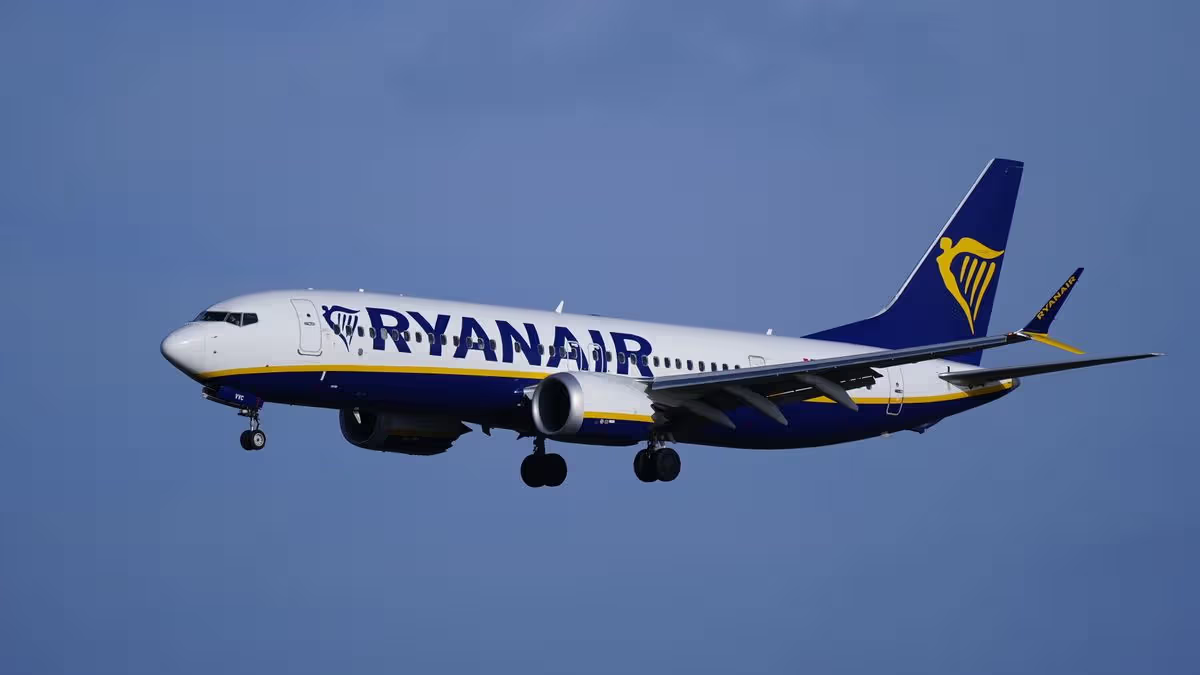
A flight departing from Manchester Airport sparked concern after declaring an emergency mid-air and turning back shortly after take-off.
Advertisement
The Ryanair service, Flight RK3226, left Manchester at 8.39am, almost an hour behind its scheduled departure, bound for Sandefjord Airport, Torp, in Norway.
The aircraft, a Boeing 737-800, appeared to be progressing normally during the early part of the journey. However, around 40 minutes into the flight, while cruising at 37,000 feet over the North Sea, the crew issued a Squawk 7700, the international code indicating a general emergency.
Get MEN Premium now for just £1 HERE – or get involved in our WhatsApp group by clicking HERE. And don’t miss out on our brilliant selection of newsletters HERE.
A spokesperson for Ryanair said: “This flight from Manchester to Oslo Torp (24 Mar) diverted back to Manchester due to a minor technical issue with the aircraft. To minimise disruption, we arranged for a replacement aircraft to operate this flight to Oslo Torp.
“This flight departed for Oslo Torp at 11:21am local time.”
Less than a year ago, Salah was sitting on a throne inside Anfield after renewing his contract and signing a deal until the summer of 2027.
His previous deal was set to expire in the 2025 but, given his numbers last season, where he topped the goalscoring and assist charts in the Premier League, the Liverpool hierarchy had no choice but to offer him a new deal.
Those close to Salah say he was always going to speak at Elland Road, regardless of the result, and that his initial discontent had started when he was benched for a Champions League game away at Eintracht Frankfurt in October, a match Liverpool won 5-1.
Advertisement
Slot admitted it was a difficult decision but it didn’t sit right with Salah, who believed he should be starting every Premier League and Champions League game, given what he had done for the club.
Put simply, that was the first seed that Salah would no longer be a guaranteed starter and, given Liverpool‘s summer outlay of £450m including Alexander Isak, Florian Wirtz and Hugo Ekitike, the direction of their attacking strategy was clear. Salah knew he would no longer be the main man.
In the weeks leading up to that explosive interview, he was left upset after meetings with the Liverpool hierarchy, including sporting director Richard Hughes, where it was outlined that he could be benched.
His punishment for the interview was being left behind for the trip to Inter Milan but, three days later, Salah came off the bench against Brighton and got an assist – with Slot saying post-match there was “no issue to resolve”.
Advertisement
From there, the Egyptian travelled to the Africa Cup of Nations while the club held talks with his agent Ramy Abbas and, when Salah returned to England in January, those close to the situation felt a verbal agreement was in place for both player and club to part ways this summer.
Last month, BBC Sport reported that a summer departure was increasingly likely.
Collagen supplements have become one of the bestselling products in the wellness industry, promising everything from smoother skin to stronger joints. But do they actually work?
A major new review of the evidence – pulling together data from 113 clinical trials – suggests that, for some health outcomes, the answer is probably yes. But as ever with nutrition science, the full picture is more complicated.
Collagen is a protein the body makes naturally. It gives skin its structure and elasticity, supports bones and muscles, helps wounds heal and plays a role in protecting organs. The problem is that production slows as we age, which is why so many people turn to supplements to top it up.
Not all collagen is the same, though. The collagen found naturally in food may be less well absorbed than the smaller forms used in most supplements. These hydrolysed forms – where the protein has been broken down into shorter chains called peptides – are thought to pass more readily into the bloodstream and making it easier for the body to transport these fragments to tissues where they may have biological effects, potentially supporting skin, joint and muscle health.
Advertisement
The new review examined research published up to March 2025, drawing on 16 systematic reviews that between them included nearly 8,000 participants. The overall picture was cautiously positive.
Collagen supplementation was linked to moderate improvements in muscle health and reduced pain in people with osteoarthritis. There were also improvements in skin elasticity and hydration – though these benefits built up gradually, suggesting that taking collagen consistently over a longer period matters more than a short-term burst.
Some of the findings were less clearcut. Results for skin elasticity and hydration shifted depending on when the studies were conducted, with newer research showing lower improvements in elasticity but greater improvements in hydration. That inconsistency is worth noting – it suggests the science is still settling.
The quality of the research itself is also worth scrutinising. The studies used a wide variety of methods, doses and ways of measuring outcomes, which makes direct comparisons difficult.
Advertisement
Fifteen out of the 16 reviews included were rated as low or critically low quality – not necessarily because the supplements don’t work, but because of methodological problems such as studies not being registered in advance and poor reporting on potential biases. Many trials were also short and included few participants, which limits what we can reliably conclude about long-term effects.
Not all collagen is equal
Part of the problem is that collagen supplements vary enormously. Some are derived from animals, such as cows, pigs and chickens, and others come from marine sources, including fish, jellyfish and shellfish. There are even so-called “vegan” collagen alternatives. Some studies used oral supplements, while others tested collagen dressings applied to the skin.
The way collagen is processed also affects the size and composition of the peptides in the final product, which in turn influences how it behaves and is absorbed in the body. Lumping all these different products together in a single analysis risks obscuring as much as it reveals.
Collagen supplements vary a lot. New Africa/Shutterstock.com
Individual differences matter too. Factors such as sun exposure, smoking, sleep quality, environment and hormone levels all affect how skin ages and how it might respond to supplementation. If studies fail to account for these variables, it becomes very difficult to know whether any observed changes are genuinely due to the collagen or simply reflect differences in participants’ lifestyles.
Advertisement
This review adds to a growing body of evidence suggesting collagen supplements are not simply expensive placebos. There appear to be real, if modest, benefits – particularly for skin hydration, joint pain and muscle health.
The research base still has significant gaps. Without more rigorous, standardised studies, it remains genuinely difficult to say what is driving those benefits, or who is most likely to see them. Studies need to clearly specify the type of collagen used, the dose, how it was delivered and the characteristics of the people taking it.
















































You must be logged in to post a comment Login