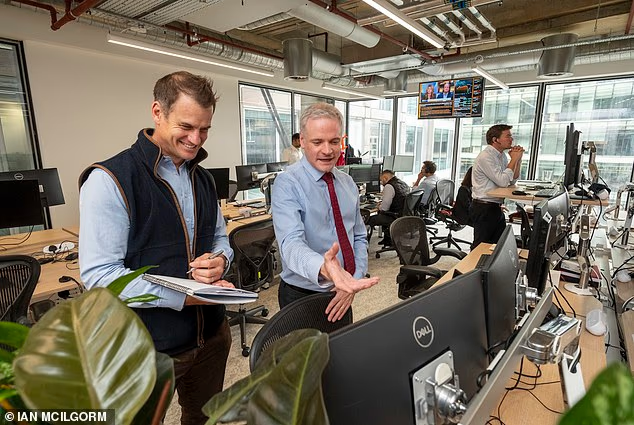
On the 6th floor of a gleaming office overlooking the Barbican, where square-jawed men wear gilets and bark into telephone headsets, the endless computer monitors are a sea of red.
It’s Thursday morning at the City of London HQ of IG Group, a FTSE 100 firm where 600 staff run one of the UK’s best-known financial trading and investment platforms. All week long, fear has stalked the market.
‘The more prices move, the noisier it gets,’ is how IG’s chief analyst Chris Beauchamp describes the office vibe. ‘Tuesday was relatively volatile. In fact, it was probably the noisiest day since Trump invaded Iran.’
At the bank of desks in front of me, IG’s staff are helping clients buy and sell everything from stocks and shares to bonds, funds, commodities and currency. Elsewhere in the building, they trade cryptocurrencies. A gargantuan volume of transactions, worth tens of billions of pounds, pass through the company’s platform daily.
IG’s revenues, derived largely from small commissions levied on each transaction, were more than £1.1billion last year. Put another way, this bustling, air-conditioned office represents one of the financial industry’s engine rooms. When markets move, phones start to ring.
All of which brings us back to that ‘relatively volatile’ Tuesday. It was the day Andy Burnham made his first Commons speech as Prime Minister, setting out what you might call an old-fashioned Left-wing vision for the country that will involve ‘stronger public control’ of the economy.
In Parliament, at least on the Labour benches, his talk of unwinding Margaret Thatcher’s legacy – while splurging cash on unreformed public services and protecting the benefits system from ‘crude cuts’ – was met with a predictably enthusiastic response.
Yet two miles down the Thames, in London’s turbocharged financial district, Burnham’s Mancunian brand of socialism immediately collided with cold, hard economic reality.
The Daily Mail’s Guy Adams in the City with IG’s chief market analyst Chris Beauchamp
Prime Minister Andy Burnham and his Chancellor John Healey face an uphill battle with bonds
It revolves around a simple fact: Britain’s Government is already spending £1,368billion a year (the equivalent of £48,000 per household) yet raising only £1,235billion (£43,000 per household) in tax.
The difference between these two figures, the annual ‘deficit,’ is £133billion. And to cover that sum, we must borrow money. Every pound we borrow has, for years, been adding to a mountain of public debt which is now valued at more than £3trillion – that’s 3,000 billion pounds.
Last year, merely paying interest on that huge sum – what the industry calls ‘servicing our debt’ – cost taxpayers £130billion. That is more than twice the amount we spent on defence and almost £10billion more than the cost of our education system.
This year the deficit will be significantly bigger, depending on exactly how profligate Mr Burnham ends up being. The more it grows, the higher the risk becomes that Britain’s Government may one day find itself unable to pay its debts. The greater that risk, the more reluctant lenders become to buy our bonds and the higher the interest rates they demand in return.
Andy Burnham’s speech, which was broadcast via rolling news channels on trading floors across the City, illustrated this phenomenon in real time. At the start of the week, the interest rate (yield) on the 30 Year Gilts, the form of bond UK governments use to issue debt, had been 5.7 per cent. By 3.38pm, when the PM walked up to the dispatch box, the price lenders were demanding hit 5.84 per cent.
At 4pm, when he finished speaking, it was 5.85 per cent. By the time markets had closed that afternoon it had reached 5.92 per cent, peaking at 10am on Wednesday at 5.94 per cent. That’s the highest level since 1998. These may sound like tiny moves but they have massive implications. Not least since the figure has already risen from 4.6 per cent when Labour came to power in 2024.
Each time the ‘yield’ ticks up by one per cent, the cost of servicing Britain’s debt rises by around £16billion a year. Thanks to this phenomenon, economists at Bloomberg reckon our new Chancellor, John Healey, has already lost £12billion of the £23.6billion in ‘headroom’ (effectively cash in the bank to pay bills) bequeathed by Rachel Reeves.
To make up that cash, Healey must now either increase taxes, which are already at historic highs, or cut spending, which Labour backbenchers (who have voted against even minor tweaks aimed at reducing our spiralling benefits bill) refuse to countenance. Should neither prove palatable, the only other option would be to borrow still more, at ever higher interest rates.
Guy found that there are fears in Britain’s financial sector the UK will be put in a recession
That may keep the wolf from the door. But it would also increase the cost of servicing our debt still further, driving up the deficit.
To put things another way, it would create a vicious circle.
This deepening trend is already hurting both consumers (whose mortgage and credit card interest rates mirror bond yields) and companies (who must also borrow to invest at increasingly elevated prices).
It’s also moving wider financial markets. The FTSE 250, made up largely of domestic stocks, fell by almost three per cent between Tuesday morning and Wednesday lunchtime. Although they recovered marginally towards the end of the week as gilt yields fell back from their peak – the red on IG’s computer scenes on Thursday showed the ‘Burnham panic’ subsiding somewhat – it has been a choppy few days.
Here in the City, there are fears that the whole thing will tip the UK into a recession that would damage public finances even more, causing yields of gilts (so named because they were once literal pieces of paper with gold leaf around their edges) to spiral further. Such a crisis could trigger the next great economic crash.
No one is sure when it might happen, or what the exact tipping point will be, but the bond markets are famously powerful beasts and even Left-leaning masters of the universe now take the view that their most important indicators are flashing red.
Take Lord (Jim) O’Neill, a former Goldman Sachs economist who was offered (and turned down) a job as Burnham’s economic advisor. He hit the airwaves this week to say the PM must ‘get real,’ saying his speech was the ‘last thing investors wanted to hear’ and calling on him to urgently ‘rein in’ spending.
Take, also, Rich McDonald, a former hedge fund manager who now hosts the IG Art Of Investing podcast. When we spoke this week, he likened Britain’s current relationship with the bond markets to that of a rugby team that finds itself battered, bruised and heavily under the cosh in the 75th minute of a test match.
A gargantuan volume of transactions, worth tens of billions, pass through IG’s platform daily
He tells me: ‘This isn’t a single episode. It’s a problem that has been building up and up through the ill-discipline of successive governments and the refusal to make difficult choices about spending that might be unpopular.
‘In the UK, we are getting to levels of bond yield that are simply unsustainable for continued economic growth because companies won’t be able to borrow and credit card and mortgage rates hammer consumers.’
At IG’s headquarters, Beauchamp shows me a striking chart on his monitor illustrating yields on 10-year UK Government bonds, a ‘variety’ which must be repaid within a decade. At the height of the Covid lockdown, it stood at 0.16 per cent, making Government borrowing virtually free.
As the world emerged from the pandemic and economists grappled with the long-term impact of that extra debt, it began to tick up.
In October 2022 – during the brief reign of Liz Truss, who announced massive tax cuts and an expensive energy bill cap without explaining how she might pay for it – they spiralled from two to four per cent in a matter of days.
Rishi Sunak’s arrival in Downing Street brought rates back down to three per cent, only for them to slowly rise to four by the time Keir Starmer won the 2024 election. They are now at 5.2 per cent.
As Beauchamp sees it, this is a long-term trend that will be very hard to reverse, not least since it’s being mirrored in other major economies, such as the US, Germany and Japan, where bond yields have also risen, despite being significantly lower than here. ‘The UK seems to want European levels of spending but American levels of taxation. You can’t have both,’ he says.
‘The Labour party of the last two years can’t seem to cut spending, despite having a huge majority. So you end up with what happened this week, when a small rise shaved off half the Government’s headroom.’
Our prospects bring to mind a quotation from Ernest Hemingway: ‘You go bankrupt very slowly and then quite suddenly.’
Luke Moore, IG’s Head Of Growth who looks after its most important clients, characterised this week’s events as the latest in a series of ‘speed crashes’ in the bond markets. ‘We have had three of four of these so far this year, where everyone gets very excited and the narrative is that the end is nigh but then the trade pulls back over the next few weeks,’ he says.
The big question, of course, is what happens when that ‘pull-back’ doesn’t materialise.
What is galling, to many who work at the sharp end of the financial markets, is how little even senior figures in the Labour Government seem to know or care about the looming crisis. Andy Burnham being a case in point. Less than a year ago, our new Prime Minister told an interviewer: ‘We have got to get beyond this thing of being in hock to the bond market.’
The remark caused bond yields to rise instantly. Angry Treasury sources briefed one news outlet that the comments had cost the Government around £1.5billion in fiscal headroom.
Shortly afterwards, the Left-leaning New Statesman magazine published a sobering article warning of a looming bond crisis.
It reported that at a recent meeting in No 10, a special adviser had piped up with the question ‘what are gilt yields?’ suggesting that ‘a government whose opponents were destroyed by the bond markets, and which is paying those markets £300million a day in debt interest, apparently employs people who have not taken five minutes to understand how they work’.
The article then quoted an investor who was betting on bond yields continuing to spiral due to the fact that ‘around 100 Labour MPs are prepared to rebel’ against any effort to cut public spending. The investor ‘thought it was reasonable to expect that this would add 75 basis points (or three quarters of a percentage point) to the interest on Government debt. Over the course of the Parliament, they said, this works out to an additional premium on debt of £1billion per rebel MP.’
Other investors are now making similar bets, believing that UK gilt yields will also be affected by global trends, including inflation caused by the Iran war, which has increased oil prices.
There’s also the fact that major corporations are being forced to borrow huge amounts of cash to invest in AI by issuing corporate bonds which means greater competition for funds and this, in turn, makes borrowing more expensive still.
Where exactly these trends now lead is anyone’s guess. But Chris Fellingham, a 40-year veteran of the bond markets, who has worked in senior roles for Blackrock, George Soros and Merrill Lynch, believes that without significant efforts to balance the country’s books, which will have to involve significant cuts to public spending, we are facing a sort of doomsday scenario.
It revolves around the fact that investors have historically faced a simple choice.
Stick cash in bonds and you will enjoy small but relatively safe returns. Buy stocks and you’ll tend to make higher returns in the end but volatility will be far higher.
Yet current trends mean that metric is on course to change.
‘For years, people have been able to make around four per cent a year in bonds and expect to get around double that by investing in stocks,’ he says.
‘But if bond yields were to rise to seven or eight per cent, the returns would be almost identical, so why on earth would you choose to buy equities or stocks anymore?’
If levels hit that point, Fellingham says, ‘people will respond by selling shares on a scale that causes a stock market crash.’ He adds: ‘That’s more or less what happened in the 1970s.
‘Andy Burnham has been saying that he wants the 70s back, wants to undo Thatcherism. But does he also want the 1976 IMF crisis back? Because that’s what will happen. I believe that without an urgent change of course, we are now in a death spiral. It could take years or it could take weeks but there will have to be a reckoning.’
One person who seems to think so is Tory leader Kemi Badenoch, who is perhaps understandably determined to talk up Burnham’s reluctance to cut Government spending in the face of a looming bond crisis.
Describing the Prime Minister as a man who ‘doesn’t know how to say no’ she declared this week that his Government ‘will run out of money,’ adding: ‘The problem with socialism is they always run out of other people’s money.’
In the City of London, many share that view.
And the question increasingly being asked is when, rather than if, Mr Burnham’s coffers will run dry.


























































You must be logged in to post a comment Login