WASHINGTON (AP) — The Trump administration on Thursday will revoke a scientific finding that long has been the central basis for U.S. action to regulate greenhouse gas emissions and fight climate change, the White House announced.
The Environmental Protection Agency will issue a final rule rescinding a 2009 government declaration known as the endangerment finding. That Obama-era policy determined that carbon dioxide and other greenhouse gases endanger public health and welfare.
President Donald Trump and EPA Administrator Lee Zeldin will “formalize the rescission of the 2009 Obama-era endangerment finding” at a White House ceremony, White House press secretary Karoline Leavitt said Tuesday.
The action “will be the largest deregulatory action in American history, and it will save the American people $1.3 trillion in crushing regulations,” she said. The bulk of the savings will stem from reduced costs for new vehicles, with the EPA projecting average per vehicle savings of more than $2,400 for popular light-duty cars, SUVs and trucks, Leavitt said.
Advertisement
The endangerment finding is the legal underpinning of nearly all climate regulations under the Clean Air Act for motor vehicles, power plants and other pollution sources that are heating the planet. It is used to justify regulations, such as auto emissions standards, intended to protect against threats made increasingly severe by climate change — deadly floods, extreme heat waves, catastrophic wildfires and other natural disasters in the United States and around the world.
Legal challenges certain to come
Legal challenges are certain for any action that effectively would repeal those regulations, with environmental groups describing the shift as the single biggest attack in U.S. history on federal efforts to address climate change.
“The Trump administration is abandoning its core responsibility to keep us safe from extreme weather and accelerating climate change,’’ said Abigail Dillen, president of the nonprofit law firm Earthjustice. “There is no way to reconcile EPA’s decision with the law, the science and the reality of disasters that are hitting us harder every year. Earthjustice and our partners will see the Trump administration in court.”
EPA press secretary Brigit Hirsch said the Obama-era rule was “one of the most damaging decisions in modern history” and said EPA “is actively working to deliver a historic action for the American people.”
Advertisement
Trump, who has called climate change a “hoax,” previously issued an executive order that directed EPA to submit a report on “the legality and continuing applicability” of the endangerment finding. Conservatives and some congressional Republicans have long sought to undo what they consider overly restrictive and economically damaging rules to limit greenhouse gases that cause global warming.
Zeldin, a former Republican congressman who was tapped by Trump to lead EPA last year, has criticized his predecessors in Democratic administrations, saying they were “willing to bankrupt the country” in an effort to combat climate change.
Democrats “created this endangerment finding and then they are able to put all these regulations on vehicles, on airplanes, on stationary sources, to basically regulate out of existence … segments of our economy,” Zeldin said in announcing the proposed rule last July. ”And it cost Americans a lot of money.”
Peter Zalzal, a lawyer and associate vice president of the Environmental Defense Fund, countered that the EPA will be encouraging more climate pollution, higher health insurance and fuel costs and thousands of avoidable premature deaths. The EPA is focusing solely on industry costs while ignoring the rule’s climate and health benefits, he and other advocates said.
Advertisement
Zeldin’s push “is cynical and deeply damaging, given the mountain of scientific evidence supporting the finding, the devastating climate harms Americans are experiencing right now and EPA’s clear obligation to protect Americans’ health and welfare,” Zalzal said.
Supreme Court has upheld endangerment finding
The Supreme Court ruled in a 2007 case that planet-warming greenhouse gases, caused by burning of oil and other fossil fuels, are air pollutants under the Clean Air Act.
Since the high court’s decision, in a case known as Massachusetts v. EPA, courts have uniformly rejected legal challenges to the endangerment finding, including a 2023 decision by the U.S. Court of Appeals for the District of Columbia Circuit.
Following Zeldin’s proposal to repeal the rule, the National Academies of Sciences, Engineering and Medicine reassessed the science underpinning the 2009 finding and concluded it was “accurate, has stood the test of time, and is now reinforced by even stronger evidence.”
Advertisement
Much of the understanding of climate change that was uncertain or tentative in 2009 is now resolved, the NAS panel of scientists said in a September report. “The evidence for current and future harm to human health and welfare created by human-caused greenhouse gases is beyond scientific dispute,” the panel said.
A rubber boat carrying migrants has capsized off the Turkish holiday resort of Bodrum after a high-speed chase, killing 19 people, officials have said.
The vessel, detected by authorities in the early hours of Wednesday, had ignored repeated warnings to stop, according to the Turkish coastguard.
Officials said in a statement that the boat, which had attempted to flee at speed, capsized and sank in rough seas.
A coastguard helicopter from Izmir was sent to the area along with three boats, and 20 migrants were rescued from the Aegean Sea, according to officials.
Advertisement
Image: A survivor is taken to hospital in Bodrum, Turkey. Pic: Reuters
The statement did not say where the boat had departed from, or its destination, and the nationalities of those who were on board are not yet known. Search and rescue operations are continuing.
The Greek island of Kos, an entry point into the European Union for people fleeing conflict and poverty in the Middle East, Africa and Asia, lies 13 miles from Bodrum. Other nearby islands include Kalymnos, Leros and Symi.
While the journey across the Aegean Sea is relatively short, it can also be treacherous. Many of the boats are unseaworthy, or set out in bad weather, and fatal accidents have been common.
Advertisement
Turkey hosts millions of refugees from Syria, Iraq and Afghanistan.
David Skaith, the elected Mayor of York and North Yorkshire, has hit back at North Yorkshire Council for its criticism of the Combined Authority’s management of bus services across the county.
Mr Skaith said it was “quite a low bar” for bosses at NYC to tell him to “step up to the mark” on bus service delivery, as the council agreed on Tuesday to “manage the buses as previously” while also deferring a decision to accept the mayor’s devolved powers relating to the provision of bus services until March 2027.
At a meeting at County Hall in Northallerton, the leader of NYC, Cllr Carl Les, said: “We had hoped that by this time this year we would not be in the position to continue with the delegation because it is very much the mayor’s initiative and he’s been very public about wanting to control bus operations in North Yorkshire.”
Advertisement
However, speaking on Wednesday, Mr Skaith told the Local Democracy Reporting Service (LDRS): “I think that’s quite a low bar from North Yorkshire to say that when we see over the last 10 years, that 50 per cent of bus mileage has been lost in North Yorkshire due to inaction from North Yorkshire Council and not funding the buses properly.
“I’ve come into a situation where bus services and delivery in North Yorkshire have been poor. I don’t think anyone would say that bus services work well in North Yorkshire, so we’re starting from a very low place, and we’re having to fix a lot of problems that have been born out of the last 10 or 15 years of underfunding of buses in North Yorkshire.”
A council report has set out “the requirement to continue to delegate some of the mayor’s transport powers back to North Yorkshire Council (NYC) and City of York Council (CYC) in order to discharge the mayor’s duties in relation to bus service provision in the York & North Yorkshire Combined Authority (YNYCA) area”.
It recommended that the mayor’s devolved powers relating to the provision of bus services are delegated to NYC and CYC from April 2026 until March 2027.
Advertisement
Conservative councillor Simon Myers, NYC executive member for culture and housing, said: “It’s about time the mayor stepped up to the mark.
“But, for the good of our residents, it’s the right thing that we continue this delegation, and he needs to look at how he intends to fund these services that he was ambitious to take on when he was elected mayor.”
Alison Hume, the Labour MP for Scarborough and Whitby, said she did not agree with that characterisation of Mr Skaith who she said “is stepping up with bus services”.
She said: “The responsibility for running the bus services has been given to North Yorkshire Council for another year while the combined authority hires all of the people that it needs to hire.
Advertisement
“But what David has inherited is a broken bus service and we are going to build it back.
“It does depend on national funding and there are conversations around that. We’ve seen improvements in Scarborough through Bus Service Improvement Plans (BSIP) funding to many of the routes, and I’m determined to keep those improvements in place.”
Asked what his plan was for buses next year, Mr Skaith said the Combined Authority was “working on the first franchising pilot, which will be coming back in about October, November this time”.
He said: “That’s going to really lay out the blueprint for how we can best fund and support bus services across York and North Yorkshire.
Advertisement
“When we have that linking in with our improved rail connectivity as well, it’ll paint a really solid picture of how we can improve buses and how we can get the best investment that’s needed into the areas that require it the most.”
Today, the Prime Minister has given a press conference warning that things are not going to be easy as the US-Israeli war in Iran continues to put pressure on the cost of living.
His address to press in Downing Street came hours after the President gave an interview to the Telegraph, saying he’s considering pulling out of Nato.
Adam assembles Henry Zeffman, chief political correspondent, Lyse Doucet, chief international correspondent and Michelle Wiese Bockmann senior maritime intelligence analyst at Windward.
Advertisement
You can now listen to Newscast on a smart speaker. If you want to listen, just say “Ask BBC Sounds to play Newscast”. It works on most smart speakers.
You can join our Newscast online community here: https://bbc.in/newscastdiscord
Get in touch with Newscast by emailing newscast@bbc.co.uk or send us a WhatsApp on +44 0330 123 9480.
New episodes released every day. If you’re in the UK, for more News and Current Affairs podcasts from the BBC, listen on BBC Sounds: https://bbc.in/4guXgXd
Advertisement
Newscast brings you daily analysis of the latest political news stories from the BBC. The presenter was Adam Fleming. It was made by Anna Harris with Shiler Mahmoudi. The social producer was Jem Westgate. The technical producer was Dafydd Evans. The assistant editor is Chris Gray. The senior news editor is Sam Bonham.
WASHINGTON (AP) — King Charles III will deliver an address to Congress during his visit to Washington in late April, becoming the first British monarch to give a speech to a joint meeting of U.S. lawmakers in more than three decades.
The joint address was announced on Wednesday by congressional leaders, who said it was part of the 250th anniversary of the U.S. declaring independence from Britain. The speech also comes at a time of friction between the two nations, which have since become close allies.
President Donald Trump’s “America First” foreign policy has called into question the U.S. commitment to European allies, and Britain has declined to support the U.S. involvement in the war in Iran.
Still, congressional leaders emphasized the close relationship between the U.S. and Britain.
Advertisement
“The American experiment endures in no small part because of the British tradition from which it sprang,” said House Speaker Mike Johnson, House Democratic leader Hakeem Jeffries, Senate Majority Leader John Thune and Senate Democratic leader Chuck Schumer in a letter addressed to Charles. “We believe an Address to Congress will provide a unique opportunity to share your vision for the future of our special relationship and reaffirm our alliance at this pivotal time in history.”
In Britain, some members of Parliament have called on Prime Minister Keir Starmer to cancel the state visit by Charles in retaliation for Trump lashing out at them for declining to support the U.S.-Israeli war with Iran. Starmer decided to proceed with the state visit, which could potentially ease the tensions caused by the war.
The pomp and circumstance of state visits by the British monarch have been used for years to bolster relations with countries around the world. Queen Elizabeth II was the last British monarch to deliver a joint address to Congress, in 1991.
But some lawmakers also want to use the occasion to press forward their investigation into sexual abuse by New York financier Jeffrey Epstein. Democratic Rep. Ro Khanna wrote to Charles to request a meeting between him and survivors of abuse from Epstein and his former girlfriend Ghislaine Maxwell.
Advertisement
“I respectfully ask that you privately meet with survivors of Jeffrey Epstein’s and Ghislaine Maxwell’s abuse, so they may speak to you directly about the ways powerful individuals and institutions failed them. Survivors want this meeting,” Khanna said in the letter.
In Britain, there has been intense scrutiny of Epstein’s ties to powerful figures in the British government. Last year, Charles stripped the former Prince Andrew, his brother, of his royal titles and evicted him from his royal residence after weeks of pressure to act over his relationship with Epstein.
Some U.S. lawmakers have bemoaned the fact that the reckoning over Epstein has extended further in Britain and other parts of Europe than it has in the U.S.
Epstein died in a New York jail cell in 2019 while awaiting trial. Maxwell was convicted of sex trafficking but has sought to be freed from her 20-year prison sentence, saying new evidence proves constitutional violations spoiled her trial.
Advertisement
The former Prince Andrew, now known simply as Andrew Mountbatten-Windsor, has repeatedly denied committing any crimes.
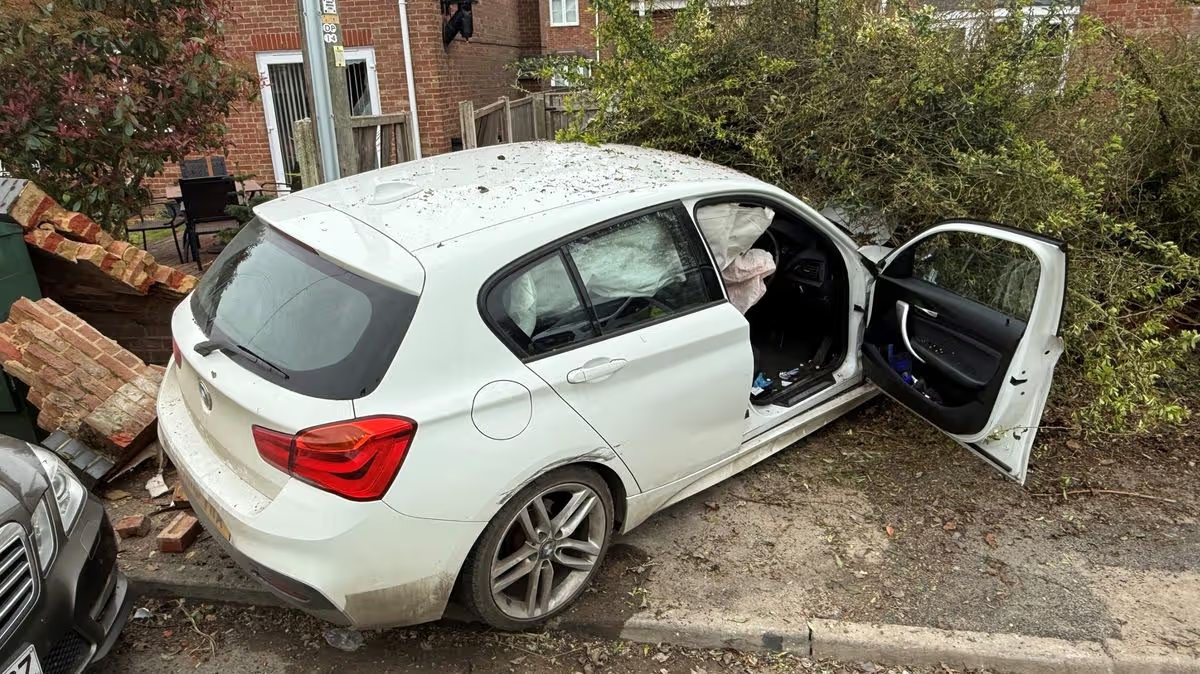
A BMW driver crashed their car into a garden. Cambridgeshire Police were called to a crash at the junction of Bevis Lane and Barton Road in Wisbech St Mary at around 1.16pm on Wednesday (April 1).
Advertisement
Officers arrived to the scene to find a white BMW had crashed into a property’s front garden. Photographs from the scene appear to show that the car had smashed through a brick wall.
A police spokesperson said: “Officers from Policing Fenland, alongside Wisbech Community Fire & Rescue Station and the East of England Ambulance Service NHS Trust, located a white BMW that had crashed at the scene.
“A male has been taken to hospital with slight injuries. Enquiries are ongoing.”
Police are appealing for information into the crash. Anyone with information, CCTV or dashcam footage should contact police online or call 101 and quote incident 239 of April 1.
Advertisement
Barton Road reopened this week after being closed for almost three years due to complex works carried out by Anglian Water.
Lamine Yamal has criticised “racist and ignorant” chants heard during Spain’s friendly against Egypt that have led to a police investigation.
The anti-Muslim chants at the RCDE Stadium, on the outskirts of Barcelona, prompted officials to display an anti-discrimination message on a screen to people inside the ground.
The messages reminded supporters that taking part in acts of racism and xenophobia was a crime, but the chants continued.
Lamine Yamal, who started for Spain, called the chants “ignorant and racist”.
Advertisement
On Instagram, the player wrote: “I know it was directed at the opposing team and wasn’t personal against me, but as a Muslim, it’s still disrespectful and intolerable.”
The 18-year-old Barcelona star said he understood “not all fans are like that”, but in a message to those who chant “these things” he added: “Using a religion as a taunt on the field makes you ignorant and racist.
“Football is for enjoying and cheering, not for disrespecting people for who they are or what they believe.”
Image: A message reminded fans at the game that racist chanting was a crime. Pic: Reuters
Spain’s manager Luis de la Fuente strongly condemned the behaviour of some fans.
Advertisement
He said: “They are not representative of football. They take advantage of football, as they do in other areas of life.
“We need to isolate these people from society.
“I feel total and absolute repulsion towards any xenophobic or racist attitudes. They are intolerable.”
The Egyptian FA said in a statement: “We firmly reject and condemn such behavior, including the lack of respect shown toward the national anthem. These actions are entirely unacceptable in football stadiums and represent a negative phenomenon that must be collectively addressed and eradicated.”
Advertisement
It added: “What happened is completely unacceptable, and FIFA remains committed to combating racism and discrimination in football.”
Image: Spain drew 0-0 with Egypt in Tuesday night’s clash. Pic: Reuters
The chants during Tuesday’s 0-0 draw at the home ground of La Liga club Espanyol highlighted increasing concerns about racism in Spanish football.
In a strongly-worded social media post, Spanish justice minister Felix Bolanos blamed the far right.
He wrote: “Racist insults and chants shame us as a society.
“The far right will not leave any space free of its hatred, and those who remain silent today are complicit.”
Advertisement
Image: Luis de la Fuente strongly condemned the chants after the match. Pic: AP
The Spanish Football Federation said it “stands against racism in football and condemns any act of violence inside stadiums”.
Mainoo has once again established himself as a key figure in United’s midfield following Michael Carrick’s arrival in January, delivering impressive performances in wins against Manchester City, Tottenham and Aston Villa.
But while Casemiro insists he will not change his mind over his decision to leave Old Trafford this summer, the Brazil international believes United will still have ‘one of the best No.8s’ in Mainoo.
Advertisement
‘Kobbie is the present and the future,’ Casemiro said in a Q&A with United.
Kobbie Mainoo has impressed since being handed a regular role at Manchester United under Michael Carrick (AMA/Getty)
‘I think that he is one of the best No.8s and can be for that for the next 12 years.
Your football fix
Metro‘s Head of Sport James Goldman delivers punchy analysis, transfer talk and his take on the week’s biggest stories direct to your inbox every week.
‘He is a player I really like. He always wants the ball. It is true that football can’t change your mentality but Kobbie demonstrated that he hasn’t changed his focus once.
‘He has to continue focusing like he is now and continue playing the important role he is now. But what a player he is, he is a great player.
‘He has demonstrated this, in the Euros final with England, he has demonstrated it in finals, he scored in the FA Cup [in the 2024 final win against Manchester City].
The latest rugby news from Wales and around the world
These are your evening rugby headlines on Wednesday, April 1.
Advertisement
Bristol ‘would have loved to keep’ Wales target
Bristol Bears director of rugby Pat Lam says he would have “loved to keep” departing centre Joe Jenkins, but the club couldn’t match the offer made by Leicester Tigers.
The 22-year-old is seen as a huge talent and is a player the Welsh Rugby Union have been monitoring for year. A former England U20s centre, he is eligible to represent Wales through his father, who is from Llanharan.
Addressing Jenkins’ exit, Lam admitted that the player was keen to stay at Bristol and they wanted to keep him there, but ultimately couldn’t match what their PREM Rugby rivals were offering.
“Joe has been a consistently positive influence around the club, and we’ve been delighted with the way his game has developed over the past four years,” said the Bears boss. “While he’s had to contend with some unfortunate long-term injuries that have disrupted his momentum, his attitude and professionalism have never wavered.
“Joe was keen to stay, and we would have loved to keep him. However, at this stage of his career, regular game time is crucial for his continued development.
“With strong competition in our midfield – including Benhard Janse van Rensburg, James Williams, Matias Moroni and Jack Bates – as well as exciting Academy talent like England U20 Victor Worsnip and England U18 Will Moore emerging, we weren’t able to match Leicester’s counteroffer,” Lam added.
Advertisement
“We’re incredibly proud of what Joe has achieved here, and everyone at the club wishes him every success as he takes the next step in his journey with Leicester Tigers.”
As his departure was confirmed, Jenkins added: “This has honestly been one of the hardest decisions I’ve had to make. I’ve loved every minute of my time here in a really special environment. The coaching has been outstanding and has pushed me to grow so much, both on and off the field.
“The culture at the club is something I’ll always value and getting to train and play alongside such a great group of lads, as well as learning from world-class players and coaches, has been incredible. I’m hugely grateful for all the support I’ve had, and I’ll leave with nothing but great memories.
“A huge thank you to the supporters – playing at Ashton Gate in front of you all has been a massive honour and I’m grateful for the support you’ve given me.”
Advertisement
English side confirm tragedy
Rugby CHAMP side Bedford Blues have announced that a supporter has tragically died after being taken ill at a match over the weekend.
Jonno Garland, a long-time supporter and season ticket holder with the club, fell ill during Bedford’s clash away to Cambridge on Saturday, with the half-time break extended as paramedics attended to a “supporter taken ill in the first half”.
Now, the club has confirmed that Mr Garland has passed away, with tributes set to be paid to him ahead of their next match against Cornish Pirates on Saturday afternoon.
“We are deeply saddened to announce the passing of long time supporter and season ticket holder, Jonno Garland following last weekend’s game,” a club statement read.
Advertisement
“Our thoughts are with Jonno’s wife, Sarah, his family and friends. We will observe a minute’s applause on Saturday in Jonno’s memory.”
Cambridge Rugby also paid tribute, with a club statement reading: “We are deeply saddened to have received confirmation that Jonno Garland passed away following last weekend’s match against Bedford Blues.
“On behalf of everyone at the club, we extend our heartfelt thoughts and condolences to Jonno’s family and friends at this difficult time.”
Exeter Chiefs boss Rob Baxter will be boosted by the return of Wales star Dafydd Jenkins and England internationals Immanuel Feyi-Waboso and Henry Slade when his side face Munster in the Challenge Cup this weekend.
Jenkins had to undergo a mandatory week’s rest after taking part in Wales’ Six Nations campaign, while Slade missed last week’s win over Newcastle Red Bulls due to his wife Megan giving birth.
Feyi-Waboso, meanwhile, hasn’t played since January having injured his hamstring while training with England ahead of the Six Nations, a setback which ruled him out of the whole tournament.
“Daf’s back from his rest week after the Six Nations, Henry Slade’s back in full training and available this week following the birth of his daughter, and Manny is in full training and available now,” said Baxter as he issued an update on his squad’s availability.
Advertisement
“So that’s a nice addition to our back-three stocks. [Feyi-Waboso] was pretty much in full training last week. He’s in full training this week, so that makes him available to play.
“He’s a pretty switched-on young man. Things happen in rugby. You get on with it and use your down periods to improve yourself and work on the little bits you can, and try to make yourself more robust.”
The Exeter boss added: “We haven’t had a great deal of luck this season, but if we could have our little bit of luck now on injuries and get through the next few weeks with this squad intact, we could end up running into the last third of the season with our kind of strongest group players.
“And that obviously allows us to try and really put our foot down and push for what we might achieve this season because obviously the more good players, you have available, the more opportunities you have, the more options you have.”
The ITV star is taking a break to spend more time with his family
16:15, 01 Apr 2026Updated 16:15, 01 Apr 2026
Martin Lewis has become well known as the UK’s most trusted voice when it comes to personal finance.
Millions seek his advice on everything from energy bills to mortgage rates and he always offers his help on his regular segments on ITV’s Good Morning Britain, This Morning and his self-titled TV show.
As well as his MoneySavingExpert website and social media platforms. He has now announced that he is taking a lengthy break from his TV work as he plans to spend some time with family.
Advertisement
The money saving expert, 53, has decided to sign off from social media for a while but assured fans that he will be back soon.
Sharing the news with his followers, The financial expert took to X, formally known as Twitter and said: “And that’s me done. As I’ve no TV show for a few weeks.
“I’m going to take advantage and put my MoneySavingExpert hat to one side for a little bit and spend some time wearing my far brighter ‘Dad’ hat instead.”
Advertisement
He continued: “So I’ll be off social and work for 10 days or so. I’d be grateful if, while I’m off here, you report any scam ads using my name or image to the platform (they often increase when I’m not posting).”
Wrapping up the post, he added: “Wishing all everyone a Happy Easter or Pesach Sameach – and for everyone else, I hope you have a great time too. See you in a week or two. Martin.”
The comment section was flooded with sweet messages from fans as one wrote: “Enjoy your family time Martin.” Another said: “Enjoy your Easter break, thank you for all your help.”
A third commented: “Enjoy your family time you deserve it.” Another said: “Enjoy your well deserved family time Martin & as always, THANK YOU for all of your advice.”
One wrote: “Peace and warmth to you and all Martin, enjoy your break.” Meanwhile one added: “Happy Easter Martin. I hope you enjoy your extended holiday with your family.”
Away from his public work, Martin is married to former weather presenter and technology journalist Lara Lewington.
Lara co-presented the BBC’s technology programme Click for over two decades before it was cancelled.
Advertisement
Following the show’s last episode this year, Lara transitioned to ITV’s Lorraine as the UK’s first AI Agony Aunt, offering insights into artificial intelligence and technology.
The couple share a daughter, Sapphire Susan Lewis, born in 2012. Martin often shares updates about his daughter, previously calling her “Mini Money Saving Expert.”


















































You must be logged in to post a comment Login