NewsBeat
Trump’s solutions to Iranian shipping threat leave insurance sector unimpressed | Money News

Donald Trump’s offer of US-backed insurance and naval escorts for shipping travelling through the Strait of Hormuz has not prevented maritime premiums soaring as underwriters scramble to reassess the risks to oil, gas and cargo vessels.
With the Strait of Hormuz effectively closed to shipping following the US attack on Iran, on Tuesday the president wrote on Truth Social that the US would provide cover “at a very reasonable price… for the Financial Security of ALL Maritime Trade, especially energy, traveling through the Gulf”.
He also suggested that naval escorts could be used to provide safe passage for tankers in the Persian Gulf, the route to market for 20% of the world’s oil supply.
Markets latest: Oil producer says it won’t fulfil contracts
Experts at Lloyd’s of London, the world’s oldest insurance market, told Sky News that the president’s proposal was unclear, and that naval escorts could even increase the risk to shipping.
On Tuesday, the Joint War Committee (JWC) of the Lloyds Markets Association, which represents participants in the Lloyds market, expanded its “high-risk” area in the Middle East to cover the entire Persian Gulf.
Underwriters had already begun cancelling or repricing war-risk insurance for vessels in the region, but Neil Roberts, secretary of the JWC, told Sky News the market was working and that the American intervention was unnecessary.
“I don’t think the details of such a scheme have been given to anyone, so far as we know, and it will take time to work it out, and the appetite is unknown,” he said.
“Essentially our market is still writing risks and there isn’t a perception here that there’s a need for intervention at this time.”

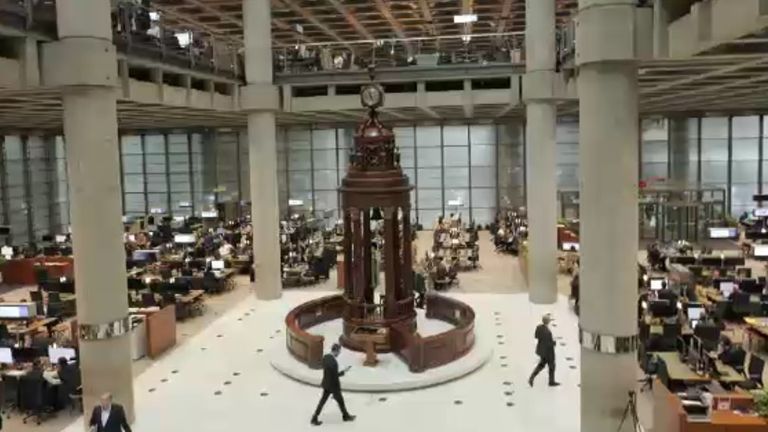
Lloyd’s of London
Mr Roberts said that premiums would rise to reflect the heightened risk in the Gulf, amid reports suggesting 12-fold increases, and that US escorts could offer a target rather than act as a deterrent.
“There will be those who think it might increase the target, because the Iranians are targeting US military. It’s not known how capable they would be against the new drone and missile threats that we’re seeing. This is not the same as the 80s.”
“So yes, obviously people would like to see the detail, they’d like to it happen, and if you’re a tanker owner, you’d be on the one hand delighted that it’s been offered, on the other hand trying to understand whether it does increase the risk or not and do you want to accept it?”
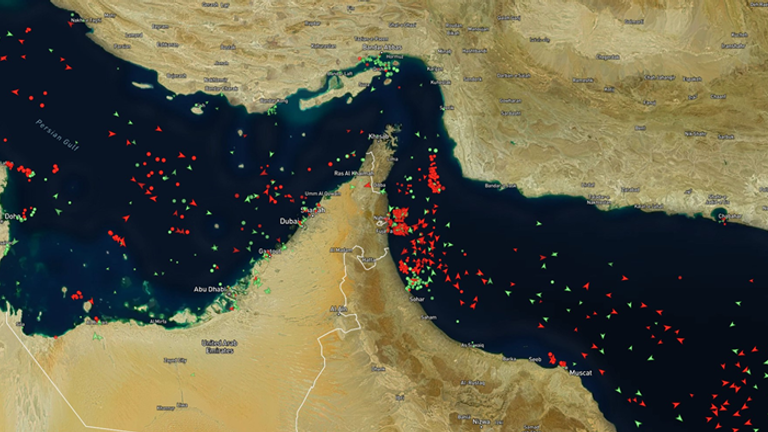
Satellite mapping from AIS ship trackers on Tuesday shows a build up of stationary tankers in the Strait of Hormuz
He added: “What’s happened over the weekend has changed the risk profile for the area and it was necessary for underwriters to be able to reassess their position given the new risks. And for the Joint War Committee we’ve recently increased our listed areas by adding the US bases which are now targets that were previously not listed. That means we’ve got the opportunity as underwriters to reassess the voyages on an individual basis.”
A number of tankers have been attacked directly in the Gulf since the conflict began, along with oil, gas and cargo infrastructure in Saudi Arabia, Qatar and the United Arab Emirates (UAE).
With scores of vessels at anchor on either side of the Strait of Hormuz, oil and gas prices have spiked, along with shipping costs.
Read more from Sky News:
Was Iran ‘days’ from atomic weapons?
US allies fear shortage of weapons
Is AI giving US lethal edge in Iran?
For now, the economic impact is largely contained to commodity markets, but a prolonged closure that ate into global oil reserves could lead to wider impacts and trade disruption.
Food and goods supplies coming into the Gulf states from Europe, Africa and Asia could also be disrupted.
The UAE government said earlier this week it has stockpiles that will last four to six months, but asked citizens to only buy what they need and avoid shopping sprees to “make sure there is enough for everyone”.