
Its ability to accelerate passenger numbers will hinge on the outcome of legal challenge by Bristol Airport over Welsh Government £205m subsidy support plans
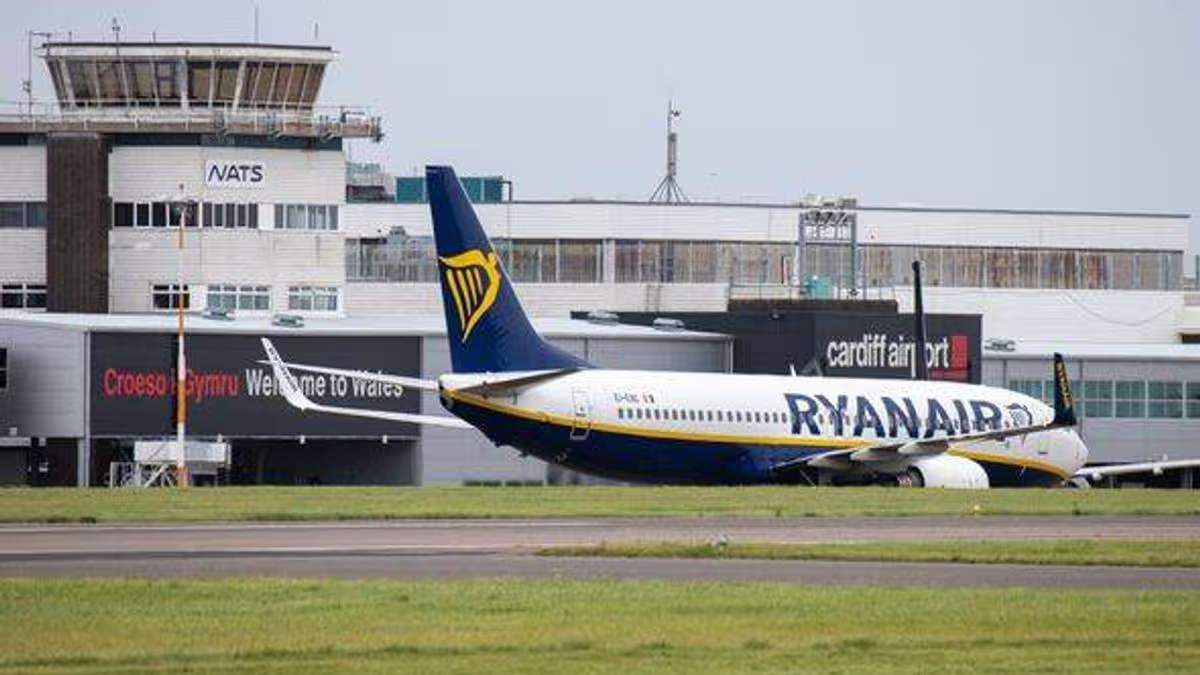
Cardiff Airport achieved a near 10% rise in passengers last year, but still remains well below its pre-pandemic level.
The Rhoose-based airport, which is wholly-owned by the Welsh Government, welcomed 963,000 passengers in 2025, up 9% on 2024, with a 4% rise in air traffic movements. The airport said the increase was supported by significant growth from Ryanair and TUI. Cargo volumes, supported by a new base from European Cargo, experienced a 7% increase .
The airport is also continuing to invest in route development, with further new services planned for this year and 2027.
Ryanair is set to operate its busiest ever summer, marking 12 years of operations at the airport. Extra frequency has been added across its five routes, For the summer season TUI will base a fourth aircraft at Cardiff, bringing increased frequencies to Antalya, Enfidha, Gran Canaria, Palma and Tenerife and new routes to Faro and Hurghada.
Further TUI growth is planned for the 2026-27 winter season, with new services to Kittilä (Finland) and the Dominican Republic.
Canadian low cost carrier WestJet, from May 23, will launch a new four-times-weekly service from the airport to Toronto Pearson – the largest and busiest airport in Canada. It connects to all major Canadian cities, as well as the US cities of New York, Los Angeles, Chicago, Miami and Dallas. For its inaugural 2026 summer season the route has released 21,320 seats for sale. Both Cardiff Airport and WestJet said they are “pleased with the sales performance to date.”
KLM continues to operate twice-daily services to Amsterdam, providing global hub connectivity. Moreover, Vueling continues services to Malaga and Alicante.
The airport said that P&O Cruises has expanded its fly-cruise programme with additional flights to Barbados and a new destination. The airport wouldn’t be drawn on providing a projected passenger figure for 2026.
Last month a legal challenge brought by Bristol Airport against Welsh Government plans to provide further subsidy support to the airport over a ten year period of £205m was heard by the Competition Appeal Tribunal.
Around £100m of the subsidy has been earmarked for route development. Long-term the airport is aiming to get back to two million passengers. In 2019, prior to the pandemic, the airport attracted 1.6 million passengers. Its subsidy support is expected to be framed at attracting routes, including more longhaul alongside WestJet, currently not served by Bristol.
As well as being deployed to attract new routes, the subsidy support will also be used to diversify away from passenger-related revenues. The airport is targeting areas such as aviation maintenance, repair and overhaul (MRO) and freight.
Bristol Airport, which in 2025 saw its passenger numbers dwarf Cardiff’s – at 10.8 million, of which around two million are drawn from South Wales – argues that the proposed funding breaches the post-EU state aid regime under the Subsidy Control Act 2022. It says the funding represents unprecedented state support for a UK airport and will put it at a commercial disadvantage relative to its nearest rival.
The Welsh Government’s position is that the airport is not a failing enterprise and that it plays a vital role in supporting the wider Welsh economy. An economic assessment by Grant Thornton estimates it generates a £220m gross value added positive impact on the Welsh economy through the airport’s direct, indirect and induced impacts.
Its subsidy support is expected to be framed at attracting routes, including more longhaul alongside WestJet, currently not served by Bristol.
A judgment from the Competition Appeal Tribunal, which would be subject to appeal, is not expected this side of the Senedd Election in May.
With the £52m acquisition cost of acquiring the airport from Spanish firm Abertis back in 2013, it has invested nearly £200m, with a significant element of repayable loans converted into equity.
The airport, in its last financial year to the end of March 2025, show its revenues improve from £19.33m a year earlier to £19.8m, while on a pre-Ebitda basis (earnings before interest, tax, depreciation, amortisation) and exceptional items it posted a positive £5.7m. However, when factoring in the receipt of an £11.8m Welsh Government grant linked to a five-year post-Covid recovery plan, the Ebitda figure slipped into the red at £5.57m.
Since being acquired by the Welsh Government the airport has accumulated losses of around £60m.
In March last year former airport chief executive Spencer Birns quit his role. The accounts show he received a £151,088 payment, approved by the airport’s remuneration committee, in lieu of notice. No reason for his departure from what was a £131,000 role was given.
The airport’s current chief executive is Jon Bridge, having taken up his role last November. He is a former chief executive of SA Brain & Co.