Connect with us
DAPA Banner

NewsBeat

Two people have died from bacterial meningitis in the UK. An expert answers your questions

Published

on

Two people have died from bacterial meningitis in the UK. An expert answers your questions

An outbreak of invasive bacterial meningitis at the University of Kent has left two people dead and 11 seriously ill in hospital, prompting the UK Health Security Agency to distribute antibiotics to students in the Canterbury area. Here’s what you need to know about the disease and how to protect yourself.

What is meningitis?

Meningitis is an inflammation of the tissue lining that surrounds your brain and spinal cord (the meninges). Any type of harmful microbe, including viruses, bacteria, fungi and parasites, can invade the meninges and cause an infection. (The current outbreak at the University of Kent is caused by bacteria.) This can be very dangerous since the meninges function as a protective layer around your brain. When it becomes damaged, your brain and spinal cord become at risk too.

What is invasive meningococcal disease, and why is it so dangerous?

The bacteria that cause meningitis are called Neisseria meningitidis, and the disease can quickly spread from person to person if they have close contact. The bacteria invade blood vessels in the meninges, damaging them, and this causes immune cells to enter the meninges and produce molecules that trigger inflammation. When the meninges become inflamed like this, the brain can stop functioning properly, leading to serious illness and brain damage.

Neisseria meningitidis bacteria (orange).
Nemes Laszlo/Shutterstock.com

What are the symptoms, and how do I know if it’s meningitis rather than flu or a hangover?

Meningitis can look different in different people. Symptoms typically include a high fever (but with cold hands and feet), vomiting, headache, joint pain, a stiff neck and feeling unusually sleepy. Some people may become confused or distressed by bright lights and sounds. Some people may also develop a rash that won’t disappear when you press a glass against it. Babies may develop an unusual cry.

Advertisement

If you suspect you have meningitis, particularly if your symptoms are not typical when compared to previous hangovers or flu-like illnesses, then go to your nearest hospital or call for help. It’s better to get checked out than wait and see, as meningitis tends to progress very quickly.

Who is most at risk?

Anyone can get meningitis, but the risk is higher for very young babies and older people. Immune-compromised people – such as those undergoing chemotherapy – are also at higher risk for the infections that can cause meningitis. Outbreaks in younger adult populations, like we are seeing at the University of Kent, tend to happen because of the increased exposure and spread of the bacteria that can cause meningitis.

How does the infection spread?

The bacteria that cause meningitis can spread by close contact, such as kissing and sharing drinks, or through coughing and sneezing. Large events that bring lots of people together can therefore be associated with outbreaks of meningitis, because of the increased likelihood that people become exposed to the bacteria. This is one of the reasons why university students can be at increased risk for meningitis, because there is a lot of social mixing in this group.
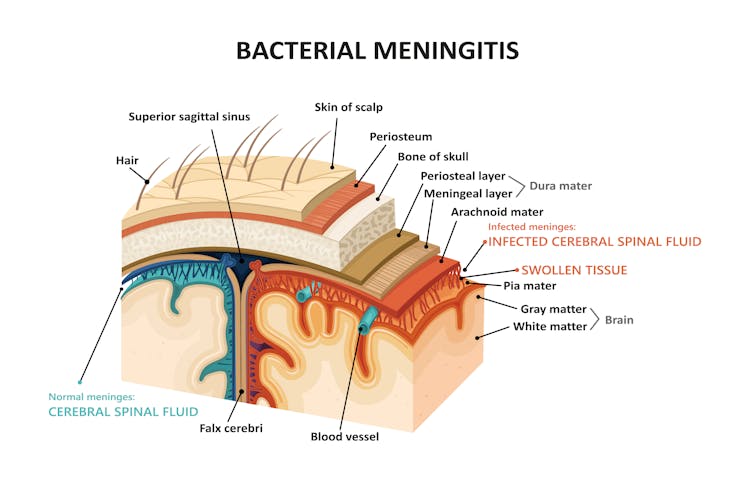
A graphic showing where the bacteria infect in bacterial meningitis.
Where the bacteria are found in bacterial meningitis.
logika600/Shutterstock.com

Why are healthy students at the University of Kent being given antibiotics?

This is a precautionary measure to ensure that anyone who has been exposed to the bacteria, but perhaps hasn’t developed symptoms yet, is protected. The antibiotics will help kill the bacteria, hopefully before it has a chance to establish an infection or invade the meninges and brain.

Is there a vaccine against meningitis and should I get one?

Several vaccines are available to protect against the most common causes of bacterial meningitis. These are effective and safe medicines that prevent you from getting seriously ill if you do become exposed to meningitis-causing bacteria. The MenB, MMR and pneumococcal vaccines are all recommended for babies in the UK because they protect against bacteria that cause meningitis infections in young children in particular.

Advertisement

How is bacterial meningitis treated, and what happens if it’s caught late?

Antibiotics are the main course of treatment for bacterial meningitis. The earlier these drugs are given, the more likely the infection will be stopped in time before any serious damage occurs.

However, some bacteria can become resistant to antibiotic treatment. When this happens, antibiotics are no longer effective at preventing meningitis. This is why vaccines are very important for protecting yourself against these infections as they can work to protect you even against antibiotic-resistant bacteria.

What should I do if I think I or someone I know has meningitis?

Meningitis symptoms typically come on rapidly. If you suspect meningitis, act quickly. The faster that antibiotic treatment is started, the better the outcome is likely to be.


Advertisement

Source link

Continue Reading
Click to comment

You must be logged in to post a comment Login

Leave a Reply

NewsBeat

Online English tests for migrants risk criminal abuse, providers warn government

Published

on

Online English tests for migrants risk criminal abuse, providers warn government

“Given the importance of secure English language testing for the UK’s immigration system and the protection of our borders, we cannot endorse the proposed approach by bidding for this tender while retaining our commitment to responsible, trusted and secure assessment,” it said.

Source link

Continue Reading

NewsBeat

Afghanistan says 400 people killed in Pakistan strike on Kabul hospital

Published

on

Manchester Evening News

A further 250 people have been reported as injured in the wake of the blast

Afghanistan has accused Pakistan of killing at least 400 people in an airstrike on a hospital in Kabul.

The strike, which Afghan officials say happened late on Monday evening (March 16), marks a dramatic escalation in conflict that began late last month and has already seen repeated cross-border clashes and airstrikes, as well as air strikes inside Afghanistan.

Pakistan has strongly rejected the allegations it hit the hospital, insisting its military targeted only military infrastructure and did not civilian sites or facilities.

Advertisement

Ensure our latest headlines always appear at the top of your Google Search by making us a Preferred Source. Click here to activate or add us as your Preferred Source in your Google search settings.

Afghanistan’s deputy government spokesperson Hamdullah Fitrat said the strike hit the hospital in the capital at around 9pm local time. In a post on X, he said large sections of the 2,000-bed facility were destroyed.

Fitrat said the death toll had so far reached 400 people, while around 250 others were reported injured.

Footage shared by local television stations on social media appeared to show security forces using flashlights as they carried casualties away from the scene while firefighters worked to extinguish flames among the ruins of the building.

Advertisement

Fitrat said rescue teams were still working to control the fire and recover bodies from the site.

The strike came just hours after Afghan officials said forces from both countries exchanged fire along their shared border, leaving four people dead in Afghanistan.

The latest clashes mark the third week of what has become the most serious fighting between the two neighbouring countries in years.

Afghan government spokesperson Zabihullah Mujahid condemned the reported strike, accusing Pakistan of targeting hospitals and other civilian sites.

Advertisement

“We strongly condemn this crime and consider such an act to be against all accepted principles and a crime against humanity,” he said in a post on X.

Pakistan has dismissed the accusations.

A spokesperson for Pakistani Prime Minister Shehbaz Sharif described the claims that a hospital had been targeted as baseless.

Advertisement

Pakistan’s Information Minister Attaullah Tarar said the military had carried out “precision airstrikes” on what he described as military installations in Kabul and the eastern province of Nangarhar.

He said the strikes destroyed technical support infrastructure and ammunition storage facilities used by the Afghan Taliban government.

“All targeting has been done with precision only at those infrastructures which are being used by Afghan Taliban regime to support its multiple terror proxies,” Tarar wrote on X.

Pakistan’s Ministry of Information earlier said Afghan claims were “false and misleading” and accused Kabul of attempting to stir public sentiment while concealing what it described as support for cross-border militant groups.

Advertisement

The strike came as the United Nations Security Council called on Afghanistan’s Taliban leadership to step up efforts to combat terrorism.

Pakistan has repeatedly accused Afghanistan of allowing militant groups — including the Pakistani Taliban — to operate from its territory and carry out attacks inside Pakistan. Kabul denies those claims.

The conflict intensified in late February after Afghanistan launched cross-border attacks in response to earlier Pakistani airstrikes that Afghan officials said had killed civilians.

The clashes disrupted a ceasefire brokered by Qatar last October following earlier fighting that left dozens dead.

Advertisement

Pakistan has since declared it is in what it described as an “open war” with Afghanistan, raising concerns among the international community.

Officials have warned that the instability could allow militant organisations such as al-Qaida and the Islamic State group to strengthen their presence in the region.

Pakistan claims its forces have killed hundreds of Afghan Taliban fighters during the fighting, while Afghan officials say Pakistani casualties have also been significant.

Both sides have rejected each other’s casualty figures.

Advertisement

Source link

Continue Reading

NewsBeat

Martin Lewis explains 18-year rule over savings ‘sweet spot’

Published

on

Wales Online

Key changes to the rules around savings are coming in soon

Martin Lewis has issued a caution for savers as you could be missing out on greater returns. The advice from the consumer champion comes as major changes to savings allowances are just around the corner.

Advertisement

During a recent question time edition of his BBC podcast, Mr Lewis was questioned by a man about whether he could open a junior ISA for his nieces and nephew. A key benefit of ISAs is that these accounts are completely tax-free. The financial specialist initially told the uncle that regrettably he wouldn’t be able to open the account himself, as a junior ISA can only be established by a parent or guardian on behalf of a young person. Mr Lewis said: “You as an uncle can’t do it, it generally has to be the person who has the guardianship or the parentship of the child, to be able to open their ISA, so you will have to do it through them.”

This should be your focus

Nevertheless, if you are creating a junior ISA to save up for your little one, Mr Lewis had a firm word of caution regarding which type of account to go for. He said: “I tend to almost always get questions about cash junior ISAs.

State Pensioners to face major tax change

“I think junior ISAs are one of those areas where you really, really want to be always be focusing if you possibly can on investing.” Mr Lewis explained there is a straightforward reason why, given how the account operates.

He explained: “You’re generally locking money away for 18 years that cannot be accessed. The rule of investing is if you’re locking money away for more than five years – and if you’ve got emergency funds and you haven’t got any high debts, which hopefully children won’t – then you should look at investing over savings because on a balance of probabilities, it will outperform.”

Advertisement

You can deposit up to £9,000 annually into junior ISAs on behalf of a child for whom you have parental responsibility. This sum can be allocated as preferred between cash ISAs or stocks and shares ISAs.

A junior ISA is held in the child’s name, but whoever opened the account manages it. When the child turns 16, they can become the registered contact for the account, and upon reaching 18, the account converts to an adult ISA, allowing them to access the funds. Mr Lewis continued in explaining that money placed into a junior ISA is in the “sweet spot” as you are saving funds which you don’t require and the sum has a lengthy period to grow.

Change to ISA rules

Several significant changes are approaching for ISA allowances. Distinct from the junior ISA allowance, adults can presently save up to £20,000 annually into ISAs.

This can be divided as preferred between cash ISAs and stocks and shares accounts. From April 2027, this is set to change, with the maximum deposit into cash ISAs being capped at £12,000 each tax year.

Advertisement

The remaining £8,000 must be allocated towards investment-based accounts. People aged 65 and above will be exempt from these new regulations and will maintain the existing allowance.

Source link

Continue Reading

NewsBeat

‘Race to stop meningitis spreading’ and ‘Donald’s Trumped’

Published

on

'Race to stop meningitis spreading' and 'Donald's Trumped'
BBC "Race to stop meningitis spreading nationwide" BBC

There is a “race to stop meningitis spreading nationwide”, writes the Daily Telegraph, following the outbreak in Kent in which two people have died. A photo of A-level student Juliette who died after contracting the infection takes up much of its front. Also on its front page, the Telegraph says the “Ayatollah’s son escaped death by popping into garden for a stroll”.

Source link

Continue Reading

NewsBeat

Taoiseach to meet with US President Donald Trump at the White House

Published

on

Taoiseach to meet with US President Donald Trump at the White House

“If you’re here to talk about opportunity for America in America through Ireland, or for young Irish to thrive and prosper and be world leaders, irrespective of what one’s views are, it’s a really important and critical element of good connections in politics that Ireland, whoever the Taoiseach is, has established a very strong tradition of being able to talk to whoever the American president is.

Source link

Continue Reading

NewsBeat

St Leonard’s Hospice in York launches Cuddle Bed Appeal

Published

on

St Leonard's Hospice in York launches Cuddle Bed Appeal

The hospice, which relies heavily on charitable donations, is hoping to raise £75,000 to purchase the specialist beds, which will be included in every room.

Cuddle beds are wider than the standard hospital beds and are extendable to accommodate two people – providing patients with the opportunity for a partner, child, friend or pet to lie beside them.

The hospice currently has nine cuddle beds, which cost £15,000 each.

Advertisement

Recommended reading:


Speaking about this, head of fundraising at St Leonard’s, Channon Barlow, said: “Every family deserves a chance to be together at the end, and not have to say goodbye from a distance.

“We want to make sure that everyone who comes through our doors is able to benefit from that closeness when they need it most.”

Another member of the St Leonard’s team, Nikki Smith, shared her experience of the hospice from the other side.  

Advertisement

‘Somewhere along the way, I had stopped being his partner and became his carer’

The Healthcare Assistant was comforted during one of the most difficult periods of her life when her partner Darren became ill and was admitted to St Leonard’s.

She said she remembered sitting beside his hospital bed prior to the hospice and holding his hands through the rails.

 “I’d say goodnight from inches away, but it felt like miles apart,” Nikki said.

She added: “Somewhere along the way, I had stopped being his partner and became his carer.”

Advertisement

When Darren arrived at St Leonard’s, there was a cuddle bed in his room.

The larger, adjustable bed meant Nikki could lie beside him safely and comfortably.

She explained: “For the first time in a long time, we were together again.

“We talked, laughed and rested in each other’s arms. That closeness meant everything.”

Advertisement

To find out more about the Cuddle Bed Appeal and donate, please visit https://stleonardshospice.org.uk/cuddle-bed-appeal/.

Source link

Advertisement
Continue Reading

NewsBeat

Major travel warning as holiday hotspot Malta faces ‘ecological disaster’

Published

on

Manchester Evening News

A charred Russian tanker is drifting crewless towards Malta after being hit by Ukrainian drones, with multiple European countries warning of an imminent ecological threat to the popular holiday destination.

Malta, a favoured holiday destination, is reportedly at risk of a “major ecological disaster”.

A burnt-out Russian ghost tanker is thought to be approximately 50 nautical miles southwest of the island, drifting without crew towards the archipelago. The vessel was attacked two weeks ago by Ukrainian drones and since then, the punctured 900ft Arctic Metagaz has been moving towards Malta.

Advertisement

Now, several European countries have issued warnings of an impending ecological threat. In a letter to the European Commission, seven nations stated that the “precarious condition of the vessel, combined with the nature of its specialised cargo” presented a “serious risk”, reports the Mirror..

Ensure our latest headlines always appear at the top of your Google Search by making us a Preferred Source. Click here to activate or add us as Preferred Source.

These countries have characterised the situation as a “dual challenge” – maintaining maritime safety and averting an ecological disaster in the context of EU sanctions imposed on.

Russia alleged that Ukraine utilised “uncrewed sea drones” to target the Metagaz in the Mediterranean Sea between Libya and Malta. The Security Service of Ukraine has yet to respond to the claim.

Advertisement

According to Russia, the attack occurred on 4 March and was launched from the Libyan coast. The vessel had previously been sanctioned by the United States and the European Union for being part of Moscow’s so-called “shadow fleet.”

Comprised mainly of elderly tankers, the fleet transports Russian oil and gas globally whilst circumventing Western sanctions. Authorities in Malta and Italy have been carefully tracking the wreck amid fears about possible pollution.

Rome stated the vessel was carrying “significant quantities of gas, heavy oil, and diesel fuel.”

WWF Italy cautioned in a statement: “A potential spill could cause fires, cryogenic clouds lethal to marine life, and widespread and long-lasting pollution of water and the atmosphere.”

Advertisement

It continued: “The affected area is of exceptional ecological value, with fragile deep-sea ecosystems and some of the highest biodiversity in the Mediterranean basin.”

Salvage specialists are already in Malta in readiness for the ship’s arrival in Maltese waters, whilst a specialist vessel is en route, a maritime source told AFP on Sunday.

Early reports suggested that the ship sank following explosions which triggered a fire on board. Libyan authorities stated the tanker went down approximately 130 nautical miles north of the port of Sirte.

Advertisement

Roughly 30 Russians were aboard the Arctic Metagaz, according to Russia’s transport ministry. They were all discovered “safe and sound in a lifeboat” by Malta’s armed forces, Maltese Home Affairs Minister Byron Camilleri confirmed.

However, Malta’s transport authority confirmed last week that the wreck was still afloat. The Ministry of Foreign Affairs of the Russian Federation recognised that the vessel was adrift in the Mediterranean and stated Russia’s continued involvement in resolving the situation would hinge on “concrete circumstances”.

It further noted that attempts to manage the situation – including surveillance, monitoring and other technical support – could potentially “undermine the integrity, effectiveness and the deterrent value of the EU sanctions regime”.

Maria Zakharova, spokeswoman for the Russian foreign ministry, revealed the ship was unmanned and was carrying 700 metric tons of various types of fuel along with “a substantial amount of natural gas”.

Advertisement

“The international legal norms applicable to the current situation imply the responsibility of coastal countries … for resolving the situation with the drifting vessel and preventing an environmental disaster,” Zakharova penned.

“Further involvement by the shipowner and Russia as the flag state will depend on the specific circumstances.”

Source link

Advertisement
Continue Reading

NewsBeat

Deliberate tree fire spreads to Cambridge garden

Published

on

Cambridgeshire Live

Police have raised a crime for arson

A deliberate fire spread to a garden fence at the weekend. Cambridgeshire Fire and Rescue were called to a fire in the Green End Road area of Cambridge at around 3.16pm on Saturday (March 14).

Advertisement

Firefighters arrived at a tree fire that spread to a garden fence. A fire spokesperson said: “At 3.16pm on Saturday, a crew from Cambridge was called to a fire in the open on Green End Road in Cambridge.

“Firefighters used a hose reel and small gear to extinguish a fire involving a tree which had spread to a fence. The crew returned to their station by 4.30pm.”

The cause of the fire was determined to be deliberate. Cambridgeshire Police are investigating the incident.

A police spokesperson said: “The fire service informed us at about 3.45pm on Saturday, March 14, that a garden fence had been deliberately ignited at Cook Close, Cambridge. A crime was raised for arson.” Anyone with information should call police on 101 and quote 35/19043/26.

Advertisement

Do you want more of the latest Cambridgeshire news as it comes in from across the county? Sign up to our dedicated newsletter to make sure you never miss a big story from Cambridge or anywhere else in the county. You can also sign up to our dedicated Traffic and Crime newsletters for the latest updates on the topics you are most interested in.

Source link

Continue Reading

NewsBeat

Can India’s $300bn outsourcing industry survive AI?

Published

on

Can India's $300bn outsourcing industry survive AI?

Over the past three-and-a-half decades, India’s software industry has created millions of white-collar jobs, spawning a new middle class driven by high ambition and strong purchasing power. This, in turn, has fuelled demand for apartments, cars and restaurants across top-tier cities such as Bengaluru, Hyderabad and Gurugram over the past 30 years.

Source link

Continue Reading

NewsBeat

Black music ‘makes up 80% of UK recorded music revenue over past three decades’

Published

on

Black music ‘makes up 80% of UK recorded music revenue over past three decades’

Ammo Talwar, chair of UK Music’s Diversity Taskforce, which led the report, said: “The aim of the report is to act as an advocacy tool and rallying cry, that is a catalyst for ongoing analysis, growth, increased representation, equity and stronger collaboration, thereby building confidence in black music.

Source link

Continue Reading

Trending

Copyright © 2025