
The Namibian genocide was one of the first genocides of the 20th century. Between 1904 and 1908, tens of thousands of Ovaherero and Nama people were killed under German colonial rule.
Despite the scale of these events, the material and human legacy of this genocide remains less understood than later atrocities. Historical accounts exist, but are often incomplete or shaped by the perspectives and priorities of the colonial period in which they were produced.
The landscapes of Namibia that testify to this violence still survive, but are under increasing pressure from urban expansion, infrastructure development and environmental change. Archaeological research is playing a key role in documenting and protecting this heritage.
The Centre of Archaeology at the University of Huddersfield has, in conjunction with community representatives, the research groups Forensic Architecture and Forensis and the Swakopmund Genocide Museum, conducted fieldwork in Namibia across two seasons (2023 and 2025). Our work has focused on sites linked to German colonial concentration camps in Swakopmund and Lüderitz.
Using forensic methods, our project seeks to locate, document and protect burial sites associated with the genocide. We aim to demonstrate how archaeology can confirm historical events, provide physical evidence, support commemoration and strengthen claims for reparations.
The research combines archival study with field methods including: GIS mapping (computer-based spatial mapping and analysis of archaeological data), walkover survey (systematic on-the-ground inspection of visible archaeological features), Ground Penetrating Radar (a geophysical technique that uses radar waves to detect buried structures without excavation), GPS survey, drone imagery and targeted excavation.
Crucially, it involves close collaboration with Ovaherero and Nama communities. Their priorities have shaped the research and discussions around site protection.
The sites under threat
Between 1905 and 1907, German colonial authorities established several concentration camps in Lüderitz, including the notorious Shark Island camp. Ovaherero and Nama prisoners were forced into slave labour to build railway lines and an extension to the harbour under the harshest of conditions.
For many, this was effectively a death sentence. Historical sources suggest that as many as 4,000 prisoners died at Shark Island, yet the final resting places of most victims remain uncertain. Written records and oral histories indicate that many bodies were never formally buried. Instead, they were disposed of in the Atlantic Ocean.
Centre of Archaeology, Author provided (no reuse)
At Radford Bay, near a memorial to the victims, several sand mounds are believed to mark graves linked to the camps, some of which are thought to conceal mass burials. In collaboration with Forensic Architecture, using photo mapping techniques in conjunction and forensic methods, we have identified subsurface anomalies consistent with graves beneath a number of these features. At least one anomaly strongly suggests the presence of a mass grave.
The results provide the first scientific evidence supporting oral accounts of burial practices at Lüderitz. However, the site is highly vulnerable due to wind and sand erosion. It is also threatened by a planned coastal infrastructure project. Without intervention, the important surviving physical evidence and the opportunity for commemoration will be lost.
À lire aussi :
Namibia’s Shark Island: Europe’s push for green hydrogen risks compromising sites of colonial genocide
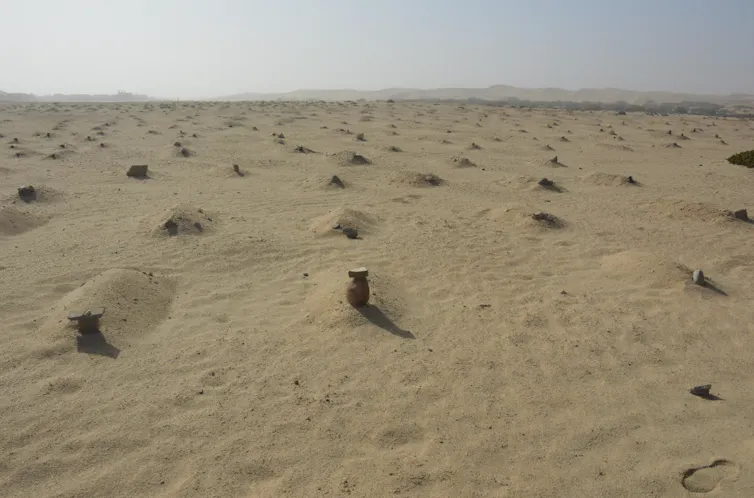
Recent investigations at Swakopmund meanwhile, once a centre of German colonial activity, have revealed the scale and fragility of another burial landscape. At the former slave worker burial ground at Kramersdorf, thousands of Ovaherero and Nama victims were buried in shallow, unmarked graves. These burials are now under pressure from housing development, as well as damage caused by vehicles and pedestrians.
One of the most significant discoveries is the extent of unmarked burials at this site. Subtle environmental indicators, particularly clusters of vegetation forming distinct patterns, have proved crucial in identifying grave locations. These patterns reflect changes in soil composition associated with burial, allowing graves to be mapped even where no visible markers exist.
Centre of Archaeology, Author provided (no reuse)

Geophysical data confirmed numerous buried anomalies consistent with graves, including some directly beneath modern vehicle tracks. This makes the conservation challenge immediate – these hidden remains are being damaged.
At one location where erosion had exposed a coffin, targeted excavation was considered necessary to verify the initial observations.
Excavation was conducted by hand, with soil sieved and human remains left undisturbed. Once identified, recording ceased and the grave was respectfully refilled, with a protective sand mound rebuilt above it.
Community leaders were present throughout the process. They conducted ceremonies, monitored the work and guided decisions about how the burial should be treated. This was an important aspect of the project, because these are not simply archaeological sites, but ancestral graves. For many participants, this work marked the first direct engagement with the physical remains of those who died in the camps.
The future of memorialisation
Beyond our fieldwork, the project feeds into wider efforts to ensure that the Namibian genocide is more widely recognised. Public engagement is a key part of this process.
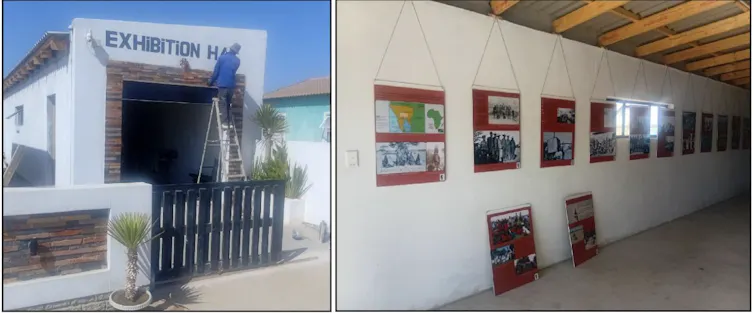
The Swakopmund Genocide Museum, founded in 2015 by Laidlaw Peringanda whose great-grandmother survived the Swakopmund camp, plays an important role in telling this history. Officially recognised by the Namibian government in 2019, the museum has recently secured funding to expand its exhibition space in response to growing visitor numbers.
With support from the Huddersfield Centre of Archaeology, the displays have been redesigned. They are due to be unveiled on Namibia’s officially recognised Genocide Remembrance Day on May 28, 2026.

Laidlaw Peringanda, Author provided (no reuse)
Archaeological evidence provides a different kind of testimony from written or oral sources. It confirms the presence of burials, reveals their condition and demonstrates their extent. It can also expose gaps between official records and the reality on the ground.
In Namibia, this evidence has implications beyond historical understanding. It contributes to ongoing debates about colonial legacies, reparations and historical accountability – issues that remain unresolved
By ensuring the material traces of the genocide become visible, this forensic archaeological approach can strengthen the basis for these discussions. It ensures that the past is not only documented, but acknowledged, protected and recognised.
You must be logged in to post a comment Login