An urgent search has been launched to find a woman who was last seen ten days ago and may now be in Manchester.
Advertisement
Police are searching for Natasha Walker and have urged anyone with information to get in touch. The 34-year-old was last seen in Whalley, Lancashire, on March 13 but has links to East Lancashire and Manchester.
Lancashire Police said she was last seen in the Mitton Road area at around 4pm on the day she was reported as missing. Natasha is described as a white female, about 5ft 5ins tall, of a medium build with brown hair and blonde extensions.
Get MEN Premium now for just £1 HERE – or get involved in our WhatsApp group by clicking HERE. And don’t miss out on our brilliant selection of newsletters HERE.
She was last seen wearing a Stitch hoodie, white skirt and yellow crocs. She potentially also has a black coat with her and a small, black, furry bag.
Advertisement
“We are concerned for her whereabouts and have been looking for her for some time and now we are asking for your help,” a spokesperson for Lancashire Police said.
If you have any information call police on 101 (999 in an emergency), quoting log number LC-20260313-0969.
‘My whole life has been a negotiation’: Donald Trump gives update on Iran conflict
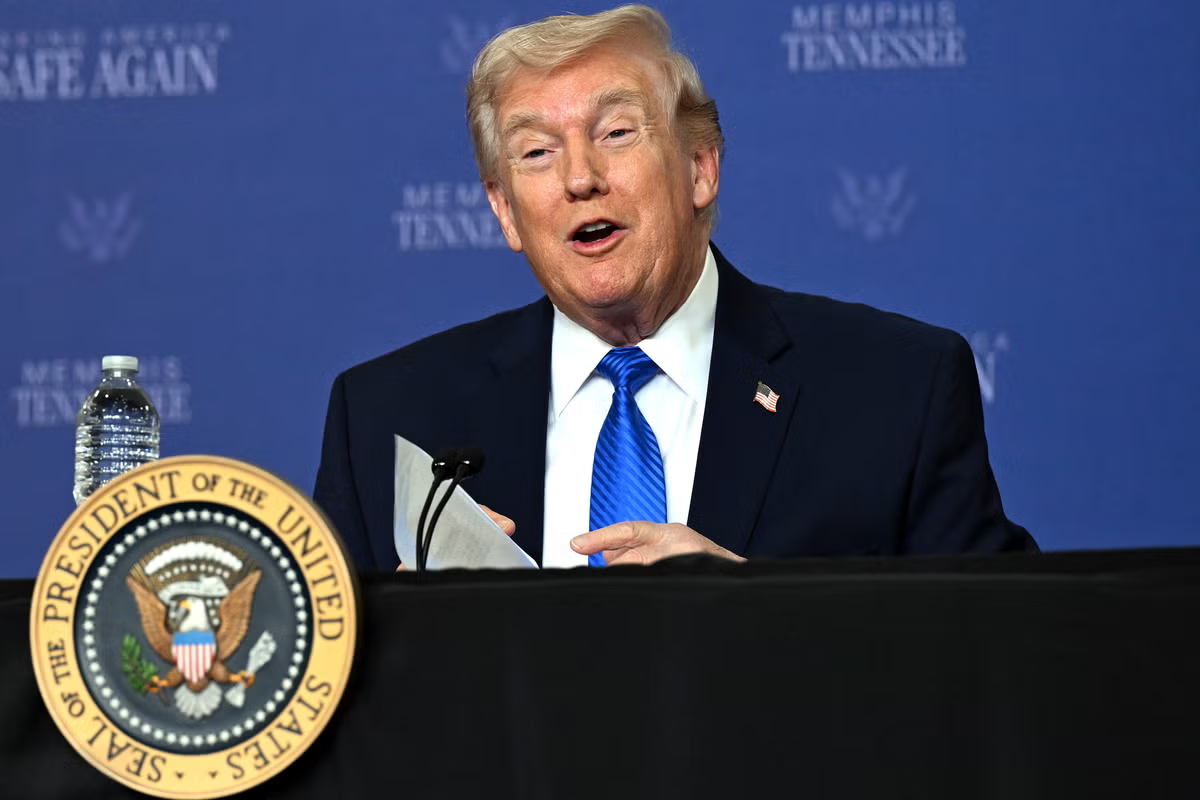
Donald Trump has issued a five-day deadline, as he warned Iran it could be “annihilated” if it does not reach a peace deal with America.
The US president insisted that “very good and productive” discussions on ending the war were taking place — a claim which has since been labelled as “fake news” by the Iranian parliament speaker, who said there had been no talks.
Mr Trump has also announced a five-day pause on US military strikes on Iranian energy sites, just hours before a 48-hour ultimatum issued by Mr Trump to Tehran over opening the Strait of Hormuz was due to expire.
Speaking on Monday, the president said: “We were planning tomorrow on shooting down some of their power plants, we’re gonna hold that up, hopefully we won’t have to do it.
Advertisement
“At the end of this [five-day] period it could very well end up being a very good deal for everybody. As good as if we went all the way and just literally annihilated the place, which if we don’t have to do that, that would be a good thing not a bad thing”.
Iran’s parliament speaker, Mohammad Bager Galibaf, has rejected claims of talks with the US, saying: “No negotiations have been held with the US, and fake news is used to manipulate the financial and oil markets and escape the quagmire in which the US and Israel are trapped”.
Trump’s special envoy travels to Pakistan: report
Steve Witkoff, US President Donald Trump’s special envoy to the Middle East, has travelled to Pakistan, The Times has reported.
Advertisement
Pakistan has offered to host in-person talks between the US and Iran, but prominent Iranian officials have not signalled that they’d be there, according to The Times.
Rachel Dobkin24 March 2026 02:30
Trump says Strait of Hormuz may be controlled by ‘me and the ayatollah’
US President Donald Trump has said the Strait of Hormuz will be controlled by “me and the ayatollah”.
Advertisement
CNN’s Kaitlan Collins asked Trump Monday, “What about the Strait of Hormuz? Who’s going to be in control of that?”
Trump said it would be “jointly controlled,” possibly by him.
“Maybe me. Me and the Ayatollah. Whoever the Ayatollah is, whoever the next Ayatollah is”, the president said.
After the late Ayatollah Ali Khamenei was killed early in the Iran war, his son, Mojtaba Khamenei, took over as the country’s leader.
Advertisement
The Strait of Hormuz, which carries about a fifth of the world’s oil, has been effectively closed by Iran amid the war, and Trump has been trying to open it.
Iranian energy infrastructure damaged in strikes: report
Iranian energy infrastructure has been damaged in airstrikes, the Associated Press reported, citing the Fars news agency.
Fars, a semiofficial Iranian news agency close to Iran’s Revolutionary Guard, reported that natural gas infrastructure in Isfahan was hit, and a gas pipeline for the Khorramshahr power plant was targeted.
Rachel Dobkin24 March 2026 01:45
Advertisement
Kuwait’s energy ministry says ‘air defense operations’ caused a ‘partial power outage’
Kuwait’s energy ministry has said “air defense operations” caused a “partial power outage”.
Seven overhead power lines were damaged by falling debris in several areas, the ministry said in a translated statement early Tuesday morning local time, adding, “Work is underway to restore power as quickly as possible”.
Rachel Dobkin24 March 2026 01:26
Advertisement
Saudi Arabia shoots down nearly 30 drones in a few hours
Saudi Arabia’s Ministry of Defence announced that it shot down 28 drones in a few hours early Tuesday morning local time.
In a series of social media posts, the ministry announced the interception and destruction of dozens of drones in the eastern region.
Rachel Dobkin24 March 2026 01:09
Advertisement
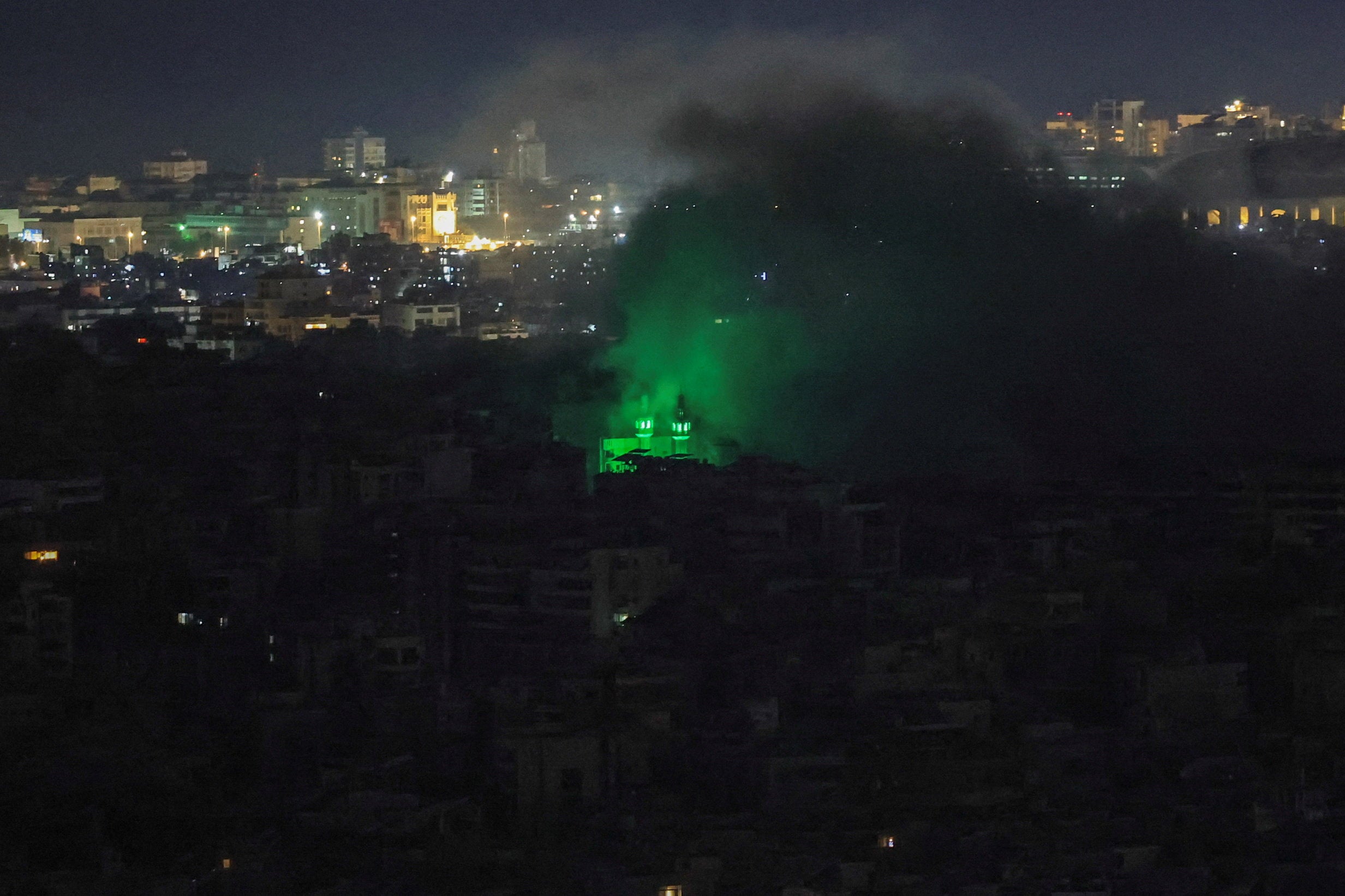
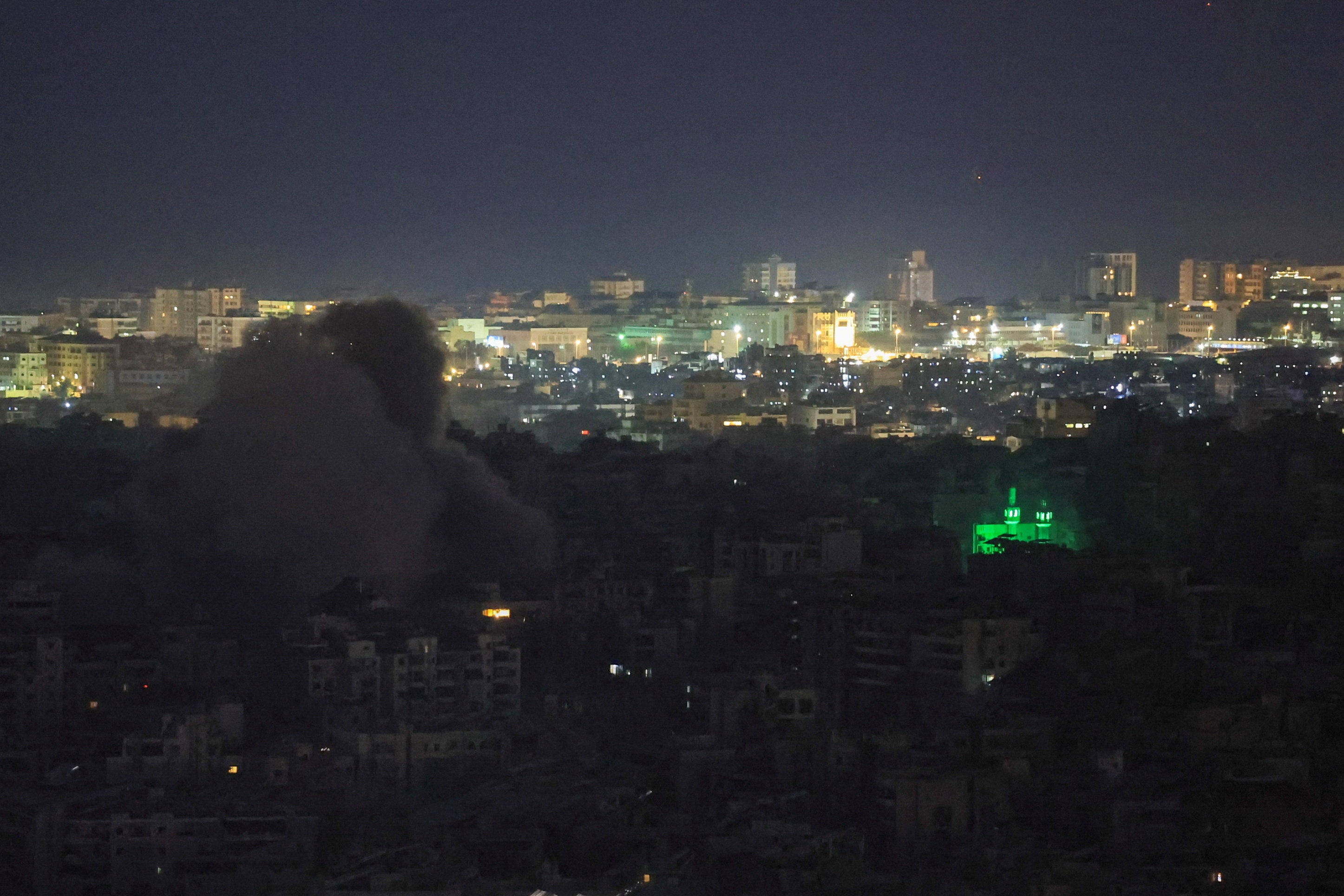
In pictures: Smoke rises from Beirut’s southern suburbs following an Israeli strike
Smoke rises from Beirut’s southern suburbs following an Israeli strike (REUTERS)
Israel has been ramping up its attacks against Iran-backed Hezbollah in recent weeks (REUTERS)
Bryony Gooch24 March 2026 00:30
Israeli minister calls for annexation of southern Lebanon
An Israeli minister has called for the annexation of southern Lebanon after Israeli troops bombed bridges and destroyed homes in an escalating military assault.
The comments by the far-right finance minister Bezalel Smotrich were the most explicit yet by a senior Israeli official on seizing Lebanese territory in a fight Israel says targets Iran-backed Hezbollah militants.
Advertisement
Lebanon was pulled into the regional war on March 2 when Hezbollah fired missiles into Israel.
Since then, Israel has ordered all residents to evacuate south of the Litani River as it pummels the area with air strikes, viewing it as a stronghold of Hezbollah, which has kept up rocket attacks on Israel.
Lebanese authorities say the Israeli air and ground assault has killed more than 1,000 people, and more than a million have been driven from their homes.
Reuters witnesses heard at least three blasts in Beirut’s Dahiyeh district late on Monday, as the Israeli military said it had attacked Hezbollah sites in the city.
Advertisement
An earlier strike in Beirut on Monday killed a commander of the elite Quds Force of Iran’s Revolutionary Guards, the Israeli military said.
Bryony Gooch24 March 2026 00:00
Airstrikes on Iraq’s Shi’ite PMF site kill six including Anbar commander
Six people are now reported to have died in airstrikes in western Anbar.
Advertisement
Airstrikes targeting a site belonging to Iraq’s Shi’ite Popular Mobilisation Forces in the western province of Anbar killed six fighters and wounded 15 others, including the PMF’s Anbar operations commander, security sources said.
Harriette Boucher23 March 2026 23:46
US claims to have hit nearly 10,000 targets since beginning of Iran war
America has struck more than 9,000 targets and damaged or destroyed more than 140 Iranian vessels since it launched strikes last month, the US Central Command said in an update.
Advertisement
“CENTCOM forces are striking targets to dismantle the Iranian regime’s security apparatus, prioritising locations that pose an imminent threat,” it said.
Donald Trump “blinks first” in his standoff with Iran, the Daily Mail says, after the US president announced a “five-day pause on energy strikes”. Trump has claimed Tehran was close to agreeing to “no more wars, no more nuclear weapons” and “regime change”, the Mail says, but the paper also notes officials in Iran have called it “fake news”.
The Earth’s climate is in a “state of emergency”, according to the United Nations which has warned it is more out of balance than at any other time in observed history.
The World Meteorological Organisation (WMO), which is the UN’s weather agency, predicted that rapid and large-scale changes to the global climate in recent decades would trigger harmful repercussions lasting centuries.
It comes as rising greenhouse gas concentrations in the atmosphere drive global warming and melt ice.
The WMO’s annual “state of the global climate” report, released on Monday, also highlighted the impact in 2025 of intense heatwaves, heavy rainfall, wildfires, drought, tropical cyclones, storms, and flooding, including widespread death and vast economic losses.
Advertisement
Image: United Nations secretary-general Antonio Guterres. Pic: Reuters
It further demonstrated the cascading impacts that extreme weather events were having worldwide, including food insecurity and displacement, and health risks driven by shifting rainfall patterns, like mosquito-borne dengue disease and heat stress.
UN secretary-general Antonio Guterres warned the global climate is in a “state of emergency”.
“Planet Earth is being pushed beyond its limits,” he said. “Every key climate indicator is flashing red.”
The report confirmed that 2015 to 2025 represented the hottest 11 years on record, with data showing last year as the second or third hottest ever documented.
Advertisement
It also revealed that Earth is close to breaching the key warming threshold of 1.5C – beyond which increasingly severe and compounding climate impacts are triggered – with the figure recorded at 1.43C last year.
Advertisement
Trump’s most sweeping climate reversal to date
Furthermore, the WMO found the accelerating amount of heat in the world’s oceans, which stores more than 91% of the excess heat in the Earth’s system, means the planet is moving to timescales of committed climate change for centuries.
Meanwhile, the planet’s energy imbalance – the rate at which energy from the sun enters and leaves the Earth – reached a new high in 2025.
Advertisement
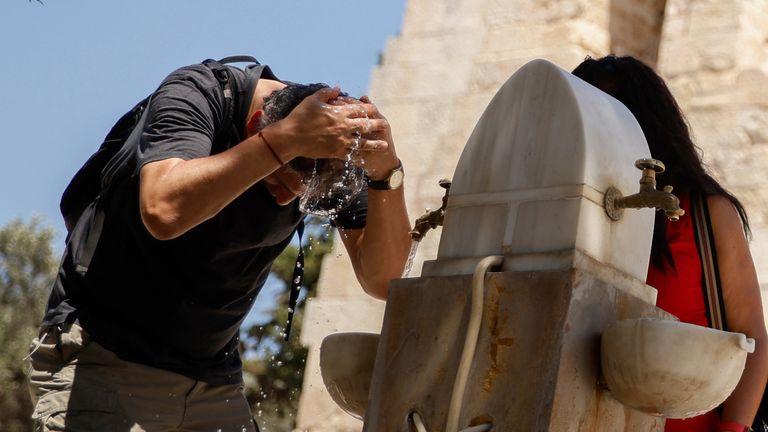
Image: A man cools off with water in Athens, Greece, amid a heatwave in July 2025. Pic: AP
At the same time, heat-trapping greenhouse gases like carbon dioxide, methane and nitrous oxide have risen to their highest level in at least 800,000 years.
WMO secretary-general Celeste Saulo said: “Human activities are increasingly disrupting the natural equilibrium and we will live with these consequences for hundreds and thousands of years.
“On a day-to-day basis, our weather has become more extreme.”
The report also outlined how climate data, early warning systems, and integrated climate services for health can protect people as the temperature rises.
Fire crews cut off a door to allow emergency services to work
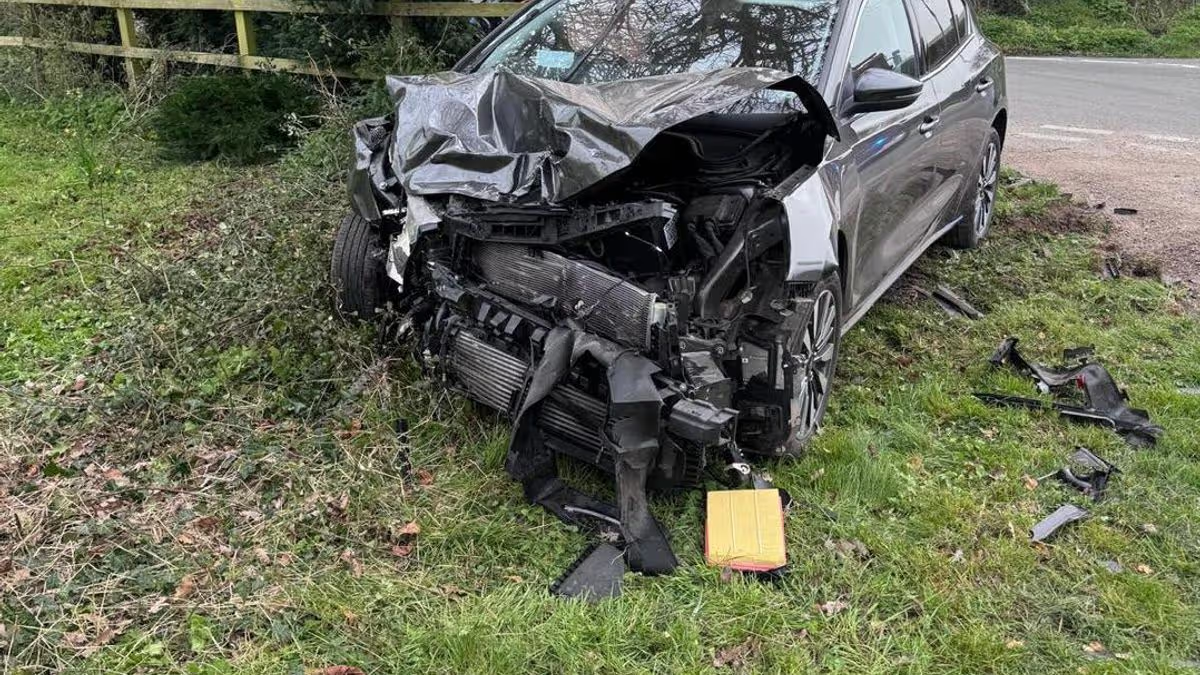
Fire crews had to cut off a car door to allow emergency services to work after a crash. Saffron Walden fire crewswere called to a crash in Ickleton at about 8am on Monday (March 23).
Advertisement
At the scene, crews removed the driver’s door from one of the vehicles to allow paramedics access. Two patients were taken to hospital after the crash.
A spokesperson for Saffron Walden fire station said: “Shortly after 8am this morning, both of our fire engines were mobilised to a road traffic collision between Strethall and Elmdon. Using specialist equipment, we quickly removed the drivers [sic] door off one of the vehicles to give our colleagues in the ambulance service some more space to work.
“We, the crew, wish both drivers a speedy recovery. This incident serves as a reminder of the importance of wearing seat belts and taking extra care when navigating our country roads.”
An East of England Ambulance Service spokesperson said: “We were called at 8.10am to a road traffic collision on Elmdon Road in Ickleton. Two ambulances were sent to the scene and two patients were transported to Addenbrooke’s Hospital for further treatment.”
Worshippers Melvin Cravitz and Adrian Daulby were killed when 35-year-old Jihad Al-Shamie, a Syrian-born British citizen, drove into the gates of the Heaton Park synagogue in Crumpsall, Manchester, in October last year, and then began attacking with a knife, wearing a fake suicide belt.
Spring has officially arrived, bringing with it brighter and lengthier days. The changing of the seasons naturally encourages a fresh beginning, particularly if you’re contemplating revitalising your home.
DIY enthusiasts and professionals have identified spring as the perfect moment to refresh your property, whether through applying a new coat of paint, replacing heavy winter textiles with lighter alternatives, or undertaking a thorough spring clean. Girls Aloud’s Kimberley recently spoke with DailyExpress.co.uk at the unveiling of her latest paint partnership with Wickes, sharing insights on home improvements and DIY projects.
Advertisement
Your bedroom should serve as a peaceful retreat, with an ambience that helps you unwind before sleep. Yet, if you’re uncertain where to begin, DIY specialists from Wickes and Kimberley have revealed their favourite paint selections for revamping your bedroom this spring, reports the Express.
Lewis Janes, Head of Decorating & Storage at Wickes, believes spring offers the optimal opportunity to refresh your living space: “This time of year is perfect for bringing natural light into your interiors and making rooms feel more open. The right shades can lift the mood whilst enhancing the sense of space.”
Always add panelling
Kimberley noted that individuals typically understand which colours suit their bedroom environment, particularly those that promote restful sleep. To enhance a basic bedroom, she suggests incorporating panelling to introduce depth and texture to the room. She explained: “In my bedroom, I focus more on the panelling, and I made the feature that rather than a strong, bold colour. And that really works, it just elevates the space…”
Advertisement
She added: “There’s the new acoustic panelling I did in my son’s room. Those kinds of things can really bring the room to life, but still keep it quite earthly and tonal if you don’t want to go too wild with colour.”
Soft Honey from Kimberley Walsh by Wickes
Lewis highlighted Kimberley’s latest interior paint Soft Honey (2.5l, £13) as an excellent choice to help brighten any bedroom space. He characterised it as “a warm, uplifting yellow with honeyed undertones that reflects daylight beautifully, creating a cosy, welcoming, and effortlessly elegant space.”
During the paint’s development, Kimberley sought assistance from her son, Bobby, whose room now showcases the inviting yellow shade.
Wheatgrass by Crown
Lewis noted that this gentle “clay hue” is ideal for those who prefer to maintain neutral walls. He characterised Wheatgrass (5l, £29) as “neutral yet inviting”.
Sage No.85 by Wickes
Green tones can help your home welcome the spring season, introducing a sense of freshness and vitality from outdoors. Lewis’ selection for spring is the Sage No.85 (2.5l, £13).
He characterised the paint colour as introducing a “gentle, timeless pastel green to the room”.
Moonlight Bay by Crown
Moonlight Bay (2.5l, £20) is a subdued pastel blue, an ideal springtime refresh for bedrooms. Lewis noted that the Crown paint “introduces a softness ideal for creating a calm, restful space.”
Kimberley’s new interior paint shade, Soft Honey, and new garden paint, Pale Clover, are now available to purchase at Wickes. Browse the Kimberley Walsh by Wickes collection here.
It’s a brief set considering the cost of entry, with Brown on and off within an hour, but the sheer pace goes some way to making up for it, leaving barely room to breathe between world-class bangers. Tonight’s gig shows that Danny Brown hit his mid-40s, got sober, settled down, and somehow came back even wilder than before.
There were tearful scenes in the central American nation of Honduras on February 23, as locals said goodbye to the Cuban healthcare professionals who had been treating them for free for around two years. It came after the Honduran government abruptly ended the Cuban medical mission under pressure from the administration of the US president, Donald Trump.
That same day, a “sensitive” US State Department memo was sent to the secretary of state, Marco Rubio. It discussed the US strategy to sabotage Cuba’s medical internationalism, which has been an integral part of the island nation’s foreign policy since 1960. In recent years it has also become a key pillar of its economy.
The US has imposed unilateral sanctions on Cuba for more than 60 years. These prevent Cuba from engaging in “normal” international trade – for example, third parties cannot sell goods to Cuba if 10% of their components are from US companies or subsidiaries. And Cuba cannot export goods to the US. On top of that, the US blockade severely restricts Cuba’s access to the international financial system.
In this context, the export of medical professionals has become vital to the Cuban economy. For decades the Cuban government sent medical missions around the world as a donation to developing nations. But over the past two decades, it has developed cooperation agreements under which governments or local authorities pay the Cuban government for the medical services of its healthcare professionals.
Advertisement
Attacking that revenue looks to be a key component of the US push for regime change in Cuba by the end of the year. This is alongside the total oil blockade imposed by Trump’s executive order on January 29, which has now caused multiple national blackouts that have left the entire island in the dark.
It is a policy of carrots and sticks. Countries kicking out Cuban medics are offered US support for “infrastructure modernisation” – things like telemedicine and virtual training. A year earlier, Rubio had announced visa restrictions for current and former officials and their families from anywhere in the world who took part in Cuban programmes.
By mid-March this year, neighbouring governments fell into line. Guatemala, Paraguay, the Bahamas, Guyana and Jamaica terminated Cuban medical missions, ending decades of cooperation. In Guatemala, more than 400 Cuban healthcare professionals, most of them doctors, are serving indigenous communities under a three decades-long partnership. The last doctors will leave by the end of the year.
Advertisement
Cuban doctors leaving Honduras in February 2026.
The US government’s attack on Cuban medical internationalism is not new. It began in 2006, the year after the oil-for-doctors programme between Cuba and Venezuela transformed the export of healthcare professionals into Cuba’s greatest revenue source.
US policy sought to eliminate this income and undermine the prestige the programmes earned the island. The then US president, George W Bush, set up the Cuban Medical Professional Parole (CMPP) Program, encouraging Cuban medics abroad to abandon missions and defect to the US. The programme was ended only in 2017, in Barack Obama’s final days as president.
Despite this, and reflecting the deficit in healthcare globally, Cuba’s earnings from the export of healthcare services rose. Revenues in 2018 (the first year Cuba published separate data for health services) were US$6.4 billion (£4.8 billion). Trump’s first administration developed policies, and funding, to sabotage these programmes.
Cuba’s bill of health
It also devised a new justification for doing this. The US government could not openly demand that countries sacrifice the health and wellbeing of their populations just to deny Cuba revenue. So instead, it accused Cuba of human trafficking and equated its healthcare professionals to slaves.
Advertisement
Anyone who has spoken to Cuban participants – as I have – knows the overseas service contracts they sign provide them with their regular Cuban salary, plus extra remuneration from the host country. They are guaranteed holidays and contact with families.
Even with tens of thousands of medical workers overseas, the state’s investment in healthcare and medical training means that the Cuban population has the highest ratio of doctors per person in the world. In 2022, it was said to have nine doctors and nine nurses for every 1,000 citizens. In the US, there are 2.6 doctors per 1,000 citizens and in the UK the figure is 3.2.
For many Cuban healthcare professionals, it signifies the fulfilment of an internationalist duty; for others a way to travel or increase their income. The Cuban government takes the lion’s share of revenues and puts them back into Cuba’s universal free public healthcare provision and medical training.
Advertisement
But under Trump’s second administration, Rubio, the son of Cuban migrants who left the island during the Batista dictatorship, has spearheaded a renewed attack on the island’s international medical programmes. The recent State Department memo stated that Cuban medical brigades were a key source of “hard cash” for the regime.
The four forms of Cuban medical internationalism practices established in the 1960s are:
emergency medical brigades overseas
treatment of foreign patients in Cuba
training foreign students as healthcare professionals, and,
establishment of public healthcare facilities overseas.
This contribution to developing nations has often been ignored or censored. But it translates into millions of lives saved and improved globally every year. Sabotaging medical internationalism would devastate Cuba. But it would also leave millions of people around the world without the vital medical attention that they had previously enjoyed.
The man was spotted driving dangerously in West Belfast by PSNI officers
Rob Currell Live news reporter
21:04, 23 Mar 2026
A teenager has been charged after he was observed driving a scrambler in a dangerous manner by PSNI Air Support Team officers on Sunday afternoon, March 22.
The 19-year-old man has been charged to court with several offences, including dangerous driving. He was spotted driving the scrambler dangerously in the Glen Road area before being arrested.
Advertisement
The man was also charged with resisting police, using a motor vehicle without insurance, no driving licence and failing to wear protective headgear.
He is due to appear before Belfast Magistrates’ Court on Friday, April 17.As is usual procedure, PSNI said the charges will be reviewed by the Public Prosecution Service.
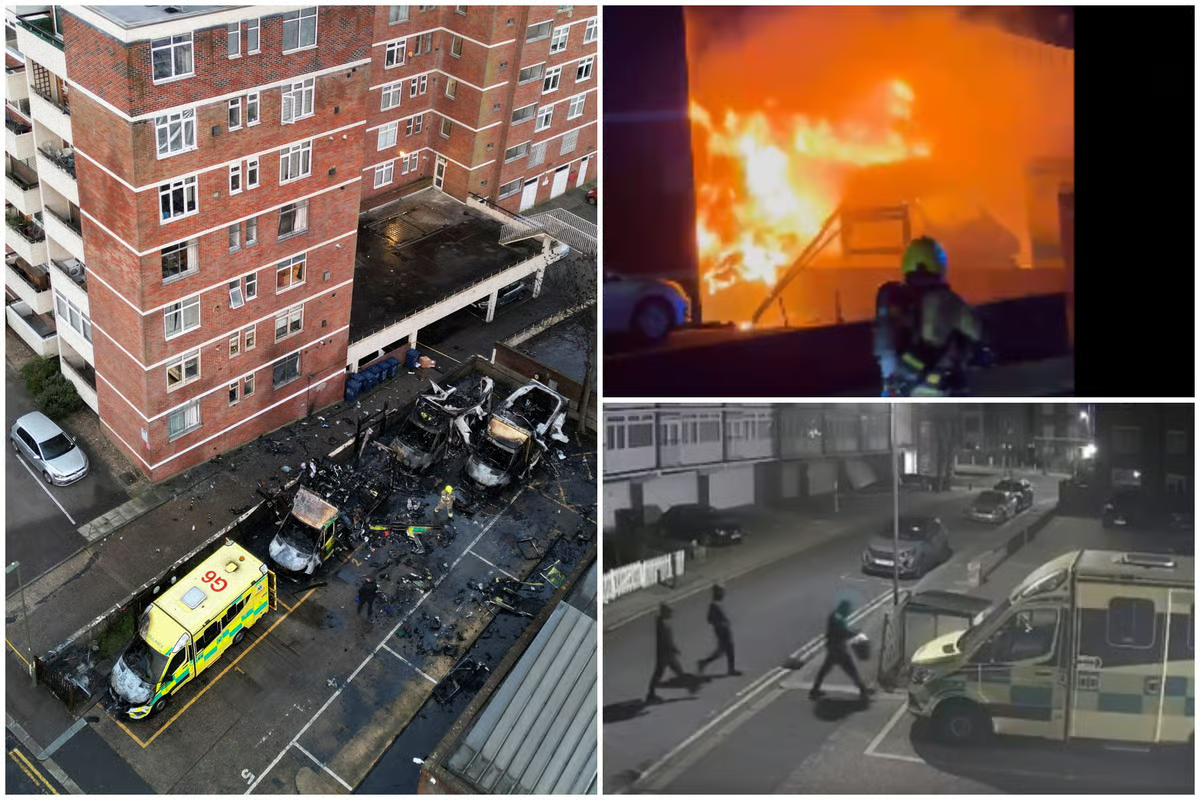
Meanwhile, at the rally organised by Our Fight UK Gideon Falter, chief executive of the Campaign Against Antisemitism, told the crowd : “Burning that ambulance service down, waiting for a moment when all four of its ambulances were in one place, not on call, it’s premeditated, it’s calculated, it’s despicable.”


















































You must be logged in to post a comment Login