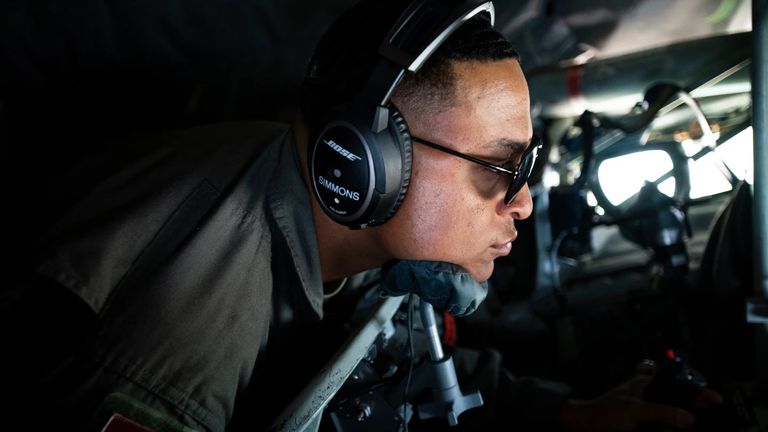








The identities have been disclosed of all six crew who died when their US military refuelling plane crashed this week.
An umbrella group of Iranian proxies, the Islamic Resistance in Iraq, claimed responsibility but US authorities have said it “was not due to hostile fire or friendly fire”.
One of the victims, Maj. John A. Klinner, 33, was deployed to help the Iran war effort less than a week before the crash
Image: Alex Klinner leaves behind three small children. Pic: Mary Remmes/AP
“It’s kind of heartbreaking to say, he was just a really good dad and really loved his family a lot – like a lot,” his brother-in-law James Harrill said.
The eight-year US Air Force veteran from Auburn, Alabama, had just moved into a new home with his family, his wife, Libby Klinner, said in a social media post. The couple have seven-month-old twins and a two-year-old son.
Tech. Sgt. Tyler H. Simmons, 28, of Columbus, Ohio, was another of the six who died.
Advertisement
Image: Mr Simmons had a smile “that could light up any room”, his family said. Pic: National Guard/AP
In a statement obtained by WCMH-TV in Columbus, Mr Simmons’ family said his “smile could light up any room”.
“His parents, grandparents, family and friends are grief stricken for the loss of life,” they added.
After the confirmation by the families of Sgt. Simmons and Maj. Klinner on Saturday, the US Department of War officially named all the crew members who died.
X
This content is provided by X, which may be using cookies and other technologies.
To show you this content, we need your permission to use cookies.
You can use the buttons below to amend your preferences to enable X cookies or to allow those cookies just once.
You can change your settings at any time via the Privacy Options.
Unfortunately we have been unable to verify if you have consented to X cookies.
To view this content you can use the button below to allow X cookies for this session only.
Capt. Ariana G. Savino, 31, of Covington, Washington; Tech. Sgt. Ashley B. Pruitt, 34, of Bardstown, Kentucky; Capt. Seth R. Koval, 38, of Mooresville, Indiana; Capt. Curtis J. Angst, 30, of Wilmington, Ohio.
The chief of the National Guard Bureau shared a picture of them all on X.
Image: A KC-135 refuelling plane. File pic: Reuters
Advertisement
Maj. Klinner, Captain Savino and Tech. Sgt. Pruitt were assigned to the 6th Air Refueling Wing, MacDill Air Force Base, in Florida.
The others were assigned to the 121st Air Refueling Wing at Rickenbacker Air National Guard Base, Columbus, Ohio.
“We share in the sorrow of their loved ones, and we must not forget the valuable contributions these Airmen made to their country and the impact they have left on our organization,” said the Air National Guard on social media.
Schools in the south of the city are predicted to be those most affected
A report set to go before Peterborough City Council has outlined how school admissions are likely to become oversubscribed in the city’s growing southern townships in the near future.
Advertisement
On Monday (March 16), the Children and Young People Scrutiny Committee will hear a forecast of how pressures on school admissions will affect both primary and secondary schools across the city over the coming years.
The report, which has been authored by Libby Walker, head of the council’s Admissions, Attendance & Transport Services, has outlined the Hamptons as an area where these pressures are most likely to be highest.
The data used to create the report forecasts primary school admission figures across the city’s north, central, west, Hamptons, Ortons, rural east, rural west, and Stanground/Fletton/Woodston areas.
Tables in the report show primary schools in the Hamptons will have by far the largest projected pressure over the next four years, with around 111 Reception pupils above capacity, indicating a significant shortfall in places by 2028/29.
Advertisement
Secondary school admission figures are set within the north, south and central planning areas of the city.
Once again, figures illustrate the south (Hamptons and Great Haddon) as showing significant and increasing pressure over the same period, rising sharply to 201 Year 7 pupils above capacity by 2028/29.
The figures are a reflection of the recent population growth across the south of the city, with significant expansion of residential developments seen across the Hamptons and Great Haddon – areas that are still continuing to grow.
Earlier this year, the council confirmed that Great Haddon Secondary School (GHSS) will be opening in 2029. Similarly, the ground has already been broken on the 420-place Great Haddon Primary School, which is set to open in January 2027.
Advertisement
The forecasts featured within the report were created by using each city school’s Published Admissions Number (PAN), essentially the number of places a school has available to allocate. This number is based on the school’s net capacity, which is determined via assessment by the Department for Education.
Adhering to each school’s PAN, priority in Peterborough admissions is given first to children with an Education, Health and Care Plan naming the school, followed by looked-after or previously looked-after children, then children in the school’s catchment area (especially those with siblings already attending), children of staff, and finally other applicants outside the catchment area.
When there are more applications than places, schools use oversubscription criteria to decide priority. If a child is not offered a place, they are placed on a waiting list ranked according to the same criteria.

Using data sourced from Primary & Secondary National Offer days, the report shows that the number of applications to primary schools (reception class) across Peterborough as a whole has actually decreased steadily over the past five years, dropping from 3315 in 2020 to 2498 in 2025.
Advertisement
Over the same period however, the number of applications to the city’s secondary schools (Year 7) has risen, from 2763 to 2926.
Ms Walker explains this in the report: “Nationally, the birth rate has fallen within the UK and this has created place issues for primary schools due to falling rolls.
“However, migration into the city has meant that as yet, we have not seen the same issues within secondary schools and have had to create additional places year-on-year into secondary schools to be able to meet demand.”
The stand-off between Ten Hag and Sancho lasted four months, before Sancho joined Dortmund on loan for the remainder of the season and helped them reach the Champions League final.
But they could not afford to keep him and, although United sporting director Dan Ashworth was credited with brokering the truce that allowed Sancho to join up with United in the pre-season of 2024, it was a temporary situation, which Chelsea seemed to solve by agreeing a loan that committed them to a permanent transfer at the end of the season.
Yet, after five goals in 41 appearances, Chelsea preferred to pay a £5m penalty to send Sancho back to Old Trafford.
This time, there was no olive branch. Sancho was placed in Ruben Amorim’s ‘bomb squad’ and had to train away from the first team until he joined Villa on 1 September.
Advertisement
United have an option to trigger an additional year on Sancho’s contract, which otherwise expires in the summer. In public, they are reserving their position on that. No-one expects it to happen.
At 25, Sancho still has a lot to offer. There have been glimpses of quality during his time at Villa, but it is by no means certain he will stay there beyond the end of the season.
“Seeing Jadon close up, technically, he’s got an awful lot of ability,” said current United interim head coach Michael Carrick, who worked with Sancho as part of Solskjaer’s backroom team and managed him for three games during his short stint in charge after the Norwegian’s dismissal.
“In and around the box; his ball carrying; his little plays; the connections; his creativity; the way he handles the ball – he’s got natural ability.
Advertisement
“He’s always had it all the way coming through. That’s one part of football.
“But – and I’m not talking about Jadon individually on this – it is just how it is and how it should be.
“You can’t just assume it’s all going to be smooth. It’s proven that it’s not always like that.
“You’ve got to find a way through it. If you are playing in a good team with good players and a good squad and depth, that’s part of the challenge to stay at the top.”
Staff will be reduced by a third in a bid to bring down costs
A Cambridge museum has been forced to reduce its opening days and staff numbers due to rising costs. The Museum of Cambridge, on Castle Street will close for an additional two days each week and will reduce staff by one third, with changes coming into effect from March 30.
Advertisement
The museum, which is in the 17th century White Horse Inn, currently opens to the public six days a week during term time. This will be reduced to four days a week. The museum will open Friday to Monday, with the addition of Thursdays during school holidays.
The Museum of Cambridge shares stories of everyday people of Cambridge and Cambridgeshire, and will be celebrating its 90th anniversary in November this year. Some of the attractions it offers include temporary exhibitions and free family activities.
Alex Smaridge, Director of the Museum of Cambridge, said: “Although this is something we would rather not have to do, increasing closure days at this time gives us an opportunity to act strategically and focus on what we do next, to ensure the long-term future of the museum. We are independent, and like many museums in the sector, we are facing rising operational costs and reduced footfall.
“We are working hard and looking forward to having events and activities on during the school holidays and making sure that everyone in Cambridge can continue to explore their local history.”
Advertisement
Roger Lilley, Chair of Trustees at the Museum of Cambridge, added: “We are incredibly proud of the work of the Museum and want to ensure that we continue to provide an amazing experience for everyone who comes to visit us.
“The Museum has worked very hard coming out of the COVID-19 pandemic to ensure its future, but in the face of increased costs, the Board of Trustees agree that this is the right moment to assess our strategy.
“We remain grateful to the support of our donors and funders. Most importantly, we’d like to reassure everyone that they will still be able to access the Museum, attend our events and learn about their local history.”
The Museum of Cambridge is an independent social history museum which relies on entry fees, venue hire, donations, and grants to keep it running, along with the help of volunteers. The museum has been at its current location since 1936 and has a collection of over 40,000 objects.
Director Silvio Soldini’s wartime drama The Tasters is a gripping and deeply affecting film. Inspired by the testimony of Margot Wölk, who claimed in 2012 that she had been forced to taste Adolf Hitler’s food during the second world war, the film examines survival and moral compromise among those caught inside the machinery of the Nazi regime.
At its centre is Rosa Sauer (Elisa Schlott), a young woman who leaves Berlin in 1943 to live with her parents-in-law in rural East Prussia while her husband fights on the Russian front. Hoping to escape the bombing of the capital, she quickly finds herself facing a different danger when Nazi soldiers arrive and force her into a van with several other women from the village.
They are taken to the nearby Wolf’s Lair, Hitler’s secret headquarters, where the women are ordered to taste every meal prepared for the Führer to confirm that the food has not been poisoned. They sit together under guard to eat dishes prepared by the kitchen staff and then wait under supervision to see whether anyone falls ill.
Advertisement
The women are fed and then observed for any signs of poisoning. MetFilm
The film unfolds within a muted visual palette that reflects the bleakness of its rural wartime setting. The countryside is drained of colour and the interiors appear subdued. This restraint extends to Hitler himself, whose presence is constantly acknowledged but never shown. The unseen dictator hangs over the film and shapes the lives of the women without ever appearing to them.
Elisa Schlott delivers a quietly commanding central performance. Her Rosa is observant and uneasy, a woman trying to understand a situation imposed on her without explanation. Schlott conveys the character’s anxiety through small gestures and careful silences, creating a performance with steady emotional weight which anchors the film.
The ensemble surrounding Schlott is equally impressive. The other women gradually come into focus, each drawn carefully with her own complexities. Emma Falck gives a strong performance as the wide-eyed and optimistic Leni, while Alma Hasun is compelling as the guarded Elfriede. Their shared circumstances create moments of closeness as well as distrust, so that survival becomes a matter of constant adjustment.
Rivalries emerge and alliances shift as the women spend long hours together under surveillance. Bonds form through conversation and secret gestures of care, and even within a system that treats them as expendable, the women continue to recognise one another as individuals.
Advertisement
The Nazi soldiers are a constant threatening presence. Their authority over the women is absolute and the violence behind it surfaces in sudden moments. One lieutenant (Max Riemelt) begins to single out Rosa and the two enter a clandestine sexual relationship that offers brief escape for them both before the reality of their situation, and their own role in the horror of war intrudes.
Soldini’s patient, understated direction allows the story to unfold through confined interiors and careful observation. Composer Mauro Pagani’s impressive score carries an insistence beneath the action, evoking the war beyond the boundaries of the film. The conflict remains outside the frame, while the score intrudes at key moments and unsettles the fragile calm of the women’s routines.
In the crowded field of second world war films, The Tasters is a rare story that places women at its centre. These women continue their lives as best they can within the constraints of their reality. They talk and confide in one another, and small acts of kindness carry enormous weight in an environment shaped by control and fear.
Advertisement
Exploring the fragile humanity which persists within an oppressive system, The Tasters is a thought-provoking, compelling and quietly powerful film that will devastate you softly.
This article features references to books that have been included for editorial reasons, and may contain links to bookshop.org; if you click on one of the links and go on to buy something, The Conversation UK may earn a commission.
Donald Trump has said that, despite Iran’s willingness for a ceasefire, he has refused
Donald Trump has turned down a ceasefire proposal put forward by Iran. Disregarding appeals for peace from the United Nations and world leaders, Trump stated that despite Iran’s readiness for a ceasefire, he had declined as the proposed deal wasn’t satisfactory enough.
Advertisement
“Iran wants to make a deal, and I don’t want to make it because the terms aren’t good enough yet,” he declared, adding that any conditions would need to be “very solid” for the US to consider negotiations. When questioned by NBC News about what terms he would accept to conclude the war, the 47th President of the United States responded: “I don’t want to say that to you.”
However, he did concede that Iran would need to abandon any remaining nuclear aspirations to secure a deal.
Ensure our latest stories always appear at the top of your Google Search by making us a Preferred Source. Click here to activate or add us as your Preferred Source in your Google search settings.
He did inform NBC that the only power Iran possesses, “is the power of dropping a mine or shooting a relatively short-range missile”, reports the Mirror.
Advertisement
Trump added: “But when we get finished with the shoreline, they’re not going to have that power either.”
He later said: “We’ve knocked out most of their missiles. We’ve knocked out most of their drones. We knocked out their manufacturing of missiles and drones, largely. Within two days, it’ll be totally decimated.”
He also told the NBC that US airstrikes had “totally demolished” most of Iran’s Kharg Island, before gloating that the American military ” may hit it a few more times just for fun”.
Advertisement
Trump’s assertion that Iran has sought a ceasefire contradicts analysis from the Institute for the Study of War (ISW), a non-partisan, non-profit, public policy research organisation that promotes informed understanding of military matters through research, analysis, and education. According to the ISW: “Neither Iran nor the United States is prepared to hold discussions to reach a ceasefire despite mediation efforts by Oman and Egypt, according to Iranian, regional, and White House officials speaking to Reuters on March 14.”
In its summary of the conflict for March 14, the ISW added: “Three sources familiar with the efforts told Reuters that the Trump administration rejected efforts by Middle Eastern allies, including Oman and Egypt, to start diplomatic talks to end the war with Iran.”
Meanwhile, during the same NBC interview, Trump also stated he has been informed Iran’s new Supreme Leader is “not alive”.
Trump went on to say that should he be alive, he ought to surrender.
Trump’s remarks about Mojtaba Khamenei follow the recently appointed Ayatollah’s absence from a scheduled camera appearance before his nation on Thursday, which had been widely expected. Khamenei, son of the Islamic Republic’s previous supreme leader who shared the same name, was due to deliver his inaugural statement as leader.
However, Khamenei did not appear, sparking worldwide speculation regarding his location and physical condition.
Trump told NBC: “I don’t know if he’s even alive. So far, nobody’s been able to show him.”
Advertisement
He added: “I’m hearing he’s not alive, and if he is, he should do something very smart for his country, and that’s surrender.”
An unidentified source based in the Iranian capital of Tehran claimed that Khamenei, 56, reportedly lost at least one leg and suffered serious abdominal or liver injuries following a strike by the US or Israel, according to The Sun.
The source offered extensive details concerning the new leader’s purported medical state, treatment, whereabouts and security measures. The source indicated he is being treated at Sina University Hospital in the city’s historic district, where a section has been cordoned off and placed under heavy guard.
Iranian state television has confirmed that Khamenei was injured in recent explosions, but the anonymous source’s allegations cannot be independently corroborated, largely due to Iran’s ongoing internet blackout. In a conversation with the Associated Press, Türkiye’s foreign minister Hakan Fidan admitted he is unaware of the extent of Khamenei’s injuries, but “what we know is that he is alive and functioning”.
Fidan’s remarks follow assertions by Iran’s foreign minister Abbas Araghchi, who stated there was “no problem” with the Islamic republic’s new supreme leader. These statements were made after US Defence Secretary Pete Hegseth suggested the Iranian leader is “wounded and likely disfigured”.
This week, Iran announced Mojtaba Khamenei as its new Supreme Leader following an airstrike that claimed the life of his father, the late Ayatollah Ali Khamenei, on the first day of the Middle Eastern conflict.
Warning: Article contains images of graphic injuries that some readers may find distressing. Adam Wiggins beat his partner up and ‘left her for dead’ now she has taken the brave step of warning others
07:37, 15 Mar 2026
Advertisement
A traumatised woman says she felt “left for dead” by her insecure ex-partner who beat her up and ran away, leaving police officers to find her bleeding and terrified. Kerry Ford described how she felt “warm” with blood as she drifted in and out of consciousness after the horrific attack.
Following the hearing Kerry bravely decided to share her story to warn other women and raise awareness of domestic abuse. “I really don’t want him to do this to anyone else,” she said. “He is the type of person who would do this again. He’s a horrible person.”
Kerry described herself as being “vulnerable” at the time she met ex-military veteran Wiggins, but that he seemed “totally fine” when she first met him around April 2025.
Advertisement
She said it didn’t take long for their relationship to deteriorate, with Wiggins showing signs of jealousy and first becoming violent around July.
“He was totally fine at first and then he started showing tell-tale signs of abuse where he was jealous of me – he would always want to know where I was,” she said.
“He drank an awful lot and he took drugs an awful lot and then it was almost like I wasn’t allowed to look at anybody, so I would walk around with my head on the floor because if I looked at anybody he would say I wanted to be with them. He would always accuse me of fancying his friends. It was just horrendous.
Advertisement
“Then the hitting started, where he would punch me and leave me with bruises. I was really vulnerable and not in a good place myself when I met him and I think he took that to his advantage because he knew that I was easy to manipulate.”]
Kerry described how Wiggins would put her down and call her names, which along with her vulnerable mental state made it feel difficult to leave him. In texts seen by WalesOnline Wiggins appears to call the woman “fat” and “elephant”. Don’t miss a court report by signing upto our crime newsletter here
Wiggins’ behaviour progressed into a serious incident against Kerry which saw him arrested and bailed. It was while on bail for this incident that Wiggins attacked her on August 16, leaving her bleeding and terrified.
Advertisement
Describing the incident, Kerry said: “On Friday night (August 15) he was out with his friends and he asked me to pick him up so I did that, brought him back to my home. I went to the toilet and he screamed at me: ‘Where’s your mobile phone?’ I said: ‘It’s in the bedroom.’
“He started going through my phone, asking me who I had blocked and asking why I had blocked these people. I said: ‘I’ve got loads of people on my blocked list, it doesn’t mean they’re anybody.’”
Kerry described how Wiggins became enraged which made her so scared that she wet herself. He then subjected her to the brutal attack.
Recalling the harrowing details, she said: “I screamed at him to get out of my house because I knew what was coming. He punched me, so I slapped him back across the face. With that, he told me: ‘Like that is it?’ and he saw red.
“I remember three or four blows to my face and side of my head and then I must have been unconscious because I woke up on the floor to him kicking me with my arm held up to my face.
“And with that I got up and I was completely covered head to toe in blood; I was warm. My whole body was warm and my face was warm.”
Advertisement
While she was in that state Kerry detailed how Wiggins ran off and left her there, as she feared for her life. “He ran off and my dog was cwtched into the side of me crying – she’s traumatised as well. She won’t go near a man anymore,” she said.
“I managed to get myself down the staircase and as I came stumbling down the stairs I had fallen into the door. He had got my car keys. Before he got in the car I said: ‘Adam please don’t leave me, I’m dying; phone me an ambulance.’ And he just drove off. I then managed to scream for help
“I got around to my neighbour’s whose reaction was: “Oh my god her throat has been slit,” because the blood was squirting. That was embarrassing as I was in my underwear walking the street. Then I went [back] to my home and that’s when I was in and out of consciousness.”
Advertisement
It was heard at the sentencing on February 26 how Wiggins called 999 after he left the scene. It was heard how he stated on the phone that he had assaulted someone, claiming he acted in “self-defence”.
He told the operator that the victim “might need an ambulance” but refused to confirm who was injured. Police officers dispatched to the area found Wiggins who was put inside a police van where he admitted that he had assaulted Kerry and should not have been in the area due to his bail conditions.
Meanwhile other officers found Kerry at her home with multiple lacerations to her head. They took her straight to hospital where she was confirmed to have a plethora of injuries.
“Police put me in the back of the car and took me to the hospital,” she said. “Staff at the Grange were amazing – they put me straight into a CT scanner and took me straight for X-rays
“They had to shower me three times to try and get the blood out of my hair otherwise they were looking at shaving it off because of the injuries to my head. I had 15 stitches to my head [for] three deep gashes to head, one broken wrist, one badly injured wrist and two broken fingers.
“I kept saying sorry to the nurse, saying: “It’s a Friday night you don’t need to be doing this for me, there are people here who are dying”. She said: ‘We don’t see this. We see people with broken noses and black eyes, but we don’t see this.’.
Advertisement
Wiggins of Queen Street, Pentre, pleaded guilty to one count of causing grievous bodily harm without intent. He has six convictions for seven offences of which three relate to the battery of “other partners”.
Judge Vanessa Francis called Wiggins’ actions “persistent and sustained” while she considered how he had “already spent time in custody” prior to the hearing. She said the time he has spent on remand is already equivalent to that of a 12-month sentence.
She sentenced Wiggins to 24 months in prison suspended for two years, which saw him released from prison on the day of the sentencing. Since her ordeal Kerry said she will continue to be affected by what happened to her, while Wiggins walks free.
Advertisement
“It’s been really hard,” she said. “My mental health is terrible, I couldn’t go out for ages. I was scared and I wasn’t sleeping. My doctor has actually diagnosed me with PTSD and put me on sleeping tablets.”
Frustrated, Kerry added that she was informed by a counselling service via her GP that she will need to wait three years to wait for psychological therapy, while Wiggins was told during his sentencing that upon his release he will begin a rehabilitation course, a mental health treatment requirement and an alcohol abuse requirement.
“I feel let down as the victim,” she said. “I’m living in fear, I have been through the worst time of my life and he’s getting help and I’m not.”
Kerry said the impact of Wiggins’ actions don’t stop with her, either. She explained: “My mum is the worst affected. “I went out on a night out in December and my phone was in my handbag and it accidentally rang my mum, its pocket dialed her, and was pressing loads of buttons.
“She woke my sister up at 1am and they got dressed to come and find me because they thought something was wrong and I was doing a code. And that’s horrendous for my mum to feel like that. I suppose she saw me in the state that I was, and my sister had seen me in hospital and cried every time she looked at me.”
If you or someone you know is affected by domestic abuse visit the Live Fear Free website or call the helpline on 0808 80 10 800.
Get daily breaking news updates on your phone by joining our WhatsApp community here. We occasionally treat members to special offers, promotions and ads from us and our partners. See our Privacy Notice
A trip with school friends changed Stef’s life forever (Picture: Helene Wiesenhaan/BSR Agency/Getty Images)
The memories of August 6, 2000 and what started off as ‘the best weekend of my life’ still play back vividly in Stef Reid’s head.
For a start there were arguments beforehand, as Stef, then 15, pleaded with her strict mother Carol to let her visit lakes in rural Canada with her best friends.
Later, having been allowed to go, Stef recalls with crystal clarity the thrill and excitement of racing along the water in a tube, being pulled by a speedboat.
‘You bounce along the waves and eventually you’re thrown into the water, as I was,’ she says. ‘I turned to wait for the speedboat to come back and collect me.’
Advertisement
However, in the final horrific seconds, Stef realised the driver of the boat hadn’t seen her in the water. And what happened next changed her life. ‘In a split second I realised he was heading straight for me – and my brain shifted into survival mode,’ says Stef, now 41.
‘I thought, “Stef, you need to avoid those propellers”, so I tried to dive under the surface to safety but I had a lifejacket on.’
Stef Reid is now a Paralympian (Photo by Michael Steele/Getty Images)
‘I have this memory of darkness in the water and suspension in time. I was underwater and swam towards the light on the surface. I remember thinking, “Wow, that was really lucky, I won’t tell my Mum,” because I didn’t realise anything was wrong.
‘I couldn’t see my legs and after a few seconds I felt weird sensations. Shock, terror and panic set in.’
A lifeguard on the boat swam to support Stef in the water. When pulled back on board, she was bleeding profusely. The propeller had left deep gashes along her back and mangled her right foot. ‘I wanted to talk but I couldn’t get the words out,’ says Stef.Back on land, ‘my friends made a stretcher out of a deckchair and put me on the back of the van.
Advertisement
‘A neighbour who was a nurse sat beside me as we raced to meet the ambulance.’
Mum Carol, who is English and married to Scotsman Philip, arrived at the hospital. As surgeons began to discuss a possible amputation, she pleaded with them to remove her own healthy foot and graft it on to Stef’s mangled limb.
‘I’ll never forget my mum begging the surgeon, “Can you amputate my leg and give it to Stef?”,’ she says. ‘And after all those years of teenage arguments and disagreements I learned in that moment that my mum put me first in everything.’
Stef and her mother Carol had a strained relationship, but the accident brought them closer (Picture: Supplied)
‘All those times as a teenager when I was angry with her because she was too strict, I realised she just wanted me to be safe.
‘I never fought with her again. I realised she loved me so much, she would sacrifice her own leg to help me. It made me realise how lucky I was.’
Advertisement
Stef remained in hospital for three weeks, with Carol, now 71 and a retired bookkeeper, sleeping on a chair beside her bed. The teenager had to face the reality that her dreams of becoming a professional rugby player were in tatters.
‘I was angry, miserable and in pain,’ she says. ‘I had to accept that sport wasn’t going to be part of my life and threw myself into my studies instead.’
Stef returned to school with hopes of becoming a surgeon. Two years later she was given her first running blade. While studying biochemistry at Queen’s University in Ontario, she asked to join the running team.
‘I wondered just how fast I could go,’ she says, and soon Stef was running alongside the non-disabled team. She was invited to run in Manchester at the age of 22 and paused her academic studies to train for the Paralympics as a long-jumper and sprinter.
Advertisement
Carol is one of Stef’s biggest supporters (Picture: Supplied)
The gamble paid off. Stef won a bronze medal in the 200m at the 2008 Paralympics in Beijing when representing Canada, and silver in the long jump at the London 2012 Paralympics for Great Britain.
With her British parentage, Stef moved to the UK full time in 2011 to live and train in Leicester, turning to inspirational speaking and broadcasting after retiring from athletics in 2022.
Behind each of Stef’s successes has been Carol, her biggest cheerleader.
Stef now lives in Loughborough with husband Brent Lakatos, a Canadian wheelchair racer.
‘Mum gave up her weekends to drive me to competitions and she was always in the crowd shouting “Go, Stef, go!”’ says Stef, whose success extended beyond the track to include appearances on TV shows Celebrity MasterChef and Dancing on Ice, where she made it to the quarter finals.
Advertisement
Which of those two was the most nerve-wracking? ‘The scariest was Dancing on Ice,’ she says. ‘I wasn’t a natural skater and it was so nerve-wracking because I’d have an epic fall in every final practice, which made the live skate on television so much worse hours later.
‘My legs used to feel like jelly but I realised I could still function under all that stress.
Dancing on ice was one of the biggest challenges Stef has taken on (Picture: Matt Frost/ITV/Shutterstock)
‘Celebrity MasterChef in 2018 was wildly different because I had very little experience of cooking and I misunderstood the show.
‘I thought I’d be mentored and taught in every episode. When I realised there was no training involved, I ended up watching YouTube for hours every day, learning how to cook.
‘The skills never left me and now I can at least throw a fantastic dinner party!’
Advertisement
Next up, Stef is presenting TV coverage of the Winter Paralympics in Italy – which begin this Friday – from a studio in Toronto. She is also a diversity ambassador for British Ice Skating, an inspirational speaker and a high-performance coach.
‘My best advice is just go for it,’ she says. ‘My life could have been wrecked when I was 15 but I would never have achieved what I have without losing my foot – or without my amazing mother helping me every inch of the way.’
Stef Reid recently launched the Hail Mary Friday Club for those looking for a gentle shove to live with more boldness and joy. Visit stefreid.com
The Reds are chasing a top-four finish as they look to consolidate themselves in the Champions League conversation, while Igor Tudor’s Spurs are looking to avoid the unthinkable, with relegation now a very real threat for the north London club.
Today’s hosts are in indifferent form, having suffered two defeats in their last three matches.
One of those came in their last Premier League outing, as they were stunned by bottom club Wolves 2-1 at Molineux.
They then avenged that loss by beating the Black Country club just days later, but they slipped back into that losing streak with a 1-0 defeat at Galatasaray in the Champions League in midweek.
Advertisement
The Premier League champions were without their first-choice goalkeeper Alisson Becker, who had picked up a minor injury in training that kept him out of the trip to Turkey.
As for Spurs, they are just one point above that dreaded dotted line, with Tudor not winning any of his first four games in interim charge.
Pressure has mounted on the Croat after the 5-2 defeat by Atletico Madrid in the Champions League earlier this week, and rumours are swirling about his immediate future as Spurs look anxiously over their shoulders.
How to watch Liverpool vs Tottenham
Advertisement
TV channel: In the UK, the game will be televised live on Sky Sports. Coverage starts at 4pm GMT on Sky Sports Premier League and Sky Sports Main Event.
Live stream: Sky Sports subscribers can also catch the contest live online via the Sky Go app.
Live blog: You can follow all the action on matchday via Standard Sport’s live blog, with expert analysis from Sam Tabuteau at the ground.
He died at HMP Bure in Norfolk on Friday, the Prison Service said.
The former actor, who appeared in the BBC drama Grange Hill, was convicted of four counts of sexual activity with a 14-year-old girl and charges of sexual assault and assault by penetration relating to a 15-year-old girl at a property in Hertfordshire on April 9 2022.
Advertisement
After Alford’s death was first reported by The Sun on Sunday, a Prison Service spokesman said: ‘John Shannon died in prison on March 13 2026.
‘As with all deaths in custody, the Prisons and Probation Ombudsman will investigate.’
John Alford was sentenced to eight and a half years in jail after sexually assaulting two teenagers (Picture: Hertfordshire Police/PA Wire)
Alford appeared in ITV drama London’s Burning (Picture: John Stillwell/PA Wire)
Jurors heard during the trial that the defendant, charged under his real name John Shannon, sexually assaulted the girls while they were drunk following a night out at the pub.
Police received a third-party report from the 15-year-old girl’s mother outlining the allegations two days later, before the defendant was arrested.
The 15-year-old girl said in her evidence she had felt ‘absolutely sick’ following the assault and had planned to keep the incident secret before having a ‘mental breakdown’ to her friend’s mother on April 11.
Advertisement
Alford told jurors during the trial that all the allegations were ‘scandalous’ and a ‘set-up’, and that there was no DNA evidence to support the assaults.
He said he had told police that the girls were ‘going to extort money’ from him, and that he suffered from mental health issues including anxiety, depression and paranoia.
During his trial in September prosecutor Chris White told the jury: ‘John Shannon was fully aware of the girls’ ages, yet he chose to exploit them – giving them alcohol and then committing sexual offences against them.’
Don’t miss a Soaps scoop! Add us as a Preferred Source
As a loyal Metro Soaps reader, we want to make sure you never miss our articles when searching for stories. We have all the latest soaps news, spoilers, videos, and interviews, with a vibrant community of highly engaged readers.
Advertisement
Click the button below and tick Metro.co.uk to ensure you see stories from us first in Google Search.
The notice on the door and at the till of Bargain Booze warns that while the team “love creative payment methods”, cash fetched from bras, underwear, socks, or mouths “isn’t on our menu”, adding that they were “sorry not sorry” for the inconvenience.
The humorous reminder suggests that incidents of unsavoury cash exchanges may have occurred more than once at the Dale Street shop.
The sign reminds customers to ‘keep it classy’ (Image: Newsquest)
A second sign reminds vape buyers that the shop will only accept cash for these particular transactions, joking that there will be “no puff” without a cash payment, and urges customers to stop the “Oscar-worthy performance” of pretending they did not know.
The tongue-in-cheek sign offered up three choices for those in a pinch, including “hitting the cash machine, ask for cash back, or sweet-talk someone into lending you a fiver”.