Connect with us

NewsBeat

‘Vibrant and creative’ Cambridge academic died of brain tumour after getting headaches and numbness

Published

on

Cambridgeshire Live

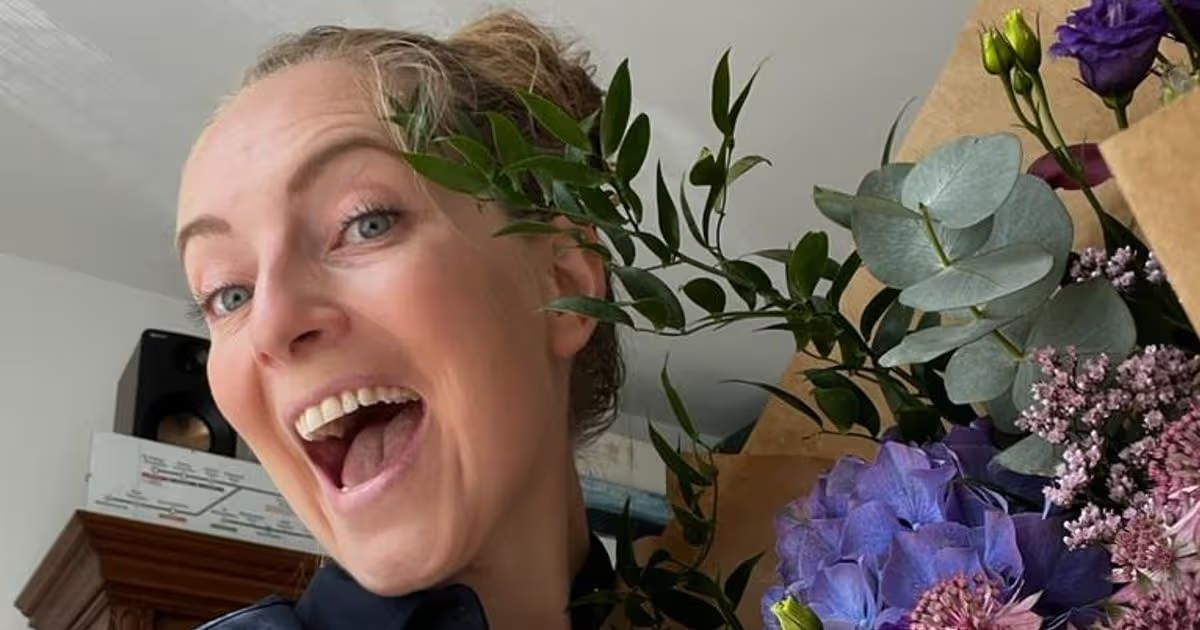
Paula Heister taught medicine at Downing College, University of Cambridge

A Cambridge man whose wife died of a brain tumour has described her as “a force of nature”. Chris Jones, 39, lost his wife Paula Heister to glioblastoma on April 26, 2025, when she was 40 – just eight weeks after going to hospital with headaches and numbness on her left side.

Advertisement

A year on from his wife’s death, Chris is taking on the London Marathon to raise money for Brain Tumour Research in her honour. Chris, an academic, said: “Last July, we emigrated from Cambridge to Vienna. We had six months in which we were making our home there, but about two weeks after the final touches to our new flat, Paula’s first physical symptoms presented.

“I watched Paula become weaker and less mobile every day. After her diagnosis, she went from being able to walk outside to the patients’ garden at the hospital to being virtually paralysed, all within the space of a few weeks. Despite Paula’s incredible bravery, the speed of it all was profoundly difficult. A year later, running the London Marathon gives me a positive focus on the anniversary of her death.”

In February 2025, Paula was suffering with strong headaches and experienced numbness in her left hand and through her arm. Blood tests didn’t detect anything, but the numbness began spreading.

Chris said: When the numb sensation spread to her leg, we rushed back to the hospital. An MRI scan revealed four tumours in the right hemisphere of Paula’s brain. The largest was nearly three centimetres in diameter and was pressing against a region of the brain responsible for motor function.

Advertisement

The tumours were growing at an alarming rate, and there was no option of either surgery or radiotherapy. Paula spent the next five weeks in hospital, and the final three weeks of her life back at home, cared for by friends and family.

He continued: “Paula was a force of nature. She was incredibly vibrant, analytic, creative, phenomenally generous, and passionate about all that she did. She was teaching at Cambridge, but waiting to resume work as a clinician, in Austria.

Paula was also a professional illustrator, and was producing her first works for young readers. Just a few weeks before her diagnosis, she had been awarded a visiting fellowship at Harvard University.

Advertisement

“Being told that neither surgery nor radiotherapy were possible was hard to take. Paula was given the chance to have a type of chemotherapy, known as Temozolomide (TMZ), but in many cases this is not effective. Paula celebrated her first chemotherapy pill with a big smile and a sense of triumph, even though she knew this drug was unlikely to make a difference.

Paula died at home in Vienna on April 26, 2025, surrounded by loved ones. Brain tumours kill more women under 35 than breast cancer, yet just one percent of the national spend on cancer research has been allocated to brain tumours since 2002.

Paula had a glioblastoma, an aggressive and fast-growing tumour that is challenging to treat. It’s the most common type of primary high-grade brain tumour in adults, with around 3,200 people diagnosed with it each year in the UK. Glioblastoma patients will almost always see their tumour recur, and when it does, treatment options are limited.

Chris is now in training for the London Marathon. He said: When I saw the marathon was taking place on the one-year anniversary of Paula’s death and learnt that Brain Tumour Research offered the opportunity to run, I knew I had to go for it. Running suspends my mind from wandering, and it’s helping me deal with the physical effects of grief.

Advertisement

Running has helped me to keep going, and raising money through the marathon gives me a positive target for that day. Brain Tumour Research supports vital research into brain cancer, and the work of young researchers who dedicate themselves to finding new treatments – Paula would approve.”

The Brain Tumour Research Centre of Excellence at Queen Mary University of London, a university where Paula was once a researcher, is working on developing personalised treatments for glioblastomas in adults. The are discovering gentler, more specific, and effective therapies for childhood brain tumours too including medulloblastoma, diffuse intrinsic pontine glioma (DIPG), and ependymoma.

Carol Robertson, national events manager at Brain Tumour Research, said: “Chris’s determination to take on the London Marathon after everything he has been through is truly inspiring. Brain tumours are indiscriminate and devastating, and stories like Paula’s highlight why greater investment in research is so urgently needed.

Advertisement

We are incredibly grateful to Chris for turning his experience into action and helping us raise vital funds and awareness as we work towards finding a cure.”

You can support Chris’ fundraising campaign here.

Source link

Advertisement
Continue Reading
Click to comment

Leave a Reply

Your email address will not be published. Required fields are marked *

NewsBeat

T20 World Cup: Sri Lanka out after collapsing to heavy defeat by New Zealand

Published

on

Fernando Alonso driving the 2026 Aston Martin during testing in Bahrain

Co-hosts Sri Lanka are out of the T20 World Cup after collapsing to a 61-run defeat by New Zealand in Colombo.

Needing to win to keep their semi-final hopes alive, Sri Lanka looked to be in control late into the New Zealand innings, having restricted them to 98-6 after 16 overs.

However, the bowlers crumbled in the face of a late surge from Mitchell Santner (47 from 26 balls) and Cole McConchie (31 not out from 23) and New Zealand bludgeoned 70 from the final four overs.

A chase of 169 left the game in the balance but Sri Lanka’s top order folded, with fast bowler Matt Henry taking two wickets in the powerplay.

Advertisement

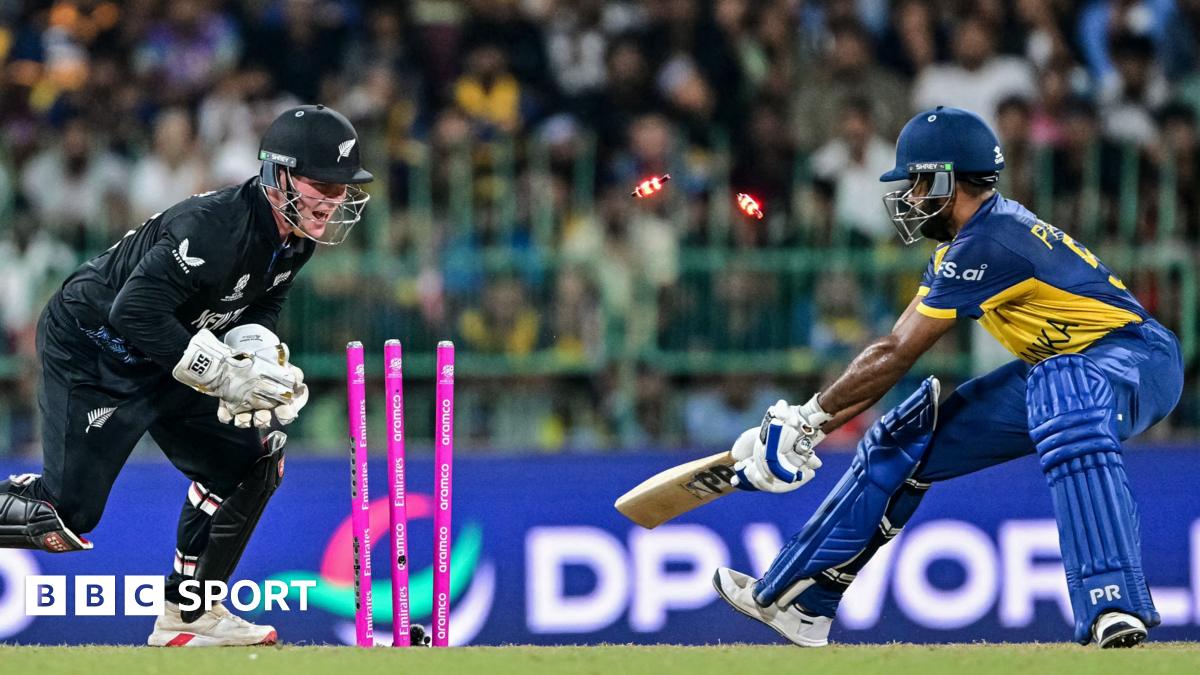
From there, the home side failed to generate any momentum and when Rachin Ravindra had both Kusal Mendis and Pavan Rathnayake stumped in the ninth over, Sri Lanka were 29-4 and the game was up.

Left-arm spinner Ravindra, who made 32 from 22 with the bat, took a further two wickets to end with figures of 4-27, while Henry was afforded the rest of the night off after taking 2-3 from his two overs as Sri Lanka dragged themselves to 107-8.

After losing to England in their opening Super 8s game, Sri Lanka depart with a whimper while New Zealand remain in contention to reach a fifth T20 World Cup semi-final.

For much of the first innings, though, Sri Lanka’s bowlers looked like being the match-winners, with spinner Maheesh Theekshana taking 3-9 from his first three overs and fast bowler Dushmantha Chameera also impressing.

Advertisement

They led the way as New Zealand slumped from 75-2 to 84-6 in less than three overs.

But Sri Lanka failed to finish the job and McConchie began the fightback before his captain took over with a brutal display of hitting, dismantling a suddenly fragile Sri Lanka attack, in a stand of 84.

It took New Zealand to a competitive total that, ultimately, proved more than good enough as the spinners took over and Sri Lanka fell apart.

Both sides have one Super 8s game remaining. New Zealand can seal their place in the semi-finals with victory over England on Friday, while Sri Lanka face Pakistan in Pallekele on Saturday.

Advertisement

Source link

Continue Reading

NewsBeat

The three big challenges facing Ukraine when the war ends

Published

on

The three big challenges facing Ukraine when the war ends

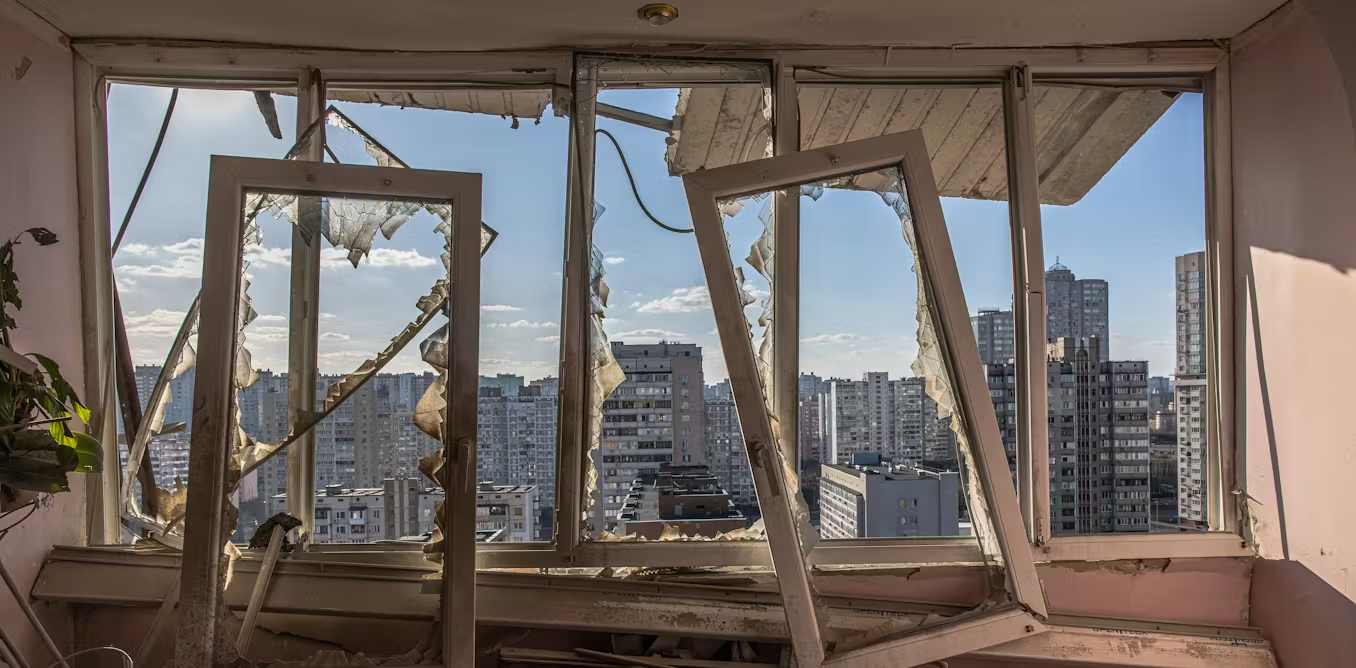
Russia’s war in Ukraine is now in its fifth year and, despite the growing impatience of Donald Trump, a breakthrough in peace talks looks a long way off. Yet even when the fighting does end, it will not represent a conclusion. Rather, it will mark the start of a considerable new challenge: reconstruction.

The crucial questions are not only how much reconstruction will cost, but also how it can be financed and whether Ukraine will have the skilled workforce needed to carry it out. Millions of Ukrainian citizens have left the country since the start of the 2022 invasion.

A further test will be whether Europe, which became Ukraine’s largest provider of military and financial assistance in 2025, can maintain the political unity needed to see reconstruction financing through in the long term.

1. Closing the funding gap

Ukraine’s reconstruction needs are enormous. According to figures released by the World Bank on February 23, the total cost of reconstruction and recovery in Ukraine will be around US$588 billion (£435 billion) over the next decade. This will only rise as the war drags on.

Advertisement

In an attempt to meet this figure, Ukraine and its allies are seeking to mobilise private capital. This has involved Ukraine’s parliament adopting a new public-private partnership law in June 2025 to incentivise private-sector participation in the reconstruction of economic sectors such as energy and transportation.

A war-risk insurance mechanism was also rolled out that year. Supported by the European Bank for Reconstruction and Development, it provides private companies that invest in Ukraine’s reconstruction with protection against war-related damages.

However, irrespective of these developments, the level of investment in Ukraine is likely to fall far short of what the country requires. In 2024, Ukraine attracted roughly US$3 billion of foreign direct investment, with reinvested profits making up the largest proportion. Data published by Ukraine’s central bank suggests this figure will drop in 2025.

A foreign investor sentiment survey from 2025 found that only 49% of members of the Global Business for Ukraine and the European Business Association, two groups of international companies focused on supporting and rebuilding Ukraine’s economy, are actually investing in the country. Nearly 70% of those surveyed cited the volatile security situation, which is likely to continue after the war, as the main barrier to investment.

Advertisement

Nearly 50% of those surveyed pointed to corruption, policy uncertainty and weak institutional capacity as barriers, while 34% voiced concerns about the strength of the rule of law. These are governance challenges that predate Russia’s 2022 invasion.

Ukraine’s ability to attract more private investment after the war will thus not only depend on the terms of the peace deal. It will also depend on how effectively the country manages to strengthen its institutions.

Private capital will play a role in Ukraine’s reconstruction. But its flows are far from guaranteed. So the donors and financial institutions that have sustained Ukraine throughout the war, such as the World Bank, International Monetary Fund and the European Investment Bank, will probably have to play a leading role in financing Ukraine’s longer-term recovery.

2. Encouraging Ukrainians to return

Nearly 6 million Ukrainians remain displaced abroad as a result of the war. There is no guarantee that these people, many of whom have spent years integrating into the labour markets and education systems of their host countries, will choose to return to Ukraine when the hostilities end.

Advertisement

Labour shortages, both skilled and unskilled, are one of the key challenges currently facing companies in Ukraine. And foreign investors have also cited labour availability as an important factor influencing their decision about whether to invest in the country’s reconstruction.

Encouraging Ukrainians to return voluntarily will require more than patriotic appeals: it will depend on there being viable employment prospects, functioning public services and credible security guarantees in place to prevent a resumption in the conflict.

Ukrainian refugees approach the border with Slovakia in the early days of Russia’s full-scale invasion.
Yanosh Nemesh / Shutterstock

The Ukrainian government has begun taking steps to maintain connectivity with the diaspora. This has included opening so-called “unity hubs” aimed at sustaining ties with the refugees and facilitating their voluntary return. One such hub opened in Berlin in 2025.

Ukraine’s authorities are also developing a portal designed to connect refugees with employment and business opportunities at home. However, these initiatives remain in their early stages and uptake remains to be seen.

Advertisement

Without the return of refugees, Ukraine risks developing a structural skills deficit. Such a shortfall could deter private investment in the country’s reconstruction and lead to a reliance on external labour.

3. European political commitment

There is also a political dimension to the challenges associated with reconstructing Ukraine. Sustaining long-term support for the country’s reconstruction may become more complicated amid shifting political dynamics across Europe.

The consensus among European countries on supporting Ukraine has largely held. But upcoming parliamentary and presidential elections in France, Italy, Denmark and elsewhere in 2026 and 2027 could shift the balance of power in key allied countries.

The elections are, at the very least, likely to absorb political attention and divert focus from unresolved questions. These include questions around the use of frozen Russian assets to finance Ukraine’s reconstruction, where agreement remains elusive.

Advertisement

Signs of fracture are also beginning to emerge. The EU has looked to push through a €90 billion loan to cover Ukraine’s needs for 2026 and 2027. Three countries – Slovakia, the Czech Republic and Hungary – abstained from the deal over the closure of an important oil pipeline in Ukraine. And Hungary now appears to be holding up the loan.

Reconstruction will be a test of political endurance as much as financial capacity. The question that will arise after any peace deal is reached is not only how to fund Ukraine’s recovery, but whether its allies can sustain the political consensus required to do so over time.

Source link

Advertisement
Continue Reading

NewsBeat

Funeral details announced for father-of-six killed in Moy accident tragedy

Published

on

Belfast Live

The announcement comes shortly after the funeral details of two others involved in the same crash

Funeral details for a father of six children who died in a tragic weekend road collision in Co Armagh have been announced.

Advertisement

John Guy, 48, Conor Quinn, 31 and Laura Hoy-Henry, 23, died following a three-vehicle collision in the Armagh Road area of Moy on Saturday, February 21, with four other people suffering injuries.

Mr Guy’s funeral will take place in St Patrick’s Church, Keady, on Saturday at 10:30am with burial afterwards in the church cemetery. Mr Guy who was originally from Dublin but resided in Keady was the beloved daddy to Troy, Maddie, Carla, Tiana, Brogan and Morgan.

READ MORE: Ballymena gym owner convicted for unlawful possession of weight-loss medicinesREAD MORE: Vehicle seized by police during midweek patrols

He was also the cherished son of Harry and Caroline and loving brother to Regina, Aisling and Christopher.

Advertisement

The notice read that Mr Guy was: “Deeply regretted and sorely missed by his heartbroken family.”

The accident happened on the main road between the Moy and Armagh around 10.20pm on Saturday. The deaths of those involved have brought shock and sadness to communities across Co Armagh and Co Tyrone. The incident was described as a “dark day” for the area.

In a statement on Monday confirming the deaths, the PSNI said all three were passengers in a red BMW that was involved in the collision alongside a grey Volkswagen Amarok and Audi Q3.

A police spokesperson said: “John, Conor, and Laura were travelling together in the same vehicle – a red BMW, along with another female passenger who was also injured.

Advertisement

“Our thoughts are with their families at this time as they come to terms with the devastating loss of their loved ones, and we will continue to support them.

“Two people travelling in the grey Volkswagen Amarok reported injuries that required medical treatment – while the driver of a white Audi Q3, also involved in the collision, reported minor injuries.

“Our enquiries are continuing today, and anyone who was in the area and may have witnessed the collision, or who has dash-cam footage or any other information, should contact police on 101 quoting reference number 1654 21/02/26.”

Want to see more of the stories you love from Belfast Live? Making us your preferred source on Google means you’ll get more of our exclusives, top stories and must-read content straight away. To add Belfast Live as a preferred source, simply click here

Advertisement

Source link

Continue Reading

NewsBeat

Venue shuts leaving staff heartbroken

Published

on

Wales Online

Owner Christakis Georgiou said he staff were “emotional” after he had to deliver some devastating news

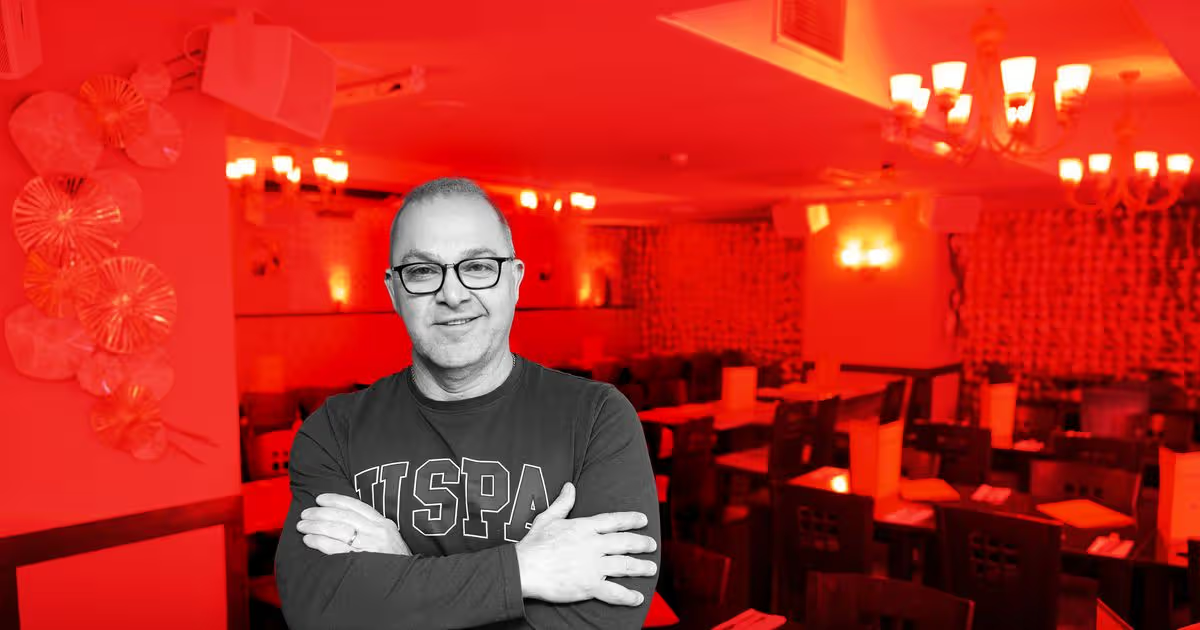
A well-known family restaurant has announced the unexpected closure of its Liverpool venue, leaving long-serving staff heartbroken. Christakis Georgiou, owner of Christakis on Aigburth Road, said the decision was forced after lease negotiations fell through and the building was sold.

The restaurant had traded in the area for five years, building a strong base of loyal customers. Significant investment had recently been made in the site, including tens of thousands of pounds spent on new flooring and furniture, much of which has now had to be sold.

The grandad told the ECHO that breaking the news to his team was especially emotional – two chefs who have worked alongside him for more than two decades were left in tears.

Advertisement

Despite the setback, Christakis has vowed to return, saying he is already searching for a new location in busy areas throughout the city.

He said: “We are devastated. It’s a hard truth, but the only truth. Our lease ran up, and we were trying to negotiate a new one, but instead, the owners sold the place. We have been at Aigburth for five years, building loyal customers full of families.

“I’ve had so many of these customers ringing me concerned we closed because of health problems but that isn’t the case at all. There is £80k alone inside that restaurant with new flooring and furniture, all that had to be sold.

Advertisement

“I have a chef who has been with me for 26 years, and another who was with me for 24, they broke down crying when I told them the news. But I said this happens in this industry, we will come back stronger.

“I am already looking for a new place. Somewhere like Woolton Village, Lark Lane, Bold Street or Castle Street, a road where we will be busy. My staff will come with me when we find a place, there’s no doubt about it. I told them to just give me some time.

“I love Liverpool, and I love my customers. I can’t be trapped in the house, so the next few months, the next three to six, will be about finding a new place and getting back to hearing ‘how are you, Mr Christakis?’ from my customers. This is my life, and everyone knows that.”

Advertisement

The closure follows a major shift within the family business last year. Operations manager Renos Georgiou, Christakis’ 32-year-old son, previously explained the Duke Street site was closed so the family could concentrate fully on Aigburth Road.

Around £20,000 was invested in refurbishing the Cressington restaurant, with the aim of bringing teams from different locations together under one roof. While the Aigburth restaurant has now shut, the family’s stall at BoxPark in the Baltic Market continues to trade.

The Georgiou family’s ties to Liverpool’s hospitality scene stretch back decades. Renos’ grandfather, also named Renos, was running eateries as early as 1969.

His dad later became a key figure at Caesar’s Palace on Renshaw Street, helping establish it as one of the city’s leading restaurants during the 1990s before it closed in 2008.

Known as a special-occasion destination with more than 300 covers, it served everything from pasta and pizza to burgers. After leaving Caesar’s Palace, Christakis continued working in restaurants across the city before launching his own venture, opening the first Christakis on York Street in the city centre.

The site had previously operated as Rinos, owned by his father-in-law. Over the years, the family also ran a Christakis branch on Smithdown Road, along with the Duke Street venue and the Baltic Market stall.

Originally from Cyprus and now based in Woolton Village, Renos says hospitality has always been central to family life. With decades of experience behind them, the Georgiou’s have built a devoted customer following.

Advertisement

Although Liverpool has lost one Christakis restaurant, the brand’s expansion elsewhere in the UK continues. The family already operates sites in Manchester, and have new openings planned in London and Birmingham later this year.

Renos said: “It’s tough to move to other cities, but it’s a family effort, and seeing the positive reaction elsewhere, not just Liverpool, makes it worth it.”

For Christakis himself, the focus is now firmly on the future. He insists he cannot imagine life away from the restaurant floor and is determined that within months he will once again be welcoming customers through the doors of a new venue.

Advertisement

Ensure our latest news and what’s on headlines always appear at the top of your Google search by making us a preferred source. Click here to activate or add us as a preferred source in your Google search settings.

Source link

Continue Reading

NewsBeat

The unintended consequences of decarbonising steelworks

Published

on

The unintended consequences of decarbonising steelworks

For more than a century, Port Talbot in Wales has been dominated by its steelworks. The daily lives of residents have been shaped by this industry. Shifts have set the traffic, sirens marked time, at night the furnaces lit the sky orange. Steel wasn’t just an industry. It was the rhythm of this place.

Where outsiders saw towers, smoke and steel, locals told me in interviews that they saw pride, beauty and belonging.

In 2023, the multinational corporation Tata Steel announced it would replace Port Talbot’s coal-fired blast furnaces with an electric arc furnace. The news felt inevitable after years of uncertainty. The promise of £1.25 billion of investment was cautiously welcomed when total closure was the other option. It would save 2,000 jobs, but another 2,000 would go. The shift was framed as a step toward a greener future.

Since that announcement, my PhD research has tracked the consequences of the action, conducting multiple rounds of interviews with a broad range of people to monitor unintended, or unanticipated, consequences as they arise.

Advertisement

Steel sits at the centre of overlapping, nested systems – from local communities to the national economy and global markets. Altering one part of a system sends tremors through the rest. Systems scientists describe this dynamic as panarchy: a concept from ecology that explains how interconnected systems operate at different scales and timescales, so change propagates unevenly and often in unexpected ways.

With this approach, focusing only on emissions risks a kind of carbon tunnel vision. Judging success by a single metric misses how one decision ripples into livelihoods, culture, mental health and identity.

Immediate surprises

When the blast furnaces shut, the change was immediate. The noise stopped. The air cleared. Residents told me how their windows were clean and when they left washing outside to dry, it no longer came in dusted grey. Families who had lived with industrial pollution for decades spoke of tangible relief.

In the short term, the local economy saw unexpected positive ripples. Redundancy payments and government transition grants meant more money circulating locally for a time and gave people the capital to try new ventures, from pizza making to dog walking. So far, 85 new businesses have been created.

Advertisement

Painting of the steelworks by artist and former steelworker Peter Cronin.
Peter Cronin, CC BY-NC-ND

Creativity became a way to process change, loss and pride all at once. Schoolchildren painted murals beneath the motorway as they imagined a different future for Port Talbot. Artists captured the towering cranes on the beach before they made way for the new electric arc furnace. The town hosted Urdd Eisteddfod, Europe’s largest youth cultural festival and people celebrated.

But not everyone experienced these changes in the same way, or at the same time. After the immediate change came quieter, more troubling effects which emerged more slowly. Steelmaking wasn’t just a job. Many former steelworkers told me of the pride, dignity and identity it gave them. When the furnaces closed, loss of purpose, stress and depression followed in ways that don’t show up in emissions data or balance sheets.

The local economy shifted again too. The short-term boost from redundancy money faded. Businesses that relied on a large, stable workforce began to feel the loss. The town entered an uncertain medium-term phase, where opportunity and fragility coexisted.

Advertisement
colourful murals on concrete pillars

Murals of Port Talbot’s past, present and future imagined by The Steeltown Storybook: Children’s Chapter.
Emily Adams, CC BY-NC-ND


À lire aussi :
Port Talbot, one year on: steelworks closure shows why public is losing trust in net zero


A slow shift

Ecosystems don’t change overnight; they slowly reorganise over decades as conditions change. Port Talbot’s coast is a good example of a novel urban-industrial ecosystem, where industry has helped shape the conditions that wildlife now uses.

Alongside the steelworks, Eglwys Nunydd Reservoir – built to serve the site and designated a Site of Special Scientific Interest for its birdlife – sits alongside sand dunes that support nationally rare plants such as sea stock.

Because of this long coexistence of nature and steel, moving to an electric arc furnace won’t instantly restore or erase what’s there, but will gradually reshape the local ecology as species and habitats adjust.

Advertisement

The new electric arc furnace will cut the steelworks’ carbon emissions by about 90% – around 8% of the UK’s industrial total.

But the global picture is more complicated. As Tata shuts the blast furnaces in Wales, it is building a new one in Kalinganagar, India. Even before the announcement about Port Talbot was made, unions warned that this could export emissions rather than reduce them, shifting the carbon cost of transition thousands of miles away. Even the most modern blast furnaces still emit far more carbon than electric arc furnaces.


À lire aussi :
Net zero will transform Britain’s economy – our map reveals the most vulnerable places


Advertisement
steel protest banner

Striking steelworkers banner warning of unintended but not unanticipated consequences.
Steffan James, CC BY-NC-ND

Beyond Port Talbot

Heavy industry must change if emissions are to fall fast enough. But in places like Port Talbot, that change lands unevenly. Some residents see opportunity, others feel loss. Versions of this story are unfolding worldwide, wherever climate policy meets heavy industry.

Decarbonisation isn’t a quick technical fix, but a complex social, economic and ecological transformation whose success depends on how well we understand them. Complex effects ripple out over time at different scales.

Job losses are immediate. Ecosystems adapt more slowly. Consequences on our warming planet will take decades to become apparent. Achieving a just transition from carbon involves looking beyond single metrics to account for how change ripples through interconnected systems over time.


Imagine weekly climate newsletter

Don’t have time to read about climate change as much as you’d like?

Get a weekly roundup in your inbox instead. Every Wednesday, The Conversation’s environment editor writes Imagine, a short email that goes a little deeper into just one climate issue. Join the 47,000+ readers who’ve subscribed so far.


Source link

Advertisement
Continue Reading

NewsBeat

Stephen Hawking pictured in Epstein files with bikini-clad women sipping cocktails

Published

on

Stephen Hawking pictured in Epstein files with bikini-clad women sipping cocktails

A photograph of the late scientist Stephen Hawking relaxing on a sun lounger beside bikini-clad women has been revealed in the Epstein files.

The world-renowned British theoretical physicist is seen reclining in the undated picture, with a cocktail placed in his hand.

The drink is steadied by one of the two women. It’s understood they were his long-term UK carers, since he needed round-the-clock care.

Hawking, whose pioneering work on black holes and general relativity in the universe revolutionised modern cosmology, died in 2018, aged 76, after living with motor neurone disease for more than 55 years.

Advertisement

The photograph, included in documents released by the US Department of Justice as it investigates sex offender Jeffrey Epstein, was taken in 2006 during a science symposium at the Ritz Carlton Hotel, St Thomas, in the US Virgin Islands, where Hawking gave a speech on quantum cosmology.

Hawking’s name appears hundreds times in the Epstein files, although simply being identified in the documents does not indicate any wrongdoing.

(US Department of Justice)

Hawking has previously been seen in photographs taken on Epstein’s Caribbean island, although no pictures of him and the convicted paedophile together are known to exist.

Advertisement

He was among 21 scientists who visited St Thomas and Epstein’s 75-acre private island, Little Saint James, for a science event.

According to the Jeffrey Epstein VI Foundation, in 2012 guests met to “discuss, relax on the beach, and take a trip to the nearby private island retreat” during the event “to determine what the consensus is, if any, for defining gravity”.

Two years ago, court documents revealed that Epstein told his accomplice Ghislaine Maxwell she could offer a financial reward to friends of his accuser Virginia Giuffre if they could “help prove” an apparent allegation Hawking had engaged in an “underage orgy” was false.

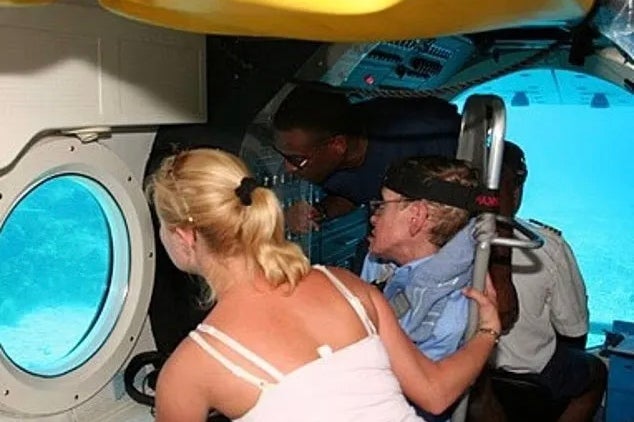
A submarine was reportedly modified to let Hawking access it

Advertisement
A submarine was reportedly modified to let Hawking access it (US Department of Justice)

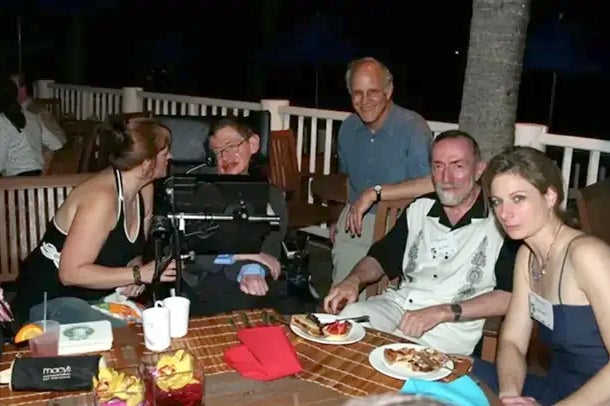
A photograph released in 2015 showed Hawking in his wheelchair at an outdoor dinner on Little Saint James with several other people.

Another picture shows the cosmologist in a submarine, having a tour of the island’s seabed.

Epstein had reportedly modified the underwater vessel to allow Hawking to get into it.

A spokesperson for the Hawking family said: “Professor Hawking made some of the greatest contributions to physics in the 20th century, while at the same time being the longest-known survivor of motor neurone disease, a debilitating condition which left him reliant on a ventilator, voice synthesiser, wheelchair and round-the-clock medical care. Any insinuation of inappropriate conduct on his part is wrong and far-fetched in the extreme.”

Advertisement

This article was amended on 25 February 2026 to include the statement from the spokesperson for the Hawking family.

Source link

Continue Reading

NewsBeat

BBC on streets of Mexican city gripped by deadly cartel violence

Published

on

BBC on streets of Mexican city gripped by deadly cartel violence

Warning: This video contains graphic imagery of the victims of stabbings and shootings, as well as images of those killed in street violence

One of the most powerful and feared criminal organisations in Mexico has unleashed a wave of violence across 20 Mexican states, following the death of drug lord Nemesio Oseguera Cervantes, better known as “El Mencho”, shortly after being captured amid a bloody firefight in Jalisco.

Members of the Jalisco New Generation Cartel (CJNG) have turned many towns and cities where the cartel is active into war zones.

BBC international correspondent Quentin Sommerville travelled to Culiacán in northern Sinaloa state, another Mexican cartel hotspot at war with itself after the removal of its cartel leader in 2024, Ismael “El Mayo” Zambada, who is now in prison in the US.

Advertisement

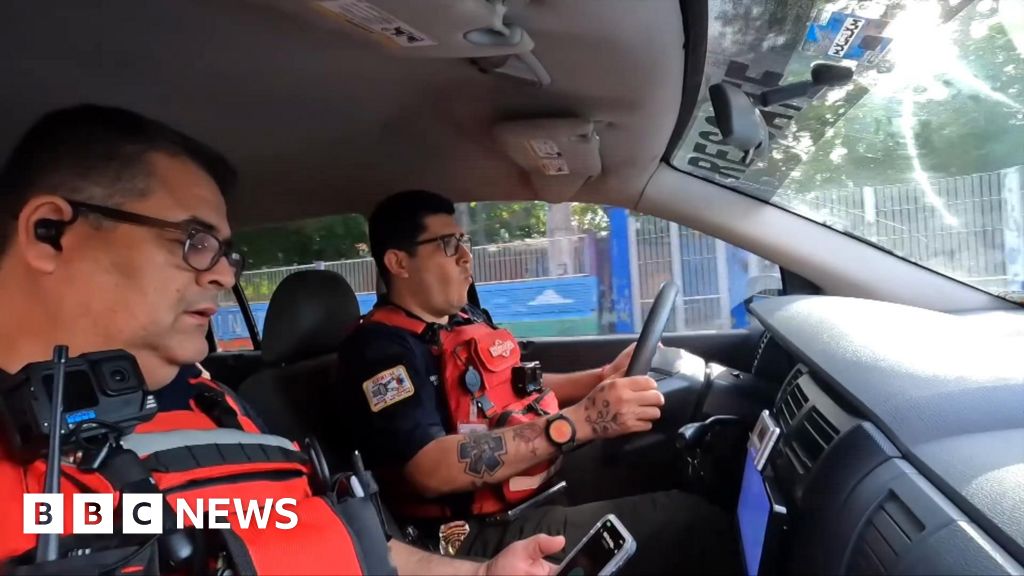
The BBC followed two paramedics in Culiacán, Julio César Vega and Héctor Torres, who attend to victims following violent incidents. Héctor said the violence in Culiacán had never been so bad or gone on for so long.

Read the full story here.

Source link

Advertisement
Continue Reading

NewsBeat

Manchester Central Mosque issues statement as it imposes new measures ‘with immediate effect’ after armed men enter

Published

on

Manchester Evening News

A suspect remains in custody after a man entered Manchester Central Mosque with a bag containing weapons

The Manchester mosque at the centre of a police investigation following a ‘concerning’ incident involving a man with an axe has introduced new security measures, it has said tonight.

Detectives have released new details and are continuing to quiz a suspect after two men walked into the Manchester Central Mosque on Upper Park Road in Victoria Park on Tuesday night (February 24). They were seen acting ‘suspiciously’ at the mosque as hundreds of worshippers engaged in prayer during Ramadan.

It was reported they were carrying bags, with one believed to be containing an axe, a hammer and a knife. One man, who was in high-vis, has since been arrested and remains in custody, police said. Weapons including an axe and a knife were found.

Advertisement

Click here to prioritise Manchester news in Google from the MEN

Security staff had initially questioned the man who had been seen acting suspiciously during a ‘congregation involving hundreds of worshippers’. Hammad Khan, president of the mosque, said the incident involving the two males, one he described as being white and one as black, has left Muslims fearing for their safety. “Everybody is very, very fearful”, he said. Police are still hunting the second suspect.

The incident has not been deemed terror-related, but investigations remain ongoing alongside Greater Manchester Police and Counter Terrorism Police.

Advertisement

While speaking to the public on Wednesday evening (February 25), Hammad Khan, president of Manchester Central Mosque, said it is ‘imperative’ places of worship remain a sanctuary for people across Greater Manchester.

“Manchester has always been a community which has been very cohesive and we’ve had multi faith events all throughout its history, and it is something we will continue to do,” he told reporters. “Mosques and another places of worship, places of peace and sanctuary for people. It is imperative that we maintain that for the communities in Greater Manchester and across the across the world.

In a new statement issued on Wednesday night, the mosque has revealed it is implementing tougher security measures ‘with immediate effect’, in the interests of ‘safeguarding worshippers and visitors’. Greater Manchester Police have also announced they are increasing patrols in the area for community reassurance.

“Until further notice, access to and from the mosque premises will be restricted to one designated entrance,” the mosque said. “Security personnel and authorised volunteers will be present and may, where necessary, carry out checks on bags and other items.

“Worshippers are requested to cooperate fully with these arrangements and to comply with any reasonable requests or directions given by security personnel or authorised volunteers. Worshippers are also advised, where reasonably practical, to attend the mosque in groups and to exercise vigilance when travelling to and from the mosque and whilst on the premises.

“These measures are being introduced on a precautionary basis in order to promote the safety and security of all worshippers and visitors.”

Advertisement

Police update

Speaking outside Manchester Central Mosque on Wednesday evening, Assistant Chief Constable John Webster said: “Last night, a concerning incident took place here at Manchester Central Mosque. A man with a bag containing an axe was acting suspiciously, during a congregation involving hundreds of worshippers.

“The security staff here acted on their suspicions to challenge the man. One of our special constables, who was off-duty and was part of the congregation, called the incident into us and we responded within 15 minutes by searching the suspect, arresting him, and seizing the items he had on him.

“There was no suggestion of verbal threats or confrontation, but it’s really important the security staff here and volunteers acted on their suspicions, on their instincts, to call us. I thank them for their actions.

“This is a time where Muslims come together to observe Ramadan. They should feel safe in their place of worship. We do give places of worship increased attention during this period, as we do with all religious festivals.

“We do understand, and we are listening, to all concerns. We’ll be listening to the concerns here at the Manchester Central Mosque here this evening. I look forward to some further conversations.

“We cannot be everywhere all the time, I wish we were. We are increasing patrols to offer security and reassurance to our Muslim community. Our officers will be on 12-hour shifts to be able to do this, certainly in the short term.

“And when incidents of concern do happen, we are in your community to act and respond. I thank the off-duty special constable for their action to ensure we could get our patrols here to detain this man.

“There is an ongoing police investigation, and we are working to locate the second suspicious man to understand who he is and what he was doing at the mosque. We’re still questioning the detained man to understand what he was doing here with an axe in his bag.

Advertisement

“I know this uncertainty can cause concern, but it is key that we have time to question the suspect, explore every line of enquiry and speak to as many witnesses as possible to understand the nature of this incident.

“We are taking this very seriously and we are working with detectives from Counter Terrorism Policing North West, but it I have to stress, this has not been declared a terrorist incident. When we know more, I will ensure we update you too. Thank you.”

Source link

Advertisement
Continue Reading

NewsBeat

M61 closed at Junction 8 over concerns for welfare

Published

on

M61 closed at Junction 8 over concerns for welfare

Lancashire Police confirmed that the closure is in place while officers deal with what has been described as a police incident.

The force said the road is expected to remain shut “for some time” as the situation is assessed.

In a statement, police said: “We want to update you and let you know that M61 J8 is currently closed in both directions due to a concern for safety.

Advertisement

“We anticipate that the road will be closed for a some time, whilst we assess the situation.

“In the meantime, we’d recommend looking for an alternative route and driving carefully, leaving plenty of extra time to get to your destination.

“We’ll keep tabs on what’s happening and we’ll update you here once the road is open.

“As always, thank you for your patience and stay safe if you’re out and about today.”

Advertisement

Eye witnesses have reported that vehicles have blocked the hard shoulder.

National Highways said the incident is affecting the northbound and southbound carriageway at Junction 8, with lane closures in place in both directions.

The incident has been classified as an “authority operation”.

Motorists travelling in the area are advised to seek alternative routes, allow extra time for their journeys and drive with caution.

Advertisement

Updates will be provided as more information becomes available.

Source link

Advertisement
Continue Reading

NewsBeat

‘Cowardly’ man left ‘beautiful’ girlfriend to die after attacking her at home

Published

on

Wales Online

Tony Devenport, who used to own a go-kart track in Wales, had denied killing Stephanie Blundell but was found guilty after a trial

A “cowardly” north Wales man has been found guilty of murdering his “caring” and “fun-loving” girlfriend at his home. Tony Devenport, 57, was found guilty of killing Stephanie Blundell on Wednesday following a 16-day trial at Chester Crown Court.

Advertisement

At around 12.20pm on Sunday, July 20, 2025, Cheshire Police were contacted by the father of the victim who told police that he had found his daughter’s lifeless body at Devenport’s house in Canal Street in Chester.

Within minutes officers and paramedics were at the scene. Ms Blundell, 41, was found dead inside the address.

She had visible injuries to her face, neck, and body. Devenport, who has links to Prestatyn and other parts of north Wales, was subsequently arrested and taken into custody.

During questioning he denied being responsible for Stephanie’s death. A post-mortem examination later confirmed the injuries on Stephanie’s body were a result of a sustained and violent assault.

Devenport, a property developer and former owner of a go-kart track in north Wales, was charged with Stephanie’s murder and an alternative count of manslaughter, reports NorthWalesLive. Following a trial he was found guilty of murder. Don’t miss a court report by signing up to our crime newsletter here.

Following the verdict detective inspector Andrea Price of Cheshire Constabulary’s major investigation team said: “Though I am pleased with today’s outcome there are sadly no winners in this case.

“Stephanie’s family described her as a fun-loving, caring, beautiful girl, and my thoughts are with them today as they continue to come to terms with such a loss.

Advertisement

“No parent should ever have to go through the pain of losing a child nor should they have to sit and relive that trauma by way of a trial.

“Devenport was a coward. He has shown no remorse for his actions and throughout the investigation he has refused to admit what he did.

“Thankfully the case presented in court against him was overwhelming and left the jury with no option but to find him guilty of murder.

“While nothing will ever bring Stephanie back I do hope her family can find some comfort in knowing Devenport will now be held accountable for what he’s done.”

Advertisement

Devenport is due to be sentenced at Chester Crown Court on Friday, February 27.

DI Price added: “Many victims of domestic abuse suffer in silence, isolated from those closest to them. If one thing can come from Stephanie’s tragic death it’s encouraging other victims of domestic abuse to come forward and contact us.

“We treat all reports of domestic abuse extremely seriously and will use all the powers available to us to ensure that those responsible are held accountable.”

If you or someone you know is affected by domestic abuse visit the Live Fear Free website or call the helpline on 0808 80 10 800.

Advertisement

Ensure our latest news and sport headlines always appear at the top of your Google Search by making us a Preferred Source. Click here to activate or add us as Preferred Source in your Google search settings.

Source link

Continue Reading

Trending

Copyright © 2025