

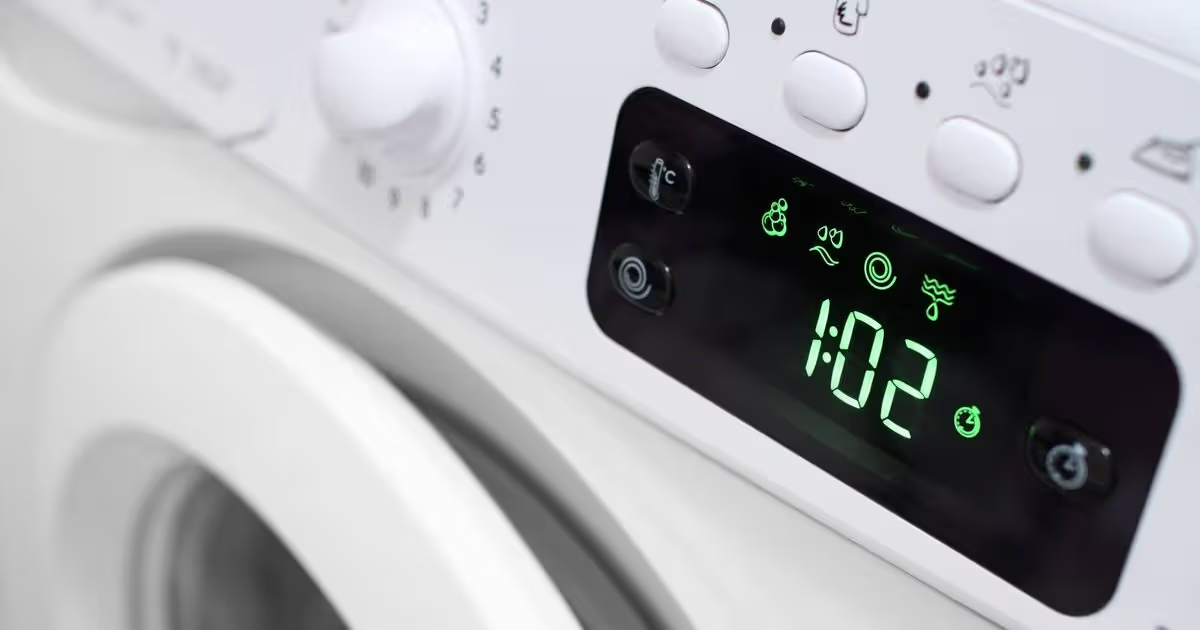
Washing machine countdowns often feel like they take an eternity, with many people noticing cycles extend beyond the displayed time – but there’s a good reason for it.
Waiting for the washing machine cycle to finish can be one of life’s most frustrating experiences – it frequently seems to go on forever. In principle, it should be fairly simple. When you begin a wash, your machine usually displays a countdown timer, informing you of the remaining time before you can take out the laundry and either hang it to dry or transfer it to the tumble dryer.
Yet many people will recognise the irritation of watching a timer that seems to crawl along interminably, and most would agree that washing machine countdowns are fundamentally misleading. When the display indicates one minute left in the cycle, it rarely means an actual minute.
A TikTok user previously posted a sketch on the platform about this common frustration – jokingly implying that when the timer shows one minute remaining, there’s still sufficient time to go for a stroll, enjoy a pint at the pub, and have a meal before returning home precisely as the cycle finishes.
The issue resonated with many viewers, with one person remarking: “Yes! I’ve stood there waiting, and it took another five minutes! I was so mad.”
Another concurred, writing: “Waiting for the click is like an eternity, it’s like, just tell me if you need extra time.” A third commented: “The biggest lie ever told.”
Nevertheless, there appears to be an explanation for why washing machine cycles take longer than expected, according to Vivien Fodor, the laundry category manager for Hotpoint UK. She revealed that the reason for these timing changes is that the machine is optimising its performance to operate more efficiently, which ultimately helps reduce your bills.
Vivien noted: “Many individuals depend on the timers of their washing machines and dryers to organise their daily tasks – and they are correct in doing so!”
“This is the reason why most contemporary appliances come equipped with displays that indicate how much time remains in your cycle.
“However, as the washing continues, the timer doesn’t always reflect the total time set at the start and, in the end, can differ by a few minutes.
“Whilst the difference is not usually big, this can be frustrating. However, there is a perfectly good explanation for this – and it is actually helping you to save energy and money.”
She added, “Washing machines are designed to save resources wherever possible, be it water, energy, or laundry detergent.
“So, there are several checks that a washing machine will do during its cycle. These are usually automated and are there to tell the machine if it is taking more or less time than expected to fill, wash or spin.”
As a result, the machine will adjust the time to end at certain points of the cycle – sometimes sooner, sometimes later.
“The only difference is that people only notice when it’s the latter! As the parameters differ with some loads being heavier than others, such as bedding and towels, this automated function ensures your laundry is washed properly yet economically every time, regardless of the load type.”
















































You must be logged in to post a comment Login