

Business
Futures Rise on Iran Talk Hopes Amid Oil Surge


NEW YORK — U.S. stock futures edged higher Monday morning, March 30, 2026, as investors weighed President Donald Trump’s signals of progress in talks with Iran against persistent geopolitical tensions that have driven oil prices sharply higher and kept markets volatile entering a holiday-shortened trading week.

Dow Jones Industrial Average futures rose around 280–300 points, or about 0.6%, in early pre-market trading. S&P 500 futures and Nasdaq-100 futures each gained roughly 0.6%, pointing to a modestly positive open on Wall Street. The modest rebound followed a tough end to last week, when the Nasdaq deepened its correction and the S&P 500 approached correction territory amid fears the five-week-old Iran conflict could disrupt global energy supplies further.
Oil prices remained elevated after fresh Houthi attacks and uncertainty over ground operations, with Brent crude hovering near recent highs above $100–$110 a barrel. Higher energy costs have stoked inflation worries and complicated the Federal Reserve’s policy outlook, with markets now pricing in fewer rate cuts for 2026. Yet Trump’s comments suggesting productive U.S.-Iran discussions provided some relief, helping futures pare earlier losses from Sunday evening.
Friday’s close left major indexes near multi-month lows. The S&P 500 finished the week around 6,368–6,477 after a 1.67% drop that day, while the Dow Jones Industrial Average settled near 45,166 after falling more than 790 points. The tech-heavy Nasdaq Composite dropped deeper into correction territory, losing over 2% on Friday to close around 20,948–21,408. The Russell 2000 small-cap index also showed weakness amid broader risk aversion.
The conflict in the Middle East has dominated market sentiment since late February, pushing oil higher by more than 30% at points and raising concerns about sustained inflationary pressure and potential supply disruptions through key routes like the Strait of Hormuz. President Trump has floated possibilities of U.S. Navy escorts for tankers and hinted at de-escalation, but analysts caution that any ground assault or prolonged fighting could exacerbate economic risks.
Energy stocks have been among the relative bright spots, benefiting from elevated crude prices, while technology and growth-oriented names have faced heavier selling on higher discount rates and growth concerns. Defensive sectors such as utilities and consumer staples have attracted some flows as investors seek safety.
Corporate earnings expectations have held relatively steady so far, with Wall Street betting that many U.S. companies can weather higher input costs. However, forward price-to-earnings ratios for the S&P 500 have compressed from October 2025 peaks as uncertainty lingers. Morgan Stanley recently downgraded global equities, viewing the U.S. market as more defensive in the current environment.
No major U.S. economic data releases were scheduled for Monday, March 30, shifting focus entirely to geopolitical headlines and any fresh corporate or diplomatic updates. The trading week is shortened by the Good Friday holiday on April 3, with markets closed that day.
Sector rotation has been evident in recent sessions. Energy and materials have outperformed on oil strength, while financials showed mixed moves as bond yields eased slightly from recent peaks. Technology names, including heavyweights like Nvidia, Amazon and Microsoft, saw some pre-market buying interest after sharp recent declines.
Individual stock movers in pre-market trading included energy-related names gaining on oil, while certain consumer and travel stocks lagged on growth worries. Broader market breadth remained cautious, with many stocks still trading below key technical levels after the recent sell-off.
The VIX volatility index, often called Wall Street’s “fear gauge,” has climbed above 30 in recent sessions — its highest level in roughly a year — signaling elevated investor anxiety. However, some analysts noted that historical precedents show equities often shake off geopolitical conflicts over time, provided disruptions remain contained.
Longer-term perspective shows the S&P 500 still up around 14% from a year earlier despite the 2026 pullback from January highs near 7,000. The index has given back some gains from its February peak amid the Middle East developments, but underlying corporate fundamentals and resilient consumer spending have prevented a deeper rout so far.
International markets offered mixed cues Monday. European shares traded modestly higher in early sessions despite ongoing energy concerns, while Asian markets closed with varied results over the weekend. Chinese markets faced their own pressures, and global investors monitored any spillover from the Iran situation.
For individual investors, analysts recommend focusing on high-quality companies with strong balance sheets and pricing power that can navigate potential cost pressures. Diversification across sectors, including some exposure to energy while maintaining defensive holdings, has been a common theme in recent commentary.
Looking ahead this week, any concrete developments on Iran negotiations could swing sentiment quickly. A de-escalation would likely spark relief rallies, particularly in rate-sensitive sectors, while further escalation risks renewed selling and higher oil. Corporate earnings season continues in the background, with results expected to test corporate resilience.
The Federal Reserve’s path remains data-dependent, but persistent oil-driven inflation has pushed back expectations for rate relief. Markets have largely removed near-term cut pricing, focusing instead on whether the central bank can engineer a soft landing amid external shocks.
Bond yields showed some stabilization Monday, with the 10-year Treasury easing from recent highs as investors balanced inflation risks against growth concerns. The dollar held firm on safe-haven demand.
As trading begins in New York, all eyes remain on real-time news flow from Washington, Tehran and the Gulf region. President Trump’s social media activity and official statements have moved markets multiple times in recent weeks, underscoring the event-driven nature of current trading.
Wall Street strategists emphasize patience in volatile times. While near-term uncertainty dominates, many maintain longer-term bullish views on U.S. equities based on innovation, productivity gains and eventual resolution of geopolitical flashpoints.
Retail investor sentiment has cooled, with some surveys showing increased caution after the recent declines. Professional managers continue to adjust portfolios toward more defensive postures while monitoring for entry points in beaten-down growth stocks.
The story is developing throughout the trading day. With limited economic data on the calendar, geopolitical headlines and oil price movements will likely set the tone for Monday’s session and the abbreviated week ahead.


Dollar set for weekly loss amid US-Iran ceasefire deal

From lottery draws to fiscal spending, China broadens digital yuan footprint
Business
AMMB Holdings Berhad 2026 Q4 – Results – Earnings Call Presentation (OTCMKTS:AMMHF) 2026-05-31


Seeking Alpha’s transcripts team is responsible for the development of all of our transcript-related projects. We currently publish thousands of quarterly earnings calls per quarter on our site and are continuing to grow and expand our coverage. The purpose of this profile is to allow us to share with our readers new transcript-related developments. Thanks, SA Transcripts Team
Business
Zoomd Technologies Ltd. 2026 Q1 – Results – Earnings Call Presentation (TSXV:ZOMD:CA) 2026-05-31
Seeking Alpha’s transcripts team is responsible for the development of all of our transcript-related projects. We currently publish thousands of quarterly earnings calls per quarter on our site and are continuing to grow and expand our coverage. The purpose of this profile is to allow us to share with our readers new transcript-related developments. Thanks, SA Transcripts Team

Dell unveils $699 XPS 13 laptop in challenge to Apple’s MacBook Neo


BOJ may heed calls to pause bond taper next year


Oil prices rise more than 2% as Israel moves further into Lebanon

‘Barron’s Roundtable’ panelists discuss investment opportunities among airline stocks.
A United Airlines flight bound for Spain returned to Newark Liberty International Airport on Saturday night after a potential security concern prompted the aircraft to turn around over the Atlantic Ocean.
United Flight 236 departed Newark en route to Palma de Mallorca, Spain, but reversed course about 90 minutes into the trip and landed back in New Jersey later that evening.
A spokesperson for United Airlines told FOX Business there were 190 passengers and 12 crew members aboard the Boeing 767 aircraft.
“United flight 236 from Newark to Palma De Mallorca, Spain safely returned to Newark to address a potential security concern,” the airline said in a statement. “The flight continued to Palma De Mallorca with a new crew.”
UNITED FLIGHT CARRYING 221 PASSENGERS HITS POLE AND TRUCK ON APPROACH TO NEWARK
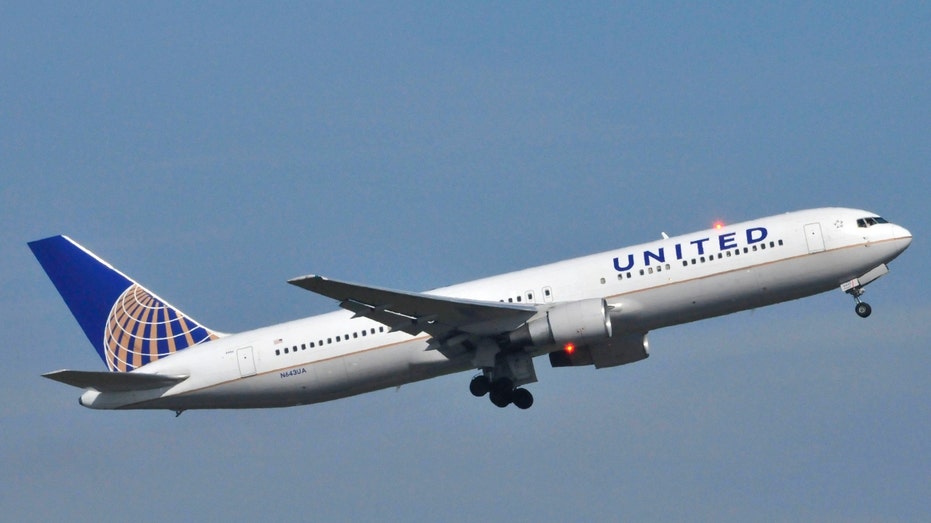
A United Airlines Boeing 767 takes off. A United flight from Newark to Palma de Mallorca, Spain, returned to New Jersey after a potential security concern prompted the aircraft to turn around over the Atlantic Ocean. (Andia/Universal Images Group via Getty Images / Getty Images)
AirLive.net reported that the incident began after flight attendants instructed passengers to disable their Bluetooth connections. Passengers later said the crew repeatedly warned that the request came from United’s operations center and that the flight could not continue unless the issue was resolved.
One passenger told the outlet that crew members made several announcements regarding a potential safety concern linked to a Bluetooth device and eventually issued a final warning before the aircraft changed course.
The warnings reportedly became increasingly urgent as crew members attempted to identify the source of the device. Passengers cited by the publication said flight attendants indicated the issue had been escalated and that the aircraft could be forced to return if the matter remained unresolved.
UNITED PILOT REPORTS MIDAIR DRONE SCARE NEAR AIRPORT DURING LANDING APPROACH
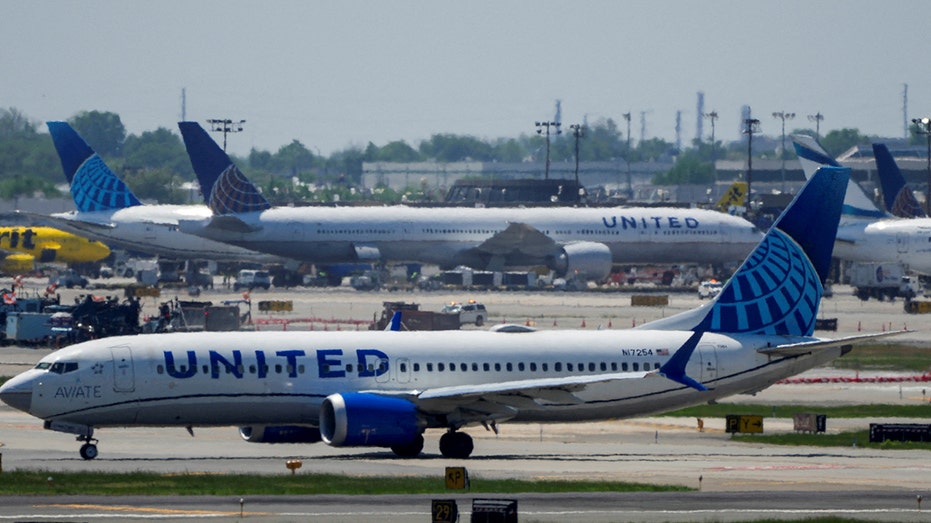
A United Airlines flight from Newark to Spain turned around over the Atlantic and returned safely to New Jersey after a potential security concern emerged onboard. Reports indicate the issue stemmed from a Bluetooth device whose visible name included (REUTERS/Eduardo Munoz/File Photo / Reuters Photos)
Air traffic control communications reviewed by AirLive.net indicated the aircraft returned to Newark after concerns arose about the name of a Bluetooth-enabled device visible to others onboard.
The outlet reported that the device’s discoverable name included the word “bomb,” which led to a security response and the flight’s eventual return to Newark.
The flight crew ultimately decided to discontinue the trip and return to Newark rather than continue across the Atlantic with the issue unresolved, according to the report.
UNITED AIRLINES RAISING TICKET PRICES UP TO 20% AS FUEL COSTS SURGE AMID IRAN WAR
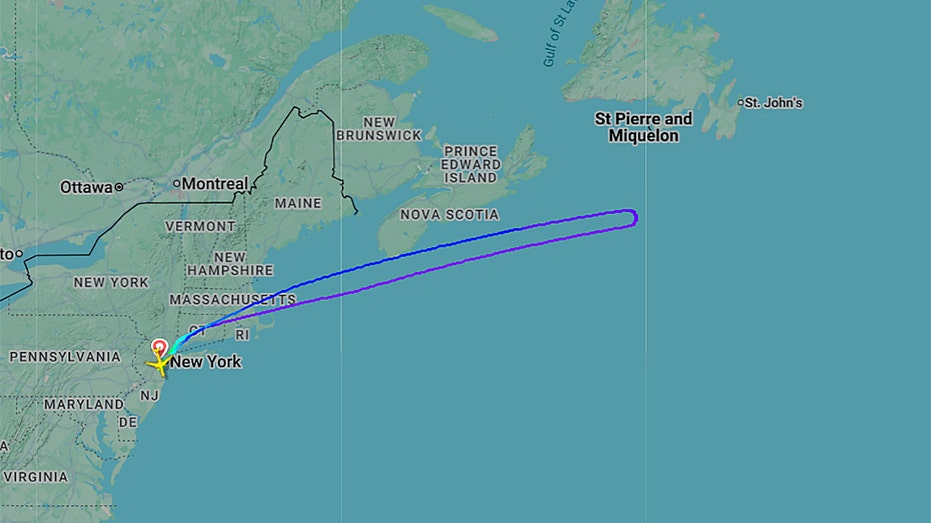
Flight-tracking data shows the route of United Airlines Flight 236, which turned around over the Atlantic Ocean and returned to Newark Liberty International Airport while en route to Palma de Mallorca, Spain, on May 30, 2026. (Credit: FlightRadar24.com / Fox News)
After the aircraft landed safely, law enforcement officers and security personnel met the plane. Passengers were removed while authorities conducted a security inspection.
Travelers were permitted to take only limited personal items with them as they exited the aircraft, according to the report. Passengers were later rescreened before boarding a replacement flight, while the aircraft and checked luggage underwent additional security screening.
Passengers were transported around the airport while security personnel inspected the aircraft, according to the report.
CLICK HERE TO GET FOX BUSINESS ON THE GO
United has not publicly identified the passenger connected to the device or announced whether any charges or penalties are being considered.
FOX Business has reached out to the Port Authority of New York and New Jersey for additional information about the incident.


AUKUS to develop unmanned undersea vehicles, delivery set for 2027

Berkshire Hathaway Has First Takeover by CEO Abel, Paying $8.5 Billion for a Homebuilder

RHS Garden Harlow Carr unveils new electric vehicle chargers

Dollar set for weekly loss amid US-Iran ceasefire deal

XRP Inflows to Binance Fall to Lowest Level Since Early 2026 as Holding Sentiment Grows


-

 NewsBeat4 days ago
Israel says it has killed new Hamas military leader in Gaza City airstrikes
-

 Tech5 days ago
NASA taps Blue Origin to deliver lunar rovers for Moon Base initiative
-

 Politics6 days ago
Bridgerton Season 5: Cast, Release Date And Everything We Know So Far
-

 News Videos5 days ago
XRP *JUST* SUCCEEDED!!!! CLARITY ACT EXPOSED!!! (SHE EXPOSED IT)
-

 Sports6 days ago
2026 NBA Finals schedule, odds: Knicks await Thunder or Spurs after winning East
-
 Crypto World5 days ago
Micron Crosses $1 Trillion Market Cap as AI Demand Reshapes Memory Sector
-

 Business5 days ago
Selena Gomez Reportedly Upset Over Benny Blanco’s Comments on Her ‘Terrible’ Diet
-

 News Videos2 days ago
This is BROKEN! INSANE 5x MONEY CAR WASH WEEK! The NEW GTA Online UPDATE Today! (GTA5 New Update)
-

 Business7 days ago
BTS Sells Out Four Las Vegas Shows at Allegiant Stadium for ARIRANG World Tour
-
 NewsBeat6 days ago
Hottest May day ever as London hits 34.8C in 2C leap from previous records
-
 Tech6 days ago
China assigns ID codes to 28,000+ humanoid robots
-

 Tech6 days ago
Microsoft’s quiet Claude Code retreat and the real cost of enterprise AI
-

 Tech3 days ago
Waymo dominates autonomous vehicle registrations as Tesla trails behind
-

 Business6 days ago
Nikkei 225 Surges Past 65,000 for First Time as Iran Peace Hopes Fuel Record Rally
-
Tech4 days ago
The Samsung pay deal is the moment Korean unions changed register
-

 NewsBeat6 days ago
Crowds find riverside shade in York as temperatures soar
-

 Tech6 days ago
Westone Audio and Etymotic Acquired by Fidelity Collective in Major IEM Market Move
-
 Entertainment6 days ago
‘Breaking Bad’ Star’s Easy-to-Binge 6-Part Crime Series Spin-Off Is Finally Heading to Free Streaming
-

 Tech5 days ago
Millions of AI agents imperiled by critical vulnerability in open source package
-
Crypto World5 days ago
SpaceX’s $2 Trillion IPO: Why Tech Giants Nvidia (NVDA), Apple (AAPL), and Microsoft (MSFT) May Face Pressure
You must be logged in to post a comment Login