
At the time of the dinosaurs, the oceans were teeming with life. Below the waves, giant marine reptiles, such as the fearsome 4m (13ft) long mosasaurs, were the undisputed apex predators.
In artistic reconstructions of these ancient oceans, cephalopods – the animal group that includes squid, cuttlefish, octopuses, and their ancestors – are almost always portrayed as prey, often seen desperately swimming away from the jaws of a marine reptile to avoid becoming lunch.
However, a remarkable new fossil suggests our view of the ancient oceans is incomplete, and that giant octopuses, perhaps reaching as long as 19m (62ft), may have been the ones doing the hunting.
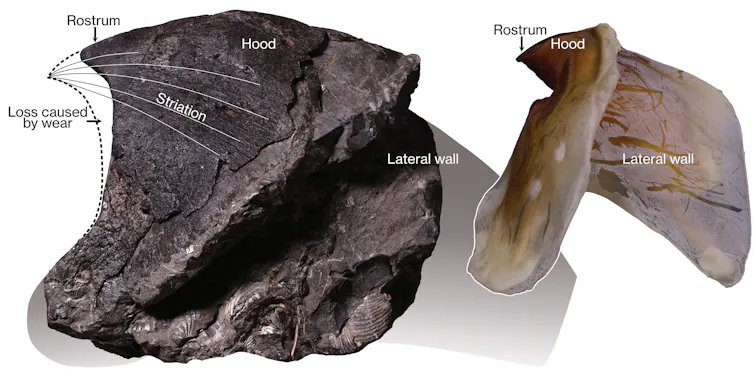
The fossil in question is a giant octopus jaw, belonging to a new species called Nanaimoteuthis haggarti. It is found in Late Cretaceous rocks of Japan, making it between 100 million and 72 million years old.
Like other cephalopods, octopuses have a hard beak that looks like a parrot’s bill, used to bite and tear prey, and this fossil example is enormous – larger than that of the famous giant squid Architeuthis.
Based on the shape and size of the beak, Shin Ikegami, from Hokkaido University, Japan, and colleagues, identify it as belonging to the Cirrata, a group of finned octopuses still found today in the deepest oceans. They estimate that the animal may have reached between seven and 19 metres in length. Details have been published in the journal Science.
Shin Ikegami et al./Science, Author provided (no reuse)
If that upper estimate is even close to correct, Nanaimoteuthis, would represent the largest invertebrate yet described from the fossil record — an animal rivalling the largest marine reptiles in scale.
The authors also use the wear and damage on the octopus beak as indicators of ancient behaviour. Scratches and pits on the surface point to an animal hunting and crushing prey with bones or shells, not scavenging or feeding on soft-bodied organisms.
Additionally, the wear pattern is asymmetric, interpreted by the authors as evidence of a preference for chewing on one side over the other, a trait associated with higher cognitive function.
Far from being food, Nanaimoteuthis may have been one of the most formidable predators in its ecosystem, in an era we have long assumed was defined by vertebrate dominance.
That such a claim can be made at all is remarkable, because cephalopods almost never leave any trace in the fossil record. Unlike fish, marine reptiles, or even ammonites, most cephalopods have no hard parts like bones.
Octopuses, in particular, are almost entirely “skin bags” filled with water. When they die, they rot quickly, and even the few hard parts, such as the beak, are seldom preserved.
This creates a systematic bias that skews our understanding of ancient ecosystems: animals that preserve well dominate our reconstructions, and the animals that don’t, even if they were common among certain ancient ecosystems, are largely invisible to us.
Every fossil cephalopod, therefore, represents a vital piece of palaeontological information, giving us a fleeting glimpse into a lost world of squishy invertebrates.
Science, Author provided (no reuse)

But not all cephalopodologists are convinced by the size estimate, with the potential length of 19m in particular drawing scrutiny on social media.
Scaling cephalopod body sizes from beaks is not straightforward. The relationship between jaw dimensions and total body size varies considerably across cephalopod species, a problem compounded by the patchy data available for rarely caught deep-water cirrate octopuses.
Other researchers have also questioned the behavioural inferences drawn from the wear patterns, arguing that bite asymmetry can be caused by many factors, and that drawing conclusions about animal intelligence from a single specimen is premature.
It is also important to put this finding into context of the living relatives of Nanaimoteuthis. Modern cirrate octopuses are not known to swim after prey, typically hunting small invertebrates on the seafloor, raising questions about whether their giant ancient cousins would ever have encountered, let alone challenged, the formidable marine reptiles.
But step back from the debate over metres and scaling equations, and something fundamental comes into view. Our reconstructions of ancient ecosystems are shaped by what preserves (bones, shells, teeth) and often systematically blind to what doesn’t.
While future investigations may test the size estimate or refine behavioural interpretations, this remarkable fossil shows that there may have been giants lurking in the vast, deep, and dark waters of the ancient oceans. We just couldn’t see them until now.
You must be logged in to post a comment Login