














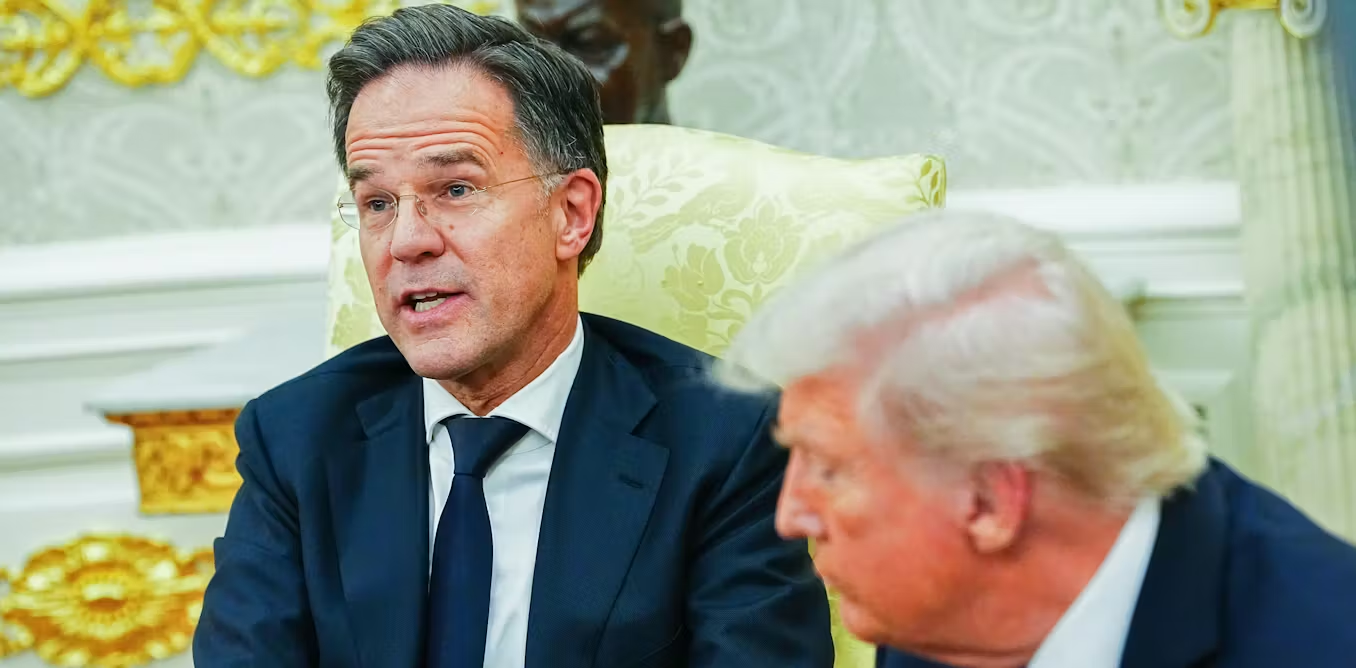
President Donald Trump met Nato secretary general Mark Rutte on April 8 for what Rutte described as a “very frank, very open” discussion. The pair are reported to have discussed the US-Israeli war against Iran at which, according to White House spokesperson Karoline Leavitt, Trump believes that Nato was “tested and they failed”.
The president later posted to his Truth Social platform that “NATO WASN’T THERE WHEN WE NEEDED THEM, AND THEY WON’T BE THERE IF WE NEED THEM AGAIN.”
The US president’s meeting with Rutte came a week after he told Reuters press agency that he was “absolutely” considering withdrawing the US from Nato, after America’s allies refused to join the US-Israeli campaign against Iran. But this is very unlikely to occur for three reasons.
First, in 2023, Congress enacted a law that prohibits the president from “suspending, terminating, denouncing, or withdrawing the United States from the North Atlantic Treaty” — which established the North Atlantic Treaty Organization (Nato) — without the advice and consent of the Senate or an act of Congress. It is extremely unlikely that this will be changed before the midterm elections in November and impossible subsequently if the Democrats end up controlling the House of Representatives.
The second reason is that Nato membership is popular among Americans. A Pew survey conducted in 2025 showed that 66% of US respondents thought that America benefited from Nato membership while 32% thought the opposite. While, as in many things, the US is divided – with more Democrat voters (77%) supporting Nato membership than Republicans (45%) – it’s clear that, on the whole, Americans approve of Nato membership.
The third reason is that leaving Nato would significantly weaken the US militarily. More than half a century of research by historians and international relations specialists has concluded that leaving Nato would also significantly weaken the US.
In 1989, historian Paul Kennedy’s detailed study of wars over a period of 500 years, The Rise and Fall of the Great Powers, found that a decisive feature of success in war is the resources that parties to the conflict can mobilise. Kennedy cites the examples of the two world wars and demonstrates that a key reason why Germany was defeated was that the allies could mobilise many more resources in manpower, arms production and economic assets than Germany and its allies. Eventually, this proved decisive in both conflicts.
Research into quantifying the military capacity of nations has been conducted for more than half a century as part of the Correlates of War project founded in 1963 by American political scientist J. David Singer. The project aims to systematically collect data about the causes and consequences of wars.
One of the datasets collected in the project is called the Composite Index of National Capability. This combines data on the demographic, industrial, economic and military capabilities of nations, including the US and China. The higher the index score the more resources a county has to fight wars.
Scores in the Composite Index of National Capability of the Top Nations
The Correlates of War Project, Author provided (no reuse)
The chart shows the size of the index for the top countries in the database. China is the most powerful nation in the chart with a score of 23 on the index. The US comes a rather distant second with a score of 13.
There are five Nato nations in the chart in addition to the US. They are Germany, Turkey, the UK, France and Italy. The total score of all six Nato members is 20 – much closer to the Chinese total.
The chart does not include the scores for the remaining Nato member states, but when they are added to the total the Nato score is well above that of China. So the assumption that the US can go it alone in a war with China is doubtful.
How Article 5 works
Article 5 of the Nato charter stipulates that an armed attack against one member state is considered an attack against all, triggering collective defence by all the member states. A recent report by the US Naval War College concluded that: “A large and growing body of evidence suggests that the PLA (People’s Liberation Army) is preparing credible capabilities to invade Taiwan”. The report argued that extensive deception will be used by China to confuse its opponents when the war is launched with rapid action by its armed forces to create a fait accompli. It notes that this type of blitzkrieg attack is very often successful.
If this occurred, then since the US has military advisers in Taiwan and military assets in the region that would need to be neutralised in the first phase of the war if the invasion were to be successful this would trigger Article 5 of the Nato charter. In that case China would find itself at war with 32 Nato countries – not to mention countries in the Far East, such as Japan, Indonesia and Vietnam, who have serious concerns about Chinese aggression, but are not members of the alliance.
So, whatever the US president’s ambivalence towards Nato, the fact is that without its support, the US could face a humiliating defeat by China in a future confrontation over Taiwan. America is much stronger as part of Nato – and Trump’s advisers should be strenuously reinforcing that message.










































You must be logged in to post a comment Login