
The death of Jeffrey Epstein in 2019 was never going to be the end of his menacing presence in the American political orbit. More than six years later, the Department of Justice (DoJ) has now released millions of the “Epstein files” to a hungry and impatient audience.
But the DoJ’s conduct has set new questions in motion, this time about its own agenda in protecting powerful figures, including – according to his political opponents – the US president, Donald Trump. The unfolding saga reveals unsettling truths about elite power networks and our own ability to critically assess information in an era of extreme overload.
The Epstein Files Transparency Act compelled the DoJ to release the files to the fullest extent possible. The content is harrowing and shocking. But there are also a number of troubling implications in the DoJ’s actions in the build up to, and since, the release of the files, as well as in the manner in which sensitive information was handled.
Despite a statutory deadline of December 19 2025, the DoJ only began drip-feeding documents on the deadline day itself, drawing widespread criticism. And while an initial DoJ report identified 6 million “responsive” documents, the deputy attorney-general, Todd Blanche, claimed on January 30 that the cumulative release of 3.5 million documents met all legal obligations. This leaves 2.5 million documents effectively missing.
There were, predictably, accusations of a cover up. At the very least, in stalling the release of the files and then turning a trickle into a flood, the DoJ could reasonably be accused of malicious compliance; trying to bury damaging needles in mountainous haystacks.
Beyond the missing files, congressional oversight has been throttled. Secure “reading rooms” were established where sitting members, without staff, were able to review unredacted pages taking only hand-written notes. Quite the task with 3.5 million documents.
Most disturbingly, the DoJ’s redaction process appeared inverted. According to Democrat lawmaker, Ro Khanna, who has scrutinised unredacted versions of the files, high-profile names were shielded, yet the full names and contact details of 43 victims were published alongside graphic photographs of young women and potentially minors.
The DoJ acknowledged these “mistakes”, but in combination with the delayed release and the missing files, alarm bells are ringing that this, too, forms part of a more sinister strategy to divert attention away from the content of the files themselves through chaos.
Gambling on the attention economy
The DoJ appears to be making two significant gambles on the attention economy of the digital age. The first relies on information and crisis exhaustion. Releasing a massive data dump creates a triage and narrative challenge that few journalists or activists can meet.
This is not necessarily new: the practice, known in the US as “backing up the truck”, which involved the government when asked to divulge sensitive public documents, releasing a truckload of documents in which they hid the sensitive ones, is a time-honoured and devious tactic well known to journalists.
In a world where attention is a commodity, the Trump administration appears to be betting that the public simply lacks the bandwidth to process the Epstein revelations amid a sea of manufactured and organic distractions.
Consider the current pulls on even a mildly engaged citizen in the US. Since the start of the year, ICE and other immigration agencies have escalated their activities in US cities, most notably in Minnesota where they have killed two Americans without, critics say, probable cause or likely sanction.
The US captured the leader of Venezuela in a legally dubious military raid, and implied other Latin American leaders could face the same demise. Trump ramped up his threats to annex Greenland.
AP Photo/Tom Brenner
Meanwhile millions of Americans have seen their health insurance premiums soar as a result of Republicans declining to extend healthcare subsidies.
It is little wonder that there have been observations in US media outlets that the public response to the Epstein revelations has seemed muted in comparison to audiences in the UK and elsewhere. With “perma-crisis” as the baseline, the administration appears to be betting that public focus will be dragged away by the next trending issue.
The partisan shield
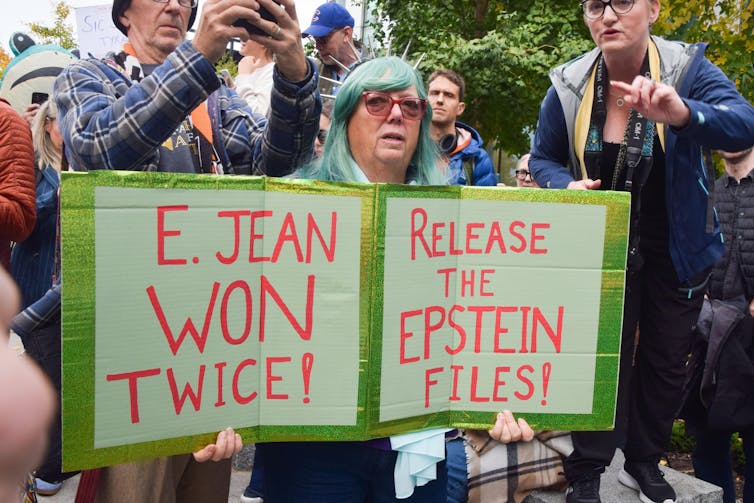
Americans are, in fact, responding to the revelations. And while there has been an unusually bipartisan horror at the content of the files, this issue, as with so many others, has served to entrench divisions and resentment towards the partisan “other”.
This is at the heart of the administration’s second gamble. Research demonstrates that increasingly, our partisan identity forms a crucial part of our whole social identity. In effect, who we support defines a large part of how we see ourselves in the world. So strong is the connection, that challenges to our partisan beliefs feel like an existential threat to who we are.
Vuk Valcic/Alamy Live New

Confronted with such a threat, we are more likely to double down on those beliefs, even in the face of contradictory evidence. So much so, that in extreme cases, people are able to see any contrary views as evidence of a conspiracy against them, their peers and their leaders. Trump has long understood this hold he has over his base.
The Maga community produced the loudest calls for the Epstein files, believing they would expose a “deep state” paedophile ring involving the Clintons and Hollywood elites. Indeed, Bill Clinton is in the files, mentioned multiple times, although he denies any wrongdoing and there has been nothing published to suggest he has been involved in any.
But to maintain their cognitive consistency, supporters must convince themselves that while the files condemn their enemies, the more than 30,000 references to Donald Trump are part of a broad conspiracy to defenestrate their leader.
Looming on the horizon to focus minds are the 2026 midterm elections in November. Republicans and the Trump White House may be gambling once more on the attention economy having long since consigned Epstein to history. Democrats will have to fight to maintain focus on Trump’s behaviour both in the files and about the files while tackling the barrage of injustices that, in reality, feel much more relevant to Americans in their day-to-day lives.
The other names in the files, those of the victims, remain much further away from any kind of justice.
You must be logged in to post a comment Login