Some of us remember having more energy in our 20s. We could work late, sleep badly, have a night out, recover quickly and still feel capable the next day. By our 40s, that ease has often gone. Fatigue feels harder to shake. It’s tempting to assume this is simply the ageing process – a one‑way decline.
The truth is that the 40s are often the most exhausting decade, not because we are old, but because several small biological changes converge at exactly the same time that life’s demands often peak. Crucially, and optimistically, there is no reason to assume that energy must continue to decline in the same way into our 60s.
Energetic 20s
In early adulthood, multiple systems peak together.
Muscle mass is at its highest, even without deliberate training. As a metabolically active tissue, muscle helps regulate blood sugar and reduces the effort required for everyday tasks. Research shows that skeletal muscle is metabolically active even at rest and contributes substantially to basal metabolic rate (the energy your body uses just to keep you alive when you’re at rest). When you have more muscle, everything costs less energy.
Advertisement
At the cellular level, mitochondria – the structures that convert food into usable energy – are more numerous and more efficient. They produce energy with less waste and less inflammatory byproduct.
Sleep, too, is deeper. Even when sleep is shortened, the brain produces more slow‑wave sleep, the phase most strongly linked to physical restoration.
Hormonal rhythms are also more stable. Cortisol, often described as the body’s stress hormone, melatonin, growth hormone and sex hormones follow predictable daily patterns, making energy more reliable across the day.
Put simply, energy in your 20s is abundant and forgiving. You can mistreat it and still get away with it.
Advertisement
Exhausting 40s
By midlife, none of these systems has collapsed, but small shifts start to matter.
Muscle mass begins to decline from the late 30s onwards unless you exercise to maintain it. This in itself is a top tip – do strength training. The loss of muscle is gradual, but its effects are not. Less muscle means everyday movement costs more energy, even if you don’t consciously notice it.
Mitochondria still produce energy, but less efficiently. In your 20s, poor sleep or stress could be buffered. In your 40s, inefficiency is exposed. Recovery becomes more “expensive”.
Sleep also changes. Many people still get enough hours, but sleep fragments. Less deep sleep means less repair. Fatigue feels cumulative rather than episodic.
Advertisement
Hormones don’t disappear in midlife – they fluctuate, particularly in women. Variability, not deficiency, disrupts temperature regulation, sleep timing and energy rhythms. The body copes better with low levels than with unpredictable ones.
Then there is the brain. Midlife is a period of maximum cognitive and emotional load: leadership, responsibility, vigilance and caring roles. The prefrontal cortex – responsible for planning, making decisions and inhibition – works harder for the same output. Mental multitasking drains energy as effectively as physical labour.
This is why the 40s feel so punishing. Biological efficiency is beginning to shift at exactly the moment when demand is highest.
Midlife is often a time of maximum cognitive load. Krakenimages/Shutterstock.com
Hopeful 60s
Later life is often imagined as a continuation of midlife decline; however, many people report something different.
Advertisement
Hormonal systems often stabilise after periods of transition. Life roles may simplify. Cognitive load can reduce. Experience replaces constant active decision‑making.
Sleep doesn’t automatically worsen with age. When stress is lower and routines are protected, sleep efficiency can improve – even if total sleep time is shorter.
Crucially, muscle and mitochondria still adapt surprisingly well into later life. Strength training in people in their 60s, 70s and beyond can restore strength, improve metabolic health and increase subjective energy within months.
This doesn’t mean later life brings boundless energy, but it often brings something else: predictability.
Advertisement
Good news?
Across adulthood, energy shifts in character rather than simply declining. The mistake we make is assuming that feeling tired in midlife reflects a personal failing, or that it marks the start of an unavoidable decline. Anatomically, it is neither.
Midlife fatigue is best understood as a mismatch between biology and demand: small shifts in efficiency occurring at precisely the point when cognitive, emotional and practical loads are at their highest.
The hopeful message is not that we can reclaim our 20-year-old selves. Rather, it is that energy in later life remains highly modifiable, and that the exhaustion so characteristic of the 40s is not the endpoint of the story. Fatigue at this stage is not a warning of inevitable decline; it is a signal that the rules have changed.
Easter is almost upon us, but it turns out many Brits don’t know when they’re actually supposed to eat their Easter eggs – and some have been tucking in too soon
Easter is almost upon us, and chocolate fans across the UK will be waiting eagerly to tuck into their stack of treats. There are many foods we use to celebrate the Easter holiday, including hot cross buns and a variety of confectionery. Some people even have traditional meals around this time, such as fish on Good Friday and roast lamb on Easter Sunday.
Advertisement
But for many, the signature food for the holiday is an Easter egg. These chocolate treats can be bought in supermarkets months before the big weekend, and millions of us will have already indulged in a Cadbury Creme Egg or two, with some tucking into the Easter treat as early as late January.
And if you surrendered to the temptation of polishing off an egg-shaped chocolate snack in the last couple of months, then we’ve got unfortunate news for you, as you’ve violated one of the unspoken customs of the Easter holiday.
When should we eat our Easter eggs?
Traditionally, Easter eggs are exchanged as presents on Easter Sunday among those who observe Christian customs around the holiday, as the egg is meant to represent the resurrection of Jesus Christ.
According to Hames Chocolates, many people opt to give up dairy products, eggs, or chocolate during Lent, which is a 40-day period of fasting observed by Christians, and so Easter marks the first occasion after Lent they can freely indulge in the treats that they have gone without.
Advertisement
Lent concludes on Maundy Thursday, which falls on the day before Good Friday, so some Christians will devour their Easter eggs between Thursday and Sunday to reward themselves for their 40-day abstinence.
However, as Easter eggs were traditionally distributed on Easter Sunday, the intention was to consume them on the same day – which means no peeling back that foil until Sunday.
Why do we eat Easter eggs?
According to English Heritage, eggs were traditionally given out as gifts during spring festivals to symbolise new life and rebirth, and it’s believed this ancient custom began part of Easter celebrations.
In the medieval period, eating eggs was forbidden during Lent, so when Easter Sunday came around, tucking into an egg was a treat. Eggs were given to the church as Good Friday offerings, and villagers would give eggs as gifts to the lord of the manor at Easter, so the egg became a symbol of the Easter holiday.
Advertisement
There were even some superstitions around eggs at Easter. Eggs laid on Good Friday were said to turn into diamonds if they were kept for 100 years, while some people believed if you cracked an egg open and found two yolks, it was a sign you would become rich.
Chocolate Easter eggs made their debut in Europe during the 19th century, with France and Germany leading the way. In Britain, it was J.S Fry and Sons who created the first chocolate egg in 1873.
Cadbury followed suit, producing the modern Easter egg we know today just two years afterwards, in 1875.
These early eggs were made using dark chocolate, but in 1897, the famous Cadbury’s Dairy Milk Chocolate was introduced, and chocolate eggs made with this recipe became hugely popular.
Advertisement
These days, the day you choose to start tucking into your Easter eggs is up to you. Some religious people may choose to only eat them on Easter Sunday, or not to eat them at all, while others will enjoy them early.
No matter how you celebrate Easter, we hope you enjoy the holiday!
Early detection is vital and can significantly improve outcomes, yet the symptoms are often subtle
Each year, around 7,400 women are diagnosed with ovarian cancer across the UK. Early detection is vital and can significantly improve outcomes, yet the symptoms are often subtle and can be mistaken for other common conditions.
Advertisement
During Ovarian Cancer Awareness Month, women in Northern Ireland are being reminded of the importance of recognising the early signs of ovarian cancer.
Because the symptoms can often be similar to other common conditions, which can make early diagnosis challenging.
Women are encouraged to contact their GP if they experience persistent signs such as bloating of the abdomen, pain or tenderness in the lower tummy area, loss of appetite or feeling full quickly after eating and needing to pass urine more frequently.
Advertisement
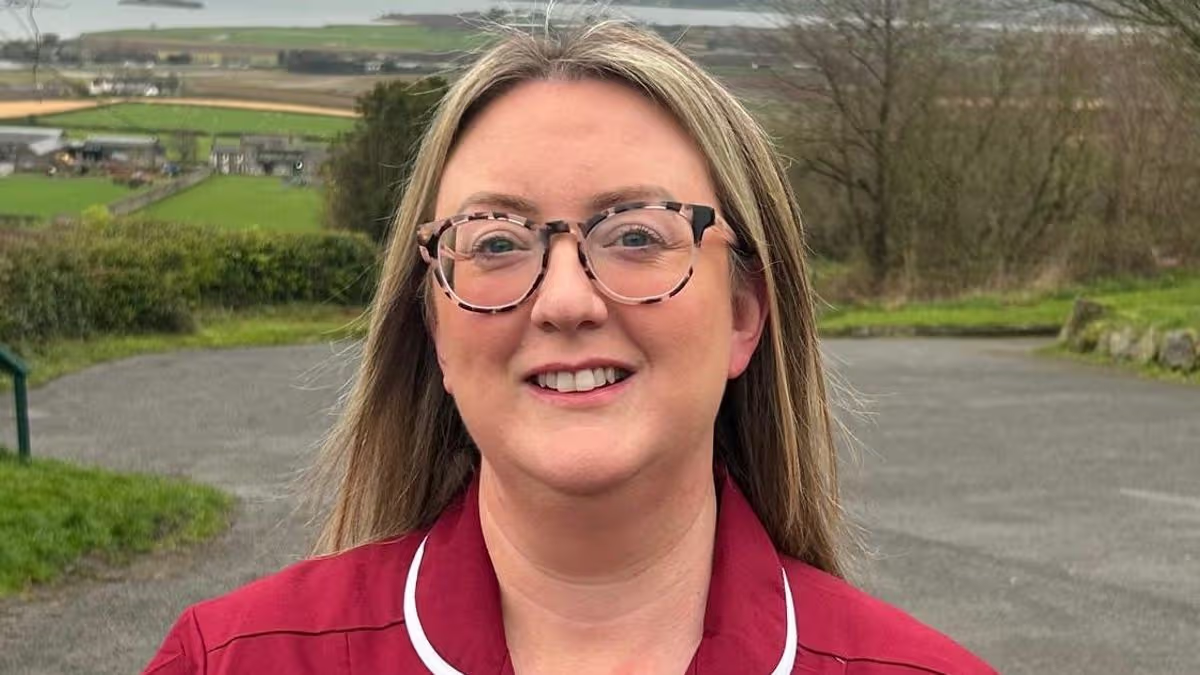
Gynae Clinical Nurse Specialist in the South Eastern Trust, Suzanne Brown stressed the importance of early diagnosis: “Early recognition and prompt investigation of ovarian cancer symptoms can make a real difference. Even if the symptoms seem minor or occasional, it is important to talk to your GP. Being proactive about your health is vital.
“Keeping a record or diary of symptoms can also be helpful and bringing this to your GP appointment can make it easier to explain what you have been experiencing and how often.”
“It has been amazing for both of us as businesswomen and now also as mammies”
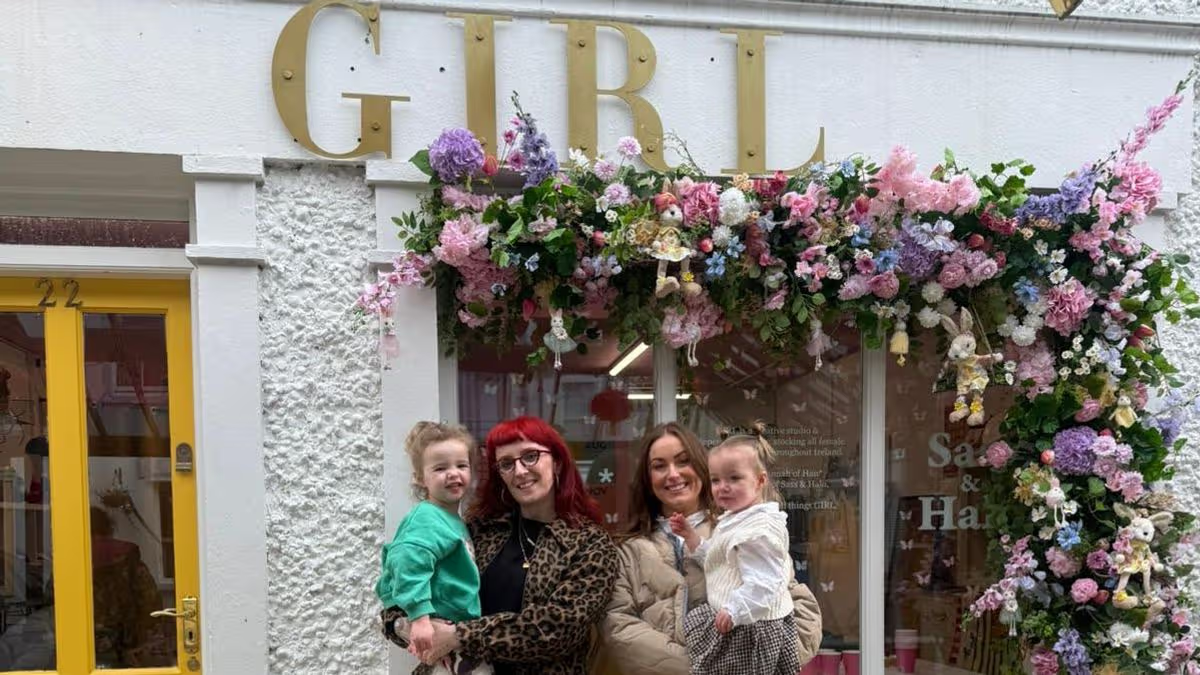
Two of Derry’s most well known businesswomen have reflected on the one year anniversary of their store, GIRL.
Advertisement
GIRL was set up by Aoife Bonner of Sass & Halo, and Hannah Vail of Han.
Both situated in the craft village, their respective businesses were incredibly popular. However, as they both became mothers and the business world because tricker to survive in, they decided to combine forces and create a space to showcase local female creative talent.
GIRL is now home to over a dozen female stockists and recently celebrated its first birthday.
Aoife spoke to Belfast Live about what the journey has been like.
Advertisement
She said: “I was across the square and Han was in this space. We knew each other briefly before but then we became really good friends talking about work and life!
“It just became harder and harder to sustain a shopfront, obviously with rising costs and staffing costs, it was really hard to run and be there all the time. Hannah had her daughter first and I had one a year later and then our priorities changed.
“I was about to pack it in and Hannah approached me about maybe coming into her space and that’s where the idea came from. It started off with just us two but then we wanted to celebrate local female businesses, they were all really onboard and it was created within a couple of months. We have around 13 different stockists in the shop all offering something different. “
After making the leap to join together and create GIRL, Aoife and Hannah knew they could rely on the people of Derry to support local.
Aoife said: “We had a great launch and everyone was so supportive. We had a really successful Christmas, I think people do make a push to support local which is brilliant. Our prints and soaps are really popular with tourists looking to pick up an Irish gift.
“We are in the craft village and Storefront moved close to us just outside the craft village and it is lovely to have a hub of local businesses near each other and we can all benefit from each other.
“Hannah has organised markets in the craft village which really helps bring people into the craft village. All in all it has been a really positive decision for both of us. It is such a nice space to work in and as a creative I feel like I can really do what I want to do. There is so much support morally between Hannah and I because we understand exactly what each other is going through.”
Advertisement
GIRL has not only benefitted customers who want to find unique clothing, jewellery and gifts, it has also allowed for Hannah, Aoife and the other stockists run their businesses as a collective, relying on each other when they need to.
Aoife said: “It has been amazing for both of us as businesswomen and now also as mammies. It has given us so much more flexibility, if we need to deal with childcare or illnesses we can work around each other.
“The other businesses we stock are really happy. It is so useful for them in that they can go on holidays or take time off and there is still cash flow coming in through the shop. It has made running a business and keeping a business going much easier.
Advertisement
“We try to keep it evolving and exciting so if people come in it doesn’t look the same as before. We have so v many regular customers who make a point in coming in and we know them by name now.
“We really appreciate people coming back to us and spreading the word, a lot of time we get people coming in who tell us someone else told them to visit. Thank you to everyone who has supported us so far and we have a really exciting year ahead!”
Celebrating the film industry is the theme for this series
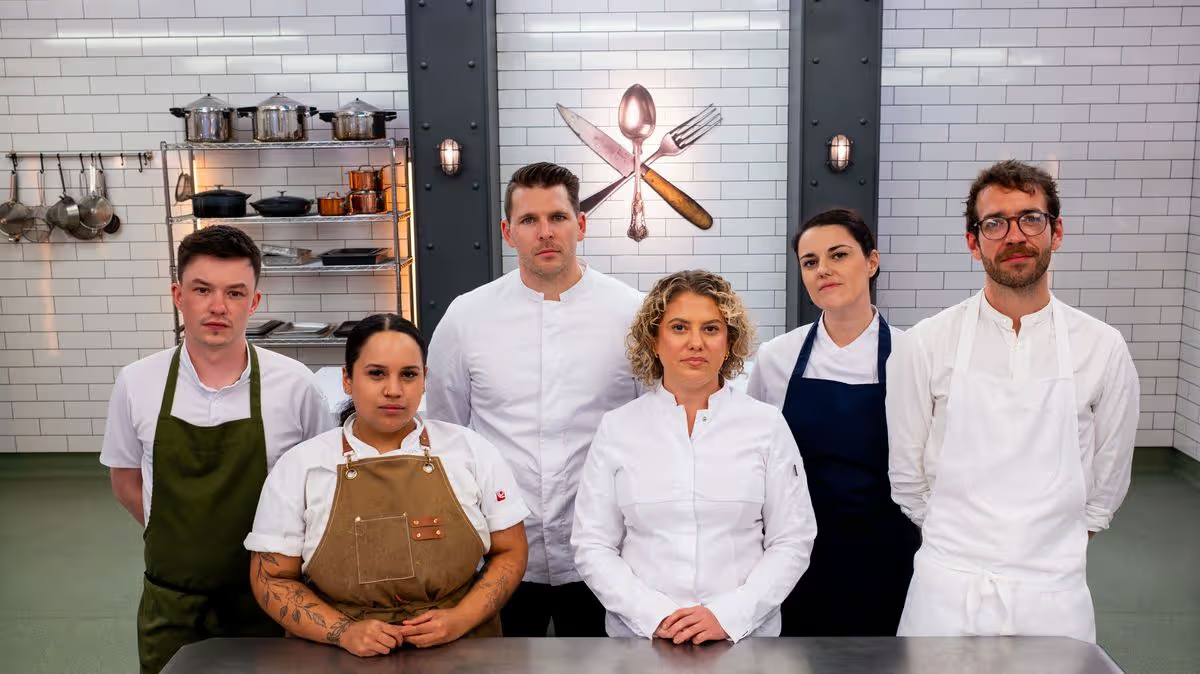
Great British Menu is back for 2026 and new hopefuls are set to battle it out for the chance to represent Northern Ireland next week.
Advertisement
One Wednesday, four of the country’s finest chefs will compete for a spot in the next round with canapes, starters and fish dishes celebrating the British film industry, all hoping to cook at the final banquet in Liverpool.
The dishes are judged by this week’s veteran judges, 2025’s banquet winners Sally Abe and Jean Delport and include an homage to The School for Good and Evil that features a red knotted brioche handkerchief, and a tribute to director Lisa Barros D’Sa with barbecued monkfish served from a teapot.
Ahead of the NI stage of the competition kicking off on Wednesday, April 1 on BBC Two, meet the local names hoping to grace the final:
Advertisement
Lawrence Barrow
Restaurant: Head Chef, Hearth and Tine
Returner Lawrence is more determined than ever to be a part of finals this year, after stepping out of the competition due to illness last series.
Born and raised in Ballymena, Lawrence is ready to show the world what Northern Irish cuisine is about!
Advertisement
Initially studying film studies before working in a bank, Lawrence fell into the world of cooking as a way to travel. But as he started exploring the world and its culinary scene, it quickly became a real passion.
This passion took him around the globe, including to kitchens in Australia, Italy and New Zealand. These experiences shaped his cooking style – blending international influences with a deep appreciation for his Northern Irish roots.
Returning to the UK, Lawrence moved to London where he staged at Tom Aikens’s Michelin-starred restaurant, Muse, before working under esteemed Michelin-starred chefs Lee Westcott and Jason Atherton. He then became head chef of James Cochran’s restaurant, 12:51, before moving on to head up Westcott’s new venture.
Since last competing, Lawrence splits his focus between a string of successful pop-ups and residencies in London.
Advertisement
He manages his restaurant concept Hearth and Tine; a project celebrating traditional Irish cuisine with a modern twist, championing seasonal Northern Irish ingredients.
Lawrence’s menu celebrates film and the talent coming from Northern Ireland.
Kristin Reagon
Restaurant: Head Chef, Lasair at Finn Lough
Advertisement
Originally from South Africa, Kristin Reagon is Head Chef at Lasair, the fine dining restaurant at Finn Lough Resort in Co. Fermanagh.
Since joining the restaurant, she has led an all-female kitchen team, creating menus that combine local produce and her love for cooking over coals.
Kristin was preparing to study chemical engineering when a college cooking competition inspired her to pursue a career in food.
She won a full scholarship to train at the Sense of Taste Chef School in Cape Town and went on to work at The Pot Luck Club, complete an internship in the United States, and join The Greenhouse under Head Chef Farrel Hirsch, where she placed third in a national inter-hotel competition.
Advertisement
After relocating to Northern Ireland in 2021, Kristin became instrumental in establishing Lasair. Her South African heritage continues to influence her cooking, particularly her use of open-fire and braai techniques, which she combines with local ingredients.
Kristin was also a UK finalist in the S.Pellegrino Young Chef Academy, an achievement that strengthened her confidence and professional network.
Kristin’s menu for the competition celebrates Northern Ireland women in the film industry.
Callum Irwin
Restaurant: Sous Chef, The Rabbit Hotel / Private Chef & Founder
At 27, Callum Irwin is one of Northern Ireland’s rising culinary talents, both Michelin-trained and award-winning.
Callum owns, runs and is growing his private dining business ‘Cooked by Callum’, where he has catered for major events and high-profile figures in sport, business, and hospitality, as well as working at The Rabbit Hotel in Templepatrick.
Callum studied Culinary Arts Management at Ulster University, graduating with first-class honours. During his studies, he was awarded an academic scholarship to Hong Kong, where renowned chef Ken Hom served as ambassador. While at university, Callum also won Féile MasterChef and a competition celebrating 25 years of Heston Blumenthal’s three-Michelin-starred The Fat Duck.
Advertisement
He joined Belfast’s Michelin-starred Muddlers Club while still studying, contributing to the team during the period in which the restaurant was awarded its first Michelin star. His experience also includes time at notable restaurants such as Edo, alongside chefs Lottie McKee and Matt Jordan.
In 2025, Callum served as private chef at a four-day hospitality event during The Open Championship at Royal Portrush, cooking for high profile guests.
Callum has been featured in Northern Ireland on a Plate and won the Ballymena Chamber Award for Best Young Person in Business. He is also an ambassador for Springboard’s FutureChef programme, mentoring the next generation of chefs.
Rooted in Northern Ireland, Callum combines technical precision with creativity, shaped by his Michelin training.
Advertisement
Callum’s menu showcases his creativity and some of the stars from the Northern Ireland film scene.
Marion Lancial
Restaurant: Head Chef, Le Cheval Noir at The Dark Horse
Originally from Normandy, Marion Lancial began her culinary journey in her grandmother’s restaurant, an early influence that has shaped her 20-year career.
Advertisement
She trained as a pastry chef in France before moving to Washington DC, where she graduated from the Escoffier School of Culinary Arts and worked as a private chef for diplomats and embassies, honing her skills in refined French cuisine.
Marion later moved to Northern Ireland, where she took on the challenge of opening Le Cheval Noir, a modern French bistro within The Dark Horse in Belfast’s Cathedral Quarter.
The restaurant has quickly gained attention from local critics, praised for its elegant cooking and confident, contemporary take on French bistro food.
Her style draws on family recipes from her grandmother’s kitchen, reinterpreted with Northern Irish produce. In addition to running her kitchen, Marion teaches at Waterman House Cookery School, mentoring the next generation of chefs, and sharing her expertise in French and modern cuisine.
Advertisement
Dedicated to empowering women in professional kitchens, Marion believes in leading with authenticity. Her competition menu reflects both her French roots and her adopted Northern Irish home.
Nigel Corner pledged to use his experience in surviving a near-fatal Goodwood crash to help patients with spinal injuries and their families during his year in office.
He also pledged to work on improving literacy among prisoners and continue the work of the outgoing High Sheriff, Sir Andrew Lawson-Tancred, in helping offenders lead crime-free lives.
“I feel I will be walking in big footsteps,” he said. “I will try to follow the example Sir Andrew has set.”
Advertisement
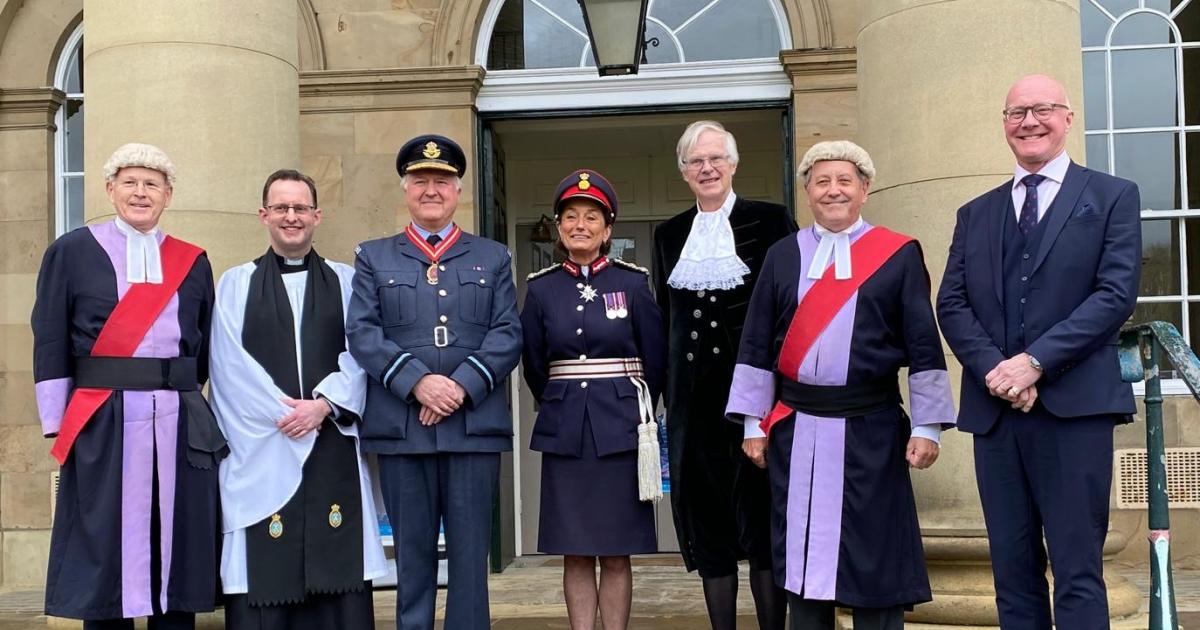
Mr Corner, of a village near Leyburn in Wensleydale, wore his uniform as an honorary air commodore in the RAF for the ceremony at York Crown Court, presided over by the Recorder of York, Judge Sean Morris.
The judge praised Sir Andrew’s work in promoting organisations including among others, Clean Slate Solutions, which encourages young people not to get involved in crime.
“How many people have you helped and desisted from going down the wrong path?” he told Sir Andrew. “You may well have got many people on the straight and narrow.”
The Lord Lieutenant of North Yorkshire, Mrs Johanna Ropner, Judge Simon Hickey, barristers and other invited guests from the justice system and the two High Sheriff’s families, saw Sir Andrew hand over the High Sheriff’s medal. The office that has been in continuous existence for more than 1,000 years.
Advertisement
Mr Corner told the gathering at York Crown Court that the care of spinal injury patients and their families will be among three priorities for him during his term in office.
“This cause is close to my heart,” he said. “I know rather too much about this issue.”
In 2000, medical staff at Goodwood Racing Circuit almost certainly saved his life by giving him advanced emergency first aid treatment after he crashed while racing a Ferrari.
He then spent weeks in a hospital ward with two punctured lungs and many broken bones before being discharged.
Advertisement
Mr Corner also wants to improve literacy in the two prisons in North Yorkshire after hearing how many prisoners cannot read or write and that this hinders them going straight on release.
And he will work, like his predecessor, with Clean Slate Solutions.
He thanked all those who have helped him prepare for his year in office.
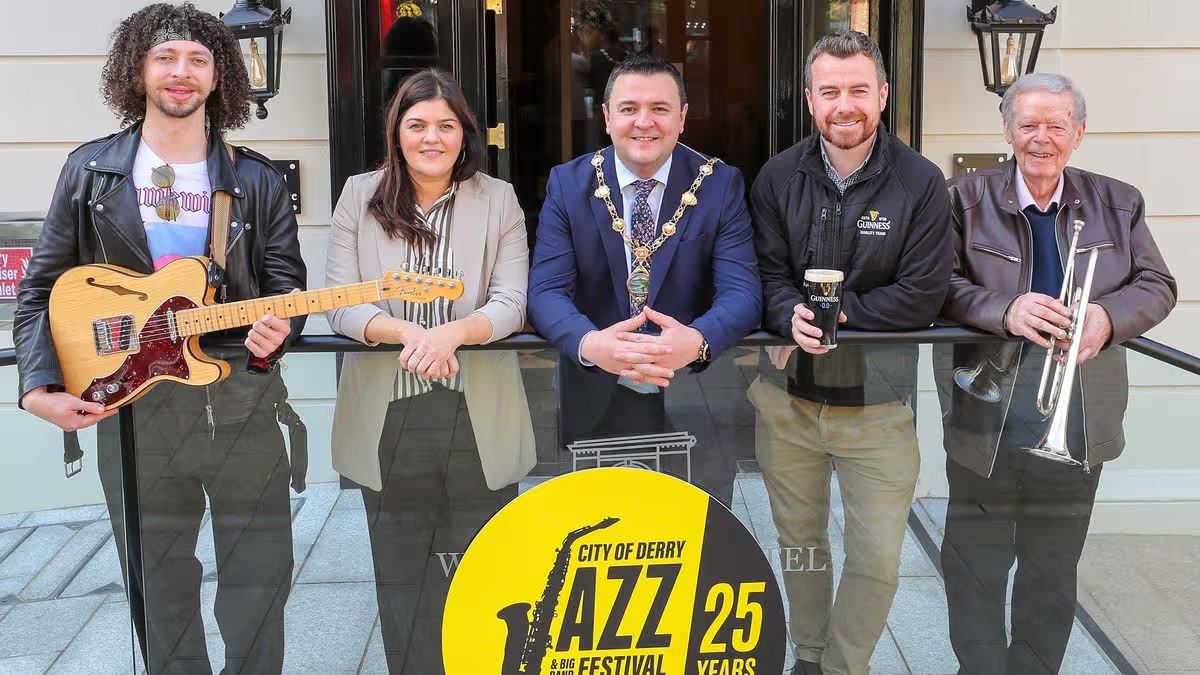
The internationally acclaimed event has gone from strength to strength, entertaining audiences for a quarter of a century with its magical medley of homegrown and international talent.
Taking place from April 29 to May 4, this year’s festival promises a vibrant line-up that reflects the event’s remarkable journey.
Over the years, the festival has welcomed internationally renowned artists while remaining deeply committed to nurturing and showcasing local talent.
A cornerstone of its success has been the popular schools’ programme, which has provided a valuable platform for emerging young musicians, inspiring the next generation of performers and giving many their first opportunity to take to a professional stage.
Advertisement
The festival has also championed the very best homegrown talent, ensuring that local artists remain at the heart of the programme while sharing the stage with acclaimed national and international acts.
Launching the programme today, Mayor of Derry and Strabane, Councillor Ruairí McHugh, said the anniversary would be aproud moment for a city that has always had music in its blood.
He said: “Over the past quarter century, the festival has evolved into one of the premier events in our cultural calendar, attracting visitors from near and far while showcasing the incredible musical talent we have here at home.
“Its continued growth is a testament to the vision, dedication and creativity of everyone involved, from our Council Events team to the many local venues that have thrown open their doors over the years. I look forward to welcoming audiences to what promises to be a spectacular celebration of music this April and May.”
Advertisement
Festival and Events Coordinator with Derry City and Strabane District Council, Aisling McCallion, said she was looking forward to a bumper year of celebration.
She said: “Reaching our 25th year is a significant achievement and reflects the enduring popularity and ambition of the City of Derry Jazz Festival.
“Each year we strive to build on the success of previous festivals, and we are incredibly proud of how the event has grown into one of the largest festivals of its kind. Our schools’ programme remains a key focus, giving young and up-and-coming musicians the chance to develop their skills and perform in a professional setting, establishing a lasting legacy for the festival.
Advertisement
“While our wider programme continues to provide a valuable platform for both local and visiting performers. We are so excited to unveil this year’s line-up and invite everyone to join us in celebrating this milestone anniversary.”
With an eclectic mix of ticketed headline concerts, free live music events, educational workshops and outdoor performances planned across the city, the 25th anniversary edition promises to be one of the most memorable yet.
Iconic jazz singer Curtis Stigers is just one of the highlights of this year’s festival, performing on April 29th at the Millennium Forum.
Donegal singing sensation Muireann Bradley will light up the Guildhall on April 30th with her amazing acoustic talents, an unmissable treat for country and blues fans.
Advertisement
The Playhouse, Bennigans Bar and St Columb’s Hall will be transformed into dedicated Jazz hubs, hosting an array of acclaimed artists over the weekend, as well as a series of music and jazz masterclasses to get everyone into the swing.
Enjoy the Bank Holiday vibes al fresco with live stages in the Guildhall Square and the Craft Village on Saturday Sunday, not to mention the DLD Second Line Parade which will take to the streets on Saturday May 2nd.
Step into the spotlight at this year’s Jazz Festival with an exclusive dance workshop in St Columb’s Hall led by Strictly Come Dancing choreographer Jenny Thomas.
Whether you’re a complete beginner or a seasoned mover, this is your chance to learn show-stopping routines, pick up insider tips, and enjoy the sparkle of Strictly.
Advertisement
This year’s City of Derry Jazz Festival programme will be sponsored by Diageo and Head of Commercial NI, Mark Mulholland, said Diageo is proud to support this landmark moment for one of the region’s most celebrated cultural events.
“Diageo is absolutely delighted to support this special anniversary year of the City of Derry Jazz Festival. For 25 years, the festival has showcased the very best of the North West’s vibrant cultural scene, while welcoming world-class artists and visitors from around the world.
“We are delighted to continue our sponsorship of the annual Jazz Festival, a cornerstone event that plays a vital role in showcasing the city’s vibrant culture and hospitality sector. This ongoing partnership reflects our commitment to supporting the on-trade and creating memorable experiences for consumers through high-quality events. We look forward to building on the success of previous years and working closely with organisers and local venues to deliver another outstanding festival.”
You can find the latest programme information online at cityofderryjazzfestival.com along with the entire programme.
Advertisement
For regular updates, follow City of Derry Jazz Festival on all social media platforms.
Get ready for a new month (Picture: Getty/Metro.co.uk)
April arrives with new energy and momentum.
With powerful Aries energy lighting up the skies — including a New Moon in Aries and fiery Mars in Aries — the cosmos is encouraging bold action, courage and decisive movement.
At the same time, the Full Moon in Libra on April 2 reminds us that life isn’t just about charging ahead alone. Relationships, fairness and emotional balance come into focus, asking us to check whether our ambitions still honour the partnerships and connections that matter most.
By the time Taurus season arrives later in the month, the energy softens and stabilises. What began as a spark of inspiration can start to take practical form.
Advertisement
April is ultimately a month of initiation followed by grounding — make the brave first move now, and you’ll give yourself something solid to build on in the months ahead.
Join my magical, mystical tarot club – where we explore the cards through challenges, lessons, guided meditations, and rituals. Metro readers can enjoy a free month at Insider level using this link.
Look to the future (Picture: Kerry King/@inlovewithcameras)
Tarot cards for Aries for April: Ten of Coins, The Sun, Nine of Coins
Meaning: Beautiful, joyful, prosperous and successful energy is blessing you and helping you all month long, Aries. It is your season, after all, so expect to get lucky!
Advertisement
Your most successful enterprises are shown by the ambitious Nine and Ten of Coins: long term goals in and around the foundational areas of health, wealth, work and home. Lay good foundations, build on them, create legacy and wealth to last. Make investments vs spending.
Use this month’s good fortune and luck from The Sun card (the best card in the deck) to bless and bestow riches on your key foundations. Look at the decade ahead and make a vision for yourself, a daydream, a fantasy… and then start work on making it a reality. It can happen.
The outcome will be better than you could’ve imagined (Picture: Kerry King/@inlovewithcameras)
Tarot cards for Taurus for April: Ace of Wands, Five of Cups, The Star
Meaning: Something very, very happy is going to arise out of something sad. You get a second chance, a piece of good karma, a validating and rewarding option that you deserve.
The Five of Cups sees you moving past a recent disappointment with integrity and good grace. Folk appreciate how you handled yourself. And The Star shows that this excellent behaviour is warranting a wish pass from the Universe! You are going to get something far better than whatever was lost. So chase after your ideals and dreams. Believe in them and breathe life into them with action and force.
The Ace of Wands shows something new will come to you, representing an authentic wish or desire, and you will be glad you didn’t get what you thought you wanted before — because this is better.
Temptation is calling this month (Picture: Kerry King/@inlovewithcameras)
Tarot cards for Gemini for April: The Lovers, Three of Swords, Knight of Swords
Meaning: You could be embroiled in a situation where you’re going to do someone wrong (or vice versa) so tread ultra carefully this April, because neither of those outcomes is desirable. You value good karma and peace, so you don’t like bothering other folk, nor do you accept being backstabbed or lied to.
Be wary of tricky situationships, temptations, gossip, and invitations to betray a confidence (you do love to chat). The Lovers and Three of Swords combine to warn you to stay on the straight and narrow path. Whatever looks like temptation… avoid.
The Knight of Swords sees you perhaps having to stand tall and firm to get through this. People always underestimate your strength and resilience because you’re so outwardly friendly and funny. They’re about to find out what happens when they threaten a Gemini’s peace… hold on!
Time to do some digging (Picture: Kerry King/@inlovewithcameras)
Tarot cards for Cancer for April: The Moon, Nine of Swords, Ace of Swords
Meaning: The Moon is your ruling planet and appears here as a guiding luminary for April, with the message that you should dig into the unsolved, unanswered or untrue illusions you know lie in your realm. There are mysteries and puzzles to be dug into.
The Nine of Swords asks you to follow your disquiet, your discomfort, your nagging sense of dread or nervousness that all is not as it seems somehow. The Ace of Swords asks you to ask questions, validate answers, research, sense check, pressure test and probe. Take nothing at face value.
Advertisement
Within the month you will have important answers that make a difference to what you decide to do next. And it feels good to have cracked the case and solved the riddle. Go do it.
There’s a green-eyed monster in your realm (Picture: Kerry King/@inlovewithcameras)
Tarot cards for Leo for April: The Chariot, Three of Cups, Seven of Swords
Meaning: The Chariot empowers you with purpose and motivation this April, you are moving (maybe literally) and striking out on your own course, built around your own goals and needs. It feels good. You’re an unstoppable force. Use that to get someplace good!
Advertisement
The Three of Cups and Seven of Swords tell a tale as old as time for Leos… social jealousy. You attract much attention, folk are always interested in what you’re doing, and people love hanging out with you and having fun. That’s the Three of Cups vibe. And then that also attracts envious eyes, critical judges and people who covet your powers. That’s the Seven of Swords vibe.
Spend as much effort and energy on putting up and holding boundaries against such energy as you do into welcoming and expanding your ever-growing circle. Be choosy. Be discerning. Be defensive when you feel things are ‘off’ – you’re too good to take rubbish off folk.
You need to simply let this happen rather than forcing it (Picture: Kerry King/@inlovewithcameras)
Tarot cards for Virgo for April: The Empress, The Hanged Man, Four of Cups
Meaning: The Hanged Man and Four of Cups both speak of limbo, stagnation, frustration, and not seeing the woods for the trees. Virgo, you are the ultimate problem-solver and troubleshooter; you have high standards (if not perfection), and you will push, push, push away at something until it yields. But that approach is not working.
Breathe. This April, you must step back, stop, surrender, and let things be as they are. You can’t force this issue. Instead, be the Empress! Surround yourself with those and what you love and like! Be adored, be generous, play, create, have fun, love, uplift, encourage, feast and indulge. Live life to the full in the environments you feel safe and happy.
And you know what… while you’re not forcing or even looking at it, this ‘thing’ that got stuck will magically get unstuck and you can return to progress. Like magic, I promise!
It’s all about balance this April (Picture: Kerry King/@inlovewithcameras)
Tarot cards for Libra for April: Knight of Coins, Temperance, King of Swords
Meaning: Work hard, stay grounded and balanced, look and plan ahead. That’s it; they’re your three rules for a successful, rewarding and happy April, Libra. Sounds okay?
The Knight of Coins is a grafter but for every ounce of effort put in, he takes equal measures of reward. That is the balance you need to strike too. Temperance shows you’re finding your feet in some way, looking to feel grounded in a ‘new normal’, and this will take conscious effort. Don’t take on more, or take massive risks, or push yourself too far. Stay on an even keel.
The King of Swords is your star sign’s tarot king, and he is like you: strategic, objective, analytical and smart. He is always looking and thinking ahead, working out the next move. This is your mental homework for April.
Is this beyond repair? (Picture: Kerry King/@inlovewithcameras)
Tarot cards for Scorpio for April: The Hermit, The Fool, Five of Swords
Meaning: A long-running cause of concern or stress is going to be totally and finally resolved this April, and it all comes from your thoughtfulness and willingness to turn the page and try something new. Sometimes you can’t fix stuff. You have to replace.
The Five of Swords sees you embroiled in something difficult, draining and fuelled by a conflict. It has gone on long enough. You have tried to repair it… to no avail. The Hermit wants you to step back, way back, and get perspective — you’re too close to see things clearly right now. Study events, sift through root causes, assess your own role, look at other options. And then return with The Fool.
Advertisement
You are going to turn the page and start a new story here. That might mean leaving this whole mess behind you, might mean drawing a line in such a way you can all call ‘truce’ and march on, might be that you sacrifice something and pivot to something different instead to remove the issue. But it’s a new perspective and a new approach. And it will work, for your benefit.
Tick off your to-do list early and enjoy the rest of the month (Picture: Kerry King/@inlovewithcameras)
Tarot cards for Sagittarius for April: Ace of Cups, Nine of Wands, Five of Coins
Meaning: A new relationship or powerful creative idea/role, or even friendship/pet/family member in your realm will bring blessings and joythis April with the loving Ace of Cups.
Advertisement
Maybe a tinge of bittersweet or poignant feeling too, because new love oftens provokes memories of those no longer around or who you miss and would want to share this with. Missing folk is the price of living a full, long life. It’s inevitable. So embrace it, be kind to yourself, share your news and ideas with them in spirit.
The Nine of Wands asks you to do the hard work/chores at the start of the month, get them out of your hair and underway so you can relax into spring and have fun. Don’t put things off or put yourself under pressure by leaving it all to the wire. Get those chores on the to-do list and ticked off!
Everything is coming together (Picture: Kerry King/@inlovewithcameras)
Tarot cards for Capricorn for April: Eight of Coins, Seven of Coins, The Devil
Meaning: The Devil is your sign’s tarot card, so you’re very much making power moves, taking control, and getting to grips with important aspects of your nature, true desires, and purpose in life. You’re in a kind of ruthless mode, too. This feels like doing what’s best for you, based on a true, objective assessment of your authentic nature and needs. No pretence or compromise.
Some things will fall to the wayside, for sure, with the evolutionary Seven of Coins. You will notice stuff that simply doesn’t suit you, fit, wear well, feel good, or bring any reward or benefit. Stop all the old habits and obligations that feel ‘for the sake of it’.
The Eight of Coins brings you a major breakthrough moment of clarity and, from there, you know exactly what to pour your precious heart and soul into. You know where your efforts matter, make a difference, and bring you closer to the lifestyle you want to lead. It’s all getting clearer. Easier. More distinct. Basically, you do you.
Luck gives you a helping hand (Picture: Kerry King/@inlovewithcameras)
Tarot cards for Aquarius for April: Strength, Page of Wands, The Emperor
Meaning: Surges of power and progress this April, a great sense of possibility and potential opening up in front of you. But the real magic comes when you take chances, free style, and play bold hands that others won’t!
Strength sees you taking on all challenges, the Page of Wands sees you playing fast and loose and approaching it all as a series of experiments rather than high-pressure strategy, and The Emperor has you putting your agenda front and centre and leading the way.
Irresistible energy is all around you, Aquarius, so put it to very good use and push in the direction you wish to head. Make moves in places you want to belong. Go for your dreams. You will find that folk find it hard to refuse you. You will find that Lady Luck is on your side… you can’t fail!
Give what you wish to receive (Picture: Kerry King/@inlovewithcameras)
Tarot cards for Pisces for April: Four of Wands, Page of Coins, Six of Coins
Meaning: You are investing in yourself this spring, with financial stability and structure, education and learning, and good karma relationships that make you feel empowered, appreciated, and secure. It’s a good feeling and it’s self-made, this is you working for you!
The Page of Coins is the educational element, which suggests you’re looking to learn — formally or informally. You are ready to take on knowledge and skill to help you get ahead… and it will prove a success because the Four of Wands points to promotion, progression and advancement. Things will come of what you learn!
Advertisement
The Six of Coins is a good karma card — the more generous and kind you are, the better treatment and opportunity will come your way. Quid pro quo. It’s a lovely way to live!
Kerry King has been reading, teaching and creating tarot for 30 years. Join her magical, exclusive Tarot Club for forecasts, predictions, lessons and readings straight to your inbox. Enjoy one month free for all Metro readers (no lock-in or commitment) over on Patreon.
Your daily Metro.co.uk horoscope is here every morning, seven days a week (yes, including weekends!). To check your forecast, head to our dedicated horoscopes page.
I’m convinced Thomas Tuchel pretty much knows his eleven – and the way this squad is split tells us even more.
The main question mark for me is who starts as the 10 – I struggle to comprehend an England side without Jude Bellingham in it if fit, but clearly Tuchel likes Morgan Rogers after a brilliant season.
However, with Aston Villa not quite in the form they were and Bellingham back in action for Real Madrid, he may still yet force Tuchel to rethink.
In midfield, Declan Rice and Elliot Anderson are two of the first names on the team sheet – Anderson’s emergence this season could be the difference between success and failure this summer and is a player I genuinely think Gareth Southgate would have loved to have had.
Advertisement
I do think there is time for the two either side of Harry Kane to change, though right now an on-song Bukayo Saka has to start, and Anthony Gordon’s numbers are hard to ignore.
Defensively, Lewis Hall’s form means for me he’s the current standout choice at left-back, and at centre-back if John Stones hadn’t had such an injury-ravaged season I’d have loved to have him and his experience alongside Manchester City team-mate Marc Guehi.
Let’s also hope Reece James is fully fit by the time 17 June comes around too – it would have been interesting to have seen Trent Alexander-Arnold in this squad too, just to give us a different option from full-back.
A notable mention also for Nico O’Reilly who’s missing mainly because I’m not sure where he’d play – though performances like in the Carabao Cup final will only enhance his chances of forcing his way in.
Four teenagers in total have been charged and the police have said more will follow.
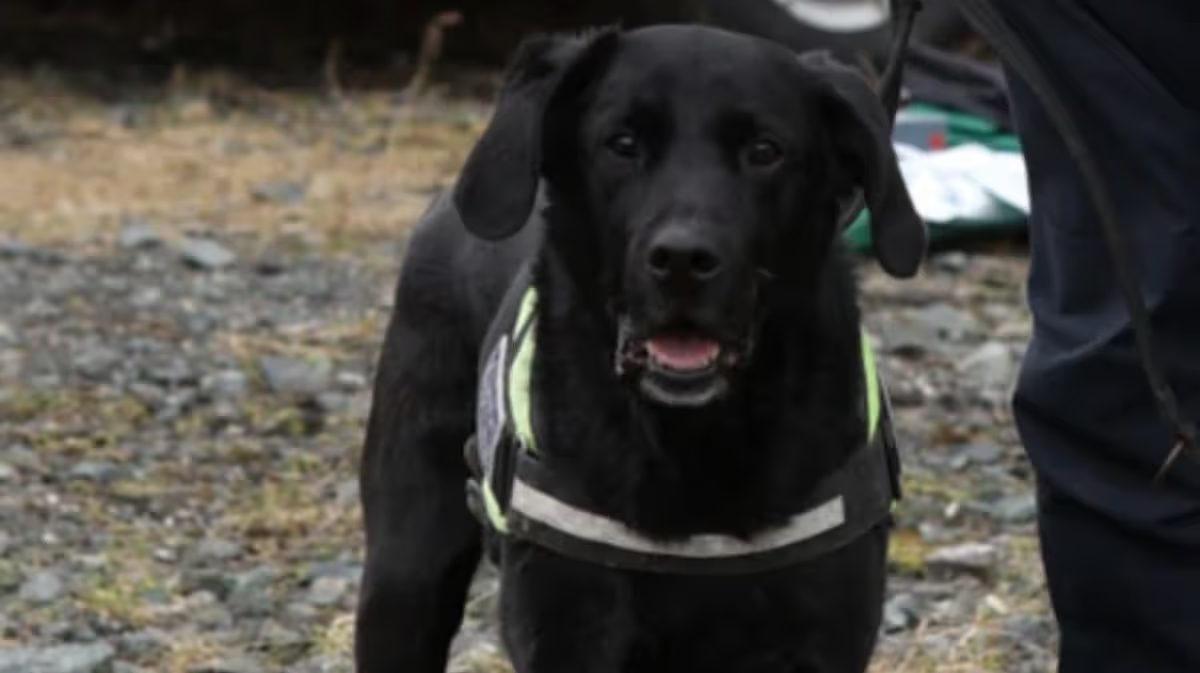
A boy of 13 and a girl of 16 are among the four teenagers arrested today in connection with an assault on a man and his dog.
The alleged incident took place in Bangor, Co Down, on Friday night where Ryan Gray, from K9 Search & Rescue NI, was walking his dog Max before they were set upon by a large group of youths.
Advertisement
It’s believed the same group harassed an elderly couple, fought among themselves and caused disturbances throughout the town on Friday evening.
As a result the police have now made four arrests and have pledged more will follow.
A statement from the PSNI said: “Police investigating an assault involving a man and a dog in the High Street area of Bangor on Friday, March 27 have charged four teenagers to court.
“A 13-year-old boy has been charged with assault occasioning actual bodily harm, affray and causing unnecessary suffering to an animal. A 15-year-old boy has been charged with assault occasioning actual bodily harm, affray and causing unnecessary suffering to an animal.
“A 15-year-old boy has been charged with assault occasioning actual bodily harm and affray. A 16-year-old girl has been charged with affray and common assault. As is usual procedure, all charges will be reviewed by the Public Prosecution Service.
“Police would like to thank all those members of the public who came forward to assist with enquiries following our appeal for information in relation to this incident. The investigation is ongoing and further arrests will be made when the other suspects are identified.”
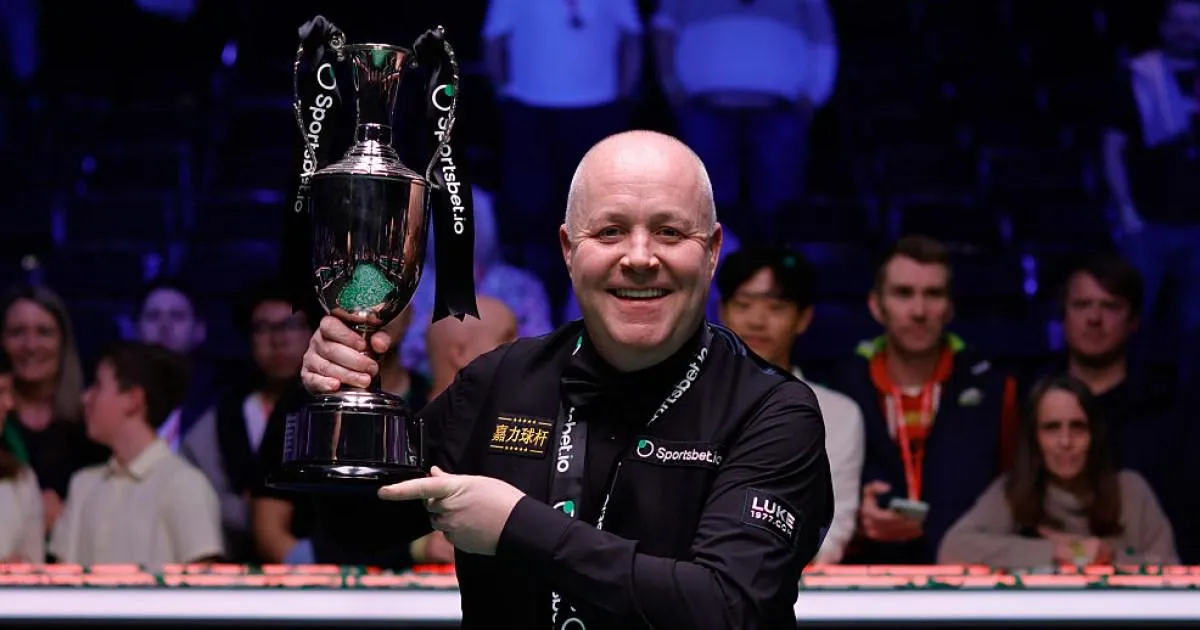
John Higgins won the Tour Championship in style last season (Picture: Getty Images)
John Higgins is in Manchester to defend his Tour Championship title this week, taking on a player he has been battling it out with for 36 years.
The Wizard of Wishaw brilliantly won the event last year, beating Mark Selby in the final and he is back to face Mark Williams in his opener this time round.
The Scot is not just wielding his cue, but also a microphone as he is on commentary and punditry duty for Channel 5, but defending his title is priority number one.
Just the top 12 on the one-year rankings make it to the Tour Championship, which Higgins says is a key aim at the start of any season.
Advertisement
‘I think if somebody says to you at the start of every season that you’ll be competing in the Tour Championship, it means it’s a good season,’ Higgins told Metro. ‘That’s your aim and I’d have bitten your hand off, really.
‘It would have been pretty poor coming down, commentating on it and speaking about it and you’re not in the event to defend your title.
‘I can’t wait to get out there and obviously playing your old nemesis, Mark Williams. It can’t be any bigger or better than playing Mark.’
Higgins finished runner-up to Zhao Xintong at last month’s Players Championship (Picture: Getty Images)
Two of the three legendary members of the Class of 92 first met professionally in 1994, but their rivalry goes back even further.
Asked for the first time he met Williams, Higgins said: ‘I’m sure it must have been the Home Internationals at Prestatyn in 1990, I was 15. That was the first time I’d met any players from out of Scotland.’
Advertisement
35 years on from that first meeting, the pair met in the 2025 World Championship quarter-final, which Williams dramatically won 13-12 on the final black.
Higgins feels he ‘owes him one’ for that painful defeat, but it is now a friendly rivalry that has lost the edge it once had.
‘I think it’s a lot better than it was,’ the Scot said of his relationship with the Welshman. ‘It’s only natural as well, I think, when you see the boys nowadays, the likes of Judd [Trump] and Kyren [Wilson], you just get a feeling that they really feel as if they’re rivals and they want to keep their distance from each other. It was probably exactly the same [for us].
‘Back in the day when me, Mark and Ronnie were playing, you were vying against each other for the same titles. As well it’s been well-documented when I’d left the management stable with Ian Doyle and Mark was still under that banner, there was a bit of rivalry there.
Advertisement
Higgins and Mark Williams played out a Crucible classic last year (Picture: Getty Images)
‘But nowadays you’re basically smiling walking into these events, knowing that you’re still playing against these guys and still competing. You’ve got to give yourself a pat in the back that you’re still doing it.
‘Listen, we’re dads now, we’re nearly grandads. I think everybody’s got a different outlook on life.’
Higgins felt his meeting with Williams in Sheffield last year was likely their last at the Crucible, but the odds of there being another have been improved this week after the announcement that the World Championship is set to stay at the venue – with a significant revamp – until 2045.
The four-time world champion was thrilled with the news and admits he was stunned by it, feeling a departure from the Crucible was likely when the previous contract was due to end in 2027.
Advertisement
‘I couldn’t believe it,’ he said. ‘I could not believe it how they got it over the line, especially for the amount of years. Incredible, incredible news.
‘I really thought it was going to be moving, I just didn’t think the Crucible was going to be be big enough for the event. I think it’s great news that it’s going to get upgraded because it certainly needs that.
‘I think obviously you don’t want to lose the uniqueness of the playing arena, which makes the Worlds that special. But behind the scenes it probably hasn’t moved with the times. Now it’s going to get the upgrade and it brings it up to the present day, and it should be a great, great venue going forward.’
Before the Crucible comes Manchester Central and Higgins will be in the commentary box, hoping that the ‘first day of school’ nerves of his Players Championship debut last month will have eased.
Advertisement
‘In the commentary box I really felt the nerves there,’ he said. ‘Dave [Hendon] was great with me, but that was like being back on the first day of school.
‘In the studio it felt okay because obviously you go into the studio after matches anyway and you’ve got somebody like Katie [Shanahan], who I think is really good, so it was all good. I really enjoyed it.
Tour Championship draw and schedule
Monday March 30
1pm Barry Hawkins vs Thepchaiya Un-Nooh Judd trump vs Mark Allen
Advertisement
7pm Judd Trump vs Mark Allen Wu Yize vs Chris Wakelin
Tuesday March 31
1pm Mark Williams vs John Higgins Barry Hawkins vs Thepchaiya Un-Nooh
7pm Mark Williams vs John Higgins Wu Yize vs Chris Wakelin
Advertisement
Wednesday April 1
1pm Neil Robertson vs Hawkins/Un-Nooh Shaun Murphy vs Trump/Allen
7pm Shaun Murphy vs Trump/Allen Zhao Xintong vs Wu/Wakelin
Thursday April 2
Advertisement
1pm Neil Robertson vs Hawkins/Un-Nooh Mark Selby vs Williams/Higgins
7pm Mark Selby vs Williams/Higgins Zhao Xintong vs Wu/Wakelin
Advertisement
‘I wasn’t really wanting to talk too much on commentary. But then again, when you listen to the other commentators, they maybe speak a little bit more, so then you think to yourself, am I speaking enough? So, I think it’s just trying to get a balance.
‘I don’t go on any social media, so I don’t know how well I would have been received with it, which is maybe a good thing in a way. So I’m only really going by listening to my wife or my brothers. They thought I’d done okay. So I don’t really know what the wider world’s thinking about it.’
The Wizard of Wishaw will be working on his words of wisdom when the Tour Championship kicks off on Monday afternoon, with his latest clash with his old rival coming up on Tuesday.














































You must be logged in to post a comment Login