Johannes Hoesflot Klaebo, Norway’s king of cross-country skiing, broke the record for the most gold medals won at a single Winter Olympics with his sixth of the Games.
Klaebo led a Norwegian sweep of the podium in the 50km mass start classic, with team-mates Martin Loewstroem Nyenget and Emil Iversen taking silver and bronze respectively.
The 29-year-old finished the brutal distance in two hours six minutes 44.8 seconds, 8.9secs ahead of Nyenget who takes his third medal of the Games.
“It’s hard to find the words. It’s unbelievable,” said Klaebo.
Advertisement
He breaks the previous record of five golds from a single Games, held by American speed skater Eric Heiden since the Lake Placid Olympics of 1980.
It also extends his own record for most Winter Olympic golds to 11, while he becomes the first athlete to win all six cross-country events at one Games.
Only US swimming great Michael Phelps, who won 23 gold medals, has more Olympic titles to his name.
Born in Oslo, Klaebo moved to Trondheim – a haven of cross-country skiing trails – as a young child, a move that has seen him become the greatest to ever do the sport.
Advertisement
No other man, active or retired, comes close to his record of 116 World Cup wins, while he is also a 15-time world champion, winning all six titles at last year’s edition on home snow in Trondheim.
“After the world championships last year, we knew that it was possible, but to be able to do it, it’s hard to find the right words,” he said.
“[There were] so many emotions when I’m crossing the finish line.”
His sixth Olympic gold at Milan-Cortina adds to the titles he had won earlier in the Games in the skiathlon, sprint classic, 10km interval start free, 4×7.5km relay and the team sprint.
Jamison Gibson-Park and Josh van der Flier back were also back to their best, having both been dropped for the victory over Italy.
In stark contrast, England appear to have dropped off alarmingly. There was no direction, their play was littered with errors, indecision, ill-discipline and their line-out fell apart to such an extent in the first half that Luke Cowan-Dickie had to be withdrawn, while Freddie Steward was also hooked before the interval.
There were pockets of resistance, where England managed to generate some momentum thanks to Ollie Lawrence and some running by Henry Pollock – otherwise largely ineffective at No 8 – and Marcus Smith, but there were never in the game, and the stadium knew it, with the atmosphere reduced to chatter and ironic jeers.
Advertisement
While Ireland look to the future, with home games against Wales and Scotland to come, Borthwick faces many questions of his own now.
England: F Steward (M Smith 39); T Freeman, O Lawrence, F Dingwall, H Arundell; G Ford, A Mitchell (J van Poortvliet 25); E Genge (B Rodd 51), L Cowan-Dickie (J George 29), J Heyes (T Davison 72), Maro Itoje, O Chessum, T Curry (G Pepper 51), B Earl (S Underhill 70), H Pollock.
Yellow cards: Steward, Pollock
Advertisement
Ireland: J Osborne; R Baloucoune, G Ringrose (C Frawley 54), S McCloskey, J Lowe (T O’Brien 18); J Crowley, Jamison Gibson-Park; J Loughman (T O’Toole 47), D Sheehan (R Kelleher 55), T Furlong (F Bealham 46), J Ryan, J McCarthy (C Prendergast 62), T Beirne, J van der Flier (N Timoney 49) , C Doris.
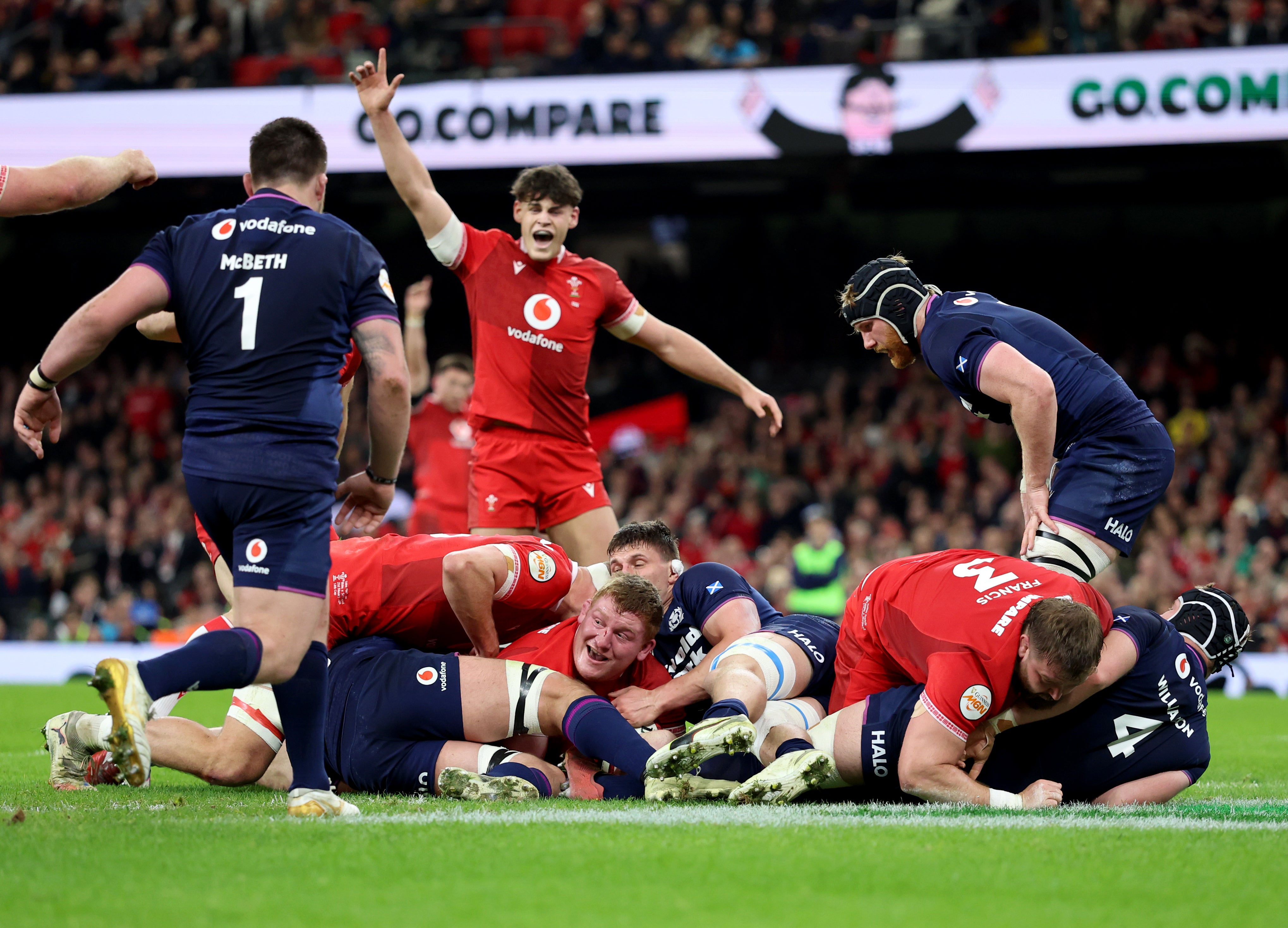
Wales led for 75 minutes at Principality Stadium – and were 20-5 up at the start of the second half – but Scotland fought back with tries for Kyle Steyn, Finn Russell, Darcy Graham and George Turner.
Rhys Carre and Josh Adams plus seven points from the boot of Sam Costelow gave Wales a 17-5 interval lead.
Advertisement
Costelow and Jarrod Evans landed second-half penalties, but it was more misery for the home fans as Wales suffered a 14th straight Six Nations defeat.
This was Scotland’s fourth consecutive victory over Wales, their best run since winning five in a row between 1923 and 1927, and will head to Dublin on the final weekend of Championship action with the triple crown on the line.
Scotland celebrated a fortunate escape against Wales (Nigel French/PA Wire)
Wales were desperate for a positive start after being blitzed in the opening quarter by England and France. But they were reduced to 14 men inside five minutes as Joe Hawkins made shoulder to head contact on Gregor Brown and received a yellow card.
Advertisement
A bunker review ended with no further punishment for the centre, but Wales were disadvantaged for 10 minutes and Adams only prevented Scotland from taking the lead with a goal-line interception.
Wales made the most of that escape after 10 minutes as Tomos Williams’ tap penalty set up a forward drive that ended with prop Carre scoring for the second successive game after crossing against France.
Costelow converted but Wales lost flanker Taine Plumtree to a shoulder injury and Scotland were soon baring their attacking teeth again. Sione Tuipulotu drove through the middle and Finn Russell released Blair Kinghorn to send over Steyn in the corner moments before Hawkins returned to the fray.
This was a far different Wales, however, to the timid team beaten by England and outclassed against France, and the lead was extended after 19 minutes.
Advertisement
Wales showed so much more than in recent games (Nigel French/PA Wire)
Dewi Lake, scurrying on the floor at one point, made crucial yardage and Wales charged to the try line again. Costelow kept his composure to send Adams over out wide, and added another five points with a touchline conversion and straightforward penalty as Wales continued to win the physical battle.
Costelow took Wales’ lead to beyond two scores with his second penalty and Scotland’s frustration was summed up by Huw Jones – who crossed twice against England – dropping the ball with the try line calling him.
But Russell made no mistake after Scotland pounded the home line with 20-plus phases, the fly-half spotting space and converting his own score.
Advertisement
Replacement fly-half Jarrod Evans’ first involvement was to extend Wales’ lead with a penalty, but Scotland struck straight from the kick-off.
George Turner went over for the decisive try late on (Getty Images)
Russell sent the ball over the head of James Botham and Graham was alert to collect the bouncing ball. Russell added the extras to cut the gap to 23-19.
Wales missed the chance to extend their lead when a penalty was overturned for foul play, and that proved critical as replacement hooker Turner claimed Scotland’s bonus point try five minutes from time with Russell adding the final gloss.
More than 20 towns with large warehouses have become stealth targets for Immigration and Customs Enforcement’s $45 billion expansion of detention centers. Some communities complain that ICE isn’t telling them anything until after it has purchased space for thousands of detainees. In some cases, warehouse owners are refusing to sell.
A look at some of the locations:
Arizona
Local officials were told nothing before ICE purchased a 418,000-square-foot (38,833-square-meter) warehouse in the Phoenix suburb of Surprise for $70 million, the state’s top prosecutor, Kris Mayes, said in a letter to Homeland Security Secretary Kristi Noem.
Documents later provided by ICE said the Department of Homeland Security estimates it will spend $150 million retrofitting the facility into a 1,500-bed processing site.
Advertisement
Florida
A TV reporter in Orlando spotted private contractors and federal officials last month touring a 439,945-square-foot (40,872-square-meter) industrial warehouse. ICE senior adviser David Venturella told a WFTV reporter the tour was “exploratory.”
Orlando Mayor Buddy Dyer said in a statement that the city hasn’t been contacted by the federal government and that it has no legal options to stop a possible ICE facility.
Georgia
ICE bought a massive warehouse in Social Circle for $128.6 million. The city said it has been informed that the facility is expected to house from 7,500 to 10,000 detainees and will be constructed using a modular design so that capacity can be scaled up or down as needed.
Plans also are in the works to convert a warehouse in Oakwood into an ICE processing facility, Republican U.S. Rep. Andrew Clyde said in a statement, although no deed has been filed. City Manager B.R. White said his first inkling that a deal was imminent came when a warehouse supervisor told a city inspector he’d been instructed to clear the job site to make way for the new owners — the federal government.
Advertisement
Indiana
After the town of Merrillville raised concerns about ICE touring a new 275,000-square-foot (25,548-square-meter) warehouse, owner Opus Holding LLC sent a letter stating it isn’t negotiating with federal officials for the property. The letter said Opus was limited in what it could share because of legal issues.
Maryland
ICE purchased a warehouse about 60 miles (96 kilometers) northwest of Baltimore for $102.4 million, a deed signed last month shows. The deed was unearthed by Project Salt Box, a Maryland ICE watchdog.
Officials in Washington County said in a Facebook post that DHS notified them beforehand that it was considering purchasing the warehouse for use as a “new ICE Baltimore Processing Facility.” County commissioners later passed a resolution in support of ICE activities.
Michigan
ICE announced its purchase of a facility in Romulus after the deal was completed. The city responded in a Facebook post that officials were concerned about the “lack of prior notification.”
Advertisement
Minnesota
The owners of warehouses in the Minneapolis suburbs of Woodbury and Shakopee pulled out of possible ICE deals after public outcry, according to local officials.
Mississippi
Republican U.S. Sen. Roger Wicker posted that Noem agreed to look elsewhere after local elected and zoning officials opposed a possible detention center in the town of Byhalia.
Missouri
After weeks of public pressure, development company Platform Ventures announced it would not move forward with the sale of a massive warehouse in Kansas City.
New Hampshire
Republican Gov. Kelly Ayotte sparred with federal officials after ICE disclosed plans to spend $158 million to convert a warehouse in Merrimack into a 500-bed processing center.
Advertisement
The issue came to a head when interim ICE Director Todd Lyons testified that DHS “has worked with Gov. Ayotte” and provided her with an economic impact summary.
Ayotte said the assertion was “simply not true.” She said the summary was sent hours after Lyons testified. The document erroneously refers to the “ripple effects to the Oklahoma economy” and revenue generated by state sales and income taxes, neither of which exist in New Hampshire.
New Jersey
Roxbury said Friday that ICE had closed on the sale of a warehouse despite it offering tax abatements to the owner to stop the purchase.
No property documents were yet available online showing the price of the sale. The announcement came just two days after ICE said it had made a “mistake” when it previously announced the purchase.
Advertisement
“Let us be clear: Roxbury Township will not passively accept this outcome,” the mayor and city council wrote in a news release.
New York
ICE said Tuesday it made a mistake when it announced the purchase of a vacant warehouse in Chester. New York state Assemblyman Brian Maher said Friday that ICE is no longer considering the facility.
Oklahoma
Oklahoma City Mayor David Holt announced last month that property owners had informed him they are no longer engaged with DHS about a potential acquisition or lease of a warehouse.
Pennsylvania
DHS purchased a warehouse in Tremont Township for $119.5 million and one in Upper Bern Township for $87.4 million. Democratic Gov. Josh Shapiro has said his administration will fight DHS’ plans to convert the warehouses in rural parts of eastern Pennsylvania into immigrant detention and processing centers.
Advertisement
Texas
In the El Paso suburb of Socorro, ICE paid $122.8 million for a trio of warehouses that span 826,780 square feet (76,810 square meters). ICE also paid $66.1 million for a 639,595-square-foot (59,420-square-meter) warehouse in San Antonio. The mayors of both cities are opposed.
However, another deal in the state was scuttled following community backlash. In the Dallas suburb of Hutchins, a real estate company confirmed that it was contacted about one of its properties but wouldn’t sell or lease any buildings to DHS for use as a detention facility. California-based Majestic Realty Co. provided no explanation in its statement.
Utah
Salt Lake City Mayor Erin Mendenhall expressed gratitude in her State of the City address that the owners of a warehouse that ICE was eying as a detention facility had announced plans not to sell or lease the property to the federal government.
Virginia
Jim Pattison Developments said in a statement last month that it became aware of the intended use of a warehouse in the suburbs of Richmond, Virginia, after agreeing to sell to a U.S. government contractor. Following boycott threats, the Vancouver-based company announced that the transaction “will not be proceeding.”
Advertisement
___
Associated Press reporters Holly Ramer, Isabella Volmert and Marc Levy contributed to this report.
He followed in the footsteps of tonight’s opponent, Warrington, in trying to take down the reigning champion Anthony Cacace, who first defeated Warrington before he swatted Wood aside by TKO. Wood had knocked out Warrington at the Sheffield Arena in 2023, down on all three judges’ scorecards before landing a right hook that felled the ‘Leeds Warrior’. Warrington beat the referee’s count, but saw the contest waved off in the seventh, controversially and to his horror.
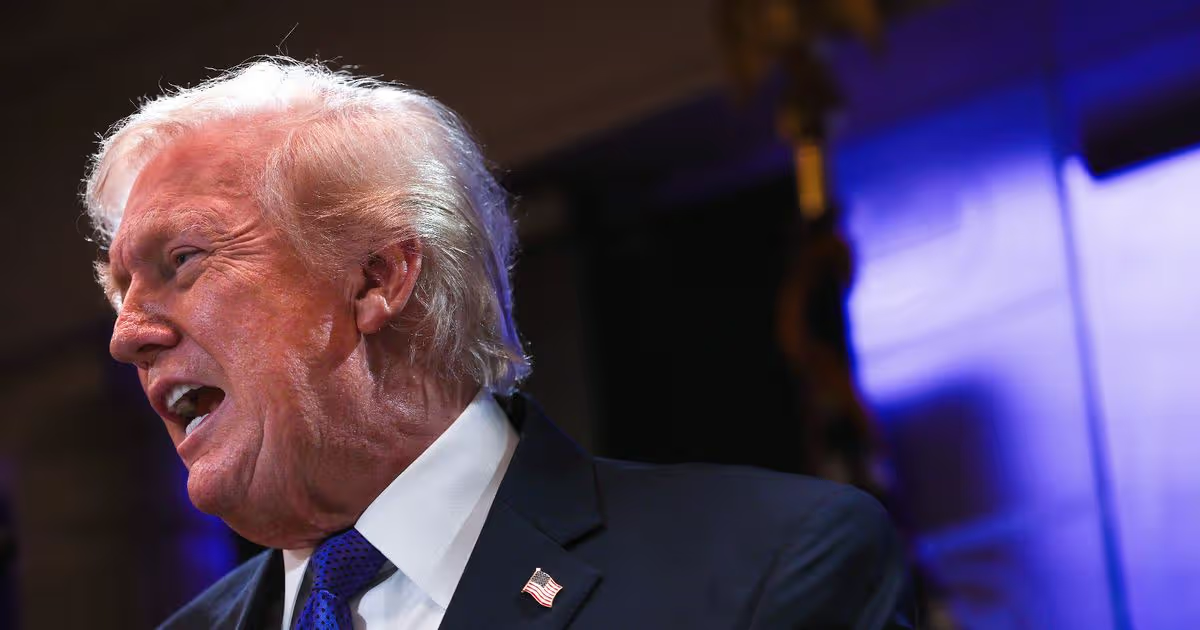
Donald Trump moved after a Supreme Court ruling deemed his use of a law was illegal.
17:57, 21 Feb 2026Updated 18:04, 21 Feb 2026
President Trump says he has ramped up tariffs on every country to the maximum allowed by US law after being humiliated by the Supreme Court’s ruling. During a televised meltdown last night, Trump declared he was replacing his illegal regime of retaliatory tariffs with a global 10 per cent levy.
It comes after the Supreme Court ruled his use of an obscure “emergency” law to impose them without consulting Congress was illegal. And tonight, Trump announced he was increasing that figure, reports the Mirror.
Labelling the highest court’s decision “ridiculous, poorly written, and extraordinarily anti-American”, he wrote on his Truth Social platform that he was hiking the global tariff rate to the maximum legal level of 15 per cent. However, he’s only allowed to do so for 150 days under the loophole his administration has found.
Advertisement
The UK’s biggest business organisation swiftly expressed dismay at the announcement and urged the Government to continue dialogue with US counterparts to keep the UK’s competitive advantage.
“We had feared that the President’s plan B response could be worse for British businesses and so it is proving,” William Bain, head of trade policy at the BCC said.
“This means an extra 5% increase in tariffs on a wide range of UK goods exports to the US, except those covered under the Economic Prosperity Deal.
“This will be bad for trade, bad for US consumers and businesses and weaken global economic growth. Businesses on both sides of the Atlantic need a period of clarity and certainty. Higher tariffs are not the way to achieve that.”
Advertisement
The UK Government repeated its assertion that it expects Britain’s “privileged trading position with the US” to continue, when approached for comment on the announcement of a new 15% rate.
Britain had received the lowest tariff rate of 10 per cent, and a subsequent agreement struck by Prime Minister Sir Keir Starmer and Mr Trump saw further carve-outs for the country’s steel industry and car manufacturers.
Questions remain over whether those deals still stand, although officials are understood to believe the changes would not have an impact on most of the UK’s trade with America, including preferential arrangements on steel, cars and pharmaceuticals.
A Government spokesperson said: “This is a matter for the US to determine but we will continue to support UK businesses as further details are announced.
Advertisement
“Under any scenario, we expect our privileged trading position with the US to continue and will work with the administration to understand how the ruling will affect tariffs for the UK and the rest of the world.”
Get more Daily Record exclusives by signing up for free to Google’s preferred sources. Click HERE.
A 37-year-old man is in hospital with life-threatening injuries, according to police
17:39, 21 Feb 2026Updated 18:03, 21 Feb 2026
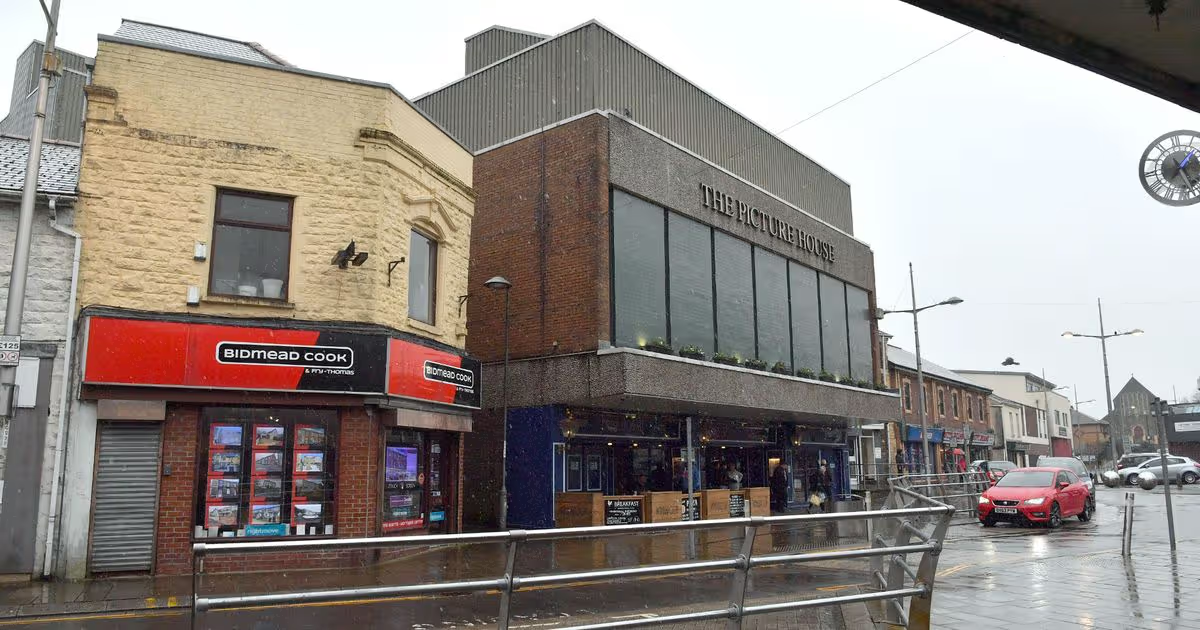
A man has been left with life-threatening injuries after an alleged assault outside a Wetherspoon’s pub. The incident, outside the Picture House pub in Ebbw Vale, Blaenau Gwent took place between 11.30pm on Friday, February 20 and 12.15am on Saturday, February 21, according to Gwent Police.
A 37-year-old man, from Ebbw Vale, has been taken to hospital with life-threatening injuries. Police were called after staff from the Welsh Ambulance Service treated a man had been assaulted on Bethcar Street.
The man’s family have been informed, and police have appealed for anyone who witness the incident to get in touch. For our free daily briefing on the biggest issues facing the nation sign up to the Wales Matters newsletter here.
Advertisement
Detective Inspector Elaine Newbury, from Gwent Police, said: “Our enquiries are ongoing to establish the circumstances of this alleged assault.
“While we believe this to be an isolated incident, we understand that reports of violence in our communities can be upsetting and unsettling.
“Our officers are in the area carrying out enquiries, collecting CCTV footage and gathering evidence; if you have any questions or information, then please do speak to them.”
There was a large police presence in the town and a number of local shops remained closed on Saturday for investigation work to be carried out.
Advertisement
Speaking before police released a statement about the incident, Richard Vaughan-Cobb who runs Fonehouse Ebbw Vale said: “Two members of our staff were unable to enter our premises this morning, and they were advised that the police were awaiting forensics and it was likely the cordon will not be lifted throughout the course of today.
“It is surprising how many independent businesses have been affected by this but it’s one of those things, the police need to do what’s needed.”
Police have asked for anyone who witnessed the alleged assault, or has relevant CCTV or dashcam footage, to get in touch.
You can assist the investigation by contacting Gwent Police via their website, call us on 101 or direct message them on their Facebook or X social media channels, quoting log reference 2600055384.
Advertisement
Alternatively, you can contact Crimestoppers, anonymously, on 0800 555 111, with information or visit their website.
Ensure our latest news and sport headlines always appear at the top of your Google Search by making us a Preferred Source. Click here to activate or add us as Preferred Source in your Google search settings
According to police, several dogs are loose, which “appear to be acting as a pack”. There are reported to be a few different breeds, possibly Daschund, Terrier, Spaniel, and Alsation.
Police are also trying to locate the owners and are keen to seize the dogs. Anyone with information has been asked to get in touch.
A police spokesperson said: “Many of you will be aware that there have been a high number of livestock worrying offences around Darwen and Edgworth.
Advertisement
“There are several dogs loose that appear to be acting as a pack. There are reported to be a few different breeds – possibly Daschund, Terrier, Spaniel and Alsation.
“We are currently out looking for the dogs with local farmers and are asking for members of the public to let us know if they see any loose dogs around the rural areas.
“You can update us on here until around 7pm today (February 21). After that, please call 101.
“We are extremely keen to seize these dogs and locate the owners.”
However, it wrote: “As an experienced BTP police officer used to dealing with a whole range of people, the panel found that, on the balance of probabilities, he probably would have known that this was an especially offensive use of language directed towards members of a minority community.”
In the third instalment of the cashless Belfast series, a spokesman from Campaign for Cash has spoken out about the “spreading disease” of cashless payments
A pro-cash campaigner has spoken to Belfast Live about his experiences — as well as his expectations — of a society moving towards a cashless future.
Advertisement
He warns Belfast residents to look towards other parts of the country that are a lot further along the digital path than Northern Ireland to see what is happening there. And he stresses the importance of holding onto cash as a viable payment option.
Martin Quinn, 52, from Sutton in South London is involved with the Campaign for Cash. The organisation is a grassroots group who campaigns for continued and expanded cash across the country.
He spoke to us highlighting the current landscape in the capital when it comes to cash, and said he wants physical money to remain a part of our spending habits.
Advertisement
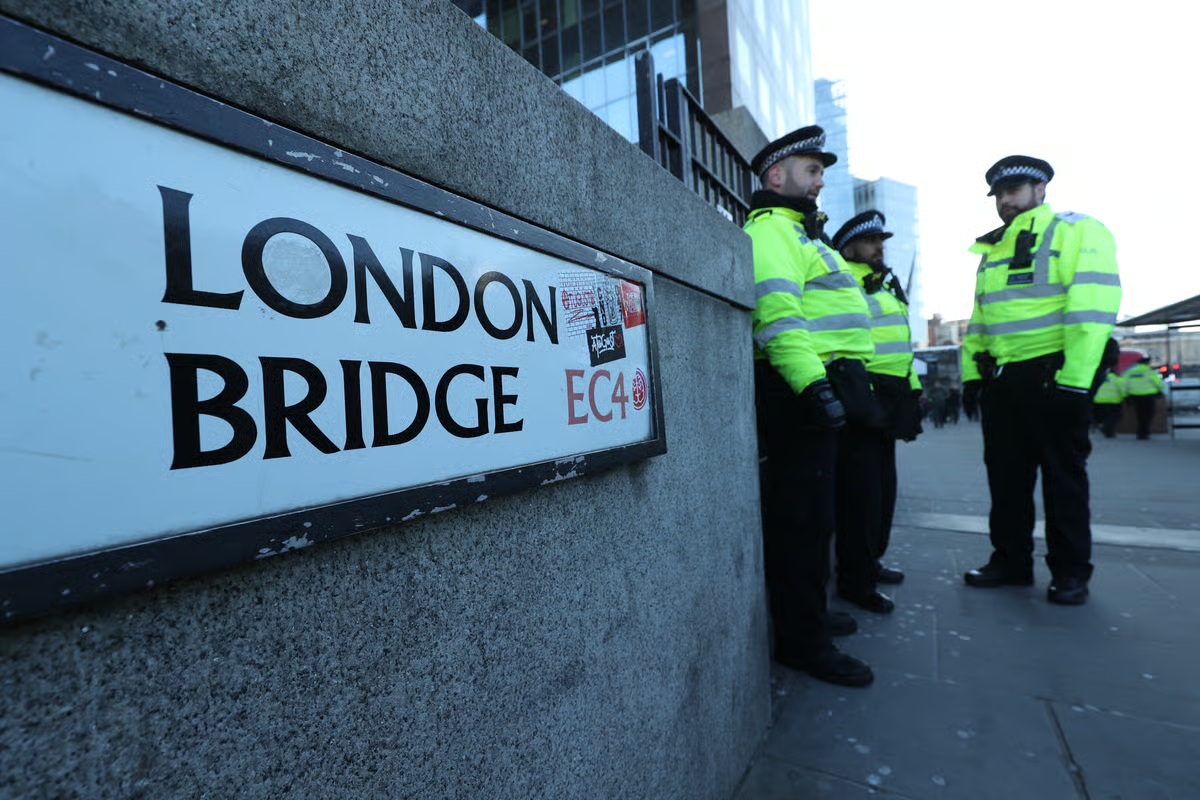
Campaign for Cash spokesman Martin said: “It is almost impossible to spend your cash in some parts of the capital.
“In London, many of the chains are card only and people need to speak up or they will not have the option to spend their cash. It is like a disease, cashless payments are spreading.
“My long term worry is that any particular high street in the country, you won’t be able to spend your cash. We’ve lost thousands of bank branches in the last decade so I can see why businesses are going card only but this is detrimental in so many ways, it hits everybody else. A wide array of society want to use cash and it should not be taken off the table.”
Advertisement
Martin said the Campaign for Cash wanted people to be proud of the cash in their pocket and to be able to use it freely. The organisation has been around for several years now and arose in response to the rapid decline in cash usage accelerated by the COVID-19 pandemic and the increasing number of businesses going cashless.
He continued: “If there is a power outage or systems go down, and we don’t have the ability to spend cash, we’ll be walking around like zombies. People need to realise that they have a right to cash and they need to demand to have the ability to be able to spend it.
“Cash is especially popular in working class areas and with self service checkouts taking over in supermarkets, it is rare that cash is accepted at terminals. People don’t just want to spend cash, they need to be able to spend cash.
“We are sleep walking into a cashless society and people need to understand the implications of not having cash. There are concerns around privacy and not having the freedom of making a decision on the way you want to spend your money is not beneficial.”
Advertisement
Throughout the cashless Belfast series run by Belfast Live, many readers have expressed their concerns about the practice of denying cash on our comment sections. Quite a few have publicly stated that they will avoid businesses that don’t accept notes or coins, and Martin encourages this practice.
“If you want to spend your cash, I’d advise boycotting businesses that refuse cash and vote with your feet. If enough people deny businesses access to their wallets then decisions will be changed,” he said.
“Cash needs to be on a level playing field with card payments, it shouldn’t be either, or, we need to have both across the board. Why should a cash user be discriminated against? Both of these payments need to be accepted for resilience. Cash needs to be there as a continuous fail safe, it is part of the eco-system.
Advertisement
“Why is it only in emergency situations that these businesses who have gone cashless want cash? They seem to be happy to take it when this happens.”
While cash use has declined significantly in certain parts of the country, Northern Ireland remains more cash‑reliant than many other regions.
According to Link, Northern Ireland was the most cash heavy part of the UK in 2024. During that year, banking customers in Northern Ireland withdrew an average of £2,274. The second and third cash heaviest regions in the same period were Yorkshire and the Humber (£1,696) and the North-East (£1,682).
A significant portion of UK adults now live largely cashless lives, relying on contactless cards and mobile payments for everyday purchases. But as digital payments become the default for many, questions are being raised about accessibility, consumer choice and whether some people risk being left behind as cash continues to disappear from the high street.
Advertisement
The ongoing closure of bank branches on high streets is also playing a role in a move away from cash. With fewer physical banks available, both customers and businesses are increasingly reliant on digital payment systems. For some businesses, security concerns are another factor, as holding large amounts of cash on-site can pose risks — something contactless payments help to reduce.
Belfast Live will continue exploring this issue in more detail as we seek answers from businesses, campaigners and others to determine whether the move towards cashless payments across the board is inevitable.
What do you think about the decline of cash in Belfast? Are you a business or a consumer that wants to add to the series? Email Rob.Currell@reachplc.com
Want to see more of the stories you love from Belfast Live? Making us your preferred source on Googlemeans you’ll get more of our exclusives, top stories and must-read content straight away. To add Belfast Live as a preferred source, simply click here
Today, Laura and Paddy are joined by Gary O’Donoghue, Chief North America correspondent to discuss the US Supreme Court’s ruling to block President Donald Trump’s global tariffs.
Is this the beginning of the end of his tariffs, what’s Trump doing now, and what does it mean for where power lies in the US?
Laura has interviewed former UK Prime Minister Boris Johnson and former Chief of the Defence Staff Sir Tony Radakin ahead of the four-year anniversary of the beginning of the full scale invasion of Ukraine. Boris Johnson said the UK and its allies “did not take strong enough action,” and the UK and its allies should deploy non-combat troops to Ukraine right now.
Advertisement
Laura and Paddy dicuss Boris Johnson and Tony Radakin’s comments.
You can now listen to Newscast on a smart speaker. If you want to listen, just say “Ask BBC Sounds to play Newscast”. It works on most smart speakers.
You can join our Newscast online community here: https://bbc.in/newscastdiscord
Get in touch with Newscast by emailing newscast@bbc.co.uk or send us a WhatsApp on +44 0330 123 9480.
New episodes released every day. If you’re in the UK, for more News and Current Affairs podcasts from the BBC, listen on BBC Sounds: https://bbc.in/4guXgXd
Advertisement
Newscast brings you daily analysis of the latest political news stories from the BBC.
The presenters were Laura Kuenssberg and Paddy O’Connell. It was made by Chris Flynn with Kris Jalowiecki. The social producer was Grace Braddock. The technical producer was Dafydd Evans. The weekend series producer is Chris Flynn. The assistant editor is Chris Gray. The senior news editor is Sam Bonham.