Connect with us

NewsBeat

Woman arrested on suspicion of murder after woman aged in her 90s dies in a house fire

Published

on

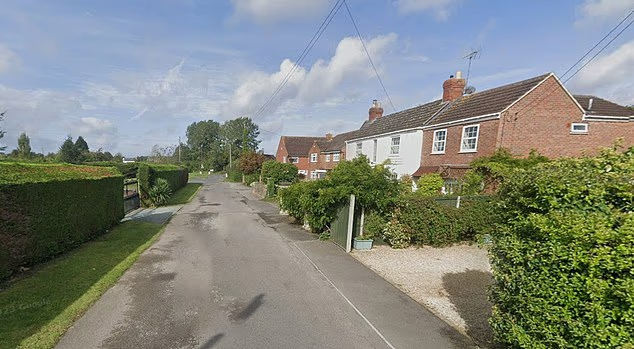
A murder investigation has been launched after a woman aged in her 90s died in a house fire in Elmgrove Road West in Hardwicke, Gloucestershire (pictured)

Advertisement

A murder investigation has been launched after a woman aged in her 90s died in a house fire. 

Emergency services were called to Elmgrove Road West in Hardwicke, Gloucestershire, shortly before 4am today after reports of a fire. 

A woman aged in her 90s was found unconscious inside the property and later pronounced dead. 

A woman in her 60s, from Gloucester, was arrested on suspicion of murder and arson with intent to endanger life and remains in police custody for questioning. 

Advertisement

The women knew each other and it is believed to have been an isolated incident, police said. 

A spokeswoman for Gloucestershire Police said: ‘Officers attended the scene along with crews from the fire and ambulance services. 

‘The property was searched and a woman in her 90s was found unconscious inside. 

‘Emergency services performed CPR but despite their best efforts, the woman was sadly pronounced dead. Her next of kin has been informed. 

Advertisement

A murder investigation has been launched after a woman aged in her 90s died in a house fire in Elmgrove Road West in Hardwicke, Gloucestershire (pictured)

‘Police would like to reassure the public that those involved in the incident are known to each other and this appears to have been an isolated incident. 

‘A cordon remains in place whilst investigators continue their inquiries at the address.’

Advertisement

Advertisement

Source link

Continue Reading
Click to comment

You must be logged in to post a comment Login

Leave a Reply

NewsBeat

Salamina wildfires: Brit holiday hotspot battles multiple fires as two bodies found

Published

on

Daily Record

146 firefighters and 10 aerial assets are tackling two wildfires on the island of Salamina

The Greek island of Salamina is currently battling multiple wildfires, as the inferno inches towards a popular British tourist village. Over 100 firefighters are deployed after two wildfires erupted, one in the Peristeria and Selinia areas, while the other spreads toward the much loved village of Kaki Vigla.

The Mirror reports the alarm was raised at 2.43pm today (August 16) as 146 firefighters and 10 aerial assets are tackling the blaze. It has been reported powerful winds are increasing the risk of the fire spreading rapidly.

Advertisement

Thodoris Zannis, deputy mayor of Salamina, speaking to ERT said: “I am on the other front of the fire in Salamina, we are trying to stop the fire.

“It has taken over the entire mountain and is spreading, but the firefighting forces are being reinforced. People had to leave because there was no way out, so the messages started early.

“I have been informed that for the other fire in Peristeria, the ferries have also gone to evacuate by sea. The fire broke out at the same time and that was the strange thing.”

The Hellenic Police has requested that two ferry boats be made available for evacuations by sea from an area between Peristeria and Kaki Vigla. Firefighters are also battling wildfire for a second day on the Greek island of Skyros but the mayor, Kyriakos Antonopoulos, hopes it will soon be brought under control.

Tragically, this afternoon the fire service says that two bodies have been found while they battle the Salamina fires. So far they have not been identified.

Four people have been rushed from the Peristeria area to Salamina Hospital after suffering burns. An elderly man who was rescued from his home in Kaki Vigla was also taken to Salamina Hospital.

Mayor Giorgos Panagopoulos said: “The situation is difficult. There are two major fires, homes are under threat, and we have asked the police to bring us two ferry boats to Saterli Beach so that we can use them for people if we see that the situation becomes much more difficult.”

Advertisement

Ensure our latest stories always appear at the top of your Google Search by making us a Preferred Source. Click here to activate or add us as your Preferred Source in your Google search settings.

Source link

Continue Reading

NewsBeat

key takeaways for language learning

Published

on

key takeaways for language learning

Exam-entry statistics in the summer tend to prompt debates about the future of language learning in the UK. These are often framed around languages being in crisis: fewer young people study languages than two decades ago, and concerns persist about the UK’s linguistic capacity in an interconnected world.

The emerging figures for 2026 reinforce some of those concerns. But they also show a more complex picture than a simple narrative of decline. Language learning is changing unevenly, with growth in some places, fragility in many others, and important questions about which languages, learners and pathways are being valued.

Combined A-level entries in French, German and Spanish (the “modern foreign languages” traditionally taught in the UK) rose slightly in absolute terms in England, Northern Ireland and Wales – from 17,407 in 2025 to 17,616 in 2026. But this still lags behind the overall growth in A-level entries, which have increased by 2.7%.

Against that backdrop, the growth in language entries looks more fragile. Since 2022, the number of A-levels taken in the three languages has fallen from 19,820 to 17,616 – an over 11% decline in five years.

Advertisement

According to provisional data published by Ofqual, England’s exams regulator, GCSE entries in French, German and Spanish have seen a slight overall decrease in 2026, as have “other modern languages” and ancient languages.

Scotland has had a national policy commitment to language learning since 2013, yet sustaining uptake remains challenging there too.

While overall entries for Scottish Highers (a school-leaving qualification in Scotland) have gone up by 2.7% in 2026, entries in languages have fallen by 3.6%. The number of entries for languages (including Gaelic) was 6,955, which amounts to only 3.3% out of the overall 207,980 entries.

The picture for language learning is uneven.
s880/Shutterstock

National 5 entries (roughly equivalent to GCSEs) for languages have been more or less stable since 2022, but the proportion of language entries in 2026 was relatively small too (4.7%).

Advertisement

Looking across the data, and alongside the British Council’s annual Language Trends surveys, five key observations can be made.

1. Spanish is now the leading school language

The rise of Spanish is one of the clearest shifts. Spanish is now the most-entered GCSE language.

This continues a longer-term change already visible at A-level, where Spanish overtook French as the most popular language in 2019. In 2026, Spanish attracted 8,434 entries, compared with 6,888 for French and 2,294 for German. All “other modern languages” combined accounted for 6,944 A-level entries.

The same trend can be observed in Scotland, where Spanish has been the most popular language in Higher exams since 2023, and in National 5 exams since 2025.

Advertisement

2. Greater recognition of multilingual identities

The “other modern languages” category deserves some special attention. At A-level, it grew by 25.8% between 2022 and 2026, reaching 6,944 entries. At GCSE, provisional entries in this category fell slightly, but the age profile is striking: 41.5% of entries came from younger pupils in Year 10 or below – far more than for French, German or Spanish, or indeed any other subject.

Many pupils are taking qualifications in languages they already use in family or community contexts, such as Arabic, Chinese, Polish, Portuguese, Turkish and Urdu.

The question is therefore not only how to persuade more young people to learn a “foreign” language from scratch. It is also how schools, colleges and universities recognise, value, develop and accredit the linguistic knowledge many students already bring with them. The planned GCSE in British Sign Language marks another important step towards recognising linguistic diversity more fully.

3. Access is uneven, especially in state schools

The British Council highlights that language provision remains under particular pressure in state schools: more than a quarter of primary schools and around a fifth of state secondary schools in England report reductions in curriculum time for languages. It also found persistent problems with transition from primary to secondary school.

Advertisement

Post-16 provision is particularly vulnerable. 43% of surveyed state secondary schools report that A-level language courses do not run if minimum student numbers are not met.

4. The university pipeline remains fragile

School trends feed directly into higher education. Data published by the Universities and Colleges Admissions Service (UCAS) shows a steady decline in applications to university courses in the subject group “languages and area studies” (which includes modern languages as well as, for example, English, linguistics and creative writing). Since 2022, applications have fallen from 89,190 to 74,110 in 2026 – an almost 17% drop.

This puts university language departments under significant pressures but also encourages them to rethink their offer. Many have introduced beginners pathways into their language degrees and increased opportunities to combine languages with other subjects.

5. Teacher supply is a cause of concern

Teacher supply remains one of the most important structural challenges, which will be exacerbated if even fewer students study languages at university and more university language departments close.

Advertisement

The British Council reports that around half of state secondary schools identify recruitment and retention of qualified modern foreign language teachers as an issue.

A cautiously optimistic outlook

All in all, there is reason for cautious optimism when it comes to language learning in the UK. The growing demand for Spanish signals a general interest in, and openness to, other languages and cultures. So does the increased visibility and recognition of multilingualism in communities.

A constructive response to the challenges should focus on protecting access in state schools and valuing home, heritage, community and signed languages alongside traditionally taught languages. It should also focus on transitions – from primary to secondary to higher and further education – and on building attractive routes into teaching.

All this depends on a shared understanding of the intellectual, cultural, practical, political and economic value of language learning.

Advertisement

Source link

Continue Reading

NewsBeat

Water companies could be allowed to charge customers more during droughts as watchdog considers giving green light to ‘surge pricing’

Published

on

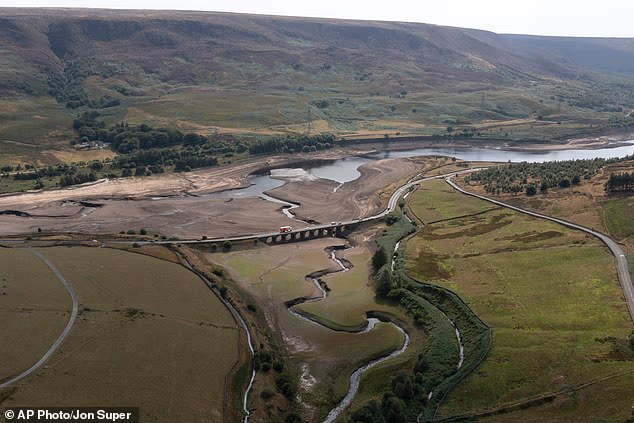
Woodhead reservoir near Manchester, pictured, as more than two-thirds of the UK suffers under drought conditions

Water companies could charge customers more during droughts as Ofwat considers giving the green light to ‘surge pricing’.

The Water Services Regulation Authority will allow firms to fluctuate prices in a bid to reduce consumption.

If the go-ahead is given, factors including ‘water scarcity’, the time of year and usage would contribute to suppliers hiking prices.

But the proposals, which would come into force in April next year, have yet to receive a final approval from the water regulator Ofwat.

Advertisement

Details of the pending price changes emerge as the UK is experiencing prolonged droughts, hosepipe bans and wildfires erupting across the nation.

Water companies could utilise surge pricing if it comes into effect by imposing seasonal charges where users would pay more during summer and less during the winter months.

Usage tariffs could similarly hike prices for homeowners if they pass a specific threshold of water use.

Households would then be incentivised to conserve water if droughts scourged the UK next summer.

Advertisement

Woodhead reservoir near Manchester, pictured, as more than two-thirds of the UK suffers under drought conditions

The bed of Bottoms Reservoir begins to crack during low water levels as the heatwave continues

The bed of Bottoms Reservoir begins to crack during low water levels as the heatwave continues

People take part in a Parkrun at Perry Hall Park in Birmingham through fields of bone-dry and yellow grass

People take part in a Parkrun at Perry Hall Park in Birmingham through fields of bone-dry and yellow grass

Advertisement

Both surge and block pricing have been trialled by water companies in small pockets of the UK.

Advertisement

In Lincoln and Norwich, 14,000 households using Anglian Water were recipients of the largest trial.

An Ofwat spokesperson said: ‘The efficient use of water is in the best interests of everyone, including businesses.

‘The options we are progressing would support greater consideration of water scarcity and efficiency by water companies when setting their charges, and encourage more tariff innovation.

‘We recently carried out a period of consultation on the proposals and will reach a final decision in the near future.’  

Advertisement

The potential green light for ‘surge pricing’ comes as Ofwat announced on August 13 that water bills would rise again for more than 30million people.

The water regulator was branded ‘toothless’ after it granted five water suppliers permission to raise bills above previously agreed levels – despite them losing billions of litres to leaks.

Prime Minister Andy Burnham said he was ‘angry’ at water companies using customers ‘as a blank cheque’ but has been challenged over what he is going to do about it.

Join the discussion

Advertisement

Should water companies be allowed to charge higher prices during droughts?

Dried fields as far as the eye can see in Weymouth, pictured on August as the fifth heatwave began

Dried fields as far as the eye can see in Weymouth, pictured on August as the fifth heatwave began

A view of the ancient stone circle Stonehenge in Wiltshire surrounded by yellow and dried grass

A view of the ancient stone circle Stonehenge in Wiltshire surrounded by yellow and dried grass

A wildfire and heat alert issued by the UK Government seen on a mobile phone screen on August 14

A wildfire and heat alert issued by the UK Government seen on a mobile phone screen on August 14

Advertisement

Scandal-hit Thames Water was granted permission to hike bills again between 2027 and 2030, along with Southern Water, South East Water, Severn Trent and Wessex Water.

Three water firms have imposed hosepipe bans on more than 20million people this summer.

Advertisement

Ofwat said it had given suppliers the provisional go-ahead for the unexpected hike in bills to fund £3.4billion-worth of new projects, including infrastructure for housing and data centres.

But the water regulator has already allowed suppliers to hike bills by 36 per cent between 2025 and 2030, with eye-watering increases last year and another 5.4 per cent on average bills from April.

Some 13 water companies applied to increase bills to fund investment of £4.3billion, and Ofwat announced yesterday it had provisionally allowed five to do so for £3.4billion of new projects.

The 2.7million people supplied by Southern Water will see bills rise by £80 over the next two years.

Advertisement

Southern – which lost about 37 billion litres of water through leaks last year – has the most expensive bills, with customers paying an average of £759 a year after an 8 per cent rise this year.

Thames Water – which Mr Burnham is expected to put into special administration to stave off its collapse as it sinks under £20billion in debt – was also allowed to increase bills for its 16million customers, as was Severn Trent, which services some 8 million.

Devastating wildfires have hit parts of the UK including Stourbridge, pictured, during the drought

Devastating wildfires have hit parts of the UK including Stourbridge, pictured, during the drought

Charred land and burnt houses following the huge wildfire which started in Stourbridge on August 14

Charred land and burnt houses following the huge wildfire which started in Stourbridge on August 14

Advertisement

Thames Water caused fresh outrage this week after it emerged it had paid a £1million signing-on fee to its new chief financial officer, Steve Buck.

Advertisement

Meanwhile the 1.4million people supplied by Wessex Water will see bills rise by £11 over the next two years, while the 2.3million supplied by South East Water will see a £1 rise.

Ofwat will consult on the proposed rises until September 24, with a verdict due in December.

A spokesperson previously said: ‘We will track performance to ensure companies are delivering the expected improvements for customers and the environment. If they don’t, expenditure can be clawed back.’

Source link

Advertisement
Continue Reading

NewsBeat

Don’t know what to do after your exams? Six ways to find your next step

Published

on

Don’t know what to do after your exams? Six ways to find your next step

“What are you going to do next?” For teenagers receiving their GCSE or A-level results, it can be one of the most daunting questions to answer. There’s often an expectation that, by the time they leave school, young people should know what they want to do with their working lives. But careers rarely follow such a straightforward path.

People change jobs, retrain, move into different industries and discover new interests. The world of work is also changing rapidly, with artificial intelligence (AI) reshaping some roles and employers increasingly looking for experience as well as qualifications.

So, if you’re not sure what you want to do next, that doesn’t mean you’re falling behind. You don’t have to choose one career and stick with it for the rest of your life. Instead, think about the next step as an opportunity to explore.

Here are six ways to do that:

Advertisement

1. Don’t choose a career, choose an interest

Rather than trying to identify the job you want to do for the rest of your life, start with subjects and areas that genuinely interest you.

Choosing something that stimulates you can make it easier to stay engaged and develop your skills. It can also open the door to careers you may not have considered.

Your interests may change over time too. That’s not a problem. The aim is to find something that interests you now and see where it takes you.

2. Try before you commit

If you’re considering a particular career, try to find out what the work is actually like. Volunteering, part-time jobs, work experience and job shadowing can all give you a better idea of what happens in a workplace.

Advertisement

You may discover that a job is exactly what you expected. You may also discover that it’s not for you. Both outcomes are useful. Finding that out before committing years to a particular career can save you time and help you make a more informed decision.

Work experience can also give you examples to talk about in future job interviews and help you develop skills such as communication, teamwork and problem-solving.

3. Choose courses that give you experience

If you decide to continue into further or higher education, look beyond the course title. Courses that include work placements, projects or other opportunities to apply what you have learned can help you understand how your subject relates to the world of work.

You can develop practical skills while also learning how to work independently and with other people. A placement can also help you decide whether you want to work in a particular profession before you have finished your studies.

Advertisement

4. Build experience wherever you can

Work experience and placements can introduce you to people already working in the field you’re interested in. Take the opportunity to ask questions and learn from them. Careers aren’t built entirely through qualifications. Knowing people and understanding how an industry works can also be valuable.

Look out for careers events, employer talks, mentoring schemes and opportunities to meet people working in areas that interest you. Simply getting to know people and finding out what they do can help you understand what opportunities are available.

You don’t need to have your whole life mapped out right now.
Iryna Imago/Shutterstock

5. Research the reality of the job

If you have an idea of the area you’d like to work in, look at actual job advertisements. What qualifications do employers ask for? What skills and experience do they want? Are there particular routes into the profession? This can help you work out what you need to do next.

You could also look for opportunities to volunteer, gain work experience or spend time observing someone who already does the job. And remember that your first job doesn’t have to be your dream job. Getting into a workplace or sector that interests you can give you experience, contacts and a better understanding of where you want to go next.

Advertisement

6. Think about where you want to live

Career decisions are also about where you want to be in the world. If you already have an idea of the area where you’d like to stay, look at the jobs available there. Some industries and professions are concentrated in particular towns and cities, while others offer more opportunities to work remotely.

Thinking about location alongside your career interests can help you understand what your options really are. It may also mean being open to opportunities you had not initially considered.


À lire aussi :
Do you want to be an astronaut? Career routes that can take you to space


The most important thing to remember is that don’t have to decide everything now. The question “What are you going to do next?” can make it sound as though you’re being asked to choose the rest of your life. You’re not, though. Your next decision is simply that: your next decision.

Advertisement

Whether you choose further study, an apprenticeship, work or another route, look for opportunities to learn more about yourself and the world of work. You can change your mind, gain new skills, or take a different direction. You don’t need to have your whole life mapped out right now. You just need to work out what you want to explore next.

Source link

Advertisement
Continue Reading

NewsBeat

Cardiff City ‘in talks’ to sign ex-Man United prospect as player omitted from squad

Published

on

Wales Online

The 27-year-old midfielder started his career at Old Trafford, with his father having been an important figure at the Premier League club

Cardiff City are reportedly in talks to sign Dutch defensive midfielder Melle Meulensteen from Go Ahead Eagles.

Advertisement

The 27-year-old is understood to have been left out of the club’s Eredivisie clash with Feyenoord on Sunday due to the transfer interest around him. Sky Sports report that he missed the 2-2 draw as the club do not want to risk the former Manchester United youth player getting injured and robbing them of a transfer fee.

Sky added that talks are not at an advanced stage just yet, but the fact the midfielder – who can also play centre-back – was kept out of Go Ahead Eagles’ line-up this weekend suggest things could quickly change.

Reports in the Netherlands add that the club are believed to keen on keeping hold of Meulensteen.

The midfielder joined the club from Sampdoria last year and has another three years left on his contract.

Advertisement

While he did not feature this weekend, he was involved in last week’s 4-1 home win over Willem II.

The name should be a familiar one to football fans, with his dad Rene having been assistant manager at Manchester United. He also managed Fulham and the Australia national team.

His sister, Pien, is a Sky Sports broadcaster who became the first woman to commentate on a live Premier League match for the channel in 2023.

Advertisement

Meulensteen scored five goals and provided three assists during his first season at Go Ahead Eagles.

Having started his career in Manchester United’s academy, he moved onto Preston – captaining their youth side.

He then moved to Dutch side RKC Waalwijk before heading to Vitesse in 2022.

The midfielder would then sign a three-year deal with Italian club Sampdoria, only to return the Netherlands a year later.

The Bluebirds made Liverpool full-back Calum Scanlon their latest signing on Saturday, with the 21-year-old putting pen to paper on another loan deal.

However, they have missed out on Omari Kellyman after Chelsea opted to pursue a permanent sale of the midfielder.

Source link

Advertisement
Continue Reading

NewsBeat

‘England’s prettiest village’ blocks new shops and cafe as locals rail against ‘overtourism’ that has left roads gridlocked and car parks overflowing

Published

on

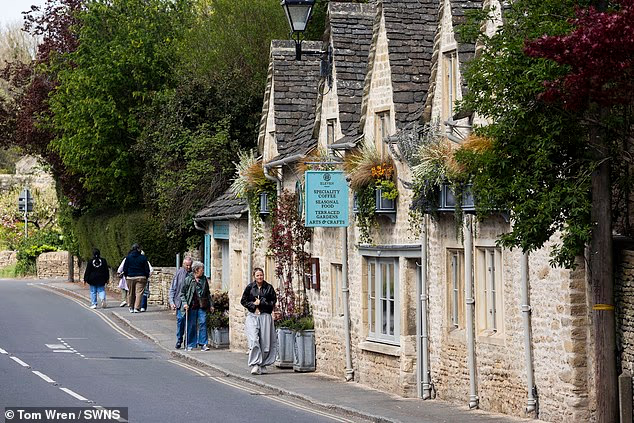
A new cafe in Bibury in the Cotswolds has been blocked after 100 residents complained about the impact of overtourism

More than 100 residents in ‘England’s prettiest village’ have blocked the building of a new café and shops after they complained that the area has become overrun by tourists.

The quaint and picturesque Cotswolds village of Bibury, famed for its 14th-century honey-coloured stone cottages, has rejected a new development because of fears it may attract yet more visitors.

It was originally made famous by textile designer and writer William Morris, who described it as ‘the most beautiful village in England’ in the 19th century.

But now furious locals have warned that the influx of tourists pouring into the small area throughout the year is becoming unsustainable.

Advertisement

Coaches and cars bringing tourists to the village are clogging up the narrow country lanes that run through Bibury, which locals said is causing dangerous traffic gridlock. 

Pedestrians have been forced to ‘run the gauntlet’ across the highway where the planned development would be built.

Now local councillors have rejected plans to turn a storage area on the ground floor of existing barns into a cafe and shopping area – fearing the wrath of residents.  

Representatives of the applicants, Bibury Trout Farm, argued the scheme would ‘bring the buildings fully back into use’.

Advertisement

A new cafe in Bibury in the Cotswolds has been blocked after 100 residents complained about the impact of overtourism

Coaches and cars bringing tourists to the village are clogging up the narrow country lanes that run through Bibury, which locals said is causing dangerous traffic gridlock

Coaches and cars bringing tourists to the village are clogging up the narrow country lanes that run through Bibury, which locals said is causing dangerous traffic gridlock 

Pictured: Trout Farm in Bibury, where a new development has been rejected by councillors

Pictured: Trout Farm in Bibury, where a new development has been rejected by councillors

Advertisement

But more than 100 objections were lodged to Cotswold District Council, arguing the additional impact on the village would be too much.

Bibury Parish Council objected to the plans, arguing that the village ‘cannot sustainably manage and maintain its character’.

In its objection, the parish council wrote: ‘The council agrees that overtourism by the Trout farm, resulting high volumes of visitors, is having a negative impact on the local environment, community, and the overall visitor experience.

‘This application we understand will be open to non-trout farm visitors therefore we believe will lead to another increase in visitor numbers.

Advertisement

‘The Trout Farm already has a large café in its grounds as well as existing extended café facility selling ice cream opposite the main site.

‘The village has another four catering businesses for the public all serving food and drink.

‘The area’s popularity with visitors is not sufficient justification for the location of new tourist attractions.

‘Any large-scale visitor development will generally be considered to be unacceptable if it would harm the landscape or features of historic interest, or have a harmful impact on the transport network.’   

Advertisement

The council said the lane was ‘constantly grid locked’ and verges ‘eroded by tourist vehicles’ using the Trout farm main car park which is ‘often full to overflowing in the summer’.

It added: ‘Therefore a new café as a standalone destination with traffic arriving will only exacerbate car parking and access to the Trout farm overflow car parks which have been overused this summer, not only creating enormous frustration to residents from Ablington and Bibury alike, but causing great danger to both pedestrians and drivers.’

Bibury was originally made famous by textile designer and writer William Morris, who described it as 'the most beautiful village in England

Bibury was originally made famous by textile designer and writer William Morris, who described it as ‘the most beautiful village in England

Gloucestershire County Council has now stepped up its enforcement of fines in response to the complaints about tourism

Gloucestershire County Council has now stepped up its enforcement of fines in response to the complaints about tourism

Advertisement

A total of 102 third-party objections were also raised with concerns ranging from congestion and pedestrian safety, harm to the village’s historic character and increased noise and disturbance of additional visitors.

Planners said the ‘scale and form’ of the development was considered appropriate but recommended refusal due to highways concerns.

They said: ‘The significant tourism pressures affecting Bibury are acknowledged, with traffic, parking and pedestrian safety issues representing established concerns within the village.

‘The Highway Authority considers that insufficient information has been provided to assess pedestrian accessibility and safety, including pedestrian movements along Ablington Lane, pedestrian and vehicle interaction, accessibility for mobility-impaired users, and conditions experienced during peak visitor periods.

Advertisement

‘The application has therefore not demonstrated that safe and suitable access can be achieved for all users.’

Councillors voted unanimously to reject the proposal at a meeting on August 11.

During the meeting Conservative councillor David Fowles said Ablington Lane was ‘frequently gridlocked’ with no safe pedestrian access.

He added: ‘Pedestrians have to run the gauntlet across the highway. It is a very dangerous situation.’

Advertisement
The quaint and picturesque Cotswolds village of Bibury is known for its 14th-century honey-coloured stone cottages which once featured on British passports

The quaint and picturesque Cotswolds village of Bibury is known for its 14th-century honey-coloured stone cottages which once featured on British passports

Locals in Bibury have also been embroiled in a long and much-publicised planning battle with the owner of Rosemary Cottage Metin Dener over the scale of building works.

The renovations have been dubbed a ‘flagrant disregard for the history and beauty of the area’ and described as turning a ‘tiny’ Grade II  historic cottage into a ‘monstrosity’.

Years of construction work at the cottage on Awkward Hill is continuing to blight their lives, villagers have claimed.

Advertisement

In the latest application, the applicants hit back at claims it had ‘overdeveloped the site’.

It added: ‘Due to the narrow access road and high level of tourists in the village the works on this site have had to progress at a slow pace as vehicle access has been relatively limited compared to most building sites and works on a steeply sloping site are complex.

‘The contractors on this site have tried to inform residents of deliveries and material removals where possible, however communication has not always been possible to be maintained.’

The village has also seen a 2,000 per cent rise in parking fines, with figures showing parking wardens dished out 651 notices in the village last year – up from 28 in 2019.

Advertisement

Fines have been set at £70, reduced to £35 if paid within a fortnight, meaning tickets issued in 2025 could have generated up to £45,570 – equivalent to around £900 a week.

This compares to the 28 fines given in 2019 generating £1,900.

Forbes previously named Bibury as the most beautiful village in the world out of a total list of 50

Forbes previously named Bibury as the most beautiful village in the world out of a total list of 50

Community representative Craig Chapman said many visitors showed ‘very little regard for villagers’ – parking wherever they can, even if this meant blocking pavements or stopping on double yellow lines.

Advertisement

Gloucestershire County Council has now stepped up its enforcement of fines in response to the complaints about overtourism in the Cirencester village.

Mr Chapman argued tougher action was needed to keep routes open for ambulances and fire engines and to make sure pedestrians could walk safely through the centre of the village.

However, the cost of sending wardens out frequently is estimated at around £4,000 a month, meaning income from fines alone does not cover the full bill for enforcement.

The county council is now planning to bring in pay-and-display parking for 24 on-street spaces along The Street, with proposed charges of £6 or £7 for two hours during the busy March to October period.

Advertisement

The tariffs have been benchmarked against other high-visitor locations, and officials say they could bring in up to £218,880 a year, delivering a projected surplus of up to £360,680 over four years once enforcement costs are taken into account.

Separately, a pedestrianised area in the middle of Bibury – previously used for coach parking – is to be made permanent, with temporary barriers replaced by structures designed to fit better with the historic setting.

A focus group is also examining options for out-of-village parking to ease pressure on residents’ driveways and the village’s tight road network, amid a wider £175,000 investment package aimed at managing visitor numbers and congestion.

The council said the figures in the latest report are ‘absolute maximums’ – and fines are reduced if paid quicker or appealed.

Advertisement

Source link

Continue Reading

NewsBeat

Could rain FINALLY be on the way? Heatwave ends and the clouds roll in as England looks for relief from record-breaking drought

Published

on

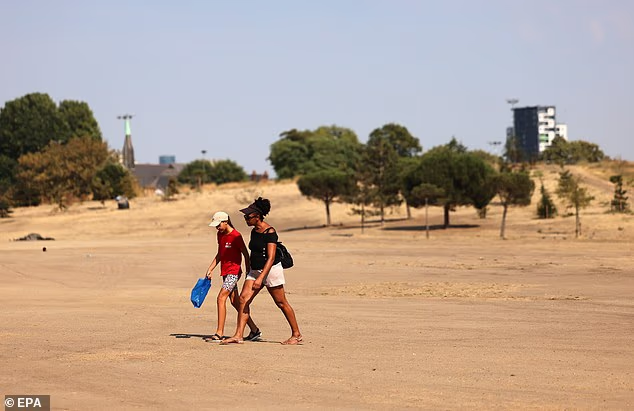
Many of the parks in London have experienced no rain and the ground has been turned a sand-like brown from the heat

After weeks of no water in a record-breaking summer for hot weather and droughts, rain could finally be set to return to bone-dry Britain.

Areas of northern England and Scotland have finally witnessed downpours early this morning, while southern areas are likely to remain warm and dry today.

But by the end of the week, nearly every corner of the country is likely to see some precipitation finally hit the ground.

It will come as a welcome relief to areas which are now close to two months without any meaningful rainfall – with Wisley in Surrey having had 60 consecutive dry days.

Advertisement

Last week around 71 per cent of England was declared to be under drought conditions, affecting almost 45 million people.

Will Lang, the Met Office‘s chief meteorologist, said that while rain is on its way, there remains a question mark over how much would fall.

The rainfall is unlikely to be significant enough to bring any areas of the country out of drought conditions.

It comes as wildfires continue to ravage the country, destroying properties and forcing residents to flee their homes.

Advertisement

Many of the parks in London have experienced no rain and the ground has been turned a sand-like brown from the heat

An aerial view of parched grass as people take part in a Parkrun at Perry Hall Park in Birmingham

An aerial view of parched grass as people take part in a Parkrun at Perry Hall Park in Birmingham

A funfair is seen before opening to the public on the parched and dry Commonside West in Mitcham

A funfair is seen before opening to the public on the parched and dry Commonside West in Mitcham

Advertisement

It was confirmed this week that the UK is on course for its hottest summer ever – with only average conditions needed for the rest of August to beat a record set only last year.

The mean temperature for the summer so far, from June 1 to yesterday, stands at 16.48C – which is 1.88C above the 1991 to 2020 average, provisional data shows.

Outbreaks of rain will continue across northern areas and Scotland tonight, with mostly dry spells in the south.

On Monday, outbreaks of rain in northern England turn heavier and more persistent, while in the south sunshine will continue, making it feel warm and humid, Met Office forecasters said.

Advertisement

The downpours will eventually reach southern areas between Monday night and Tuesday morning.

On Wednesday, dry conditions return to the south, with a mix of sunshine and showers elsewhere. And on Thursday, rain becomes more spread out across the country once again. 

Throughout the summer, Britain has experienced consistently above-average temperatures for the time of year. Later this week, temperatures will fall below the yearly average.

On Friday evening, millions of people in England and Wales received an alert on their mobile devices warning them of a ‘very high risk of wildfires nationally’.

Advertisement

It came after Prime Minister Andy Burnham described Britain as a ‘tinderbox’ and a temporary ban on disposable barbecues was put in place.

Derbyshire Fire and Rescue Service said it has been ‘inundated’ with 999 calls since the emergency alert and urged people to help ‘keep our lines available for those who need urgent assistance’.

Rain has been missing for months across the south, leaving many areas dry and in drought conditions

Rain has been missing for months across the south, leaving many areas dry and in drought conditions

Rain is finally set to return to large parts of the UK on Tuesday, with heavy showers expected in northern England

Rain is finally set to return to large parts of the UK on Tuesday, with heavy showers expected in northern England

Advertisement


On Wednesday night and Thursday morning showers will also be present in areas across the UK

On Wednesday night and Thursday morning showers will also be present in areas across the UK

Advertisement

West Midlands Fire Service declared a major incident on Thursday as a wildfire spread across more than 500 acres and destroyed 19 homes in the market town.

This message was echoed by South Wales Fire and Rescue service who said on Saturday evening it had already received 736 calls compared to an average of about 300, and urged people only to call 999 if there was a new emergency to report.

The region has been affected by wildfires, leading to the deployment of about 200 military personnel – from the Queen’s Own Gurkha Logistic Regiment, supported by the 22 Engineer Regiment – to provide support.

According to the Ministry of Defence, its main task was to provide logistical support, such as water distribution, and help free firefighters and specialist responders to focus on frontline firefighting.

Advertisement

Deputy chief fire officer Adam Openshaw said he was ‘incredibly proud’ of everyone involved in the response to the major incident, and thanked fire crews from across the UK who had come to assist them.

He added: ‘We know this is a challenging and worrying time for many people. I would like to thank our communities for their continued support throughout this time.

‘Please be assured that we remain committed to protecting our communities and keeping the people of South Wales safe.’

It was one of several blazes to ravage through the UK this week as temperatures soared and the hottest day of the year was recorded.

Advertisement

Locals affected by the Stourbridge fire have been invited to attend an address in the area and meet with emergency service officers who will outline ‘if further assessment needs to be made to let you into your property… or if you cannot currently return to your property’.

The fire service provided instructions to those who have been evacuated and said that alongside other agencies, it has worked ‘around the clock to bring the incident under control’.

It comes as Staffordshire Police said a 23-year-old man and a 24-year-old woman have been arrested on suspicion of arson over a fire in Stoke-on Trent yesterday.

And a 29-year-old woman was arrested on suspicion of arson in Wales after a wildfire tore through homes in the old mining village of Newbridge, Caerphilly, on Wednesday. 

Advertisement

Meanwhile the Government has issued a temporary ban on the sale of disposable barbecues as they pose a ‘significant risk to the public’ due to the ongoing heatwave, and Prime Minister Andy Burnham has called in the military.

Mid and West Wales Fire and Rescue Service was fighting a wildfire in the Rhandirmwyn area, near Llandovery, which it described as a ‘challenging and dynamic’ major incident.

The service said: ‘A helicopter is actively supporting firefighting operations by carrying out water drops on affected areas, helping crews suppress fire activity in challenging terrain and respond to areas of ongoing concern.’ 

However many are enjoying the hot weather, using it as a chance to relax, such as on the  Serpentine in Hyde Park, London

However many are enjoying the hot weather, using it as a chance to relax, such as on the  Serpentine in Hyde Park, London

Advertisement
An aerial view of Tittesworth Reservoir in the Staffordshire Moorlands showing low water levels

An aerial view of Tittesworth Reservoir in the Staffordshire Moorlands showing low water levels

Advertisement

The Prince of Wales shared a statement on Saturday thanking emergency services which have been ‘working tirelessly’ to battle wildfires across the country.

Advertisement

Prince William said: ‘To the firefighters, emergency responders and volunteers battling wildfires across the UK, thank you.

‘Our thoughts are with everyone affected, particularly those who have lost their homes, and with those working tirelessly to protect communities, homes and the countryside.’

A Network Rail boss said that extra funding could be needed to help the railway cope with the impact of climate change.

It comes after a Greater Anglia train derailed on Friday south of Wickford railway station in Essex, while an incident at Lewes on Thursday seriously injured two passengers.

Advertisement

Martin Frobisher, group safety and engineering director at Network Rail, told BBC Radio 4’s Today that investigations into the incidents in Essex and East Sussex will be ‘looking at climate and all sorts of other issues’.

Source link

Continue Reading

NewsBeat

People who fled Stourbridge fires start to return home

Published

on

A large building with white pillars, significantly destroyed by fire. The roof has burnt away and much of the back of the building, as visible through the door and many windows.

There are four fire engines remaining in Stourbridge, with crews patrolling the area and identifying hotspots to prevent reignition.

A fundraiser created by Dudley Council to help residents “rebuild their lives” has surpassed £31,000.

Another by the Heart of England Community Foundation to help families impacted by fires across the West Midlands has hit £50,000.

Stourbridge MP Cat Eccles urged anyone who needed additional support to reach out for help.

Advertisement

“I’m on hand to support however I can, the Town Hall remains open for food, clothes, pet supplies, phone chargers, general inquiries,” she said.

“Counselling is available and being offered by several local professionals free of charge for adults and children.”

The Stourbridge and District branch of the RSPCA has also shared posters, external about several cats who have gone missing from the area since the fire.
In Stoke-on-Trent, four homes were completely destroyed by a fire that started in a park in Sandyford and 13 other homes suffered structural, roof and window damage.

Advertisement

Marie Leese told how her treasured garden went up in flames after fire ripped through properties in Maureen Avenue.

When she was allowed to return home, she discovered she had also lost the summer house her husband built before he died three years ago.

Police have arrested a man and woman on suspicion of arson in connection with the Stoke-on-Trent fire.

Investigators are still working on what caused the blaze in Stourbridge.

Advertisement

Fires also caused extensive damage in Warstock and Kings Norton, Birmingham on Thursday.

A 55-year-old man was arrested on suspicion of arson with intent to endanger life in regards to the blaze in Kings Norton.

Source link

Advertisement
Continue Reading

NewsBeat

This new crime thriller is a sci-fi True Detective – and I couldn’t stop watching

Published

on

This new crime thriller is a sci-fi True Detective - and I couldn't stop watching

To view this video please enable JavaScript, and consider upgrading to a web
browser that
supports HTML5
video

This review is based on the first seven episodes of Lanterns.

Advertisement

The DCU has got off to a mixed start. While Superman soared, Supergirl was more the woman of yesterday than tomorrow.

Yet I’ve enjoyed the small screen offerings from this nascent shared universe.

Creature Commandos impressed me with its weird confidence, while Peacemaker season 2 didn’t exactly dazzle but definitely entertained.

So with that in mind, I was quite excited for the new show Lanterns, which I was assured was like an odd mix of True Detective and a space adventure like Doctor Who

Advertisement

So does Lanterns burn bright or is it another dim bulb?

Well, I’m pleased to say that in the blackest night of the streaming era, this is one show I’m happy to give a ring-ing endorsement (especially episodes three, five, and seven).

The greatest Lantern there ever was! (Picture: HBO)

But I’m getting ahead of myself; what’s this sci-fi thriller about? The show follows two Green Lanterns – think of them as space cops armed with a powerful ring that gives them incredible powers.

Our heroes are partners Hal Jordan (Kyle Chandler), a cocksure veteran who doesn’t play by the rules, and new recruit John Stewart (Aaron Pierre), whose laces are so straight you could use them as a ruler. 

Advertisement

While training one day, Hal gets a report of a mass shooting in Rushville, Nebraska and flies off to investigate, convinced this is no run-of-the-mill spree killing. 

Lanterns Key Details

Director
James Hawes, Stephen Williams, Geeta Vasant Patel, Alik Sakharov

Writers
Chris Mundy, Damon Lindelof, Tom King

Cast
Kyle Chandler, Aaron Pierre, Kelly Macdonald, Nathan Fillion

Advertisement

Episodes
8

Release date
Lanterns premieres on HBO on Sunday, August 16, 2026, in the US and August 17 in the UK.

Advertisement

And upon arriving, both Hal and John quickly uncover an extraterrestrial conspiracy that’s far darker than anything they could have imagined. 

So, I’ve already given away that I liked Lanterns, but what exactly was it about the show that charmed me?

Well, if I might pretend to be an academic for a paragraph or two, I enjoyed how the show played with contrast and juxtaposition.

You know, you have the maverick Hal and by-the-book John, the differences between the otherworldly alien planets we get glimpses of and the empty plains of Nebraska, the grand plot of alien invaders and the more relatable forces plaguing Rushville.

Advertisement

It’s fun, and it really plays into one of the show’s central ideas about difference and how, while ultimately we’re not all the same, we all want similar things, be that safety, a family, respect, or even power. 

There’s trouble in town (Picture: HBO)

I thought it was surprisingly sophisticated for a show about men with magic rings. I also think it has some really interesting things to say about fear and how courage can be a privilege.

Now, I can’t say too much about it; otherwise the Guardians of the Spoilers will come and take me to space jail, but the series does have some compelling thoughts about race and why an African American man might have a very different idea of what it means to ‘be without fear’ than a white guy. 

I’m probably not the best qualified to muse on this for too long, but it definitely recontextualised some of my preconceived notions about the Lanterns, which I quite liked. 

Pseudo-intellectual ramblings aside, the real question for any thriller like this is: is the central mystery a good one, and does it live up to those comparisons to True Detective? 

Advertisement
Aaron Pierre is brilliant (Picture: HBO)

Well, yes, and no. 

I definitely think the mystery works; it’s intriguing, and by the last few episodes I was relieved I could binge them without having to wait a week for answers. But does it live up to True Detective? No.

That’s not me being mean; True Detective is a masterpiece, and Lanterns is very, very good; it’s just that they’re doing different things. 

You can definitely see True Detective DNA in the show, and it’s not just superficial.

There’s a clear ambition under the surface to make Lanterns something exceptional, but the show is a bit too interested in space lasers, ring slingin’, and making cute nods to the wider Green Lantern mythos (space squirrels included) for it to be considered a ‘grown-up show’ like True Detective.

Advertisement
The best thing about Lanterns is its cast (Picture: HBO)

But you know what? Sometimes I don’t want a grown-up show. Sometimes I want an action-packed, funny show about two space cops solving a space crime, and that’s what I got. 

In fact, there’s a definite argument to be made that Lanterns works so well because it understands that it doesn’t have to stop being a superhero show in order to be sophisticated.

Of course, Lantern’s greatest superpower is its cast. 

I think everyone is brilliant, from Garret Dillahunt, who plays the chief antagonist, to Kelly Macdonald, whose American accent is so convincing I didn’t even realise it was her until episode 2. 

Kelly Macdonald had me convinced she was American (Picture: HBO)

Still, this show belongs to Chandler and Pierre. Now the hack journalist in me wants to wax lyrical about their sizzling chemistry and how the pair come together like Mentos and Diet Coke to create something spectacular, but honestly I can’t do that.

The pair are both so good it would be churlish of me not to talk about them both separately. 

Advertisement

Chandler is sensational as the slightly weary and sardonic Hal; he gives it just the right amount of irreverent charm while still allowing the audience to see that beneath that green bodysuit, Hal is a very broken man. It’s such an impressive performance; I was stunned.

You’d be a fool to miss this (Picture: HBO)

Pierre, meanwhile, is just the man. Ever since I saw him punch his way through Shelby Springs in the woefully underrated Rebel Ridge, I knew he was a star, and this role just proves it. 

It’s not easy to make a character like John, who’s taciturn and stern, likeable, but Pierre gives him such a relatable humanity that it’s impossible not to fall in love with him. 

Verdict

Lanterns might not be True Detective but it doesn’t need to be

Advertisement

And of course, when they come together, it is like the aforementioned Mentos being dropped in Diet Coke.

Ultimately, then Lanterns is a near-perfect superhero show that should be mentioned in the same breath as the greats like The Penguin, Loki, and WandaVision. It’s funny, exciting, and there’s just enough emotional depth to it for ‘grown-ups’ to get their teeth into. 

So let those who worship evil TV’s blight beware their power… Lantern’s much better than just alright! 

Advertisement

Lanterns airs on HBO and HBO Max Sunday, August 16 in the US and on HBO Max in the UK on August 17.

Advertisement
Advertisement

Source link

Continue Reading

NewsBeat

Aldi urges supermarkets to offer period products in toilets

Published

on

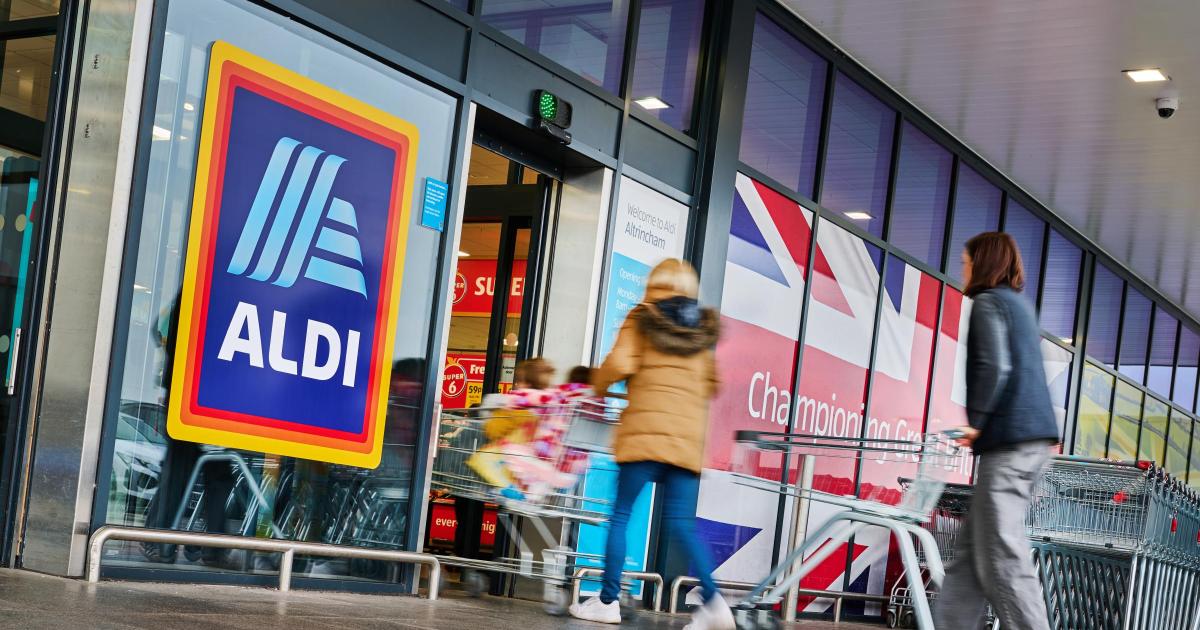
Aldi urges supermarkets to offer period products in toilets

The retailer, alongside menstrual equity charity Freedom4Girls, has written to the chief executives of major UK grocery chains, encouraging them to make pads and tampons available to shoppers in-store, where facilities allow.

The call follows an Aldi-commissioned survey of 2,000 UK shoppers, which found that 67% believe supermarkets should provide free period products in customer toilets.

Julie Ashfield, chief commercial officer at Aldi UK, said: “Access to period products should be a basic right, not a privilege.

Aldi has partnered with menstrual equity charity Freedom4Girls on the call to other supermarkets (Image: Aldi)

“That is why we made free period products available in our store toilets for customers and colleagues, with no questions asked.

Advertisement

“The latest research shows shoppers support supermarkets making period products more accessible.

“Together with Freedom4Girls, we’ve written to the chief executives of other major UK supermarkets, encouraging them to consider introducing free period products where facilities allow.”

The survey also revealed that 75% of respondents view period products as an everyday bathroom essential, equivalent to toilet paper and soap, while 67% said they would view a supermarket more positively if it offered the service.

‘Period poverty remains a huge issue in the UK’

Aldi says it became the first UK supermarket to introduce free period products in all customer and colleague toilets in March 2025.

Advertisement

Since then, it has provided one million free period products through its store toilets, with customers and colleagues able to take what they need without using a code word or signing up to a loyalty scheme.

Tina Leslie MBE, founder of Freedom4Girls, said: “Period poverty remains a huge issue in the UK, and we’re encouraged to see Aldi continuing to use its platform to push for wider change.

“Providing free period products in supermarket toilets is a practical way to help people access what they need discreetly and with dignity.

“We would welcome more retailers taking similar action to help tackle stigma, affordability and access.”

The research suggests the move could address several barriers.

Advertisement

In total, 69% said it would help people who start their period unexpectedly while out, while 58% said it would support those who cannot afford products when they need them.


Recommended reading:

  • Watchdog warns of new rules for Lidl and Aldi in line with other UK supermarkets
  • Autumn is coming early as Aldi launches £6.99 dupe of Anthropologie £20 candles
  • Aldi to look at ‘damaging’ packaging of children’s product after customer complaint

Nearly half (48%) believe it would reduce embarrassment around asking for or buying period products.

Separately, Aldi has donated one million period products to people experiencing period poverty through its charity partnerships, including with Freedom4Girls.

Customers can also donate items via Aldi’s in-store donation points, with products distributed to food banks and charitable organisations by Aldi’s partner, Neighbourly.

Advertisement

Do you agree with Aldi’s suggestion to other supermarkets? Let us know in the comments.

Source link

Advertisement
Continue Reading

Trending

Copyright © 2025