NewsBeat
Women ‘missing out’ on motherhood because of ‘delay’ in men maturing, think tank claims

Hundreds of thousands of women are “missing out” on having children, partly because of a “delay” in young men maturing into adulthood, a report has claimed.
The Centre for Social Justice, a think tank founded by Tory MP Sir Iain Duncan Smith, said around three million women aged between 16 and 45 are projected not to have children under current trends. If birth trends were the same as their grandparents’ generation, then around 2.4 million women would not have children. It means around 600,000 fewer women are having children, it said.
The paper, published on Sunday, cited a range of reasons for falling birth rates, including declining marriage rates and the later average age at which women are having children. But the report also suggests “male employment and education trends may play a role in falling birth rates”.
The report said that, “in the past”, a 24-year-old man would have likely been married, had a child and been working for a decade, but now men are only leaving home at the age of 25 on average.
One way to tackle the UK’s falling birth rate is to encourage marriage at a younger age and for men to “enter adulthood” earlier than 25, the report said.

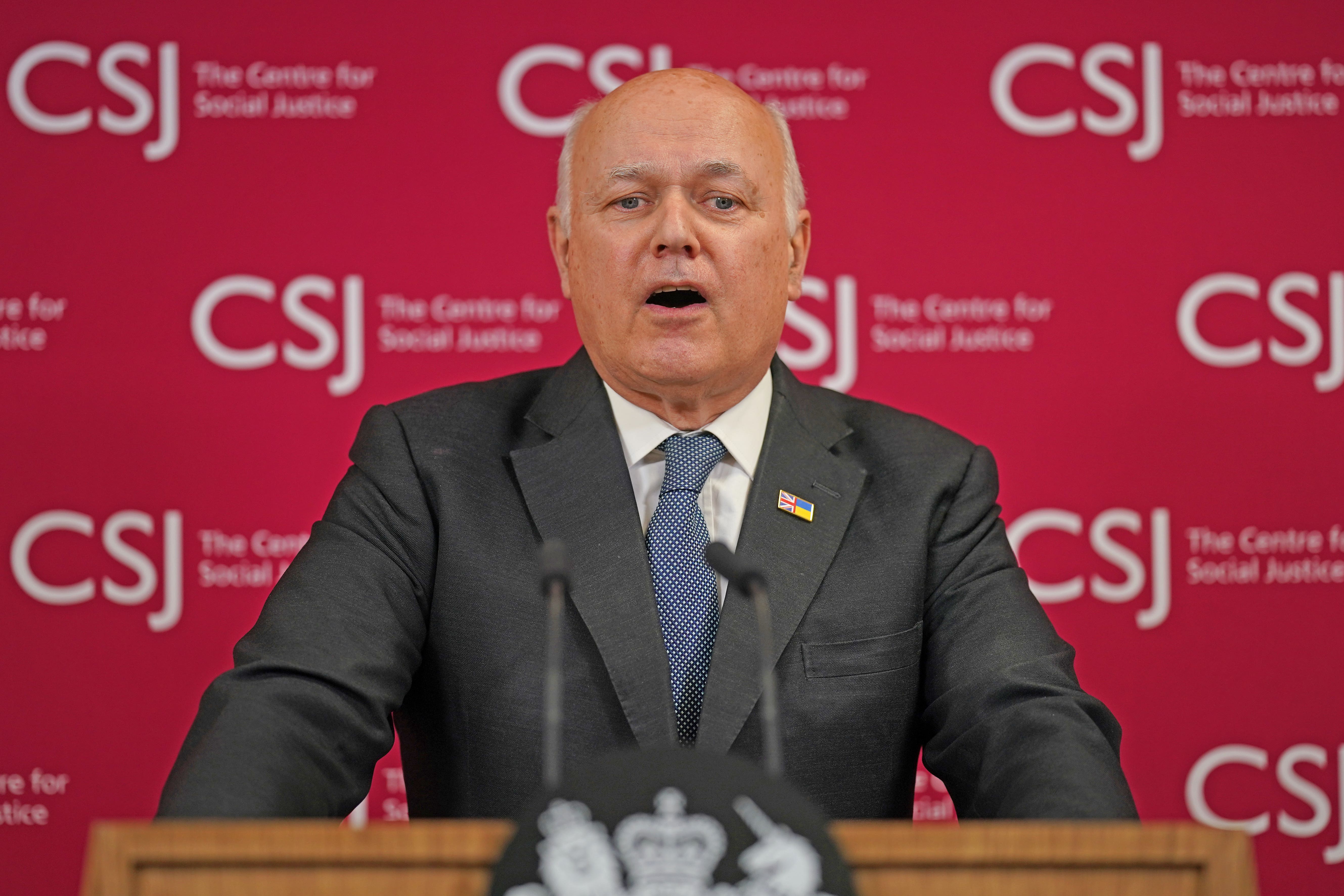
The Centre for Social Justice was founded in 2003 by Sir Iain, a former minister for Work and Pensions under the Conservative government. The CSJ’s report is also supported by Miriam Cates, a former Tory MP who has been outspoken in her concern about declining fertility rates in Britain and has called for policies to promote marriage and having children.
Elsewhere, the report recommends that the government explore so-called “pro-natal” policies which incentivise people to start or grow families, such as tax cuts and conditions for benefit changes.
But it said creating financial incentives to have children without addressing low marriage rates is “putting the cart before the horse”, citing an analysis published in the Financial Times.
The FT article included in the report does not specify marriage but does link fertility to falling relationship rates. It said: “From the US, Finland and South Korea to Turkey, Tunisia and Thailand, falling birth rates are increasingly downstream of a relationship recession among adults. Baby bonuses put the cart before the horse when a growing share of people are without a partner. Even in parts of Sub-Saharan Africa, similar trends may be underway.”
The think tank’s suggestion to incentivise marriage through tax cuts comes after Reform UK MP Matt Goodwin was criticised for saying in a blog that people who don’t have children should be taxed extra as punishment.
The think tank said falling fertility rates could also impact the ratio needed between pensioners and working-age people, and said that to maintain the ratio, the state pension age would need to rise to 75 by 2039.
In a report published in January 2025, the UK’s Office for National Statistics said total fertility rates had fallen between 2012 and 2023.

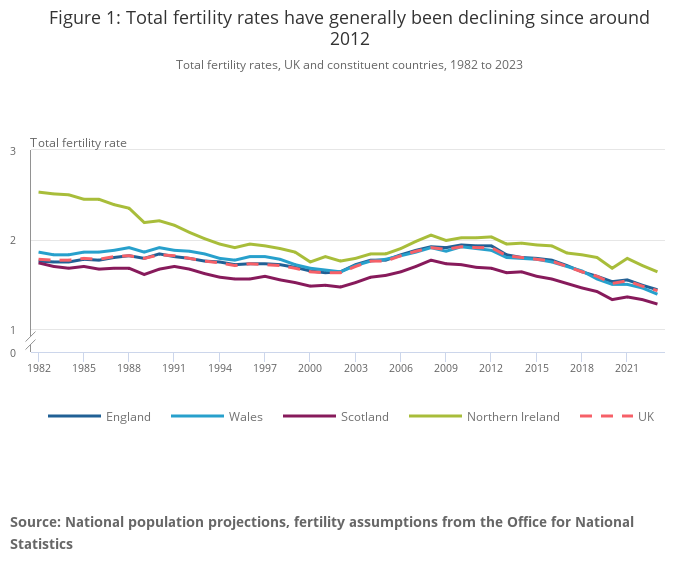
It also said fertility rates for women in all age groups under 30 years are projected to decrease, while age groups over 30 years are projected to increase between 2022 and 2047.
The ONS asked a panel of experts to outline various factors that could impact future fertility rates and found:
- The cost of living crisis would reduce fertility in the short term
- Climate change could have either a “negligible impact” or may reduce fertility
- Change to childcare funding will have a “limited” impact in the short term
- International immigration patterns may influence future fertility levels
- Conflicts will either put “downward pressure on fertility or have a negligible effect”