
Banning under-16s from social media was one of Keir Starmer’s last acts as prime minister before he stepped down in July 2026. Following Australia’s ban on under-16s in 2025, which turbocharged the debate globally, the UK ban is timetabled for early 2027.
As Meta’s $18bn (£13.2bn) recent settlement over teen addiction to its online platforms demonstrates, there is growing recognition that social media poses real risks to young people.
Thinking around this issue is constantly developing. Popular platforms such as Instagram and TikTok offer an endless stream of algorithm-driven material tailored specifically to each consumer. And while the full effect of social media use on developing brains is unclear, parents, teachers and politicians have all expressed concerns around the social and emotional impact of this consumption on young people.
Happy Zoe / Shutterstock
Social media feeds off a portrayal of real life that is fundamentally unreal. And in an age of filters, AI and engagement farming (using manipulative and often misleading tactics to boost engagment), the distinction between performance and reality online is increasingly blurred. In the face of this targeted barrage, children and teenagers are ill-equipped to distinguish between reality and the performance of that unreality flickering across their screens.
I’m a classicist and theologian with an interest in how culture and performance shape our ideas of what it is to be human. It strikes me that there is a fascinating parallel for this contemporary debate in the Greco-Roman obsession with theatricality and drama. The great dramas of classical Athens remained popular for a millennium, inspiring new genres and theatrical styles throughout the Mediterranean world.
Imitating life, imitating Fear
As research, including my own, into this breadth of ancient media production has developed over time, one theme has emerged again and again: as theatrical performance grew into a cultural staple, it was accompanied by the fear that just as art imitates life, so art could overcome reality itself.
This “theatrophobia” – a fear of the theatrical – appears throughout the literary record. This was a genuine anxiety, yet one that clearly fascinated ancient audiences.
Drama embodied the artistic imitation of life, and in doing so spoke to contemporary debates, offering moral or emotional exemplars. But how was the audience to best respond? What if the “wrong” lesson was learned? The potential impact was enormous. As theatrical events spread beyond the theatre and into homes, marketplaces and political spaces, the boundary between performance and reality had to be continuously renegotiated, lest performance overtake reality itself.
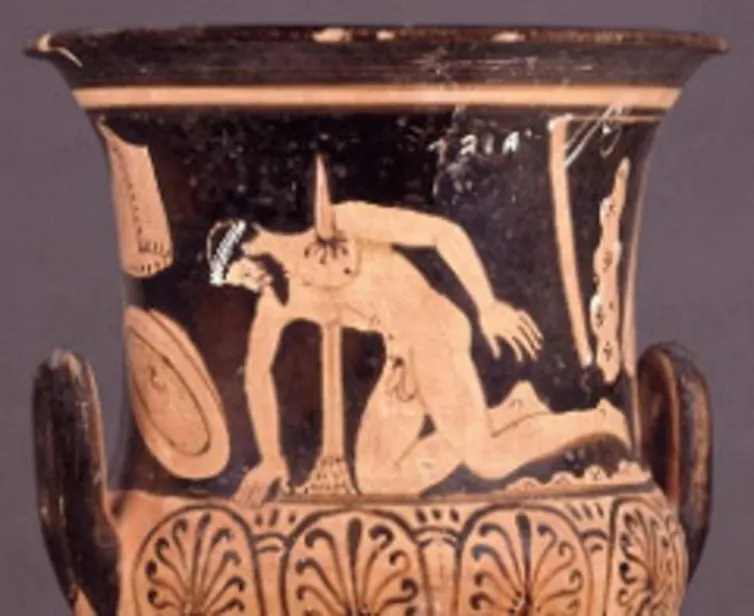
The second-century satirist Lucian of Samosata experimented with this anxiety. In a text defending the popular genre of pantomime (don’t picture the local am-dram Christmas production here, but rather a single actor/dancer staging a one-man play, accompanied by a singer and surrounded by delighted crowds), Lucian includes a story of an actor playing the Trojan war hero Ajax who was consumed by his role:
In dancing Ajax going mad immediately after his defeat, he so overextended himself that it might well have been thought that instead of acting insane he was insane, for he tore the clothes of one of the men that beat time with the iron beater, and snatching a flute from one of the accompanists, with a vigorous blow he cracked the crown of Odysseus, who was standing near and exulting in his victory. Indeed, if his helmet had not offered resistance and borne the brunt of the blow, poor Odysseus would have lost his life through falling in the way of a crazy dancer. The whole theatre, however, went mad with Ajax, leaping and shouting and flinging up their garments …

The History Collection / Alamy
“Ajax” here forgets his mania is only performed and wreaks violent havoc on stage. But his actions corrupt his audience too, who enthusiastically pile into the ensuing chaos.
In another text, where Lucian parodies contemporary history writers, the satirist recalls a similar scene in the city of Abdera, where the whole populace is overcome by “tragedy madness” after enjoying a performance of Euripides’ Andromeda in the heat of summer. The Abderians descend into a kind of tragic apoplexy, sick with fever and reciting endless quotations.
Lucian’s exaggerated anecdotes were lighthearted, but they only amused because they resonated with his readers. The boundaries between performance and reality were porous. This made drama exciting, but it also made it dangerous. How could one ever truly know where the boundary lay? For the unsuspecting audience, this could have disastrous results.
Modern anxieties around social media represent the latest iteration of this ancient theatrophobia. We are dealing with an online dimension that privileges performance and exploits the sense that art can imitate and even hyper-realise life itself. The ancients continually returned to this anxiety because it really mattered: one could take performance too far, with real-world consequences.
As young people’s lives are played out as much on TikTok feeds as in reality, the distinction between performance and real life continues to blur. While the blunt instrument of an age-graded ban will go some way to addressing the dangers posed by this new world of performance, it doesn’t necessarily address the root issue.
A simple ban cannot be the end of the public debate on this matter. Instead, we must recognise – and challenge – the theatricality and explicit performativity of social media. It is not too late to avoid getting lost in the production.
You must be logged in to post a comment Login