Politics
“A reminder of what we stand to lose”: Monica Harding reviews ‘Hiroshima, 8:15: The Lost Memoir’


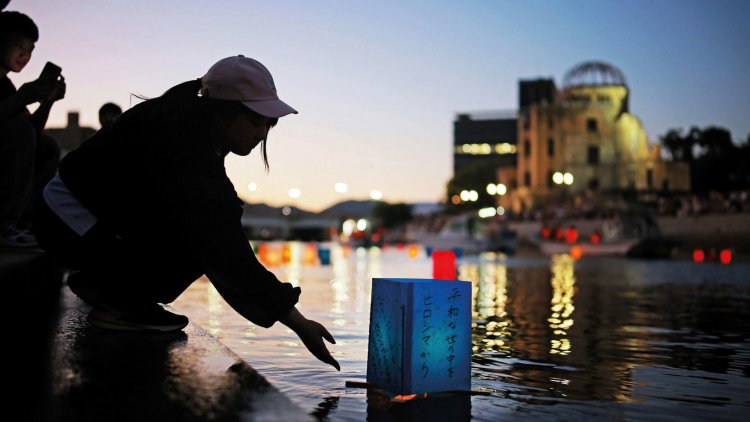
Hiroshima, 6 August 2026: Lanterns are floated in front of the Atomic Bomb Dome in memory of the victims of the world’s first atomic bomb attack | Image by: Associated Press / Alamy


7 min read
At a time of global crisis, the publication of this recently discovered eye-witness account of the aftermath of Hiroshima gives us a chance to reflect again on the horror of nuclear war
The city of Hiroshima has a strange feeling to it. Like many places imbued with a tragic history or designated a place of pilgrimage, it is hard to ascertain whether it is because of what it represents and its prominence in the public imagination or because it is a place of ghosts and souls, of spirit and spirituality. I have had the same feeling in other places – in Lourdes; in Mycenae, Agamemnon’s city of violence – and I felt it again in Hiroshima.
I first visited as part of a Japanese school visit, when I was 21 and teaching in Kyushu, Japan’s southern island on the JET (Japan Exchange and Teaching Programme). I remember the orizuru, paper cranes. I remember the dome that withstood the ferocity of the A-bomb, and I remember the shadows of people burnt onto the stone. I remember reading the pledge to peace. I remember the consensus amongst my group of teachers that Japan would never touch the bomb.


Today, in 2026 with the world on fire, on the 81th anniversary of the nuclear bombs dropped on Hiroshima and Nagasaki, that consensus is breaking. The new Japanese Prime Minister Sanae Takaichi has avoided clarifying that Japan’s three nuclear principles – not to possess, produce or allow nuclear weapons to enter Japan – will remain. As the old architecture of non-proliferation crumbles, Japan’s neighbours sabre rattle – Russia threatens nuclear attack, North Korea expands its nuclear arsenal, China continues its military expansion, Iran squares up to America and European allies enter talks on advanced deterrence. The world has never been this close to nuclear war since the Cold War.
As if timed for an intervention, Kiyoshi Tanimoto’s diary, Hiroshima, 08:15: The Lost Memoir, records the moment and the immediate aftermath of the A-bomb and its human consequences. It is a personal recollection of the moment his community was hit by this brand-new weapon, marking an inflexion point – not only for warfare but for humanity. Tanimoto’s daughter, Koko, now in her 80s and one of the hibakusha or ‘survivors’ of that day, writes in the foreword: “We are the only people left who experienced an event that remains unique in human history. We have memory of it, and this memory is a very valuable one…. Memory is our hope for survival as human beings, and for the survival of the beautiful world we inhabit.”
When ‘Little Boy’ exploded above Hiroshima on 6 August 1945, Tanimoto, a 36-year-old methodist minister was outside of the city moving furniture from his church to a home as protection from air raids. He described it as “a sharp flash of light” and “a strong blast of wind”. The bomb became known in Japan as pikadon (the literal translation of ‘flash-boom’); 80,000 people died in the first few minutes – victims instantly vaporised or crushed to death.
As Tanimoto begins to run towards the city and his home, and black rain begins to fall, the vast numbers killed or injured becomes clear to him. “Skin from faces, hands, arms and breasts were stripped off or hanging lose… all faces were without expression… It seemed like a procession of ghosts.” Tanimoto rushes past victims, apologising for not staying to help. He runs through fire, with guilt that he has survived, and then reveals – with supreme unselfconsciousness – that he felt not the slightest pleasure in seeing his wife and child safe and was instead filled with indignation that a parishioner, who had visited the parsonage at the moment the bomb had hit, had died in their care.


His diary recounts starkly the devastation of that first day, of the search for remains when “not one piece of bone could be found”, buildings leaving no trace, relatives cremating the dead who would be dead themselves within a couple of days, of victims he pulled from the river only to find when he pulled on their hand “the skin of his hand slipped off as if it were a glove. When I laid my hands on the back of another man, the skin of his back came off”.
Tanimoto’s diary chronicles it all: the days and the months afterwards, how radiation sickness claimed the survivors, his feelings at the end of the war, and of the community as it tries to rebuild. It is a story of personal and community resilience, exploring duty and obligation, and how a war-ravaged country comes to terms with a peace – and a new relationship with its enemy.
Tanimoto dedicated the rest of his life to the pursuit of peace. His heroic efforts to rescue his community, rose to prominence in the Pulitzer Prize winner John Hersey’s 1946 piece for The New Yorker, which brought the reality of the bomb home to the US public for the first time. But this is the first time we have been in receipt of Tanimoto’s own words – this diary had remained hidden, sitting quietly in one of Hersey’s folders stored at Yale University, until it was discovered by Hersey’s grandson in 2023.
His diary starkly recounts the devastation of that first day
The decision to drop the bomb still divides opinion – the cumulative total of lives lost because of the Hiroshima bomb is estimated at 140,000. The intense wartime study of the effects of radiation played little part in the political decision to drop the bomb.
The single-minded drive of the Manhattan Project which built it meant that its use had almost unstoppable momentum by the time the new US president Harry Truman took the decision to deploy it. The scientists were uneasy: “Well, I have my doubts, General Groves,” the ‘father’ of the atomic bomb J Robert Oppenheimer famously told the army officer in charge of the Manhattan Project, while Groves told a 1945 Senate hearing that radiation sickness was “a very pleasant way to die”.
Philip Morrison, a physicist with the Manhattan Project, told the BBC in 1975 that those working on the project knew intellectually very well both the short- and long-range effects of radiation. But he said, it was “seeing the living reality, the dying reality, is a very big difference to everyone, to the whole world. So I think we knew it, but we didn’t feel it”.


At the Pacific island American military base where Enola Gay had taken off, there was a big party on the night of the bomb. The military knew the end of the war was coming. But we are told by Morrison, “the scientists sat around looking morose and thinking about the end of the world”.
The publication of Tanimoto’s diaries, as the world races to arm itself, is another moment of reflection, a chance to pull back from the seemingly unstoppable momentum of war, and remember what can be lost, in a moment.
Monica Harding is Liberal Democrat MP for Esher and Walton
Hiroshima, 8:15: The Lost Memoir
By: Kiyoshi Tanimoto
Publisher: Ebury Press

You must be logged in to post a comment Login