Politics
After Watching Their Mums Fight To ‘Have It All’, Gen Z Women Would Rather Be Dads

One night at dinner, our friend admitted she hadn’t been happy for a long time. She was the breadwinner, the homeowner, the manager of all domestic tasks despite being in a relationship. She’d hoped it would even out, but it hadn’t.
Her boyfriend was desperate for children, but she wasn’t so sure. She would have to carry and look after the baby, hold the majority of the responsibility to keep the child alive, and pay the rent.
What he brought to the relationship didn’t seem like enough in exchange. A few weeks later, they broke up.
Her story is part of a wider trend: among childless 18-34-year-olds who want children (and don’t already have them), there are about 5 million more men than women. But men in this demographic are also struggling to attain economic stability, complete college and build meaningful social connections.
That gender gap in aspirations for parenthood, and what’s driving it, could deepen growing public concern about America’s declining birthrate.


Dimensions via Getty Images
While aspirations for fatherhood are most pronounced among conservative young men, according to the Young Men’s Research Initiative, having children seems to be an important part of how most men see success in their future.
There’s been extensive reporting on Gen Z men and masculinity and on pronatalist movements and declining birthrates. As Gen Z women who research our peers, we unpack where the Gen Z parenthood divide is coming from and how we think it could be bridged.
Spoiler: if having children meant carrying the responsibilities of our dads, we think we’d be on board, too.
Motherhood doesn’t feel ‘cool’ anymore
The “motherhood penalty” remains stubbornly present: in nearly every country, women’s employment fails to return to pre-birth levels within a decade of having children, while men get an employment boost in their first year of fatherhood.
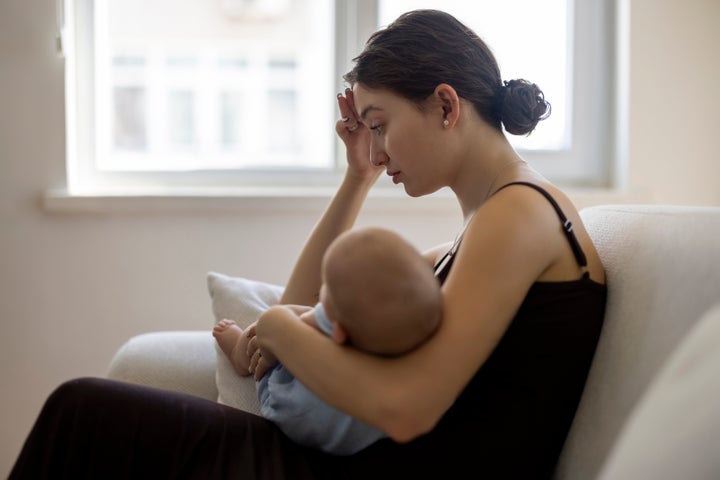
Then there’s everything that follows: the physical risks of pregnancy (especially for Black women) and the mental load and worry labour that fall disproportionately to mothers.
Meanwhile, the opportunity cost of mothering has increased: sure, the cost of child care significantly outpacing inflation has made having kids more expensive, but so has the value of what’s being given up with motherhood.
The trade-off between our earning potential and providing care labour has become more deeply imbalanced. We’ve broken the village model of care – nearby grandparents to provide child care, and children who one day return the favour – and now we buy it back through apps and care homes.
Motherhood seems antithetical to what we’ve learned about bodily autonomy, particularly at a moment when abortion care is being rolled back and women’s rights are retreating worldwide. Encounters with bodily violation have become normalised, from getting IUDs inserted without adequate pain management to the one in three of us globally who have been assaulted.
Against that backdrop, the thought of becoming pregnant in a world that continues to deprioritise women’s health feels like accepting the oldest lie: women are only as essential as their wombs, and inferior, while men control the creation of life.
With renewed examinations of “my body, my choice,” women are asking real questions about what it really means for them to carry a pregnancy and sign up for a lifetime of parenthood.
bymuratdeniz via Getty Images
Despite the progress by millennial fathers, who are participating more actively in their children’s lives than men in previous generations, cultural signals keep pulling men in the other direction. Just this February, one of the masculinity movement’s greatest allies, Scott Galloway, recently argued that fathers don’t need to be there for the first few months of a child’s life.
Hearing this kind of rhetoric can make motherhood seem even more isolating – and as attitudes on gender equality seem to be moving backward, motherhood feels more like a trap.
Many of us have guarded against maternal tendencies as a result. From childhood, girls are judged as to whether they’d make good mothers: are they caring enough? Kind enough to their dolls? Ambitious, but not too ambitious? For many of us, being complimented on our emotional skills or gentleness with a baby feels uncomfortable compared to being complimented on our personality or smarts.
We think: it feels so belittling, like the saying we often hear from older generations about “making someone a very lucky husband one day”. For many Gen Z women, motherhood has come to feel diminishing – offering a fraction of the possibility of who we can be as women.
Watching our mothers “have it all” didn’t inspire us
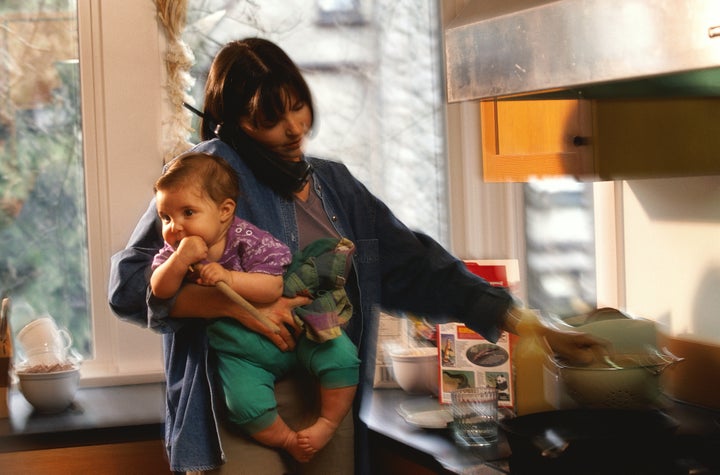
Our mothers were among the first generation of women who could have both a career and children. But coupling careers with unchanged domestic duties at home meant a “second shift” that still constrained women’s professional freedom. Despite some improvement, women’s lives have never recalibrated fully. And we’re increasingly doubtful an equilibrium will ever be reached.
In heterosexual marriages where the female partner is the breadwinner, she still does more domestic and caregiving work than her male counterpart – at the expense, of course, of her leisure time. And even when the female partner is the only earner, she still spends more time on housework than her male partner.
But that data only accounts for what’s on the surface. It doesn’t capture the cognitive labour taking up someone’s headspace at all times – what economists refer to as the “mental load”. Women still take on a disproportionate amount of the physical and cognitive labour involved in executing almost every domestic task.
These tasks are unremunerated work: knowing every teacher’s name, planning out every detail of child care when travelling for work, or scheduling routine doctor’s appointments. The energy someone exerts cognitively and physically on maintaining a household comes at a cost, diminishing their focus at work or ability to relax properly.
For too long, gender essentialism – the assumption that women simply care more about domestic and caregiving labour, are naturally better at it or have higher standards than men – has provided a convenient cover for men’s weaponised incompetence. It’s telling that 42% of mothers look online for parenting advice monthly, compared to 22% of fathers – with just over half of dads saying they’ve even visited any such sites.
Gen Z women are desperately looking for signs that things will be different for us. But nothing is pointing that way. Millennial mothers are as burned-out as ever. And there are signs we might even have it worse, as young men in our generation are notoriously regressing in their perspectives on women’s roles at home: For example, 31% of Gen Z men believe women should “always obey their husbands”. Mothers are extraordinary, but the narrative that they can “do it all” is broken and unrealistic.

Keith Brofsky via Getty Images
One of the most well-known statistics circulating among young women is that marriage benefits men more than women. Whether or not the data fully bear this out, the perception itself is real and consequential: according to one survey, only 32% of women believe that women who get married and have children live fuller, happier lives, compared to 49% of men who believe the same.
There’s a sense that women are draining themselves to provide for men, and our Gen X mothers are warning us not to end up in the same traps they did. With women in the U.S. outpacing men in college completion rates by over 10 percentage points, women today are in a stronger financial position, leaving them more room to negotiate without compromising on what they want from a partner.
Gen Z women already know what motherhood looks like – men don’t seem to
Some might argue that Gen Z women are already parenting pros: after all, we’ve mothered our ex-boyfriends. Many Gen Z couples got a preview of married life during Covid-19, “playing house” for the first time – when women still found themselves defaulting to cleaning up after their partners.
Then there’s the time we spend encouraging our partners to make plans with friends, stay organised and check in on their families. We call this labour “mothering” or “mankeeping” – language that empowers us to name our frustrations, but leaves us hesitant to commit to a future where actual parenthood enters the equation.
This imbalance might stem from the 16% of Gen Z men who are less likely to have noticed that their mothers did more housework. Boys and girls grow up observing the same households, but seeing them differently. Boys aren’t socialised to notice domestic labour the way girls are. Women observe their female role models carefully, with an implicit awareness: One day I will be a woman, so let me learn how to do this. Boys don’t necessarily apply the same lens to their mothers.
There’s also a breadwinner gap: more women than men recall their mother having paid employment, suggesting daughters are more attuned to the double shift, while sons remained insulated from it. The downstream consequences are enormous. If Gen Z men don’t accurately perceive how unequal their own upbringing was, they have no baseline for what “equal” actually looks like – and we’re all stuck in an entrenched cycle of gender inequity.
This coincides with a moment when men’s economic contributions to households are declining, with more men out of employment than women. We are absorbing the fallout of men’s social and economic dislocation. While young men believe that their financial status is a top characteristic for women considering them as a partner, women value kindness and honesty far more. As young women, we expect to share breadwinner status with our future spouses, and we’re looking for partners who can share the care labour.
In fact, there’s a gross mismatch between what women want from men and what men think women want. Online, men’s perception of what women find attractive is constrained by the male gaze: “looksmaxxing” for each other’s approval. Men’s ideas about what makes them desirable are drifting farther from what women actually want – and yet young men increasingly blame women for punishing them for their looks. In reality, we’d take a therapy session over a hammered jaw any day.
For aspiring fathers, here’s some advice
If men want to be parents as much as the data implies, two things need to happen: we need to close the gap between aspiration and preparation for parenthood – and we need a version of fatherhood that absorbs more of the demands of motherhood.
“What I see from speaking to young men is [that] a lot of their thinking around this is just ideas, not necessarily grounded with real-life examples,” Elliott Rae, founder of Parenting Out Loud, a campaign fighting to improve support around men’s caring responsibilities, told HuffPost. “The ideas come from what young men have been told – mainly online – about what their role in family life looks like.”
Scheduling your child’s yearly check-up, learning how to braid hair, writing a grocery list from scratch and knowing how to sit with your child’s broken heart – these are the acts that constitute parenting in practice.
“In a lot of cultures, men don’t do much [of the household labour] – the expectation is on the oldest daughter to do a lot of the housework,” Rae noted, adding that the solution can’t be found in simply encouraging sons to “chip in”, but in raising all children with an equal understanding of what running a household actually involves.
“We should not just encourage sons to do their domestic duty – cook, clean – but show equal treatment with our sons and daughters,” Rae said.
The “aspiration gap” is closable, but it requires rethinking the social contract around parenthood for heterosexual couples. That starts with rethinking masculinity and broadening what it means to “provide” beyond financial contributions to encompass emotional labour, domestic consistency and genuine presence.

Nikola Stojadinovic via Getty Images
“To close the gap between aspiration and action,” Rae argued, “we need to create more spaces for young men to connect and have mentoring relationships with slightly older men – a village of uncles, coaches – to know what it looks like to care, love, and parent within a family.”
We also need an expanded sense of what it means to “protect” beyond physicality – to instead support creating a true sense of safety. How do you create an environment in your home that encourages your child to open up? After all, most fathers want to feel as connected to their children as moms are. Men are instinctively caring, but are too often socialized to repress their nurturing side by the time they reach adulthood – and yet, young women are most excited by communication and kindness in a partner.
There’s also a structural piece. Paternity leave offers more than just an extra pair of hands; it provides a developmental window to enable both partners to feel confident enough to read the signs of what’s needed of them as parents. “It makes a difference who is seen as capable in parenting, and so can split the load,” Rae said. The United States does not have a federal law guaranteeing paid parental leave, making it the only OECD member country, and one of six countries in the world, with no national paid parental leave policy.
Around the world, countries like China, Hungary and South Korea are striving to incentivise marriage and fertility with financial encouragement, to little avail.
Yes, child care costs are exorbitant and a significant barrier to parenthood. However, the solution to the gender divide in parenting aspirations is not purely financial. It’s also social. And countries like Rwanda, which is on track to become the first country with national fatherhood training, and Senegal, which is setting up Schools for Husbands, are paving the way.
Ultimately, if fatherhood looked like what the best fathers actually do – performing the worry labour and the care work, and not just the fun parts – more women might find themselves willing to say yes to becoming parents with men. While we don’t expect men who have not been conditioned to give care to learn overnight, we do hope that those who want to be fathers take the time to learn what active fatherhood and healthy parenting look like.
However, the Gen Z parenthood divergence isn’t a story of women retreating from family life. It’s a story of women who have watched closely and understood exactly what is being asked of them.
We’d love to be dads. Who wouldn’t? We’re just not willing to be mothers and fathers at the same time.
You must be logged in to post a comment Login