Politics
Argentina criticised over Falklands banner after England clash

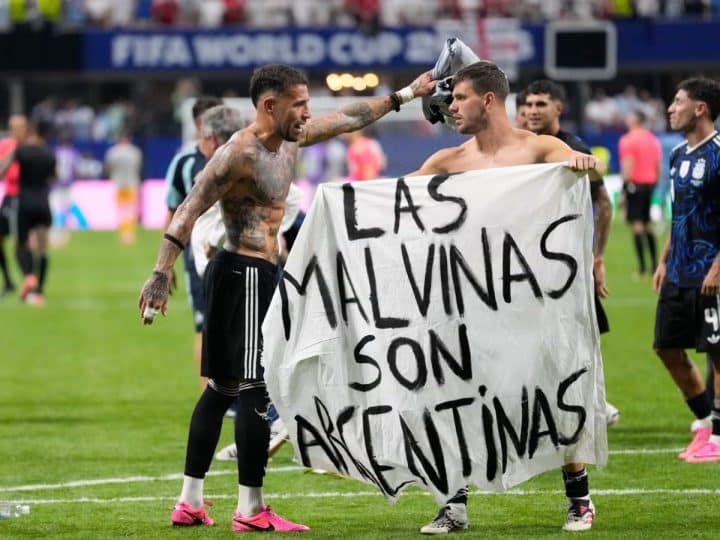

Argentina’s players have been criticised after displaying a banner referencing the Falkland Islands in the aftermath of their 2-1 World Cup semifinal win over England. The banner, held aloft on Wednesday night, translated as: “The Falkland Islands are Argentinian,” prompting immediate political reaction and renewed scrutiny over FIFA’s rules on political messaging.
The Falkland Islands remain a UK overseas territory, with islanders voting overwhelmingly in 2013 to retain that status. The islands have long been a point of tension between the two nations, most notably during the 1982 conflict, when Argentinian forces invaded before being forced to surrender two months later.
Argentina have previously been sanctioned for similar displays. FIFA fined the federation after players held up a banner with the same slogan following a 2014 friendly against Slovenia. Under Article 34.3 of the tournament regulations, political messages or slogans are prohibited before, during or after matches.
Business Secretary Peter Kyle told BBC Breakfast that the gesture crossed a clear line. “My reaction is that it was entirely inappropriate,” he said:
Politics needs to be separate from football. In fact, the World Cup has one of its central tenets that politics is separate from football. That is now a matter for FIFA. I expect FIFA to do its investigation thoroughly.
Kyle added that an investigation was inevitable given the nature of the breach:
We expect FIFA to undertake an investigation into this. I think it was certain to happen because it was such an egregious violation of the rules of not having political activity as part of the football.
The political reaction drew comparisons with a recent UEFA case. Spain players Rodri and Álvaro Morata were banned for one match each after singing about Spain’s claim to Gibraltar following their Euro 2024 triumph. Citing those sanctions, Liberal Democrat leader Ed Davey called for the Argentina players involved in Wednesday’s banner display to be suspended for Sunday’s final against Spain.
England’s exit sets backdrop for controversy
The banner emerged in the immediate aftermath of England’s elimination. Anthony Gordon had given England a first‑half lead, but Argentina overturned the deficit with two late goals from Enzo Fernández and Lautaro Martínez, both created by Lionel Messi, who once again shaped the decisive moments of a major tournament.
England’s performance was statistically stark, with five shots, 12% possession, and long spells spent chasing Argentina’s movement and tempo. Messi’s influence, as ever, proved pivotal, threading passes that unlocked England’s defensive structure and swung the semifinal decisively.
Argentina’s victory booked their place in Sunday’s final against Spain, who beat France in the other semifinal. The win also extended Messi’s remarkable run of decisive contributions deep into major tournaments, with his creativity again proving the difference.
Argentina — FIFA expected to review incident
FIFA has yet to comment publicly, though the governing body is expected to review the incident under its regulations on political messaging. The organisation has historically taken a strict stance on such matters, and the precedent from 2014, when Argentina was fined for the same slogan, adds weight to expectations of formal action.
The banner’s appearance also revived long‑standing sensitivities around the Falklands, a subject that has periodically surfaced in football contexts despite FIFA’s attempts to keep political issues separate from the sport. The governing body’s rules are designed to prevent precisely these moments, where geopolitical disputes spill into the global spotlight of a major tournament.
Wider context
The incident sits within a broader pattern of political expressions in football being met with disciplinary measures. UEFA’s sanctions against Rodri and Morata last year underscored the governing bodies’ insistence on neutrality, particularly during major competitions where global attention is heightened.
Football’s reach often makes it a stage for political symbolism, intentional or otherwise. Governing bodies have repeatedly emphasised that the sport’s global appeal depends on maintaining separation from political disputes, even when players or fans feel compelled to express national sentiment.
In this case, the banner’s message touched on a decades‑long territorial dispute that remains deeply sensitive. The Falklands conflict, though more than 40 years old, continues to shape political identity and national narratives in both countries. The World Cup’s scale ensured that the gesture would draw immediate and widespread reaction.
England left to reflect on familiar shortcomings
Away from the political fallout, England’s exit prompted renewed scrutiny of their tournament shortcomings. The semifinal defeat followed a pattern familiar to recent campaigns. There was early promise, moments of control, but ultimately undone by lapses and the brilliance of elite opponents.
Anthony Gordon’s opener had given England a foothold, but Argentina’s late surge driven by Messi’s vision and the clinical finishing of Fernández and Martínez, clearly exposed England’s vulnerabilities. The Three Lions struggled to retain possession, failed to impose their rhythm, and were repeatedly forced into reactive defending.
Player ratings reflected the gulf in influence. Messi earned a 9/10 for his decisive contributions, while England’s key figures were unable to match Argentina’s tempo or creativity. The defeat extended England’s wait for a major tournament final and added another chapter to their catalogue of near‑misses.
Argentina moves on, England head home
Argentina now prepare for a final against Spain, a matchup shaped by contrasting styles and the presence of generational talents on both sides. Spain’s controlled possession game and Argentina’s incisive transitions promise a compelling contest, with Messi once again central to Argentina’s hopes.
England, meanwhile, depart with frustration and familiar questions. Their semifinal exit, combined with the controversy surrounding Argentina’s banner, ensured a dramatic and politically charged end to their campaign.
Nothing will come of FIFA’s investigation, which is expected to unfold in the coming days, but for now, Argentina’s focus shifts to Sunday, and the chance to lift another World Cup trophy.
Featured image via the Canary
By Faz Ali
You must be logged in to post a comment Login