Politics
As Trump’s Iran War Stretches Toward A Month, Rubio And Vance Remain Curiously Quiet

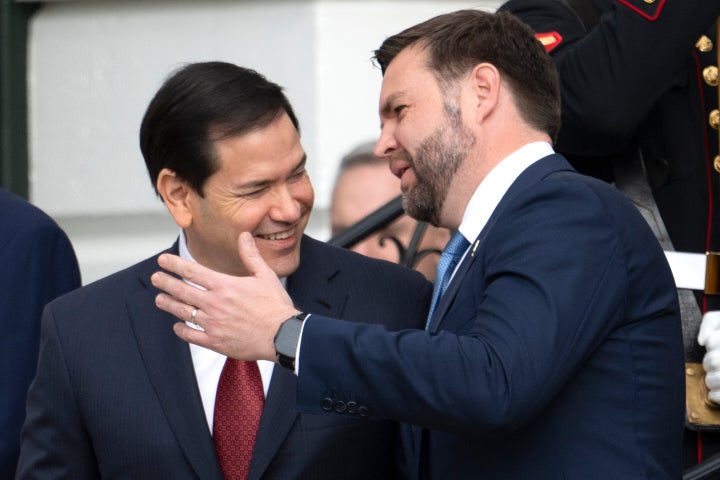
As President Donald Trump’s war against Iran approaches its four-week mark, two Republicans who could seek to succeed him in the White House have grown curiously quiet about it: Vice President JD Vance and Secretary of State Marco Rubio.
Two voices who in a normal administration would be key messengers on the president’s most consequential foreign policy decision have faded from view in recent weeks. Instead, the most frequent public advocate for the war appears to be Treasury Secretary Scott Bessent, who has made multiple appearances on television.
“Beats the hell out of me,” said David Axelrod, the Democratic consultant who helped Barack Obama win the White House twice. “Vance is easily understood. This is antithetical to his brand. Bessent is necessarily out there because while the war is a national security issue, its ramifications are very much economic. Rubio is bewildering because he was so visible at the beginning.”
Trump attempted a coup to remain in power despite losing reelection in 2020 and has hinted that he would try to stay in office past 2028 notwithstanding the two-term limit in the Constitution.
But if the 2028 elections do take place on schedule, any Republican running, and especially those serving in his administration like Vance and Rubio, may have to overcome a deeply unpopular president and be forced to explain their public support for what is already an unpopular war that is projected to increase inflation and has thus far raised gasoline prices by more than a dollar per gallon.
Further complicating Vance’s and Rubio’s public posture on the Iran war is the significant segment of Trump’s voters who cast ballots for him based on his promise of ending foreign wars who may feel betrayed by Trump’s repeated use of military force.
Rubio, meanwhile, as the son of Cuban immigrants in South Florida, has long been a proponent of US intervention in Latin America to oppose socialist rulers.

State Department spokesman Tommy Pigott, in what has become a standard Trump administration tactic, personally attacked HuffPost’s reporter and said: “A ridiculous question debunked by a basic internet search. To be clear for those in the back, let me say once again, Secretary Rubio fully supports the president’s policies, which are making the world a safer place.”
Vance has stated that whatever advice he gave Trump prior to the start of the war in a classified setting would remain between him and Trump.
“Partially because I don’t want to go to prison, and partially because I think it’s important for the president of the United States to be able to talk to those advisers without those advisers running their mouth to the American media,” he told reporters during a March 13 visit to North Carolina.
At least one hawkish Republican thinks Vance ― who in earlier iterations of his political persona was a vociferous opponent of American adventurism in the Middle East ― is unwilling to make the case for the war.
“Vance is against the policy but can’t say so,” said John Bolton, a former national security adviser to Trump in his first term and a longtime advocate of regime change in Iran. “Rubio is worried that it is distracting from Venezuela and Cuba.”
Like many Trump critics, Bolton is under investigation by Trump’s Justice Department, which Trump is openly using as a political weapon.
On top of the political considerations are the practical ones of trying to defend the policy of a president liable to change his mind about it at any time. Rubio, who is also Trump’s national security adviser, explained to reporters early on that Trump attacked when he did because Israel had told him it was going to attack, which would have led to Iranian reprisals against the US.
He backtracked on the explanation the very next day after Trump contradicted him.
Matt Wolking, a Republican political consultant and a former Rubio aide, said there is little point in Rubio or Vance in making declarations about policy when Trump is constantly making them himself.
“With Trump so accessible, it’s just not that necessary,” he said. “This is one of those areas where a Trump administration official is more at risk of getting ahead of the president than offering significant value to the public debate. I think Vance and Rubio have been doing enough.”
On that point, even Democrat Axelrod agreed. “Maybe as this gets more complicated and Trump becomes more frustrated, he is calling on the spokesperson he trusts the most: himself.”
You must be logged in to post a comment Login