Politics
At 56, I Thought I Was Middle-Aged. 1 Word Changed Everything.

I experienced a startling moment when I was working on marketing copy for my most recent novel, The Snowbirds. The story follows empty nesters who head to sunny Palm Springs, California, to escape the harsh Midwestern winter and figure out the rest of their lives.
I described my characters as “middle aged” because they are my age, 56 (now 57), and that’s how I thought of myself – and them – the whole time I was writing the book.
But my longtime editor suggested a slight modification to my text, one she never would have guessed would hit me sideways: She inserted the word “late” in front of those words.
I stared at that phrase for a good long time and thought, what exactly is that? I thought I’d written a novel about the travails of midlife. Was it possible my characters had already rounded that bend… and so, too, had I?
Even though my editor is always right, my first instinct was denial, because most of the time I feel like my young self. I still act like a dumb teenager, saying and doing all the wrong things. I take yoga and lift weights. I wear barrel jeans. I attend concerts and try to stay hip. (True confession: I had to ask my grown kids which word to use instead of “hip.” They suggested “aura,” “rizz,” “skibidi,” “steeze” and “Ohio.” I wasn’t sure if this was actual slang or if they were making fun of me).
Yet there’s no denying the old is starting to push through. The warranty on our new mattress expires after I probably will. I make 5:30pm dinner reservations. I use Hotmail. My lower back is a mess, and I get a kink in my neck unless I sleep on the exact perfect pillow.
When I was young, I liked to think my body was filled with stuffing. Now my internal organs call attention to themselves one at a time. After a few startling bouts of arrhythmia, I’ve even begun to fear my own heart.
Like most edits, this correction, once brought to my attention, seemed as obvious as the face that stares back at me when I accidentally have my phone camera on selfie mode. Honestly, how could I think I was still in straight-up midlife? Did I really expect to live to 114?
This isn’t the first time I’ve been startled off a mental set point age. For years – or even decades – I’ll see myself stuck on a certain notch on the life cycle dial until a jolt of recognition sends me reeling into a new era, like the first time a stranger called me ma’am, or when a Christmas card arrived from our kids’ former babysitter who now has her own children. I’ll never forget my late father-in-law returning from his high school reunion when he was in his 80s, dumbfounded. He couldn’t believe how old everyone else was.
When I was a kid, I loved to flip through the pages of family albums. I remember photos of my beautiful grandmother as a young woman. She’s young — flip — young — flip — young — flip — and just like that, she was the Nana I knew. There was no middle or late-middle age.
I thought ageing was a flipped switch, and it sure seems that way when I look twice at a celebrity or someone I haven’t seen in a while because they’ve turned that corner.
I guess I figured I’d linger in midlife until that happened to me, or when a grandchild or retirement pushed me into senior territory. Then again, there are places in Palm Springs where 55 is the minimum age for the senior discount. My friends are getting grandchildren. My husband talks about retirement when he wants to scare me.
Nobody I know thinks of themselves as “late middle age” because the phrase signals the end of an era, like late antiquity or late modernism. The term sounds over-ripe, but also charitable. It says you aren’t old old, but you’re in the vicinity.
While some of our friends have already put deposits on assisted living places they don’t plan to move into for a decade, my husband and I decided to shake things up once this reality set in. We recently moved from Madison, Wisconsin, the beloved city where we raised our children, to Chicago. After cleaning out our parents’ homes, it felt good to get rid of our accumulated junk – skateboards, preschool construction paper art, my graduate school notebooks and papers, musty towels, and the Crock-Pot we never use – so our kids won’t have to when the time comes.
We gave up extra rooms and a backyard to live on the third floor of a building with no elevator because we think the steps will keep us fit. Now we’re surrounded by people, traffic, concrete and activity (and Bears fans). When I search for parking or miss a bus on a subzero day, I console myself by thinking, this is good for my neural networks.

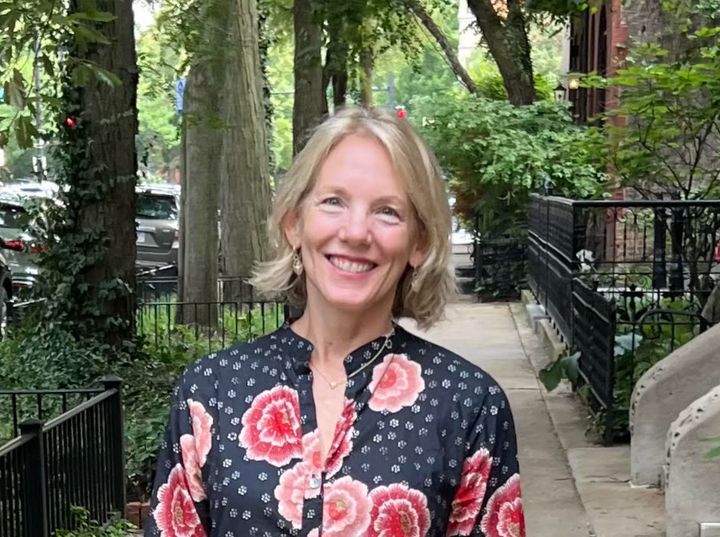
Courtesy of Christina Clancy
Sometimes I wonder if, after feeling constrained by jobs and kids for so long, we put our lives in a blender and hit “puree” simply because we can. It’s scary and invigorating and maybe stupid, but I find myself wondering: If we don’t do this now, when will we?
Honestly, I’m enjoying this ambiguous in-between time defined by what I no longer am and haven’t yet become: post-young, pre-elderly. Sure, I have one eye on death, and my earlobes are longer, but I’m still young enough to adopt a puppy.
Despite the occasional Mohs surgery for skin cancer, there’s a lot to love about this age. I’m still healthy enough to travel and engage in most of the same activities I’ve always enjoyed. It’s a lot more fun for me to drink beers and have conversations about Plato’s cave with our kids than it was to change diapers and worry about missed curfews. I find it such a relief to stop talking with my friends about menopause – the thing everyone says nobody talks about.
I’m also not as fearful of old age because it isn’t what it used to be. The seniors I know lead incredibly active, vigorous lives. I care a lot less about how I look and what other people think of me. Maybe I’ve grown a thicker skin (publishing three books will do that), but what used to send me into a tailspin hardly merits a shrug now.
That’s why I wish there were a phrase to describe this phase in life that’s less doleful than “late middle age.” I’ve heard it referred to as “a second adolescence,” “the third chapter,” a “free period,” and “the queenteens.” A friend jokingly defines it as “20s with money.” Another friend likes to think she’s in “the freshman year of old age.”
The closest word I can think of sounds poetic, if a bit grim: “the gloaming” – the Scottish word for the mystical end of day when light fades but darkness hasn’t descended, a twilight filled with shadows made more dramatic by the golden, glimmering light.
I have a feeling I’ll linger here longer than I should, or until something jolts me out of it, like a stranger offering me their seat on the city bus.
Christina Clancy is the late-middle-aged, USA Today bestselling author of “The Snowbirds,” “Shoulder Season,” and “The Second Home,” (All from St. Martin’s Press).
Do you have a compelling personal story you’d like to see published on HuffPost? Find out what we’re looking for here and send us a pitch at pitch@huffpost.com.
You must be logged in to post a comment Login