Politics
Backrooms: 17 Behind-The-Scenes Facts You Probably Didn’t Know

The mysterious new horror film Backrooms hasn’t just been a hit at the box office and with critics, it’s also one of the most talked-about films in the world right now.
Kane Parsons’ directorial debut stars Chiwetel Ejifor as a disillusioned man who stumbles upon an alternate universe through the basement of a furniture store, and tries desperately to get his therapist, played by Renate Reinsve, to see things his way.
Backrooms has a completely distinct visual style that has made it immediately iconic, and considering how many people on both sides of the Atlantic have been flooding cinemas to see it, many will no doubt be contemplating exactly how the movie came to be.
Here are 17 facts you probably didn’t know about the making of Backrooms…
1. Backrooms’ journey to the big screen was a surprisingly long and winding one
Rather than being an adaptation of a book, TV series or even video game, Backrooms started life as a viral photo.
Back in 2019, 4chan members asked fellow users to submit “disquieting images that just feel ‘off’”, with one response featuring an image of an environment similar to the one seen in the film Backrooms, showing a sprawling empty space in the back of a furniture shop.
Shortly afterwards, an anonymous user in the same thread submitted a potential origin story for the space, which read:
“If you’re not careful and you noclip out of reality in the wrong areas, you’ll end up in the Backrooms, where it’s nothing but the stink of old moist carpet, the madness of mono-yellow, the endless background noise of fluorescent lights at maximum hum-buzz, and approximately six hundred million square miles of randomly segmented empty rooms to be trapped in.
“God save you if you hear something wandering around nearby, because it sure as hell has heard you.”
The photo and accompanying text then became widely shared across message boards like 4chan and Reddit, becoming its own “creepypasta” (a term that basically refers to a viral meme that’s more scary than funny).
People then began putting their own spin on the concept of the “backrooms”, with Kane Parsons starting a hugely successful YouTube series created using the design software Blender, which is how he caught the eye of production company A24.
One other key adaptation of the “backrooms” trend came in 2024, when an episode of the stand-alone anthology series American Horror Stories brought the concept to the small screen.
2. When A24 first began speaking to director Kane Parsons, it wasn’t a film that he had in mind
“Initially, the hope on my end was TV,” Kane told YouTuber Patrick Tomasso.
He also shared that the “TV show I would have been pitching is not at all the same narrative that this movie is”, and made it clear that he’d still be up for pursuing that previous idea for a series in the future.
3. To create the world of Backrooms, Kane Parsons created that seemingly endless set of rooms for real

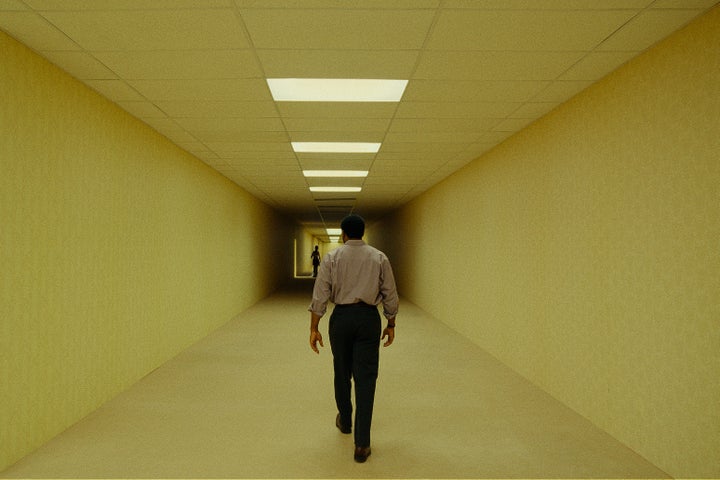
First designed using Kane’s go-to tool Blender, the production design team then put together a veritable maze of generic, mono-coloured rooms that spanned a whopping 30,000 square feet.
“I always maintained that I want to go as practical as possible, and we did,” the director told Interview magazine.
“So the vast majority of what you see in the film is built sets. Anytime a character is physically walking on the floor, it’s a real floor. Anytime they’re physically touching a wall, that’s a real wall.”
He added: “Most of the time, if you were on the set, you could stand in the middle of it, do a 360-degree turn, and not see any blue screen and not see anything that breaks the facade of actually being there.”
Production designer Danny Vermette compared the process of piecing each of the rooms together on set to a game of Tetris, telling IndieWire: “We had to go in and measure every square inch of all four sound stages to make sure that we had the room to build and then figure out the Tetris plan of how those sets are gonna fit.”
4. Apparently, Kane Parsons originally wanted the set to be even bigger than 30,000 square feet
Danny told Architectural Digest that when Kane sent his original Blender plans over “it was something like 100,000 square feet”.
“It crashed my computer,” he then admitted.
5. Being in a physical space on set helped the Backrooms cast really get into their characters’ mindsets

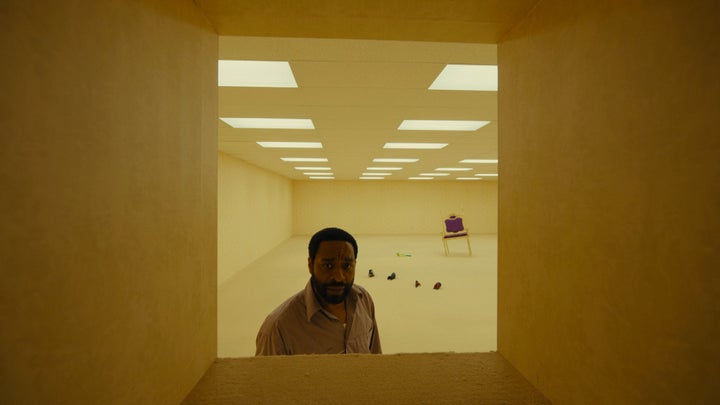
“We wanted it to be awkward and to throw our actors into a world of discomfort, in a sense,” Danny told IndieWire. “Whether it’s crawling through a small space or crawling up a ramp and really sell that we’re in the middle of levels, that there’s multiple levels.”
Clearly it worked, with Chiwetel telling Playlist that being on set was “a kind of psychological torment”.
“You can definitely feel that disconnect with reality and that creeping dread when you’re in there, and that sense that if you were in here endlessly, just what that would mean to your mind,” he recalled. “It’s not a place that is very forgiving for your psychology.”
6. And yes, the cast and crew often got lost while trying to navigate the Backrooms set
Chiwetel told YouTuber John Feitelberg: “We had a huge set, and we were wandering around, getting lost, trying to figure our way through it. It was great to have it as a physical space.”
In his IndieWire interview, Danny also recalled: “On some of the stages there’s five or six sets. So, it was day to day. It wasn’t just the first day people getting lost.
“They’d been out shooting in the real world, and then they come in [on the sound stage], and the sound guy hadn’t been there, and the camera crew hadn’t been there. And sure enough, you hear ‘Hello? Hello?’. Like, the sound guy’s lost, and he went in the wrong entrance…”
7. Finding the perfect shade of yellow for the Backrooms set was no mean feat
“We did a lot of tests there to make sure we were getting the general tone that people expected [from] Backrooms,” Kane admitted to Creative Bloq. “We did 50 wallpaper tests to get the right shape of yellow.”

8. As the shoot went on, certain parts of the Backrooms set could be dismantled and rearranged for other scenes
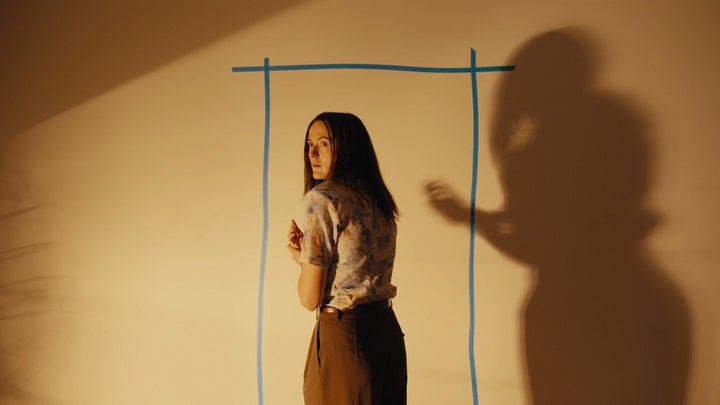
“We started cannibalising parts from other sets and reshaping one of our main stages and adding extra walls,” Kane told Interview. “So it took on a new form and a new layout.
“By the last day, most of the sets were butchered and a lot of the walls were gone and it was in disarray.”
Conversely, other rooms never got used in scenes at all, but they were still important as they would loom in the background, adding to the overall eeriness of the piece.
“There’s definitely areas in the sets that are not used, although technically, each set is at least somewhat shot,” the filmmaker revealed to the horror outlet Dead Meat.
9. With Kane Parsons preferring to lean on practical effects rather than computer-generated imagery, VFX was mostly used only in the film’s ‘found-footage’ sections
“By and large, what you see in the film is what it felt like to be there,” he told Interview.
“The only places where we do run into VFX would be the stuff that is obviously impossible to build, some of the massive spaces and whatnot.”
He added: “I do love VFX, so I don’t consider it a weakness to leverage them to a certain extent. And then, in the found footage sections, a decent bit of that was done in Blender.”

10. The idea of incorporating generative AI was never really in the question
“I would never lean in a generative AI direction, and I’m personally in opposition to the use of it in the creative workforce, outside of automating menial tasks,” Kane relayed to Interview.
Elaborating further to Variety, he claimed: “[Like] most well-adjusted people […] if I could snap my fingers and make generative AI disappear forever, I probably would. Creatively, I get no enjoyment from using those tools. It defeats the purpose entirely for me.”
Some viewers have suggested that parts of Backrooms are actually an analogy for AI, though Kane has never made this intention clear directly.
11. How exactly did they pull off that ‘noclipping’ effect?

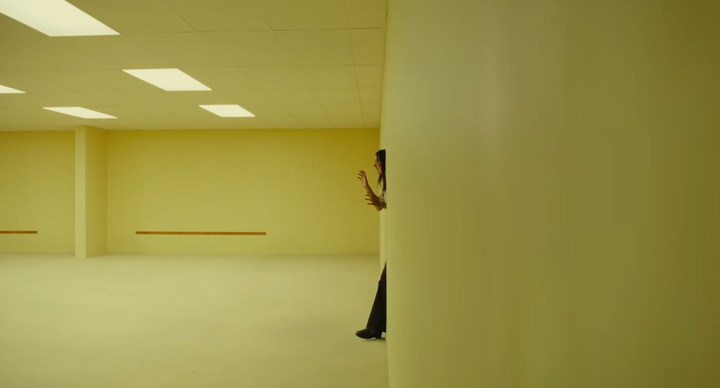
Well, it turns out it was more practical than you might have realised.
“We have a portal for the camera and a portal for the actor [and] we have a plug that goes back in, so once the actor’s through, the wallpaper plug goes back up with a seam,” Danny told IndieWire. “It’s fixed in post, there’s seam repair there…”
He continued: “And to rotoscope that, when their hands are going through, moving at a slow pace, that’s incredibly challenging, but they did such a great job with it.”
By the way, “noclipping” is a gaming term that refers to a glitch or cheat code that allows users to pass through walls and other obstacles, which is featured in the original backrooms “creepypasta”.
12. Backrooms is set in Southern California, but was shot in Vancouver, which did raise some issues for the team
During an interview with BuzzFeed Canada, Kane claimed that “the zoning” of Vancouver made it a unique setting for his film.
“I don’t know if ‘liminal’ is the right term for Vancouver, it might actually be the opposite,” he said. “I find [the city] very compelling and interesting [visually], but also horrible when it comes to casting the location as Southern California, when ever single building in the suburbs is a completely different architectural trend and design.
“There’s no consistency in any given neighbourhood for the most part. So, you get a brick castle next to a 2016 YouTuber mansion next to just a cube.”
13. There’s a very sensible reason Kane wanted the Backrooms film to be set in the 90s, as was his YouTube series
He told Dazed that being in the 90s makes Backrooms feel “far away in time”.
But also, on a more practical level, he needed it to take place in a pre-internet time, because “it would be far easier to uncover the nature of this place” if the characters had access to iPhones.
14. Backrooms’ ‘camcorder’ scenes definitely feel realistic – but they were actually all shot on modern tech
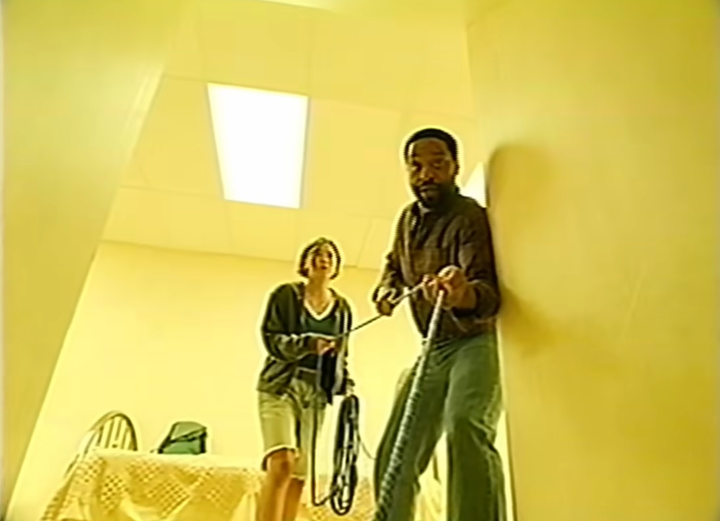
Kane told Patrick Tomasso that he and his team “do authentically run [what they’ve recorded] through a VCR” to give it a 90s feel, but “it’s all digital”.
“There’s a version that exists where it’s all crystal clear, 4k high quality,” he revealed. “But then after the fact, we reconform the footage to become more fitting of the actual vehicle.”
Elsewhere in the interview, he shared: “Generally speaking, the conversion process is true to the camera – I would never go and do a VHS filter on top of things. We colour grade a lot before and after the conversion, to play into the cultural expectation of that media.”
15. ‘Lore’ was something Kane Parsons was careful not to be too wrapped up in when it came to bringing Backrooms to the big screen, but he did have a few simple rules for keeping things consistent

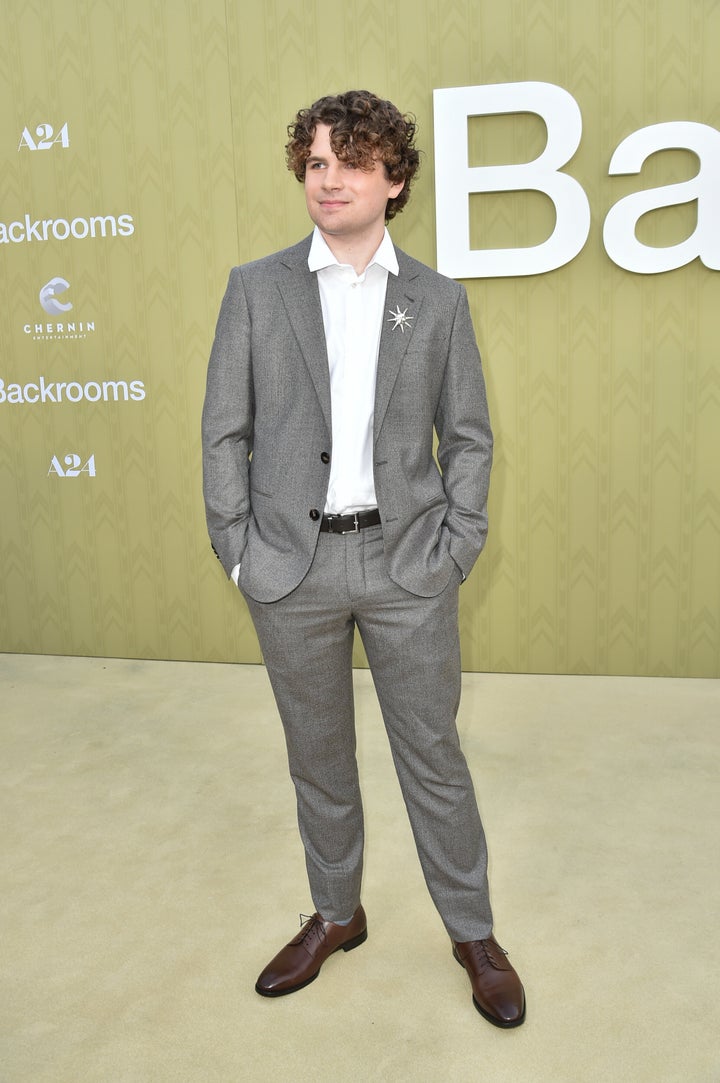
Speaking to Dead Meat, Kane noted that “because the backrooms is obviously a pretty public concept”, there are “a lot of different interpretations”, some he feels are not as “effective” as others.
He particularly takes issue with the “inclusion or over-reliance on non-euclidean geometry and whatnot”.
Kane explained: “That’s a preference – you can pull it off and it can be great, but I feel as though there’s something I like quite strongly about the backrooms feeling like a building built by people and then it’s just the certain construction choices that don’t make a lot of sense.
“[That could be] a hallway that’s slightly too narrow or a crevice that you couldn’t even fit a desk in, so why is it there in the first place? Stuff like that. It [should get more] absurd and impossible through your continued exploration and probing of it, rather than an immediate ‘walk this way and walk back and shit this is a different room’.”
“I think it’s scarier to me thinking that you end up getting lost in there wandering for a while, knowing that you can backtrack,” he continued. “I feel like if the environment is immediately changing all around you, you lose the game too quickly.”
16. What was that seagull all about?
Forbes has pointed out that in the olden days, seagulls were considered a bad omen among sailors, and that it was particularly bad luck to kill one. This, of course, plays up to the sailing iconography scattered throughout the film, most notably in Clark’s furniture store.
Offering a more vague explanation, Kane told Polygon: “I would say there’s a significance to picking seagulls. Birds evoke a certain kind of imagery that we wanted to be evoking.
“But without explaining the thought process fully — logically, there’s nothing that would prevent anything from getting in there. Logically, literally anything that could walk through a wall could end up in that place. Birds and flies and humans just so happened to be some of the more unfortunate ones in this film.”
“The implication inside the film — I’m not going to be cute about that for a second — the implication when we see the birds is yes, they came from outside,” he added, although he added it “very well could be” a backrooms creation, too.
17. There is a good reason why there’s so much pirate imagery in the film…

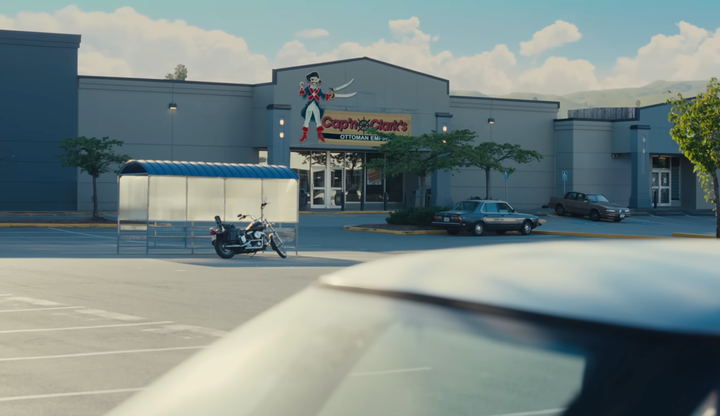
Unfortunately, Kane just doesn’t feel like sharing it right now.
“It was a pirate from the beginning,” Kane told Dead Meat. “I won’t say more, but I think people will dig into it. I think symbolism can be a crutch a lot of the time, and I wouldn’t ever lead with it… but there’s some specific reasoning behind the pirate steering wheel and ocean and all that.
Backrooms is in cinemas now.
You must be logged in to post a comment Login