

Politics
Brandon To: Japan demands integration – Britain just debates it


Brandon To is a Politics graduate from UCL and a Hong Kong BN(O) immigrant settled in Harrow.
I am writing this from Japan, where I have spent the past week rediscovering what it means to be unmistakably in someone else’s country.
The cultural signals are relentless. Bowing — so much that my back may never recover. Escalator etiquette (standing on the left, how deeply unsettling for a Briton). The absolute silence on public transport. The choreography of politeness in even the most mundane transactions.
Japan has an unshakeable confidence in its own way of doing things.
But something else struck me this time. Compared to my last visit over a decade ago, there are far more foreign faces. Not just tourists, but immigrants.
In Tokyo, I found myself speaking to a bank manager from Denmark in an izakaya (the Japanese equivalent of a pub), who was heading to his weekly onsen retreat. In Kyoto, I chatted with two Malaysian exchange students in a tea house. Convenience store workers, hotel staff, restaurant servers… many were from South or Southeast Asia.
Yet what surprised me was not their presence.
It was how unmistakably Japanese they were.
They spoke fluent Japanese (at least according to my Japanese friend). They bowed instinctively. They navigated the rituals of politeness with ease. They did not appear to be living adjacent to Japanese society; they were part of it.
And it made me reflect on a simple truth about immigration that Britain has spent years avoiding.
There is a spectrum, from tourist to student to worker to permanent resident to citizen. The duration differs. The legal status differs. But the core principle is the same: when you enter another country, adapt to it.
Integration is not an optional extra that begins after settlement. It is the starting condition of being a guest, be it two weeks or two decades.
Japan is unapologetic about this. If you wish to live and work there, you are expected to learn the language properly, respect public order, and internalise their etiquette. That expectation is not framed as hostility. It is framed as respect — both for the host country and for those who came before you.
It is, in effect, a country with faith in its own culture.
Britain once had that confidence too. We are a country famous for etiquette, from holding doors open to queuing instinctively. But more importantly, we are defined by deeper civic habits: respect for the rule of law, free speech, fairness in public life, and tolerance rooted in shared norms.
Where we faltered was not in allowing immigration. It was in losing clarity about the need for integration.
For too long, governments of different stripes treated migration primarily as an economic instrument. Integration was assumed to happen organically. Cultural cohesion was dismissed as either automatic or irrelevant. And don’t forget there’s the liberal flank that always confuse integration with “ assimilation “, framing any discussion of it as racist and xenophobic.
The result, in some areas, has been parallel lives rather than shared ones. When any group, especially religious ones, begins to “ claim “ certain neighbourhoods, and behave as if British freedoms such as free speech apply selectively, integration has clearly failed.
That failure has fuelled understandable public frustration. It has also created space for parties like Reform UK to argue that the only solution is a blanket hostility towards immigration.
But here is where we must think carefully.
Reform’s instinct is blunt. It risks suggesting that if you do not look British, you may never truly be British. That is not a confident nationalism; it is a brittle one.
A country unsure of itself excludes by default. A country secure in its identity integrates by expectation.
The Conservative answer should not be a return to liberal complacency. Nor should it be a race to outflank Reform on rhetorical hardness, a competition we will never win, because they can always go further.
In this immigration debate, the Conservative answer should be integration.
If you come to Britain, whether as a student, a worker, or a permanent migrant, you are expected to adapt. Learn English properly. Obey the law. Respect social norms. Participate in civic life. Contribute economically.
Those who refuse should not remain.
But those who do integrate should be more than welcome. They should be recognised as strengthening the country, and as Conservatives, we should actively speak up for them.
This is not “weakness in the face of the immigration crisis”. It is the ability to distinguish. To welcome the contributors, and stop the disturbers.
Japan’s lesson is not that it has no immigration. It is that it manages immigration with cultural clarity.
Britain does not need to become Japan. Our history, our diversity, and our institutions are different. But we do need to recover the confidence to say that British norms matter, and that adapting to them is the price of entry. That is the middle path between open-door policy and blanket hostility, and if the Conservative Party wishes to win again, it must articulate that difference clearly.
Welcome to those who adapt. Exit for those who refuse. It is just common sense, and it is long overdue.


The world’s largest pension fund has revealed that it sold its shares in the Bolloré group, a powerful French conglomerate. This was due to unresolved concerns about “serious human rights violations” at a plantation company which Bolloré partly owned.
A report from the Norwegian Bank Investment Management (NBIM) made the decision public on 26 February. The report states that after years of dialogue with Bolloré SE and Compagnie de l’Odet SE on “their management of human rights risks, sexual violence, harassment and labor rights abuses” at the plantations of the Luxembourg-based company Socfin, in which the Bolloré group holds a “significant share”, NBIM decided to exclude them from its investment portfolio.
Affected communities have long denounced the violations and abuses. The Socfin group dates back to 1909. It controls 370,000 hectares for the production of palm oil and rubber in ten countries of Africa and Asia.
Plantations on stolen land
In many of these countries, Socfin acquired the lands without community consultation or consent. As a result, the communities feel their lands were robbed from them. The plantations often surround villages and pollute their water sources, such that villagers cannot grow their own food crops.
When villagers gather fallen palm nuts or speak out about their conditions, they regularly face harassment. For women villagers and girls, sexual violence and even rape by plantation labourers or security forces is a common occurrence.
In 2024, after years of complaints from communities and civil society, Socfin hired the Swiss-based Earthworm Foundation to investigate these issues. The results were appalling: 59% of the complaints were said to be founded, to one degree or another, and 85% of these were judged to be the responsibility of the company.
Norway’s move follows a similar decision by Switzerland’s largest pension fund, BVK. The Swiss spent three years discussing these issues with the Bolloré group, which argued that it held no responsibility for what happens at the Socfin plantations. This was despite Bolloré being a major shareholder and sitting on the board of directors of several Socfin holdings and plantation companies.
Félicité Ngo Bissou of the Association des Femmes Riveraines de Socapalm Edéa in Cameroon said:
It’s about time that investors take action against Socfin and Bolloré. For too long, the Bolloré group has claimed it’s not responsible for the abuses we face around the Socfin plantations and as a result, the abuses have continued. This cannot go on.
Rizal Assalam of the Transnational Palm Oil Labour Solidarity, in Indonesia, agreed:
For us, Norway’s decision, like that of the Swiss, means that someone is listening to the communities and the workers, even if it’s not Bolloré.
For rights groups in Europe, Norway’s move puts EU decision-making to shame. Indra Van Gisbergen of Fern made the point:
The European Commission invited Socfin last week to be a key partner and speak at the EU-Liberia Business forum in Brussels. Yet Liberian communities are to this day denouncing Socfin’s lack of action on their long standing complaints!
NBIM runs Norway’s pension fund, which currently has $2.1tn in assets, making it the largest in the world. At the outset of 2025, it held $91m worth of shares in Bolloré SE. It had sold these by the end of the year.
Featured image supplied

We hope you love the products we recommend! All of them were independently selected by our editors. Just so you know, HuffPost UK may collect a share of sales or other compensation from the links on this page if you decide to shop from them. Oh, and FYI – prices are accurate and items in stock as of time of publication.
Yes, that’s right, Mother’s Day is indeed coming up, and fast.
Don’t feel bad if you let it creep up and surprise you – it tends to do that.
The good news is it’s definitely not too late to get your lovely ma the gift she deserves.
I have put my cholesterol levels on the line (willingly, don’t worry) to try and test the very best gift-friendly boxes of chocolates so that you don’t have to.
From pralines to truffles to whisky-infused delights, here’s my list of the best of the best.


(Alamy)
5 min read
The government has launched its long-awaited consultation on digital ID. Here is what we learned, as well as questions that remain unanswered.
Speaking at a Downing Street press conference on Tuesday afternoon, the cabinet minister tasked with leading the rollout of digital ID, Chief Secretary to the Prime Minister, Darren Jones, said that the planned scheme could save “tens and tens of billions every year”.
The government has said that the consultation, which is expected to last for eight weeks, will go further than those before it. It will include engaging with a ‘People’s Panel’, which Jones himself today admitted was “a gamble”.
The Keir Starmer administration is trying to rebuild public support for the policy after the initial announcement last year had a rocky landing.
Legislation implementing digital ID is expected to be put to Parliament later this year, with work on the app to begin in 2027.
Will digital ID be compulsory?
In January, PoliticsHome revealed that the government was scrapping plans to make the new digital ID scheme mandatory amid warnings, including from many Labour MPs, that going ahead with the compulsory element would be strongly opposed by the public.
While the public will still be required to carry out some digital right-to-work checks, they will be able to do so using other documents, like a passport of eVisa.
The consultation being launched today will ask the public how the government can ensure that everyone who wants to use the scheme can do so after concerns were raised about accessibility.
Jones today told the House of Commons that it “must be for everyone” and the government “will help those who are less confident with technology or don’t have other forms of ID like a passport”.
Ministers are consulting on at what age someone should be able to obtain a digital ID.
What will a digital ID look like?
The digital ID will be held in an app on a smartphone or tablet, with the government today publishing a working prototype of the digital ID system, pictured below.
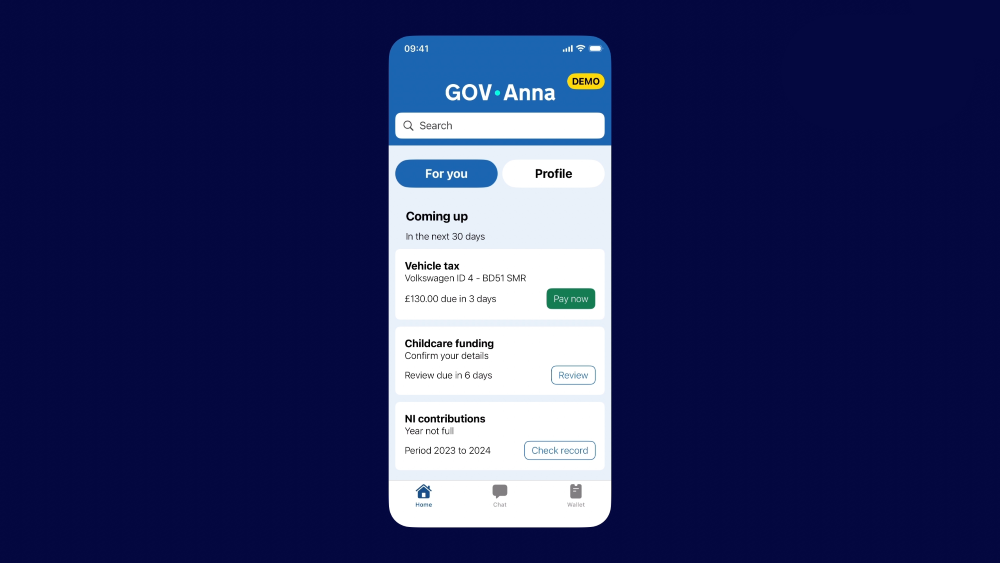
Jones also said on Tuesday that the NHS app “will be separate” from the government’s digital ID, as the NHS app is “already pretty well developed”.
Ministers are also consulting the public on what information digital ID should contain, which will go a long way to determining how it will appear on a user’s screen.
Digital ID will make processes “fairer”
While the government initially focused on digital ID as a way of tackling illegal migration, since then, the emphasis has shifted to making aspects of everyday life easier, with ministers using examples like filing a tax return and managing free childcare.
“The status quo is a legacy system of call centres, paperwork, and the need to tell your story, multiple times, to the different parts of government, with hours on hold and not knowing where you are in the process,” Jones said today.
“The whole point with this is that it should be easy, simple, and accessible to everybody.”
Jones claimed that digital public services could also be cheaper to run and more efficient.
“We cannot continue on this two-track process where services in the private sector, in banking and shopping, and all the other things that we do in our day-to-day lives are fast, easy, and digital, and then when you come to the public sector, they’re slow, clunky, and disjointed.”
What will the scheme cost?
It is still unclear how much the digital ID system will cost to develop, with today’s consultation claiming it was “not yet possible to quantify or assess the full impacts of the system”.
The government has previously pushed back against the Office for Budget Responsibility (OBR) forecast that the policy would cost £1.8bn over the next three years, arguing that the design of the scheme is yet to be decided on.
Today, Jones said the government had already carried out estimates showing that digitising customer services could save “tens and tens of billions of pounds every year” that is currently being spent on “very unproductive call centres, lots of paper shuffling, slow processes”.
Jones claimed that a digital ID could “free up taxpayers’ money” to go on frontline services like the NHS or “give back to taxpayers in the years ahead”.
‘People’s Panel’ to “help debate difficult questions”
Jones also confirmed that the government will go beyond a typical consultation, announcing the creation of a ‘People’s Panel’ on digital ID, with 100-120 people to be randomly selected, bringing together people across the country from different backgrounds.
Jones told reporters that the panel was a “gamble” as it would mean the government “kind of giving up control of it around the process”.
He said the panel would “help us debate the difficult questions, find ways forward and help us build a system that will win the trust and support of the public at large”.
Speaking at an event hosted by the Institute for Government think tank (IFG) in January, Jones said he believed the policy would grow in popularity over the next 12 months as people realised how it would positively impact their day-to-day lives.

The Minas Gerais State Championship football final in Brazil turned into a historic scene of on-field violence after a mass brawl erupted between players from Cruzeiro and Atlético Mineiro in the final moments of the match, resulting in 23 players being sent off at once after the final whistle.
These events occurred after Cruzeiro defeated their rivals Atlético Mineiro 1-0 in the match held in Belo Horizonte, securing their first championship title since 2019.
Football match erupts
The chaos didn’t end with the final whistle. The celebrations turned to an uproar after the match, when a violent confrontation broke out in stoppage time. Cruzeiro player Cristian rushed towards Atlético goalkeeper Iverson while chasing a rebound inside the penalty area. His legs collided with the goalkeeper, who fell to the ground. Iverson retaliated by pushing Cristian and placing his knee on Cristian’s chest, which sparked a full-blown brawl involving the entire Cruzeiro team.
Tensions escalated dramatically when Cruzeiro’s Matheus Pereira attempted to capitalise on a weak ball inside the penalty area, colliding with goalkeeper Iverson. Veteran player Hulk (39 years old) then joined the fray, being struck by Atlético defender Lucas Villalabá. He retaliated with a powerful blow to midfielder Lucas Romero, amidst chaos that lasted for several minutes despite the intervention of security personnel and military police to separate the players.
According to the BBC, referee Matheus Delgado Candansan did not issue any red cards during the match itself, despite the tense atmosphere and nine yellow cards. However, the intensity of the brawl led the referee to later record 23 official dismissals in his report, a record number in the history of the domestic leagues. These included 12 Cruzeiro players, among them Caio Jorge, and 11 Atlético Mineiro players, most notably Hulk.
Between the joy of Cruzeiro’s historic victory and the players falling in the middle of the brawl, the final turned into an event that will be recorded in the annals of Brazilian football as one of the most controversial matches, highlighting the impact of emotion and collective violence on the reputation of the game even during times of great celebration.
Featured image via the Canary

Jamaican club Mount Pleasant suffered a major blow ahead of their highly anticipated match against Los Angeles Galaxy in the The Confederation of North, Central America and Caribbean Association Football (CONCACAF) Champions Cup. The United States refused to issue visas to ten of their players, preventing them from participating in the first leg of the Round of 16 match against LA Galaxy on Wednesday.
The Jamaican team traveled to Los Angeles on Sunday with a squad of only 18 players, including five from the academy, to compensate for the absences caused by the visa crisis.
CONCACAF throws up inevitable problem
This incident highlights the restrictions imposed on citizens of certain countries entering the racist regime of the United States. Mount Pleasant has seven players who hold Haitian citizenship, and Haiti was among the 19 countries targeted by US President Donald Trump’s executive order as part of his campaign to tighten immigration procedures.
Last June, Trump issued an executive order suspending entry to the United States for Haitian citizens, casting a shadow over the participation of some of the team’s players in the continental tournament.
While athletes participating in major sporting events like the 2026 World Cup or the Olympics usually receive exemptions from such restrictions, the United States refused these exemptions, highlighting the depth of their commitment to racist border policies.
Visa obstacles.
The club’s sporting director, Paul Christie, said the visa obstacles put his team at a disadvantage before facing the 2024 MLS champions.
He told the Jamaica Observer:
We don’t want to participate just for the sake of it; we want to be able to compete, but we haven’t been given the opportunity to be at our best.
Featured image via the Canary

Approved unanimously by Your Party’s Central Executive Committee: “Ordinary Iranians now being bombed are already suffering from economic sanctions, which should be lifted to provide relief.” Magic grandpa still hasn’t lost his touch…

Striking Queen’s Hospital workers will demonstrate outside the office of their constituency MP Wes Streeting on Wednesday 11 March.
When: 9.30am, Wednesday 11 March 2026
Where: 12a Highview Parade, Woodford Avenue, Ilford, IG4 5EP
The workers initially took three days of strike action over a range of issues in February. Fresh strikes began on Monday 9 March and will end on Friday 13 March.
They are demanding that health secretary Streeting takes a more active role in ensuring Barking, Havering and Redbridge University Hospitals NHS Trust puts forward an acceptable offer to bring the dispute to end.
The strikes are causing disruption to blood tests and other laboratory services carried out by the pathology workers for the trust and GP services. The maintenance and management of medical technology carried out by the engineering workers is also being disrupted.
Unite general secretary Sharon Graham said:
These workers are dedicated to serving the NHS but have been left with no alternative but to continue striking.
As both health secretary and the local MP, Wes Streeting must intervene to ensure the trust ends a damaging dispute it is solely responsible for causing by putting forward an acceptable offer.
Unite regional officer Sujata Virdee said:
While there has been some movement from the trust it has not been far enough to bring this dispute to an end.
Featured image via Unite

The Football Association which administers football in Iraq has requested FIFA postpone the national men’s team’s World Cup 2026 playoff match, scheduled for March 31 in Monterrey, Mexico.
The request for postponement stems from the security situation in the Middle East and the inability of the team to travel from Baghdad, according to a source cited by Agence France-Presse (AFP).
The source explained that the Iraqi FA’s request was a result of the airspace closures and the current security risks in the region, which are preventing the team from leaving the capital.
Iraq coach Graham Arnold said:
About 60% of my players play in Iraq, all my backroom staff live in Iraq, all my medical staff live in Qatar and we’re having trouble getting Mexican visas at this moment.
Iraq: a team stranded
Meanwhile, Arnold himself remains stranded in Dubai, unable to travel to Baghdad to finalise the squad and begin preparations for the crucial match.
The Iraqi national team was scheduled to travel to Houston, Texas, for a training camp ahead of their crucial World Cup qualifier against the winner of the Bolivia-Suriname match. However, these plans were canceled due to the current travel restrictions.
In an interview with CNN, Arnold suggested postponing the match, saying:
Let Bolivia play Suriname this month, and then a week before the World Cup, we play the winner in the United States. The winner of that match qualifies.
The coach concluded by emphasising the need for FIFA to make a swift decision on the matter, arguing that the current circumstances make the situation unfair to the Iraqi national team.
The intercontinental play-off is scheduled to determine the final two teams to qualify for the 2026 World Cup, which will feature 48 teams, at a time of escalating tensions in the Middle East since late February following the US-Israeli strikes on Tehran.
Featured image via the Canary

Arsenal topped Opta’s list of favorites to win the UEFA Champions League title ahead of the Round of 16, a surprising result considering the London club has never lifted the continental trophy.
According to details published on The Analyst website, the network gave Arsenal a clear advantage of 26.7% to win the title, ahead of their rivals, before the anticipated match in the next round. This reflects the high level of confidence in the work being done by Spanish coach Mikel Arteta this season.
The supercomputer’s predictions were not much different from Opta’s, also predicting Arsenal to win the tournament with a 27.4% chance in the final to be held in Budapest, Hungary. Bayern Munich came in second with 14.28%, while Liverpool finished third with 12.83%.
Champions League: PSG in trouble
Meanwhile, Paris Saint-Germain’s task of retaining their title appears more complicated this season. French radio network RMC reported that the team is well aware that retaining the continental trophy is much harder than winning it, especially given their inconsistent results recently.
The Parisian team ranked only seventh among the favorites to win the title, with a 4.3% chance, after delivering inconsistent performances in the group stage, before struggling to overcome Monaco in the play-offs.
Furthermore, Luis Enrique’s team suffered several setbacks domestically, with two heavy defeats against Rennes and Monaco (both by a score of 3-1), which has negatively impacted their chances in the European competition.
Bayern Munich and Liverpool trail the leaders.
According to Opta’s predictions, the top contenders to win the Champions League title are:
• Arsenal — 26.7%
• Bayern Munich — 16.4% (facing Atalanta)
• Liverpool — 11.4% (facing Galatasaray)
• Manchester City — 11.1%
• Barcelona — 9.7%
• Chelsea — 6.4%
• Paris Saint-Germain — 4.3%
Featured image via the Canary

From 7am on Tuesday 10 March, two activists from the People Against Genocide group scaled the front canopy above the front doors of Chubb Insurance’s Manchester office in Booth Street.
After climbing onto the platform, they covered the area in symbolic blood-red paint. Police removed and arrested the two action takers at 1.30pm. Firefighters had earlier refused to assist the police in removing the protesters.
Multiple actions against Chubb
This is the third action that People Against Genocide has undertaken against Chubb. The company provides insurance for UAV Engines, a subsidiary of Elbit Systems, Israel’s biggest weapons company. Chubb took over this role after Aviva, UAV Engines’ previous insurer, dropped the company following a sustained direct action campaign.
At its site at Shenstone in Staffordshire, UAV produces engines for Israel’s huge killer drone fleet, of which Elbit Systems produces more than 85%. They include the R902(W) Wankel engine for Elbit’s Hermes 450 drone. This is the same model Israel used to kill seven aid workers from the World Central Kitchen, including three British nationals.
Without the mandatory Employer Liability Insurance provided by Chubb, UAV Engines could not operate in the UK.
Last month, on 18 February, three activists from People Against Genocide targeted the London headquarters of Chubb Insurance. They sprayed blood-red paint all over the front of the building, and locked-on to shut it down.
A week later, on 25 February, the group targeted Chubb’s Birmingham offices, again using symbolic blood-red paint.
In addition to targeting Chubb, People Against Genocide has also recently targeted Aspen Insurance. Aspen took over providing cover for Elbit Systems UK, after its previous insurer, Allianz, also succumbed to pressure from pro-Palestine activists.
A spokesperson for People Against Genocide said:
While the Gaza Genocide continues, and civilians are killed by Israel on the Palestinian West Bank, Lebanon, and Iran, Elbit Systems are cashing in.
Elbit and UAV Engines can only manufacture deadly weapons in Britain because they are provided with Employer Liability Insurance by Chubb and Aspen.
Our action today, in Manchester, is aimed at disrupting the operations of Chubb Insurance, and exposing their role in profiting from war-crimes.
We will continue to target these greedy, amoral companies until they drop the Israeli weapons makers they are facilitating.
Featured image supplied

Israel praises Iranian women’s soccer team for staying silent during anthem

You Have To Hold All Three… (1000x)

City restaurant hit with late night music ban after ‘noise nuisance’


-
Business4 days ago
Form 8K Entergy Mississippi LLC For: 6 March
-

 Fashion4 days ago
Weekend Open Thread: Ann Taylor
-

 News Videos1 day ago
10th Algebra | Financial Planning | Question Bank Solution | Board Exam 2026
-

 Crypto World1 day ago
Paradigm, a16z, Winklevoss Capital, Balaji Srinivasan among investors in ZODL
-

 Tech5 days ago
Bitwarden adds support for passkey login on Windows 11
-
 Sports5 days ago
499 runs and 34 sixes later, India beat England to enter T20 World Cup final | Cricket News
-

 Sports3 days ago
Three share 2-shot lead entering final round in Hong Kong
-

 Sports3 days ago
Braveheart Lakshya downs Lai in epic battle to enter All England Open final | Other Sports News
-

 Business7 days ago
Guthrie Disappearance Enters Fifth Week as Family Visits Memorial
-
 Politics4 days ago
Top Mamdani aide takes progressive project to the UK
-

 NewsBeat5 days ago
Piccadilly Circus just unveiled ‘London’s newest tourist attraction’ and it only costs 80p to enter
-

 Business2 days ago
Search for Nancy Guthrie Enters 37th Day as FBI Probes Wi-Fi Jammer Theory
-

 Entertainment4 days ago
Hailey Bieber Poses For Sexy Selfies In New Luscious Lip Thirst Traps
-
 NewsBeat18 hours ago
Pagazzi Lighting enters administration as 70 jobs lost and 11 stores close across Scotland
-

 Tech1 day ago
Despite challenges, Ireland sixth in EU for board gender diversity
-

 Crypto World6 days ago
New Crypto Mutuum Finance (MUTM) Reports V1 Protocol Progress as Roadmap Enters Phase 3
-

 Tech5 days ago
ACIP To Discuss COVID ‘Vaccine Injuries’ Next Month, Despite That Not Being In Its Purview
-

 Business2 hours ago
ExxonMobil seeks to move corporate registration from New Jersey to Texas
-
Entertainment6 days ago
Harry Styles Has ‘Struggled’ to Discuss Liam Payne’s Death
-

 Business22 hours ago
Search Enters 39th Day with FBI Tip Line Developments and No Major Breakthroughs