Politics
Brexit ten years on: regulation
Ahead of the ten year anniversary of the EU referendum on 23 June, UK in a Changing Europe experts have written a short series of blogs reflecting on some of the issues at the heart of Brexit then and now. Here, Joël Reland reflects on Brexit and regulation.
The Leave campaign’s central slogan – ‘Take Back Control’ – evoked the idea of EU rules preventing the UK from looking after its own best interests. Boris Johnson bemoaned Brussels “telling us how powerful our vacuum cleaners have got to be, what shape our bananas have got to be” while a Leave campaign briefing claimed that EU regulations serve ‘a small number of large multinationals’ and ‘crush entrepreneurial competition’.
Against that backdrop, Theresa May quickly decided that regulatory freedom would be central to her Brexit agenda, using her first Party Conference speech to promise that “our laws will be made not in Brussels but in Westminster”.
But it soon became apparent that this would both add major costs to EU trade – due to leaving the single market – and create a regulatory border with Northern Ireland (which had to remain aligned to EU law to keep the Irish border open).
This realisation was, according to Philip Hammond, “like a light bulb going on” – leading May to develop the ‘Chequers deal’, under which the entire UK would continue to adhere to all EU regulations necessary to maintain frictionless trade in goods. Boris Johnson and David Davis resigned at this “semi-Brexit” and May ultimately failed to get her plan through Parliament.
Johnson subsequently won an election promising to use ‘post-Brexit freedoms to transform the UK for the better’ and accordingly negotiated a Brexit deal which gave Great Britain near-total control over its law-making, at the cost of new trade frictions with the EU and – despite his denials – Northern Ireland.
Yet Johnson’s administration consequently struggled to develop a plan for unpicking EU red tape. A 105-page paper called ‘The benefits of Brexit’ outlined a long list of options for regulatory reform, but gave no sense of prioritisation or how policy would be delivered.
The strategy – if there was one – focused on the quantity, not quality, of reform. In 2022, the newly-installed Minister for Brexit Opportunities, Jacob Rees-Mogg, announced plans for a ‘Brexit freedoms bill’ – officially titled the Retained EU Law (REUL) Bill – under which all REUL (i.e. EU-derived law) would expire by default, except where ministers chose to retain specific pieces. It was accompanied by a Retained EU Law Dashboard, to provide live data on the proportion of REUL which had been abolished.
The highly performative approach was heavily criticised, especially by business, for creating a deeply uncertain regulatory horizon which prevented long-term planning and risked citizens losing vital legal protections – especially as officials did not even seem to know how much REUL was out there in the ether.
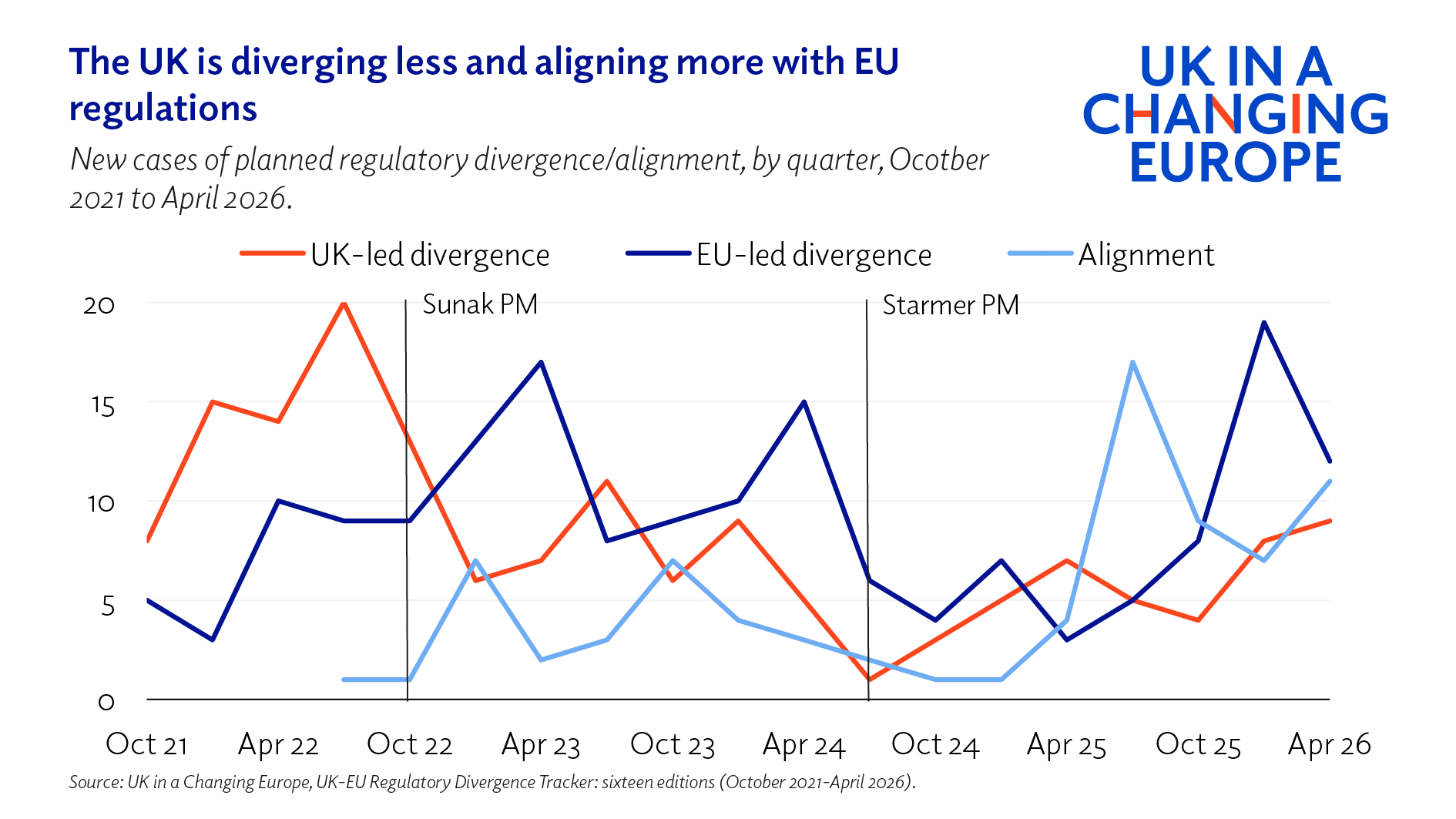
The plan was eventually abandoned under the Sunak government, with then-Business Secretary Kemi Badenoch stating “we are not arsonists… I do not think a bonfire of regulations is what we wanted”. Since then, the rate of plans for divergence has slowed significantly.

A glance at the REUL dashboard today might make you think that a bonfire of EU red tape has, nevertheless, been lit. It shows that 37% of REUL has been reformed – with 23% repealed and 13% amended or replaced (the other 1% has expired).
But this, in fact, amounts to little more than a glorified regulatory spring clean: the vast majority of ‘reformed’ REUL has either been subject to technical amendment (e.g. restated in a new legislation) or is no longer of relevance (e.g. legislation relating to the 2001 foot-and-mouth crisis or EU regimes which the UK is no longer part of).
Moreover, our series of Divergence Tracker reports, shows that successive UK governments have delivered little in the way of substantive divergence from EU law.
There have been a smattering of changes to financial services regulations, such as lifting the cap on bankers’ bonuses, while rules on the use of genetic editing techniques have been liberalised. Several ‘freeports’ have been established; the export of live animals for fattening and slaughter has been banned; and certain alcohols are now taxed by strength, not quantity. There have also been some symbolic changes, such as permitting the sale of Champagne in pint-sized bottles and new guidance on selling groceries in imperial measures.
Given regulatory control was so central to Brexit, what explains this lack of action? One reason was that the government never set a clear strategy for divergence, while the civil service – overwhelmed with a wide range of new post-Brexit regulatory functions – had little capacity to focus on strategic ideas for reform.
But the most fundamental reason is that divergence, more often than not, adds costs to trade. The government argued that regulation could be better ‘tailored’ to UK interests (rather than being a cross-EU ‘compromise’). But, from a trade perspective, regulation is all about compromise: creating common standards between parties which reduce trade frictions.
‘Tailoring’ regulation to a single country therefore increases frictions, and several marquee plans for divergence – including on data protection, medical devices and conformity assessments – were abandoned for this reason.
British companies have made it more than apparent that they prefer to avoid divergence where possible. Across multiple sectors – from vehicles to products to food – they have voluntarily opted to adhere to new EU rules, even though they do not apply in Great Britain, because it is necessary to maintain access to the EU market. This is the reason why Rachel Reeves now argues that divergence “should be the exception, not the norm”.
One final curiosity is that the UK has repeatedly used its regulatory freedom to move in a similar direction to the EU. It has set higher emissions reduction targets and has an earlier phase-out date for combustion engine vehicles. Its new rulebooks on online safety and digital markets bear an uncanny resemblance to the EU Digital Services and Digital Markets Acts. And employee protections have increased, despite earlier promises to scrap the Working Time Directive.
Even the few notable cases of divergence often serve to strengthen the hand of the state – increasing animal welfare protections and alcohol taxes – while a fully-fledged UK-US trade deal remains elusive, not least because of public opposition to any watering down of food standards.
Brexit has revealed the UK’s regulatory instincts to be much more European than many assumed.
By Joël Reland, Senior Researcher, UK in a Changing Europe.
You must be logged in to post a comment Login