Politics
Brexit ten years on: the referendum
Ahead of the ten year anniversary of the EU referendum on 23 June, UK in a Changing Europe experts have written a short series of blogs reflecting on some of the issues at the heart of Brexit then and now. Here, Anand Menon reflects on the referendum ten years on.
I find it difficult to reflect on the last ten or so years. Partly, I fear that’s a function of my increasingly unreliable memory. Partly too, it’s because I’ve tracked the Brexit story, blow by bitter blow. From referendum to leadership election, to Lancaster House, to Salzburg, to implementation vs transition phases, to max fac, to borders to another leadership election, to Boris to non-tariff barriers to the Protocol, to another leadership election, to France as foe, to another leadership election, to general election to reset to possibly another leadership election. Frankly, it virtually impossible to discern the wood at all for the various trees.
But a few things stand out. First, the impact that Brexit has had on our politics. These are complex, and, as I’ve suggested elsewhere, Brexit might have facilitated the current upsurge in support for populist parties. However, amidst all the churn and the uncertainty, there has I think been one positive. Brexit further eroded the organic ties that once linked parties to their voters. Voter volatility means parties have to work harder to attract support. Who knows what now qualifies as a genuinely safe seat? Clearly, this is not to say that our system is either fair or proportional. But it is one in which politicians have to be more responsive to the electorate.
The second issue that Brexit has made me ponder is the complicated relationship between economic outcomes and political effects. I was struck by this a couple of weeks ago, listening to a lady declare in a focus group that ‘Brexit obviously isn’t affecting us now – we left in 2016.’
Clearly this isn’t true. But it does point to the fact that, for all the evidence that economists have to underline the various ways in which Brexit has impacted on our economy, making the political argument about this economic impact is not straightforward. Drawing causal lines between events many years ago and outcomes today poses a challenge. That was the whole point of the ‘slow puncture’ analogy that Matthew Bevington and I wrote about some years ago. As we put it then, ‘it can take a while to notice a slow puncture. And…it is hard, once it has become apparent, to remember when and where you picked it up’.
This has implications for current and future debates on the UK-EU relationship. The public have not carefully tracked the way in which Brexit has impacted on growth in the UK. But their views of Brexit have tended to be shaped by the state of the economy. As John Curtice argued for us in October 2022, the Liz Truss mini budget seemed to have played a role in increasing negative opinions about Brexit. Which of course raises the prospect that an improvement in the economy might impact on public perceptions, even if Brexit had nothing to do with this improvement.
Which brings us to where we now find ourselves. As out recent report suggests, there are a host of options facing the UK now ranging from the status quo to membership (I reproduce our new staircase here because I think it’s rather cool).
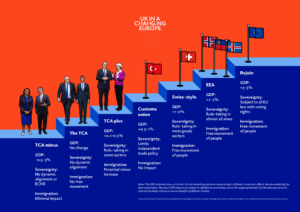

The key points are that, first, Brexit, as it always has, involves trade-offs between political autonomy and market access. Second, Brexit tends to be polarising. As the drawbacks involved in compromise outcomes (either in terms of economic impact or sacrifices of autonomy) become clear, people gravitate towards membership or complete autonomy. This was the case back in 2019, and is becoming the case once more. While the Tories and Reform UK are essentially promising what we used to call a ‘no deal’ outcome (via their pledge to leave the ECHR), ‘progressive’ parties seem to be adopting more ambitious schemes for bringing the UK closer to the EU. It’s hard to avoid a sense of déjà vu.
Allow me to finish with a few words on UK in a Changing Europe. First, to pay tribute to all those who’ve worked here over the years. Not just the academics and researchers who have featured regularly on this site. That they’ve reached such a large audience is a testament to the comms specialists and the admin staff who have kept the show on the road.
And the show itself is an important one, and for two reasons. One, which you’ll hardly need convincing of if you’re reading this, is that Brexit matters. The last decade has been seismic, and Brexit promises to continue exerting an impact on the UK – economically, politically and constitutionally – for years to come.
The other – as important if not more so in my opinion – is that UKICE has underlined the relevance of social science and the importance of ensuring that scholarly research is made available to audiences outside the academy. Research based on evidence provided in a clear and accessible way is fundamental to informed political and public debate. During the twelve years of our existence, we’ve tried to produce this without fear or favour. In an era of ‘fake news,’ of ‘post-truth,’ I believe that undertakings like ours are more important than ever.
By Anand Menon, Director, UK in a Changing Europe.
You must be logged in to post a comment Login