Politics
Companies abandon AI as prices skyrocket


For the past few years, billionaires and their media lackeys have told us that the AI revolution is inevitable. Opposing this narrative, some are warning that the ‘generative AI’ technology in question lacks the competence or cost-effectiveness for such a transition. And the emerging signs are proving those naysayers correct:
NEW: Uber is reportedly capping employee use of AI vibe-coding tools at $1,500 per month after blowing through its AI budget.
— Polymarket (@Polymarket) June 2, 2026
Why now?
Over the past few weeks, anyone who follows the AI industry will have noticed a big increase in stories like this:
Microsoft Bans Claude Code After AI Costs More Than The Humans It Replaced
— NewsWire (@NewsWire_US) June 1, 2026
Uber handed its 5,000 engineers an AI coding assistant in December. By April, the company had blown through its entire AI budget for all of 2026, with two thirds of the year still to go.
Cheap, basic AI has gotten almost free over the past few years. But almost no company builds… https://t.co/rTlWgZECa7
— Anish Moonka (@anishmoonka) May 24, 2026
Why is it happening now? It’s because AI companies have switched from a subscription-based offering to a pay-per-token model. The ‘tokens’ in question are what AI models use whenever they process a request, with more tokens used depending on the complexity of what’s asked.
As it turns out, many of these companies were burning through an unfathomable quantity of tokens:
NEW: AI consultant reveals a client accidentally spent $500,000,000.00 in a single month after failing to set employee limits on Claude usage.
— Polymarket (@Polymarket) May 28, 2026
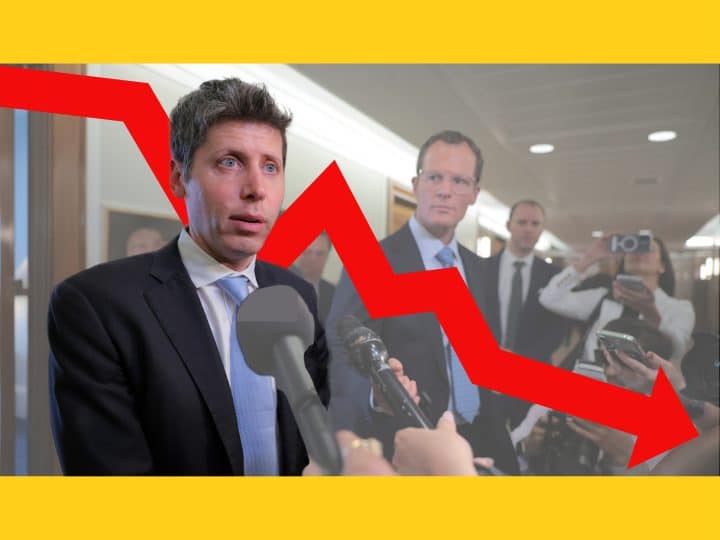
As the sky falls in, OpenAI CEO Sam Altman is pretending to not understand what’s happening:
Sam Altman said AI budgeting has recently become a "huge issue" for some companies, something that "never came up" earlier this year. https://t.co/P2zODBNmDp
— Business Insider (@BusinessInsider) June 3, 2026
Altman does have to say something to reassure investors, but we’re not sure this is it.
OpenAI is absolutely cooked. This is loser language. You can’t be four years into the bubble saying “yeah our customers have a huge issue with how expensive our business is.” You just raised $122 billion! You can’t say shit like this!https://t.co/1uKEEpSS03 pic.twitter.com/HWMuy3TQX8
— Ed Zitron (@edzitron) June 4, 2026
Ed Zitron is one of generative AI’s most vocal critics. Responding to the latest developments, he highlighted a case in which one AI user used 50% of their token credits with just one prompt. This is a problem, because some users like coders had grown accustomed to making hundreds or thousands of prompts a day.
If you want to see what happens when people have to pay the actual costs of AI, the day is finally here. It’s obvious that every customer sees the deep, meaningful value and isn’t angry at all pic.twitter.com/Z8xzyYOFH7
— Ed Zitron (@edzitron) June 1, 2026
As Zitron highlights, companies are now paying the “actual price” of AI.
Up until now, AI companies used multi-billion pounds cash injections from wealthy investors to subsidise their technology. They hoped AI would prove to be so useful that when they switched to a more realistic pricing point, companies would have no option but to carry on paying.
Yeah, so about that …
Expensive? Yes. Useful? No.
To make things worse, companies already weren’t making money:
First it was MIT and McKinsey. Now Bain finds that returns to corporate AI investments are disappointing. pic.twitter.com/sXqXQVSMH0
— John Cassidy (@JohnCassidy) June 3, 2026
The artificial intelligence industry has a big problem: 95% of companies that try AI aren’t making any money from it, according to a report from the Massachusetts Institute of Technology last month.
The same article carried multiple quotes from supposed experts who promised AI would be very profitable as soon as these businesses pulled their fingers out and implemented it correctly. A year later, the technology is no more useful yet considerably more expensive.
Many companies laid off employees hoping they could replace them with AI. Many companies have since realised the error of their ways:
Friend works for REDACTED tech company. They fired 30 people because the CEO insisted AI could do their jobs. Now they’ve spent 6 months making unusable code and have had to hire more people. How the turns table
— Madelaine Hanson (@MadelaineLucyH) June 3, 2026
Not yet, not this
While it does seem likely the world will one day be run by smart, automated systems, the generative AI that’s being sold to us isn’t ‘smart’. Functionally, it’s little more than a juiced-up auto-type, but the tech chancers claimed it was a digital god that would perform our menial tasks for us.
The problem now is that the global economy is propped up by the over-inflated AI bubble. And when that bubble pops, it won’t be the billionaire tech bros who suffer.
Featured image via Chip Somodevilla (Getty Images)
By Willem Moore
You must be logged in to post a comment Login