Politics
‘Dead Mouse’ slams cruel sepsis experiments at QMUL open day

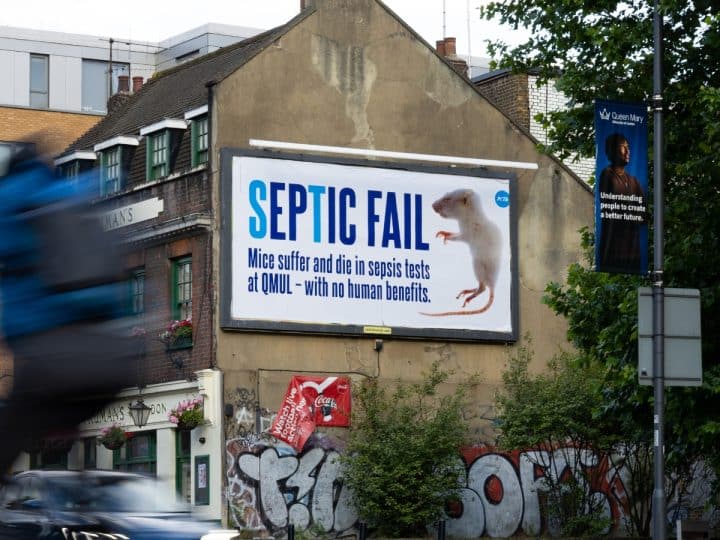

Ahead of undergraduate open days at Queen Mary University of London (QMUL) on 12 and 13 June, PETA has placed a new ad just a stone’s throw from the campus.
It warns prospective students that researchers at the university are tormenting mice in cruel and useless sepsis experiments that consistently fail to lead to effective treatments for humans.
The appeal depicts a dead mouse alongside the message:
Septic Fail. Mice Suffer and Die in Sepsis Tests at QMUL – With No Human Benefits.
PETA senior campaigns manager Kate Werner says:
What QMUL’s tours fail to divulge to students is that on campus, terrified mice are being cut open while they’re still alive and subjected to the agonising experience of sepsis, all for worthless experiments that benefit no one.
PETA is urging the university to stop wasting time, resources, and animals’ lives on these cruel and ineffective experiments and adopt human-relevant research methods.
More than 150 drugs have successfully treated sepsis in mice, yet none have been effective in treating humans. Despite the well-documented failure in using mice to model human sepsis, QMUL experimenters are cutting open terrified mice and puncturing their intestines to leak faecal matter into their bodies.
During experiments, some mice experience severe sepsis, which can include major organ failure and difficulty breathing. All animals are killed at the end of these experiments.
Some data from these experiments have been published in papers that were later retracted by the publisher because the animal data and conclusions were deemed ‘unreliable’.
Mice are intelligent, complex, and social individuals who experience a wide range of emotions. They become attached to each other, love their families, and easily bond with their human guardians, returning as much affection as they receive.
PETA encourages everyone to urge QMUL to heed the scientific evidence and join other institutions, including the University of Kent, that have committed to non-animal methods in sepsis research.
Featured image via PETA / Lucy Watson
By The Canary
You must be logged in to post a comment Login