Politics
Finger Clubbing: The Lung Cancer Sign On Your Hands

Though they’re usually nothing to worry about, small details – like changes to your fingernails and little yellow bumps around your eyes – can sometimes point to more serious conditions.
And according to Dr Jiri Kubes, a radiation oncologist at the Proton Therapy Centre, a lesser-known symptom of lung cancer can sometimes show up on your hands rather than your chest.
“Finger clubbing” can be linked to “many serious, long-term conditions,” the NHS agreed – lung cancer among them.
In fact, the symptom appears in 35% of people with non-small cell lung cancer and 4% of people with small cell lung cancer.
What is finger clubbing?
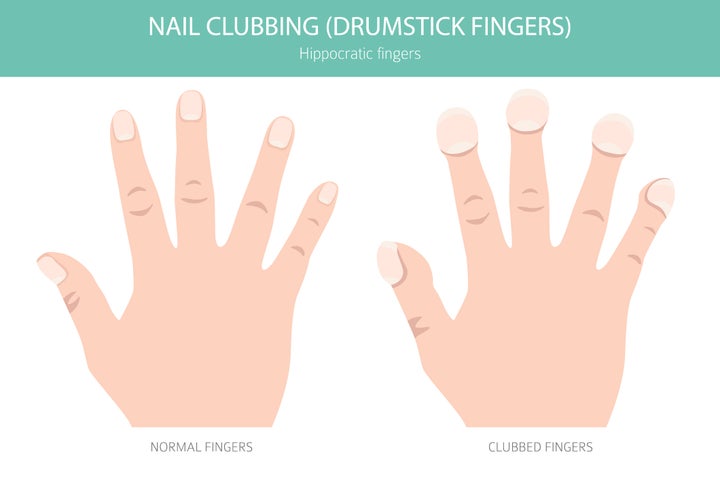
It’s a condition in which a person’s fingertips become larger and more curved over time.

Dmytro Bosnak via Getty Images
Finger clubbing is also called “digital clubbing” or “Hippocratic nails”. And because it can happen really gradually, Dr Kubes said “it can be difficult to notice the difference early on.
“It typically progresses in stages, meaning knowing how to spot initial signs is crucial in potentially securing an early diagnosis.”
One of the first early indicators is softening of the nail bed, accompanied by redness around the skin of the nail.
This can develop into a steeper curve and eventually means patients’ fingertips take on a clubbed, enlarged appearance.
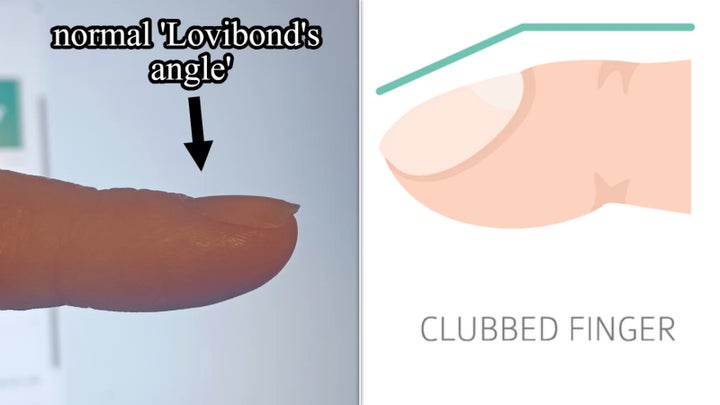
In the early stages, you might also want to look out for the “Lovibond angle” – the small dent at the bottom of your nail that you can see from the side.
Per the Cleveland Clinic, “In the early stages of nail clubbing, your nail and nail bed look flat from the side”.

Amy Glover / HuffPost UK / Getty
The Schamroth window test, which is related, involves putting the nails of different hands together back-to-back to see if there’s a diamond-shaped space between your cuticles.
If there isn’t one, you might have finger clubbing.
When should I see a doctor about finger clubbing?
“Any unexplained changes to the fingers should be taken seriously and assessed by a medical professional as soon as possible,” said Dr Kubes.
“While finger clubbing does not always mean cancer, it is still linked to other lung, heart or inflammatory conditions, meaning any unexplained changes should be checked by a doctor. They can examine you and any other symptoms you have, as well as send you for tests if deemed necessary.”
- a cough that doesn’t go away,
- coughing up blood,
- often being breathless,
- unexplained tiredness,
- unexplained weight loss,
- pain when breathing or coughing.
If you’re experiencing any of these signs, regardless of whether or not you’ve got signs of finger clubbing, speak to your GP.
You must be logged in to post a comment Login