Politics
Growing Up With A Dad Old Enough To Be My Grandfather

The first time a kid in my kindergarten class asked, “Is that your grandfather?” when my dad dropped me off at school, embarrassment consumed me.
My dad didn’t look like the other dads; what little hair he had was silvering, and he had deep wrinkles that sank into his face.
I remember the stubborn certainty of being six years old and wanting to blend in.
“I don’t want you to walk me into school anymore,” I told my dad.
I didn’t yet have the language for difference. I only understood sameness, who matched and who didn’t. I just wanted to fit in.
“Please? I’ll walk you to your classroom door quietly,” he asked,
But I was firm, saying: “No. Just wait here. I can go by myself.”
He slid my Little Mermaid backpack onto my tiny shoulders. Just as I reached the front gate, I turned around to see his worn Gucci loafers, thick-rimmed reading glasses and pomaded hair. He blew a kiss in my direction, and I waved to show I’d made it safely – eager to hurry him along.
I’m the only product of my dad’s second marriage (and his second divorce). With two half-siblings 20 years older than me, I grew up as an only child. I vacillated between worshipping him as the creator of all fun (he’d play Talking Heads while I jumped on the bed) to treating him as a humiliating, old appendage. His inevitable extinction was always on the horizon, and it scared me.
Today, walking up the brick staircase of my childhood home, I reach the front door, painted green now instead of red. To my right, under the mail slot, is an opaque garbage bag. I can make out a heap of Depends and baby wipes inside.
As footsteps approached the front door, I brushed the small pearls of sweat gathering at the nape of my neck. Returning home always unsettles me.
“Hi, come on in. He’s just taking a nap,” his caregiver smiles at me.
I spent 18 years in this house, and every college break after, and now it feels like an echo of what it used to be. The dining room is lined with boxes of bottled water and Ensure, and the table is piled high with mail and old newspapers.
As I make my way to the den, I see my father, now 91, lying back in his chair. Our 54-year age difference feels wider than ever. I know he has a feeding tube, though I can’t see it beneath the pile of blankets on his lap.
“Hi, Daddy!” I bellow as I sit beside him. I take his hands in mine and begin to warm them as I try to rouse him from his deep slumber. These were the hands that reached out for me in our pool when he was teaching me how to swim. The hands that once pushed me higher on the yellow Fisher Price swing now seemed tired and weak. His leathery fingers begin to wiggle, and his eyes slowly blink open.
“Hiiiiiiiii,” he croaks.
“Do you know who this is?” his caretaker asks as she begins to lift his recliner.
“A nice lady?” my dad replies through a mouth of decaying yellow teeth. He no longer allows anyone to clean them. As his memory waned, his refusals grew stronger.
I gazed into his hazel eyes. “It’s me, Jordan. Your daughter,” I answer, trying to stay as upbeat as possible while a piece of me disintegrates inside.
This happens every time. The fact that he doesn’t remember me is soul-crushing. How do you introduce yourself to the man who taught you how to play gin rummy? Watching his eyes move across your face as if he’s trying to place you. Realising that the archive of your shared life, birthdays, park adventures and driving lessons, now lives only in you.
It isn’t just that he forgets me. It’s that I remember everything alone.
In 2010, the summer I graduated from college in New York, my father was diagnosed with cancer. He decided to wait until the day after graduation to tell me about his diagnosis so as not to “ruin my big day”.
“The melanoma has spread to a lymph node in my right thigh, so I have to have it removed,” he explained.
“Do you want me to come home for your surgery?” I asked.
“No. I don’t want to disrupt your summer. I’ll be fine,” he replied.
“I really don’t mind. I can take care of you,” I insisted.
“You don’t have to,” he said, and he reached for my hand and held it tightly in his.
Then a familiar feeling swept over me: shame. But this time it was directed not at him, but at myself. I was such an ungrateful daughter. What my dad lacked in youth, he made up for in generous parenting. From crawling around on the floor with me in his dress trousers to doing a one-man singing competition of all the Disney princes, to taking me to see David Bowie in concert, his talents for making me smile were infinite.
And after all the effort and energy he put into my happiness, I’d always wanted to trade him in for a younger model. All I wanted now was to tell him how sorry I was.
“I’ll be there,” I said.
Two weeks later, I was in my childhood kitchen, fixing my dad a plate of egg salad and multigrain toast. Post-surgery, he was on bed rest. During those weeks, I showed him how to reduce his oedema by elevating his legs against the wall (I had just completed my 200-hour yoga teacher training) and brought him green tea. It was the first time I had catered to him since preparing him breakfast-in-bed for Father’s Day in 1995: cottage cheese with half a banana, and coffee with creamer.
During his recovery, I would sit at his bedside and rummage through his keepsake box, pulling out mementos from his past. He would tell me stories of his mother’s victory garden in Boyle Heights and of hiding behind blackout curtains during Japanese bomb scares in World War II.
My father saw The Wizard of Oz when it first came out in theatres and ran out into the lobby, horrified by the Wicked Witch. As a boy, he would listen to Captain Midnight on the radio and flip through Norman Rockwell pictures in the Saturday Evening Post. My father was a rivet in America’s “Golden Years.”

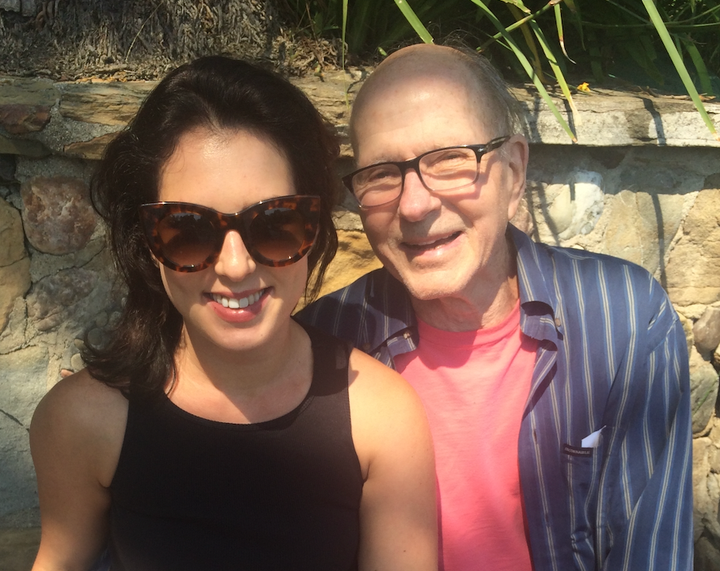
Photo Courtesy Of Jordan Ashley
Last year, I had important news to share with him. “Look, Daddy, this is my ring. I’m getting married in just a few months,” I projected as I flicked my wrist back and forth to show him my diamond.
“Wow, congratulations, honey,” he exclaimed as drool began to seep down his chin.
I quickly grabbed one of the many washcloths, the same ones he used to clean me with during bath time, now withered and tattered, just like he was. Through his rosy cheeks and rotting smile, a genuine sweetness radiated.
“Do you want me to read you a story?” I asked.
Going into my childhood bedroom, still filled with my picture books and stuffed animals, but now also lined with his folded laundry, diapers and medicinal lotions. Grabbing Goodnight Moon off the shelf, I thought of how he used to always read it to me.
Now living in London, I come home at least three times a year to see my dad. Sitting for 10.5 hours to fly across the world, I always remind myself that I don’t want any regrets.
As I opened the first page, I looked at him, and the same twinge of bitterness ran through me. A feeling that I always carried. This isn’t fair. Two of my best friends had married just months before, and their fathers walked them down the aisle. That was never in the cards for me.
“OK, here we go,” I said as I opened the first page.
“In the great green room,
“Goodnight stars, goodnight air…”
The lines hung between us, small and delicate, stretching across the decades that separated my father and me. I brushed a kiss over his bald head, feeling the weight of years that we never had together and the fullness of all the ways he had shown up anyway. In the quiet of that moment, I understood how much love can compress a lifetime, even when time itself is limited.
“Goodnight noises everywhere, Dad.”
Do you have a compelling personal story you’d like to see published on HuffPost? Find out what we’re looking for here and send us a pitch at pitch@huffpost.com.
You must be logged in to post a comment Login