Politics
Helen Millman: Kemi, it’s time to get real about climate change

Dr Helen Millman is a climate scientist and glaciologist based at the University of Exeter. She writes in a personal capacity.
The UK’s commitment to reach net zero by 2050 was introduced by a Conservative government and supported across Parliament because the scientific evidence shows that limiting warming to 1.5°C requires global CO₂ emissions to fall rapidly this decade and reach net zero by the middle of the century.
This is the consensus reflected by the IPCC and, like all IPCC reports, was approved by the governments of its 195 member countries. Even Saudi Arabia, a nation not known for its eco-zealotry, couldn’t change the scientific assessment to suit its interests. It is, therefore, surprising to see Kemi Badenoch dismiss our 2050 net zero target as “arbitrary” and a “political programme.”
Accepting the target and delivering it are different things, but the target itself is scientifically grounded. As long as greenhouse gas emissions remain above net zero, global temperatures will continue to rise, increasing the frequency and intensity of heatwaves, wildfires and other climate extremes. This summer, in a 1.4°C warmer world, we have seen people lose everything to wildfires and our infrastructure fail in unnaturally hot weather. A&Es have experienced their busiest period on record, with excess deaths from heatwaves running into the thousands in England alone. As UK temperature records continue to be broken, farmers have raised concerns about food shortages amid what’s expected to be the worst harvest on record.
Against this backdrop, the party leadership has made a series of dubious claims about net zero. Badenoch has claimed that net zero by 2050 is “impossible”. In reality, the transition is achievable for around 1 per cent of GDP, far less than the costs of not reaching net zero by 2050.
She has suggested that the UK’s net zero commitment has caused emissions to increase. In fact, since our net zero target became legally binding in 2019, our consumption-based CO2 emissions figures – which include offshored emissions – have fallen from 23 per cent below 1990 levels to 27 per cent below 1990 levels. In contrast, the party’s proposals of more North Sea drilling, removing emissions targets and cutting carbon taxes would put the UK on a higher-emissions pathway than current plans and keep the UK tied to a more expensive energy model for longer.
Just recently, Claire Coutinho was forced to defend a report which she’d hailed as “the most detailed energy analysis ever.” When it was found that those details were questionable, she doubled-down in a Trumpian style rebuttal with further inconsistencies and attacks on her critics.
Coutinho and Badenoch are right that British industry faces exceptionally high electricity prices, but they are wrong to blame carbon taxes and renewables. The steel industry, for instance, is largely exempt from environmental levies and receives network cost relief through the Supercharger scheme.
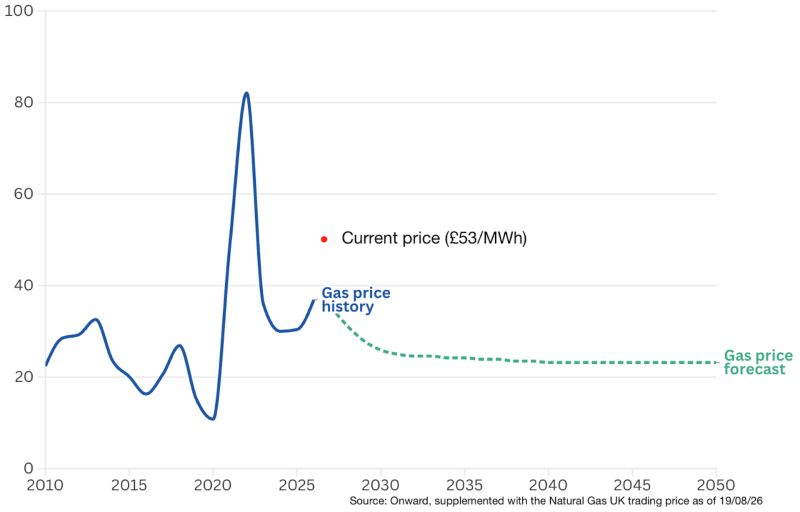

Yet British steelmakers still pay more for electricity than their French and German counterparts because UK wholesale electricity prices remain tied to the price of gas. In the latest auction, contracts for onshore wind and solar were awarded at around £72 and £65 per megawatt hour respectively, compared with more than £147 per megawatt hour for new gas generation. Renewables are not cost-free, requiring investment in networks, storage and flexibility, but clinging to an outdated system dominated by expensive gas is not the cheaper route.
Until the world reaches net zero, warming will continue, making climate impacts harder, more costly and, in many cases, beyond our ability to adapt to. This year’s poor harvest points to what more frequent and severe droughts will mean for crop yields and food security. Rising sea levels will make low-lying coastal communities increasingly difficult or impossible to defend, threatening homes, infrastructure and farmland. More properties will become uninsurable due to extreme weather, wildfires and flooding, while investment will be diverted towards repairing damage and adapting existing assets rather than raising productivity and living standards. A slower transition for Britain carries severe economic, diplomatic and physical challenges, but the party leadership has yet to acknowledge them.
Yes, the UK only makes a small contribution to global emissions, but so does almost every other country on Earth. Countries that each account for less than 1 per cent of global emissions collectively produce more than a fifth of global emissions – more than the USA and India combined. It also doesn’t take a diplomat to realise that a country which refuses to meet the 2050 target will struggle to persuade others to do so.
We were the first to commit to net zero, and 144 countries have followed our lead. Before the 2015 Paris Agreement at COP21, the world was on course for 4°C of warming, but due to net zero policies and the falling cost of green technology, we are now on course for 2.8°C of warming. This is still well beyond the 1.5°C limit, but we have helped to lead the world in the right direction and should continue to do so.
Conservatism has traditionally understood that facts cannot be negotiated with. Markets, public finances, demographics and geopolitics impose constraints that governments ignore at their peril. Climate change belongs to this same class of realities, governed by atmospheric physics rather than political beliefs. When the truth is inconvenient, it’s best to work towards solving the problem, not to imagine a different reality to suit the argument you would rather be making.
Barring Conservative candidates who support net zero by 2050, including former Government Ministers, puts compliance with a populist ideology ahead of the national interest. It risks excluding the people with the knowledge and expertise the party needs to navigate one of the most serious challenges the country faces. Treating knowledge as a tribal marker rather than a basis for decision-making might be popular in the online world, but it leads to bad policy and poor outcomes in the real world.
There are serious debates to be had about how we decarbonise more rapidly, how the costs are distributed, and how we strengthen economic competitiveness while doing so. But by treating the net zero target itself as heresy, Badenoch’s approach has opened a void where constructive debate should be. Ignoring scientific evidence doesn’t form a strong foundation for winning political arguments or for tackling the problems we face. For a party that once prided itself on governing through competence, this is a deeply damaging direction to take.
The post Helen Millman: Kemi, it’s time to get real about climate change appeared first on Conservative Home.
You must be logged in to post a comment Login