Politics
How can policies on migration for work and economic growth gain public support
Heather Rolfe looks at British attitudes towards immigration and migrant workers according to voting intention. She argues that although there is no broad consensus from the public, those likely to vote Labour or for other parties on the left and centre-left generally believe that migration benefits the economy and that migration for work should not be cut.
The latest immigration figures out on 21 May show a continuing fall in levels of net migration for work since 2024: skilled worker visas applications for the year 2025 were 17% lower than the previous year and 59% lower than in 2023 when work migration peaked. Unless the government adjusts strict requirements and reduces employer visa costs, these changes are likely to continue.
British Future’s latest immigration tracker survey, also published on 21 May, finds that more than half (55%) of the public would like immigration to be reduced. Most people are not aware that it already has. Around half believe that levels of net migration increased during 2025, and a similar number believe it will continue to do so.
At 31%, migrant workers make up the second largest group of new arrivals to the UK, students being the largest at 52%. The tracker survey continues to find positive attitudes to migrant workers, particularly compared to those who come to seek asylum.
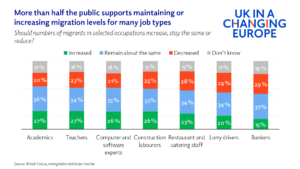
Preferences to reduce, keep the same, or increase numbers of migrants across a range of occupations have stayed almost the same since the last tracker in 2025. More than 60% of the public supports increasing or keeping numbers the same for nurses, doctors, care home workers, engineers, seasonal agricultural workers, academics, teachers and information technology experts. More than half of the public supports increasing or keeping numbers the same for construction workers, restaurant and catering staff, lorry drivers and (for the first time) bankers.
Should numbers of migrants in selected occupations increase, stay the same or reduce?

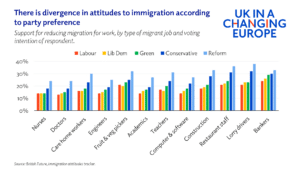
These aggregated figures belie a large divergence in views by political allegiance. Preferences of Labour and Lib Dem supporters are very similar with fewer than one in five supporting reductions in most of the occupations listed. Greens and then Conservatives in turn are somewhat more in favour of reductions. But the preferences of Reform UK supporters show a step change and a wide gap between those of Labour supporters: they are around twice as likely as Labour supporters to favour reductions for occupations including health and social care workers, as well as for IT workers and construction workers.
Support for reducing migration for work by voting intention

Different attitudes to migrant workers reflect divergent priorities
To a degree our findings reflect broad preferences around the scale of immigration. Some 60% of Conservatives and 69% of Reform UK supporters want less migration overall, compared to 38% of Labour supporters. Attitudes to migration for work are more positive than other forms. But they also vary by political allegiance in ways that reflect political values and priorities. These include the importance of the economy, of economic growth and questions of who benefits.
There is a strong economic case for immigration, and agreement that reducing immigration for work on the scale currently in progress will have serious consequences for the economy and for growth. Migration has driven job growth since the pandemic, as rates of economic inactivity in the UK have increased. A continuing fall in net migration is likely to increase the government financial deficit and result in unpopular spending cuts and tax increases.
From a list of priorities, the public ranks growing the economy fourth after dealing with the cost of living, improving the NHS and managing asylum and immigration. Conservatives are slightly more lightly to see this as a priority, and Reform UK supporters the least.
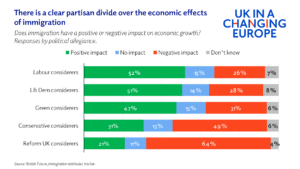
Yet while the economic growth impact of immigration has been shown to be positive, there is no public consensus that it has. Again, views are divided by politics: almost two-thirds of Reform UK supporters believe its impact is negative, and nearly half (49%) of Conservatives. In contrast, a majority of those considering voting Labour (52%) or Lib Dem (51%) believe immigration has a positive impact on economic growth (and 47% of Greens).
Does immigration have a positive or negative impact on economic growth, by political allegiance

The question of who benefits is also important: supporters of Reform UK are less likely than those of other parties to agree that they benefit from economic growth: only a third (33%) say they do, compared to nearly half (48%) of Labour supporters.
How should Labour respond to the fall in migration for work?
Our survey findings show that migration for work is less contentious than other forms of migration. The latest figures show it has fallen continuously since 2024 and is likely to continue. Yet for most of the occupations listed in the tracker survey, only a minority of people across political preferences support the reductions which are taking place.
Just how far the government can go without jeopardising economic growth remains to be seen, but there is a clear danger that this will happen in the absence of a change in policy on work visas.
There is no consensus from the British public on the best course of action, since the priorities of those on the left, centre and right diverge. Supporters of Reform UK, in particular, do not believe that immigration benefits economic growth. Neither do they believe that economic growth benefits them.
Yet people who are likely to vote Labour, or for other parties on the left and centre-left, are in broad agreement that migration benefits the economy and that migration for work should not be cut. This gives the government the permission it may need to reverse the decline in migration for work and achieve its plans for economic growth.
By Dr Heather Rolfe, Director of Research, British Future.
You must be logged in to post a comment Login