Politics
How Do We Define The Far-Right?

How do we define the far-right?
It’s a phrase which has been long associated with those on the political fringes, like the English Defence League (EDL) and the British National Party (BNP).
But the Alternative for Germany (AfD)’s success in a regional election this week has sparked significant alarm that far-right ideas are becoming mainstream again.
The AfD is now the first far-right party to gain power in Germany at a state level since the Nazi era of World War 2.
Britain’s Treasury minister Emma Reynolds said she would put Reform UK in the “same bracket” as AfD, even though many of the parties’ policies are different.
Rising concerns over immigration and the impact of Donald Trump’s second term in power have also caused concern about a global swing towards the political right.
But what exactly makes something or someone far-right? Here’s what you need to know.
What is the far-right?
According to the European Commission, the “extreme right” consists of five characteristics: nationalism, racism, xenophobia, calls for a strong state and an anti-democratic attitude.
Yet the Commission said not all of these traits need to be present for it to qualify as far-right extremism.
Campaigners at Hope Not Hate have also warned that the term is not interchangeable with fascism.
They describe it is an umbrella term which encompasses the “radical right” – who still believe in the essence of democracy – and the “extreme far right” – who reject the ballot box.
Hope Not Hate then claimed the definition of “far right” has not been broadened in recent years, but what we see as normal has changed.
“More ‘mainstream’ figures are increasingly crossing the line making it legitimate to use the term to describe them. The centre ground and conservative right are shifting rather than the definition expanding,” the campaigners said.
They added: “You do not have to be part of a far-right organisation to be a far-right activist.”
So what are the key differences between the far-right and the right-wing?
As voices on the right grow stronger in both the UK and the US, the term “far-right” is often used as an insult, but they are fundamentally different.
Dr Nafeez Ahmed – author of Alt Reich: The Network War to Destroy the West from Within – previously told HuffPost UK: “The right and the far-right are not the same.
“The right is about conserving markets, liberty and nations within a democratic framework.
“The far-right is anti-democratic: it thrives on conspiracy theories, scapegoating minorities and authoritarian ‘solutions’.”
Does anyone in the UK identify as far-right?
According to YouGov, only 3% of Brits identified themselves as “very right-wing”, while a further 9% describe themselves as “fairly right-wing”.
That’s compared to 4% who describe themselves as “very left-wing” and 14% who say they’re “fairly left wing”.
Figureheads like Nigel Farage have been clear to reject the “far right” label, and claims to have “done more than anyone else to defeat the far right in Britain”.
His deputy leader Richard Tice has also described being called far-right “defamatory and libellous” – and the BBC had to issue an apology for describing Reform so in 2024.
How do we define what is happening in the UK right now?

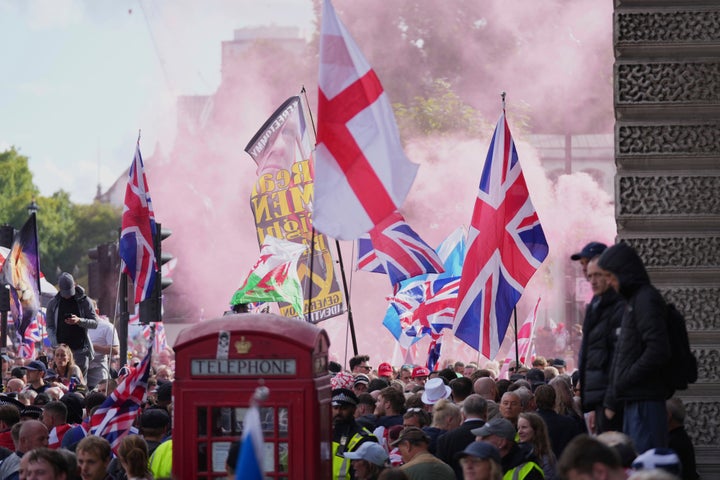
Robinson’s “Unite the Kingdom” rally last September saw Brits from all over the country call for “free speech” and listen to Elon Musk’s call for them to “fight back or die”.
The leader of the Conservatives – traditionally seen as a centre-right party – Kemi Badenoch refused to condemn Musk’s statement, saying that she does not think he was inciting violence.
Two anti-migrant protests over the weekend have also sparked concern, even though the number of small boat crossings have declined compared to last year.
So what does this all mean?
Ahmed explained: “What we’re seeing in Britain is not just a surge of street mobilisation.
“It’s something deeper: far-right narratives – from the so-called ‘Great Replacement’ which says white people are being replaced by Black and brown migrants to attacks on fundamental rights – bleeding into mainstream politics.
“This signals a dangerous new phase. The far right is going mainstream, but it is also morphing into something unrecognisable: a trans-Atlantic project that fuses white nationalism with billionaire-backed techno-authoritarian hyper-capitalism.
“Its goal is not simply to influence democracy, but to smash it and replace it with a system built on surveillance, disinformation and the concentration of wealth and power.”
Why is this such an important topic?
As Britain’s two-party system looks ever-more precarious, movements usually confined to the peripheries of the political system are shifting into the spotlight.
While there is appetite for further movement on the left – as seen by the spike of interest in the Greens – right-wing policies are dominating the news agenda right now and influencing government policy.
The Tories, usually Labour’s strongest centre-right opponents, have also started to drift further right to try and take back its voters from Reform.
As all the parties compete for voters’ attention with stronger policies to tackle immigration, some critics believe there is a dangerous drift to the far-right within the mainstream.
This debate is compounded by rising tensions over in the States, where opponents of the Trump administration have accused the White House of taking government policy to extremes.
London mayor Sadiq Khan claimed in 2025 that the US president had been “fanning the flames of the far-right” by “scapegoating minorities, and illegally deporting US citizens, deploying the military to the streets of diverse cities”.
He warned that the rise of the far-right presented a major threat to Britain’s progressive values – and urged voters to hold onto them during this time of change.
You must be logged in to post a comment Login