Politics
How do young people in the UK feel about its relationship with the EU?
Heather Rolfe aruges that campaigners for a closer relationship with the EU will find it challenging to engage young people in a debate that has passed them by.
In the months following the Brexit vote it was widely noted that older people had swung the vote to Leave while young people had largely voted to remain. Almost three-quarters (73%) of 18–24-year-olds voted Remain, and only 27% Leave, compared to a 60%/40% split among the over 65s. Media articles talked of baby boomers ‘messing things up’, or ‘snatching away’ young people’s freedom of movement.
It is often assumed that the 2016 vote division by age remains, and even that anti-Brexit feeling among young people has become stronger. Recent research by British Future on public attitudes to a future UK-EU relationship casts doubt on this narrative. Findings suggest that pro-EU campaigns cannot take the youth vote for granted.
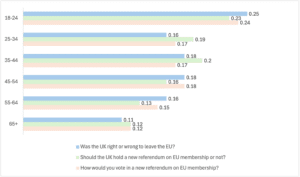
It’s true that 18–24-year-olds are more likely to believe it was wrong for the UK to leave the EU (57% vs 49% for all age groups), but they are much more likely than others to say they don’t know (31% vs 19%). Across a range of other questions on the future UK-EU relationship they are also more likely to lack an opinion or to lack understanding of key aspects, including free movement.
Nearly a quarter of young people (23%) say they don’t know whether the UK should hold a second referendum or not, compared to 15% across all age groups. When asked how they would vote in a future referendum, they are least likely to support staying out (17% vs 29% of all age groups). But they are also much more likely than others to say they don’t know or would not vote (39% vs 25% of all ages).
‘Don’t know’ responses to key questions on the UK’s membership of the EU by age group

As recorded by many other surveys on immigration, ours found that young people aged 18-24 have more positive attitudes to immigration than other age groups and are less likely to favour reductions in immigration numbers. But this does not necessarily mean they are more in favour of EU migration or free movement. They are less likely than those in other age groups to say it should be easier to work in another EU country (46% vs 53%). They are also more likely than others to say they don’t know whether post-Brexit immigration controls should be kept, whether they would accept free movement if it meant less trade or if they would support a range of measures to manage free movement (for example restrictions on state benefits).
All of this might be understandable given that they were children or adolescents at the time. However, it might also be expected that as young adults they would be more inclined than others to support the types of mobility that they, or their siblings, could benefit from. However, they are no more likely than others to support a closer UK-EU relationship for school trips or for study. And, strikingly, they are less likely than other age groups to support the Youth Experience Scheme, currently under negotiation, by 45% compared to 57% of all age groups.
To understand attitudes in more depth, we held eight focus groups – two of them with young people who could not vote in 2016. Participants said that Brexit was not their decision, whether they thought it had been a good idea or not. The idea that young people have disproportionately lost out was a stronger theme of the all-age groups than those with young people. However, when potential opportunities for young people were discussed with 18–24-year-olds, they did feel that they had few opportunities to study and work in the EU.
Participants of all ages liked the idea of Erasmus+, the EU’s funding scheme for education, training, youth, and sport which the UK will join in 2027. They also liked the idea of the Youth Experience Scheme. For both, support came with the condition that they are inclusive and available to young people facing financial or other barriers. Older people believed that Erasmus had largely benefited those from advantaged backgrounds. Young focus group participants said they would not know how to go about looking at study or work opportunities abroad and wanted help with this if they were to participate.
We had expected young people to be more in favour than they were of a closer UK-EU relationship in their survey responses and to be more engaged in the focus group discussions. Their detachment from the issues is partly because, as they said in the focus groups, they were too young to absorb the arguments around free movement, sovereignty and rule taking vs rule making. Few also said they had learned about the EU at school or discussed with family or friends. Wider research suggests they are not disengaged from politics in general, but are more interested in issues such as job insecurity, cost of living and housing affordability.
Are today’s 18–24-year-olds fundamentally different to those of 2016? Research before the referendum found similar levels of disengagement to now: only half said they were certain to cast a vote, compared to more than two-thirds in other age groups. Turnout in the referendum was also lower in areas with a higher proportion of young people.
The planned reduction in the voting age to 16 is seen as an opportunity to encourage interest in democratic engagement. However, more is needed if young people are to engage in the UK’s place in the EU. Their lives and opportunities are rarely part of the narrative of campaigners, politicians and the media and many do not see it as relevant to their lives. On the issue of youth mobility which offers them opportunities, the focus of the debate is on inward migration: how many EU citizens will come to the UK for work or study? Should numbers be capped and who will pay their study fees?
It might also be that opportunities to study and work abroad appeal to relatively few young people, even if barriers were removed. But we can only be certain if they are more involved in discussions about what a closer future relationship might mean for them.
By Dr Heather Rolfe, Director of Research, British Future.
You must be logged in to post a comment Login