Connect with us

Politics

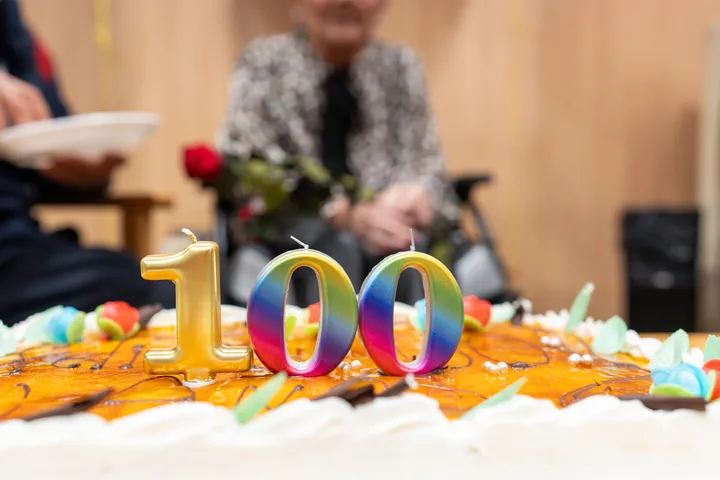
If Your Parent Lives To 100, It Might Spell Good News For Your Longevity

Published

on

The offspring of centenarians tend to live longer, too.

If one or both of your parents lives to 100 – or surpasses that mighty age – it might mean you’re likely to reap the rewards, too.

Not only do you get to spend more time with your parent(s), but a new study suggests children of centenarians are likely to also live longer – and they’re less likely to develop cardiovascular disease and hypertension, too.

What did the study find?

Researchers at Albert Einstein College of Medicine, Boston University, and Tufts Medical Center analysed data from three long-running studies. A total of 2,319 centenarians’ offspring were compared with 2,703 controls (the offspring of people who lived to age 85 or younger).

Advertisement

Compared with people whose parents had shorter lifespans, centenarians’ offspring had a 42% lower risk of early death, the study found. They also had a 33% lower risk of cardiovascular disease, and a 32% lower risk of high blood pressure.

Having a centenarian parent didn’t seem to affect cancer or stroke risk, however.

The offspring of centenarians tend to live longer, too.

Daniel Lozano Gonzalez via Getty Images

The offspring of centenarians tend to live longer, too.

“The overall consistency of these findings across these quite different studies was especially noteworthy and reinforces the idea that exceptional longevity runs in families,” said Eric Reed, a staff scientist in medicine and lead author of the study.

“This is not to say that lifestyle doesn’t count – healthy behaviours remain important for everyone.”

Advertisement

Researchers said studying families with exceptional longevity can provide a window into the biology of healthy ageing and might even lead to treatments that could enhance lifespan, including in those who don’t inherit exceptional longevity from their parents.

Study co-author Paola Sebastiani, director of the Center for Quantitative Methods and Data Science at Tufts Medical Center, ended: “These findings bring us closer to understanding the biological factors that may help protect against age-related disease and promote longer, healthier lives.”

What can I do for my own longevity?

If you’re keen to try and ‘lifemaxx’, Dr Asiya Maula, a GP and functional and lifestyle medicine specialist at The Health Suite, previously shared three habits she swears by for healthy ageing and longevity.

Advertisement

1. Regular strength training and general exercise

“Building and maintaining muscle mass is so important, especially as we age,” Dr Maula said.

“I try to stick to at least two strength sessions a week, plus making sure I do some kind of daily movement each day, whether that be a brisk walk, some yoga or swimming.”

2. Getting at least seven hours sleep a night

Advertisement

“Good quality sleep is fundamental to living a healthy life so I always try to prioritise getting at least seven hours each night,” the doctor added.

“That means sticking to a regular bedtime routine and turning off my phone at least an hour before bed each night.”

3. Following a Mediterranean diet

“Finally, I like to stick to a Mediterranean diet that prioritises whole foods, healthy fats and lean protein,” the GP ended.

Advertisement

“Numerous studies have linked a Mediterranean diet to a reduced risk of chronic disease and increased lifespan. It’s also not overly restrictive, so it doesn’t feel like a diet, but becomes a way of life instead.”

Source link

Advertisement
Continue Reading
Click to comment

You must be logged in to post a comment Login

Leave a Reply

Politics

Emmys 2026: 19 Awards Show Moments You Might Have Missed

Published

on

Every year, the Emmys gathers some of the biggest names from the small screen under one roof to celebrate the past year’s achievements in TV – and this year’s ceremony was especially jam-packed with stars.

Unfortunately, the Emmys is one of those few US awards shows that doesn’t actually air in the UK, meaning those of us on this side of the Atlantic often miss out on the fun (which is particularly disappointing in years like this one, when numerous homegrown stars are up on stage there winning prizes).

However, we’re happy to say that we’ve got you covered.

Advertisement

From the red carpet to the main event, here are all the key moments you might have missed from the 2026 Emmys, where Widow’s Bay, The Pitt, Pluribus and Hacks were among the evening’s most recognised shows…

Obviously, whenever Zendaya steps onto a red carpet, that’s going to be a moment

But some of our other favourite red carpet looks from the 2026 Emmys included Florence Pugh

Colman Domingo (who never misses, let’s be real)…

…and Selena Gomez, who dressed fittingly for the awards show in gold

Meanwhile, if ever there was a chance you’d forgotten what Monday night’s red carpet was for, Hacks star Megan Stalter was on hand to remind us

The night’s host Mariska Hargitay kicked things off with a pre-recorded musical number celebrating some of the year’s nominees, featuring cameos from HuffPost faves Jean Smart, Jennifer Coolidge and Jeff Hiller

Kate O’Flynn got the ceremony off to a great start as the first Brit of the night to win an award for Widow’s Bay

Her Widow’s Bay co-star Matthew Rhys then picked up his first award of the evening for The Beast In Me, briefly tapping into his character from the Netflix series before delivering his acceptance speech

Advertisement

Nicole Kidman heckled host Mariska Hargitay during a skit parodying her now-infamous AMC sketch

There was no mistaking how excited Sally Field was to win her award (the best part has to be when she praised ‘author Shelby Van Pelt… or whatever her name is… anyway, she knows what it is’)

Taylor Swift surprised everyone when she joined host Mariska Hargitay in a pre-taped sketch about whether or not she’d be at the Emmys (spoiler alert… she wasn’t because, as was said in the skit, ‘her husband has a work thing’)

Matthew Rhys then made Emmys history as the first actor to win two leading awards in the same night

As did Jean Smart – not only becoming the first actor to win an acting Emmy for every season of a show, but also matching the record for the most performance wins ever

Country icon Reba McIntyre’s tribute to three-time Emmy winner and ‘piece of America’s heart’ Dolly Parton had us totally choked up

And by the time it got to Macaulay Culkin and the Schitt’s Creek stars sharing their memories of Catherine O’Hara, we were a total mess

Advertisement

The Pitt went into the night as the most recognised show, and while it wasn’t exactly a clean sweep for the medical drama, it did pick up a couple of awards, including an acting win for Noah Wyle, making him another of the night’s double winners due to his work as a producer, too

Towards the end of the ceremony, Matthew McConaughey and Woody Harrelson piled on the charm to present Best Comedy Series

And – by this point, as if there was any doubt – Widow’s Bay rounded off the night with one last win

Advertisement

Source link

Continue Reading

Politics

Donald Trump Condemned For Dismissing AI Threats As Hoax

Published

on

Donald Trump Condemned For Dismissing AI Threats As Hoax

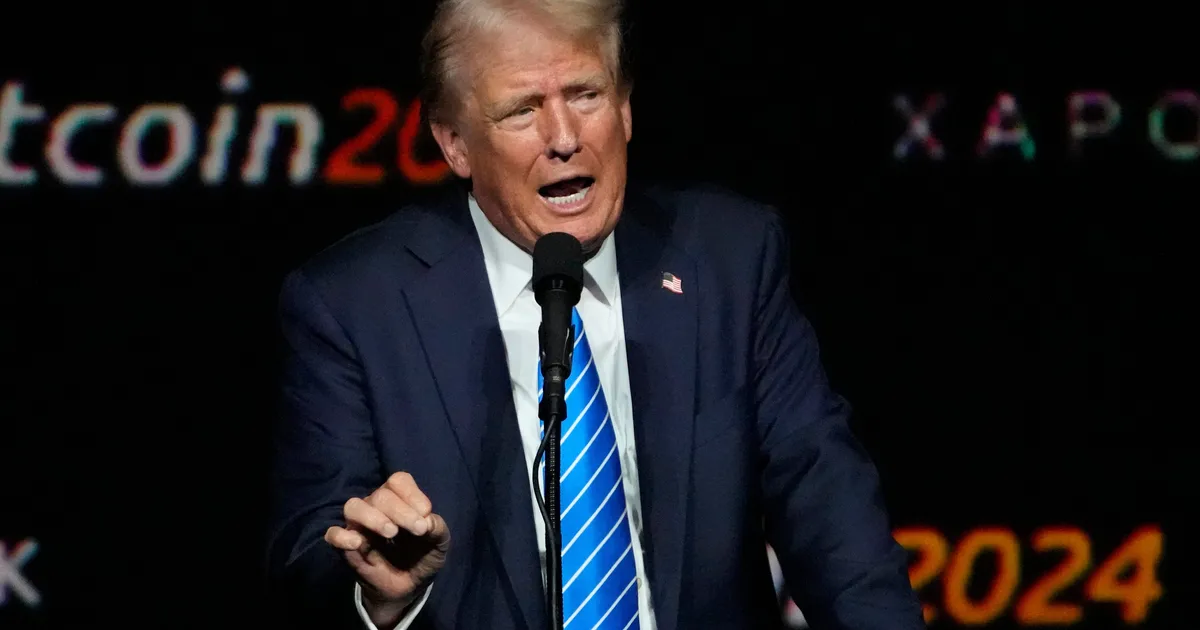
Donald Trump has been condemned after dismissing warnings that articifical intelligence could destroy humanity as “a hoax”.

The US president was accused of “gaslighting” the entire world after he said AI and the data centres that drive it “will be the greatest economic development engine in history”.

Trump himself is a keen user of AI, regularly posting bizarre slop videos and images on Truth Social.

Senior executives and staff at AI firms have called for greater regulation of the technology before it gets out of control.

Advertisement

But in a rambling post on Truth Social, Trump rejected those fears and said there were no need for new guardrails to tame the technology.

He said: “Concerning AI, when, in the History of Business, did anyone see the Leaders of an Industry call for Regulation that, if strongly implemented, will drive them into oblivion and bankruptcy?

“AI taking over the World, destroying Humanity, and all other things bad, is a HOAX, no different from RUSSIA, RUSSIA, RUSSIA — UKRAINE, UKRAINE, UKRAINE — IMPEACHMENT HOAX #1 — IMPEACHMENT HOAX #2 — and all of the other HOAXES and SCAMS that America was forced to endure through the Destructionists’ and Deviants’ foul play and illegal conduct.”

Trump said President Xi of China “will be doing absolutely nothing to stand in the way of AI, or its future” and so America should follow suit.

Advertisement

He added: “AI, and Data Centers, will be the Greatest Economic Development Engine in History — Bigger than Oil, Gold, Diamonds, or even the Internet.”

But his comments drew widespread criticism online, with the president being branded “unfit for office” for gambling with the future of the planet.

Meanwhile, First Secretary of State Louise Haigh will today say the government must “heed the warnings” of AI experts about the dangers posed by technology.

Addressing the TUC congress in Brighton, she will say ministers are “ready to work with international partners” to prioritise public safety and national security.

Listen to Commons People, the podcast that makes politics easy. Every week, Kevin Schofield and Kate Nicholson unpack the week’s biggest stories to keep you informed. Join us for straightforward analysis of what’s going on at Westminster.

Advertisement

Source link

Continue Reading

Politics

3 Symptom Patterns That Could Flag Your Child Has Cancer

Published

on

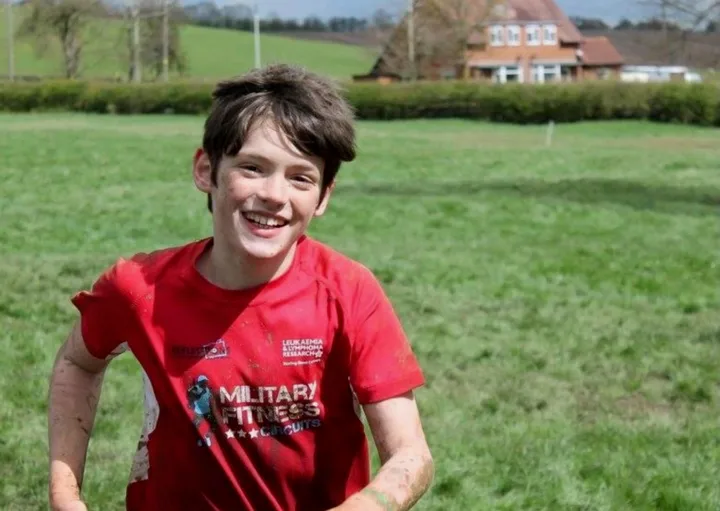
Fred Bennett died a year after his leukaemia diagnosis.

A mum is urging parents to be aware of the symptoms that could flag childhood cancer, after her son was diagnosed with leukaemia at just 13 years old and tragically died a year later.

Louise Bennett, from Rugby, Warwickshire, said her son Fred had initially seemed tired and off his food, which the family put down as typical teenage changes and tiredness with the school year coming to a close.

But when his glands began to swell, they took him to the GP thinking it might be glandular fever instead.

A blood test revealed he had acute lymphoblastic leukaemia (ALL), and within hours he was preparing to begin treatment at Birmingham Children’s Hospital.

Advertisement

Around 1,900 children aged 0-14 are diagnosed with cancer in the UK every year, and cancer remains the leading cause of death from disease among children.

Yet survey findings from CCLG: The Children & Young People’s Cancer Association reveal that public awareness of childhood cancer is low.

Louise said: “I didn’t know anything about childhood cancer in terms of what to look for. I had memorised all the symptoms of meningitis. I knew about sepsis. I actually sent my husband a list of sepsis symptoms the day before we took him to the GP because that was in my mind.

“But a cancer diagnosis was completely off our radar.”

Advertisement

Sadly, her son died in May 2020 – a year after his diagnosis – aged 14.

Fred Bennett died a year after his leukaemia diagnosis.

The most common types of cancer in children are leukaemia, brain tumours and lymphomas, according to Children With Cancer UK.

As the symptoms of childhood cancer can mimic common illnesses and viral infections, CCLG’s Child Cancer Smart campaign is encouraging parents and carers to look for patterns of symptoms rather than focusing on a single sign.

Dr Sharna Shanmugavadivel, a paediatric emergency medicine doctor and the Child Cancer Smart lead, has shared three patterns of change in a child’s health that may need investigating.

If symptoms don’t go away after two weeks or something doesn’t feel right, her advice is simple: “Trust your instincts and see a doctor.”

Advertisement

Stay vigilant for three symptom patterns

1. Persistent symptoms

These are symptoms that do not improve or go away as expected and keep coming back after a child has been unwell.

Parents and carers should look out for symptoms that last longer than expected or where their child is taking more time than usual to recover from an illness, said CCLG.

Advertisement

2. Progressive symptoms

Any symptoms that get worse, become more frequent, or change over time rather than improving as expected should be flagged with a GP.

Parents and carers should look out for changes in the way symptoms develop, for example, a child may start with one symptom, such as a headache, but over time the symptom may become more severe or additional symptoms may appear.

3. Clustered symptoms

Advertisement

This refers to a group of symptoms that appear together rather than a single symptom on its own. Parents and carers should look out for combinations of symptoms, particularly when they occur at the same time, persist, or seem unusual for their child.

For example, a child who has ongoing tiredness alongside unexplained bruising, persistent pain, fever, or a lump may need further medical advice.

Symptoms can vary depending on the type of cancer, but these should definitely be checked out

Some of the more common signs and symptoms of childhood cancer include:

Advertisement
  • persistent tiredness or paleness,
  • repeated infections,
  • flu-like symptoms that don’t go away,
  • unexplained bruising or bleeding,
  • ongoing fever or night sweats,
  • persistent aches or pains,
  • unexplained lumps or swelling,
  • limping or leg weakness,
  • changes in bowel habits,
  • unexplained weight loss,
  • slow growth,
  • and changes in behaviour.

Source link

Continue Reading

Politics

Emmys 2026: Full Winners List As Widow’s Bay And Matthew Rhys Make TV History

Published

on

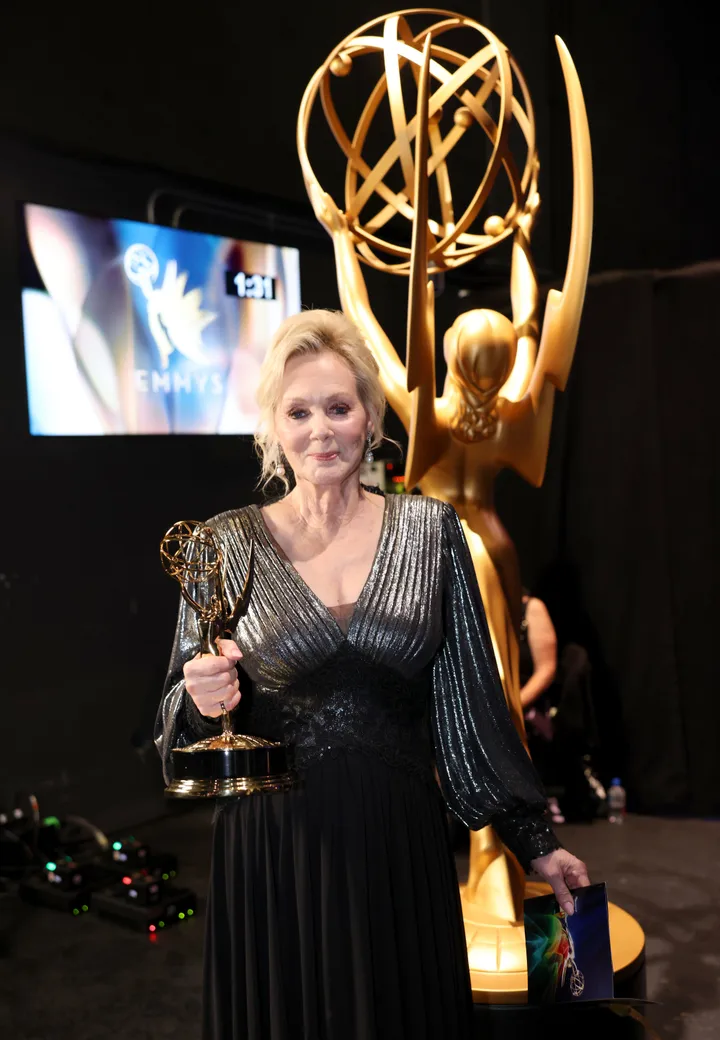
Jean Smart has now won an Emmy for every season of Hacks

In news that will come as little surprise to anyone who’s binge-watched Apple TV+’s Widow’s Bay in the last five months, the hit comedy horror was the big winner at this year’s Emmys.

Across major and technical categories, the show came away with a total of 14 Emmys this year, the most for any single season of a comedy in the awards show’s history.

This included acting wins for cast members Kate O’Flynn, Stephen Root and Matthew Rhys, who also made history as the first performer to win an Emmy for two leading performances in the same night, having also picked up a prize for his work in Netflix’s The Beast In Me.

Meanwhile, Hacks star Jean Smart set a new record of her own, as the first person to win Best Actress for every single season of a show’s run.

Advertisement
Jean Smart has now won an Emmy for every season of Hacks

With a total of eight wins across her career, she now equals Cloris Leachman and Julia Louis-Dreyfus’ record for the most acting wins at the Emmys.

Here’s the full list of who won what at the 2026 Emmys on Monday night…

Outstanding Supporting Actress In A Comedy Series

Kate O’Flynn (Widow’s Bay)

Outstanding Lead Actress In A Comedy Series

Advertisement

Outstanding Lead Actor In A Limited Series, Anthology Series Or TV Movie

Matthew Rhys (The Beast In Me)

Outstanding Supporting Actress In A Drama Series

Allison Janney (The Diplomat)

Advertisement

Outstanding Lead Actress In A Drama Series

Kate O'Flynn was among the winners for Widow’s Bay
Kate O’Flynn was among the winners for Widow’s Bay

Outstanding Supporting Actor In A Comedy Series

Stephen Root (Widow’s Bay)

Outstanding Reality Competition

Outstanding Lead Actor In A Drama Series

Advertisement

Outstanding Supporting Actor In A Drama Series

Outstanding Lead Actress In A Limited Series, Anthology Series Or TV Movie

Sally Field (Remarkably Bright Creatures)

Outstanding Lead Actor In A Comedy Series

Advertisement

Matthew Rhys (Widow’s Bay)

Outstanding Writing For A Comedy Series

Outstanding Directing For A Drama Series

Outstanding Variety Series

Advertisement

The Late Show With Stephen Colbert

Noah Wyle adds two more Emmys to his collection for The Pitt

Outstanding Directing For A Comedy Series

Outstanding Writing For A Drama Series

Outstanding Limited Series, Anthology Series Or TV Movie

Outstanding Drama Series

Advertisement

Outstanding Comedy Series

Source link

Advertisement
Continue Reading

Politics

Lord Ashcroft: Can the right unite? I’ve revisited the question after a summer of upheaval in the political landscape

Published

on

Lord Ashcroft KCMG PC is an international businessman, philanthropist, author and pollster. For more information on his work, visit lordashcroft.com

 Much has changed since we last looked at the idea of an alliance between Reform UK and the Conservatives. It was, for one thing, a whole prime minister ago (admittedly not as great a measure of political time as it once was), and the fortunes of several parties look different. Is the same true for the prospects of a united right?

A year ago, with a consistent ten-point poll lead and a divided opposition, Nigel Farage could credibly claim that he was going to win the next election and form a majority government with no help from anyone else. That lead has disappeared, and as we saw in Gorton and Denton, Caerphilly and Makerfield, the party’s opponents are willing to vote tactically to keep Reform out. This is not to say that a Reform majority government is impossible, but it is certainly not inevitable. Even if Labour’s Burnham bounce subsides, the damaging publicity around Reform’s finances is likely to endure.

Another factor is the removal of Keir Starmer, whose tenure was marked by a parade of unforced errors and an inability to articulate any kind of purpose: this, rather than the unpalatable but necessary decisions inherent in modern government, was the root of his unpopularity. Even allowing for the adage that elections are lost by governments rather than won by oppositions, Keir Starmer was the ideal incumbent for the Conservatives and Reform.

Advertisement

We might also consider recent policy announcements from the two parties, which suggest might they could find common ground in areas like net zero, welfare, defence and the European Convention on Human Rights.

All of that being the case, if Nigel Farage regarded coming to an agreement with the Conservatives as an unnecessary and avoidable risk, that is no longer the case – not because it isn’t risky, but because all options are risky. Leaders can employ a risk-averse “ming vase” strategy when blessed with double-digit polling leads, but when their party is level or slightly behind in the polls, that won’t cut it.

On the Conservative side, if they would once have been the junior partner in an alliance with Reform, they would now look much more like equals. In the new political landscape, should they look at such an arrangement with new interest? When we looked at a potential Conservative-Reform alliance last September, we found it was considerably weaker than the sum of its parts. Have the changing circumstances made a united right more viable?

The starting point is that a party leader will need the support, or at least acquiescence, of their voters for any kind of deal. We found previously that Conservative voters were much more likely to oppose working with Reform: any alliance would disproportionately damage the Tories. We have analysed this again based on people’s answers to two questions: first their preference in a head-to-head between Burnham and the other party’s leader (Badenoch if they are Reform voters, Farage if they are Conservatives); second their preference for a coalition comprising Reform and the Tories or between Labour, the Lib Dems and the Greens. Based on this, we have three groups:

Advertisement
  • Loyalists, who prefer the other right-wing party’s leader to Burnham and who prefer a Conservative-Reform coalition
  • Defectors, who prefer Burnham to the other right-wing party’s leader and who do not prefer a Reform-Conservative coalition in the event of a hung parliament (they either prefer the left-wing coalition or say they don’t know)
  • Waverers, who do not fall into either of these category
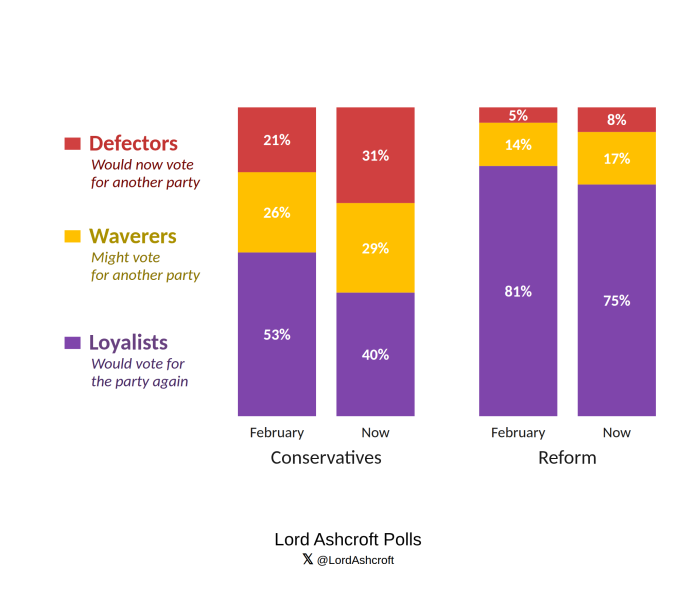
Last time, a slender majority of Conservative voters were loyalists; this majority has shrunk to a plurality of just 40 per cent. The growth has mostly come in defectors, who are up by 10 points to 31 per cent. While Reform voters remain broadly positive about such an arrangement, the proportion of loyalists among them has dropped 6 points to 75 per cent; waverers and defectors are both up slightly compared to last time. Not only do Conservative voters remain much less positive than Reform voters about a Conservative-Reform alliance, their disapproval is growing more quickly.

As the name suggests, we would expect loyalists to stick with a Reform-Conservative alliance and defectors to refuse to vote for it. If we assume that all the loyalists, half of the waverers and none of the defectors would vote for a Reform-Conservative alliance, then we would currently expect it to poll 28 per cent of the vote – much less than the share the two parties currently command between them.

Of course, the argument could be made that these defectors – of either shade of blue – are not actually going to end up supporting the party which they currently say they do. To assess this, we turn to our political map, where we have plotted the current support for each of the major parties, as well as the Reform and Conservative voters of interest. The size of the bubbles is proportional to the size of the voter group, and the closer bubbles are together, the more similar these groups are.
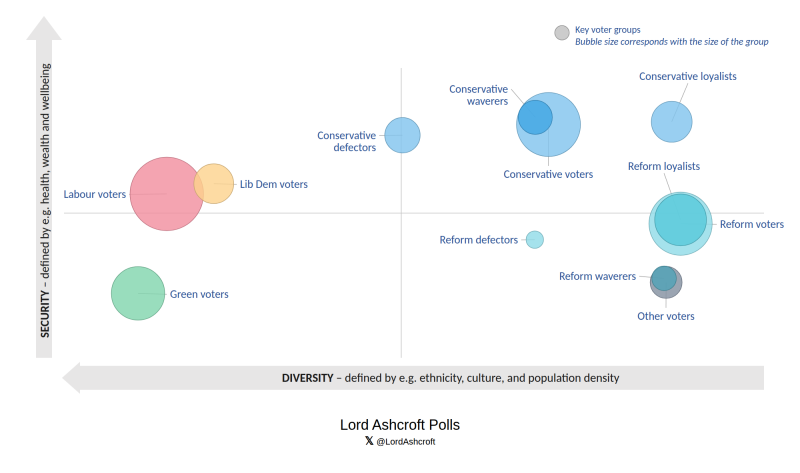
The Conservative defectors (who prefer Burnham to Farage and do not prefer a Tory-Reform coalition to a Labour-Lib Dem-Green one) are at around the “12 o’clock” point on the map, not especially close to any of the major party bubbles. However, they are still closest to the Conservative bubble and therefore have most in common with current Conservative voters. The Conservative waverer bubble overlaps with the overall Conservative bubble, suggesting that this is where the centre of gravity in Conservative opinion currently sits.

Advertisement

For Reform, the overall bubble and the Reform loyalist bubble largely overlap – unsurprisingly, given that three quarters of Reform voters are loyalists. However, the Reform waverer bubble overlaps with the bubble for people intending to vote for a party other than the major parties (mostly Restore Britain). Therefore, while the Conservative defectors look likely to end up voting Conservative at the next election (if there isn’t a unite the right alliance), the Reform defectors – and especially the Reform waverers – are closer to the bubble for “another party” than their own party’s bubble.

This suggests that the voters who Reform would risk losing from making a deal with the Conservatives are already at high risk of switching away from Reform (mostly to Restore Britain), whereas the Conservatives would risk losing voters who are otherwise not especially likely to switch away from their party.

We can confirm this with a simple question about whether people feel there is a political party which represents them. Overall, 49 per cent of people say that they can usually find a party which more or less represents their views, while 40 per cent say that none of the current parties really represent them. The remaining 11 per cent say they don’t know. The chart below illustrates how this question breaks down among the various groups of Conservative and Reform voters.
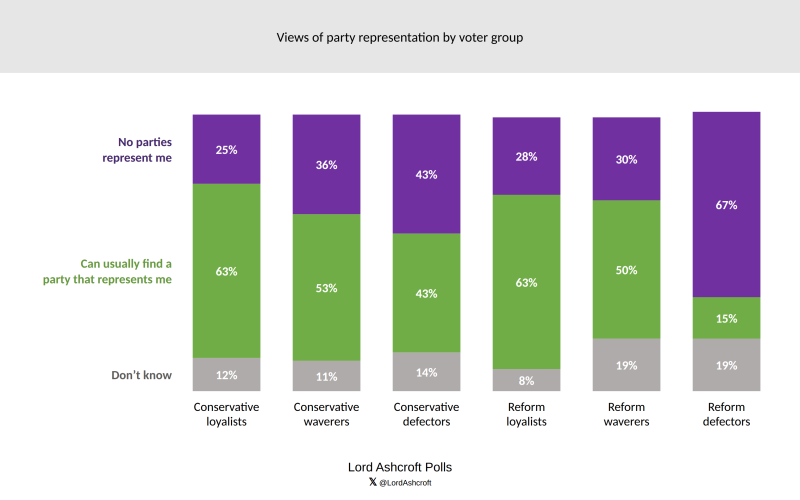
The Reform defector column here is the noteworthy: two thirds of these people – who are currently saying that they’ll vote for Reform – say that none of the British political parties represent them. That suggests that these voters will be difficult for Reform to retain. In contrast, the Conservative defectors divide evenly as to whether they feel any party represents them. Looking at the political map, one can understand it: these voters are in a “no-man’s land” between the Labour and Conservative bubbles, albeit closer to the Tories. We have written before about the challenge Badenoch faces in keeping her voter coalition together: she cannot make these centrist “12 o’clock” voters the cornerstone of policy offerings because that gives Reform a free hand on the right, but nor can she lose them.

Advertisement

Another question – how likely people are to vote for each party are to support each party at the next election on a scale from zero to one hundred – allows us to distinguish between committed supporters and floating voters. We can therefore derive three categories of voters for each party:

  • Core voters, who say their likelihood of supporting that party is very high (75+ out of 100)
  • Soft voters, whose likelihood to support is between 50 and 75
  • Potential voters, who are currently intending to support a different party but who are at least slightly open (25-49) to supporting this party
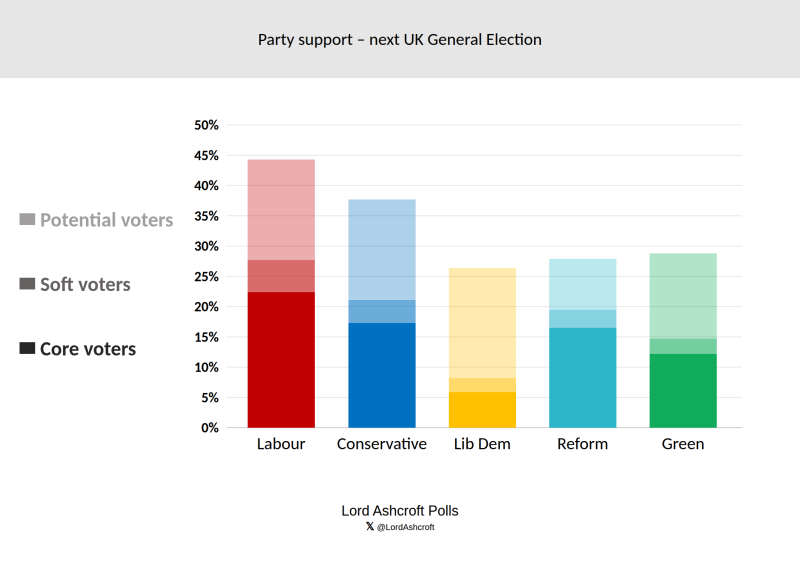
Asking about the individual parties we find Labour slightly ahead, but with the combined Reform and Conservative vote share some 13 points higher than the Labour vote share. Notably, Reform have the smallest gap between their floor and ceiling and the highest proportion of their current voters being core voters, demonstrating that they retain a highly motivated base, but have limited scope for expanding their vote share.

When we ask the same question including a Conservative-Reform alliance in place of the two parties separately we find a somewhat different picture:
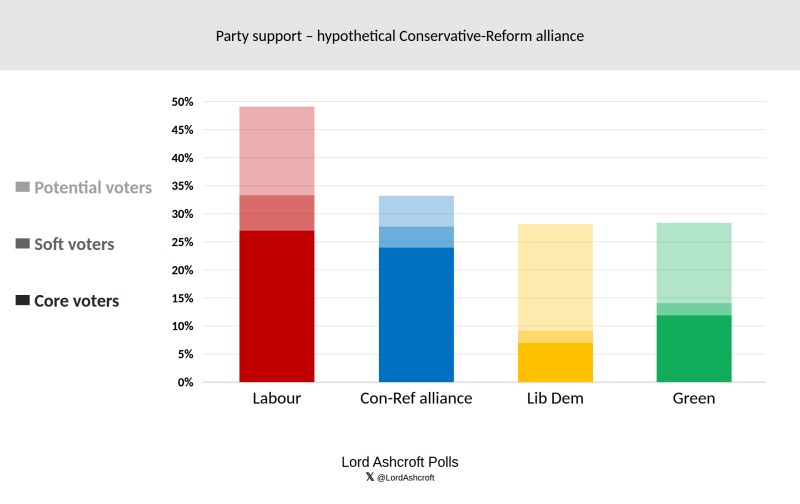
Merely because of facing a Conservative-Reform alliance, Labour’s vote share increases five points, and their ceiling also increases by five points. One might think that this is a manifestation of anti-right bloc tactical voting, but in fact only 8 per cent of these voters come from other parties on the left: 31 per cent of these new Labour voters would currently vote for the Conservatives, 29 per cent are undecided, and more than a quarter say they would not vote.

Advertisement

The Conservative-Reform alliance cuts Labour’s current lead from 7 points to 5 points. However, while the Reform vote share and the Conservative vote share add up to 41 per cent, the alliance only manages 28 per cent – some 13 points lower. This is even worse than a year ago, when we found that a Conservative-Reform alliance would poll 10 points less than the sum of its parts. The alliance also has a high floor and a low ceiling. Its ceiling is at 33 per cent, halfway between the Reform’s at 28 per cent and the Conservatives’ at 38 per cent. These are inauspicious numbers for a putative alliance.

If uniting the right has never been more important since we entered the era of five-party politics, it has also never been more difficult. An electoral alliance between Reform and the Conservatives would be doomed to fail, and the Conservatives have much more to lose from trying.

Full data at LordAshcroftPolls.com

The post Lord Ashcroft: Can the right unite? I’ve revisited the question after a summer of upheaval in the political landscape appeared first on Conservative Home.

Advertisement

Source link

Continue Reading

Politics

Trump’s Irish trip was a nightmare for his haters

Published

on

Trump’s Irish trip was a nightmare for his haters

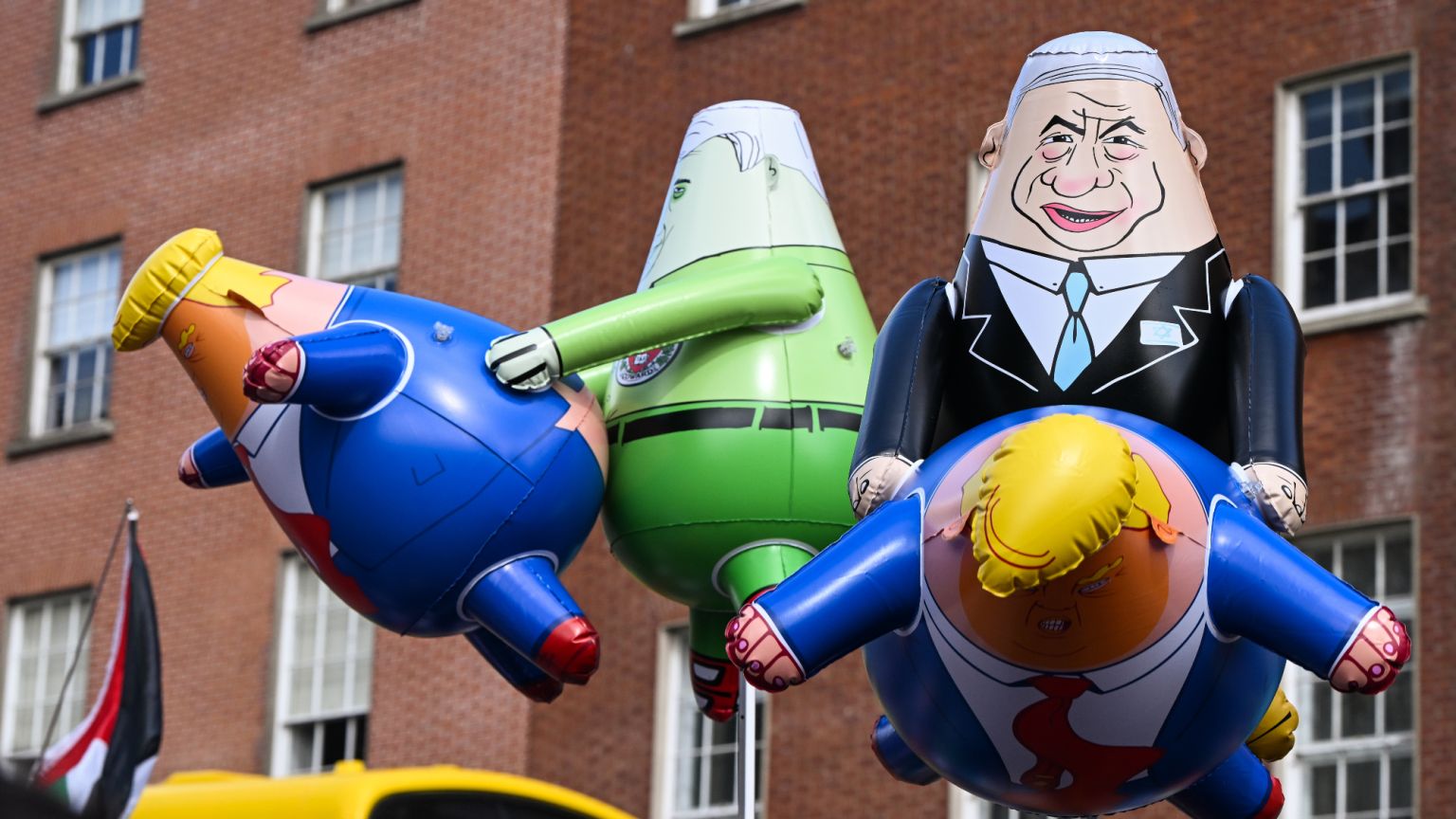
Who sounds madder to you: the bloke in the pub who likes golf and whiskey or the twat on the street wearing a keffiyeh like a holy shroud while cackling dementedly as an inflatable Jeffrey Epstein sodomises an inflatable Donald Trump? Come on, it’s an easy one. Give me the normie whiskey-sipper over the bourgeois half-wit who simps for Hamas any day of the week. Luckily for Trump, it was the former who cheered for him during his trip to Ireland, while his haters consisted of the most batshit agitators ever to disgrace the streets of Dublin.

It always amazes me when Trump supporters are painted as loons, given there’s no one in Christendom as nutty and annoying as a Trump hater. His two-day jaunt in Ireland was hard proof that anti-populists are far more mentally unstable than populists. Trump was cheered by everyday men and women thronging the bar of his golf course in County Clare, while 150 miles away, in the fallen city of Dublin, overeducated eejits foamed at the mouth about the ‘Epstein class’ and raised the trans flag alongside the Palestine flag. Imagine calling Trump supporters thick when you don’t even know that the only ‘transition’ a genderfluid Mick would be permitted to undergo in Gaza would be from the top of a tall building to the street below.

Trump’s visit to Ireland was hilariously uncontroversial. The press had panted for scandal. Ireland ‘braces’ for the Trump storm, said Time. We must ‘expect the unexpected’, said the Irish Independent. They couldn’t wait for Trump to say something crazy so that they might wank out yet more thinkpieces on what a menace to decency he is. Yet all he did was swap niceties with Taoiseach Micheál Martin, watch the Irish Open at his Doonbeg golf course, and commit to lifting tariffs on Irish whiskey. Will that apply just in Ireland or across the EU, he was asked? ‘Just Ireland’, he said. Oh snap.

Advertisement

The only thing they could cite as proof that he’s still the great uncouth blunderer of Western politics was his comment on Irish unification. A United Ireland would be a ‘fantastic thing’, he said. But here’s the thing: that’s an entirely mainstream opinion in the Irish republic. It’s the only thing Trump’s cheerers in Doonbeg and his detractors in Dublin are likely to agree on: that Ireland should be united. Even former UK PM Gordon Brown has said it’s ‘inevitable’ Ireland will be united.

Yet that didn’t stop the broken-record loathers of Bad Orange Man from trying to blow up his comments into the scandal of the decade. Trump used his trip to ‘fan the flames’ of war in Northern Ireland, said the Daily Beast. Babe, lie down. The idea that a throwaway remark by a US president could reignite the Troubles is not only fantastically dumb – it’s borderline anti-Irish racism. The Irish Indie used the words ‘geopolitical bombshell’ for its recap on Trump’s visit, yet it could cite not one crazy thing done by Trump. You could smell the disappointment.

Advertisement

Enjoying spiked?

Why not make an instant, one-off donation?

We are funded by you. Thank you!

Advertisement


Please wait…

Advertisement
Advertisement

No, for true insanity, for a glimpse into the bottomless black hole of dogmatic stupidity, one had to look to the opposition to Trump. Thousands gathered in Dublin to impotently froth about the president. It was a sea of Palestine flags – raw proof that that emblem has been wholly hijacked by pampered Westerners as little more than a vanity metric for their own moral superiority. The irony was too much: Trump gave voice to a genuinely Irish nationalist idea, while his haters wrapped themselves in a foreign flag, clearly preferring the holy relic of performative Palestinianism to anything Ireland-related. The populist cares for nationhood, the anti-populist only for the self.

They burnt the US flag. Down with the Land of Free, up with the Land of Hamas! A blimp version of Benjamin Netanyahu and Jeffrey Epstein took it in turns to bugger a blimp version of Donald Trump. Two Jews fucking an American president in the ass – it’s not exactly subtle, is it? The old fascists saw Jewish tentacles everywhere, the new ones see Jewish todgers. To drive the point home, placards showed Epstein and Netanyahu as the puppetmasters of a marionette Trump. Yeah, that’s anti-Semitic as hell. You almost have to admire the nuclear-grade gall of activists screaming ‘Fascist!’ at a democratically elected president even as they hold up imagery that might have made Der Stürmer wince.

Advertisement

Of course the trans flag was everywhere, too. No lefty demo is complete without the voodoo cry that you can have a cock and be a woman. Quite when ‘left-wing’ became synonymous with being a socially disordered douche who thinks men should be free to show their knobs to women (‘trans rights’) and Islamofascists should be free to kill Jews (‘resistance’) is anyone’s guess. But we can all agree, surely, that the sex-denying, Jew-taunting, anti-American bollocks on display in Dublin was in every way imaginable more unhinged than anything said by anyone in Doonbeg.

We’re told to fear populism but I find anti-populism far scarier. Trump might not be your cup of tea – fine – but an anti-Trump movement that agitates for the right of hulking fellas to play in women’s sports and for Hamas to annihilate the Jewish State all the way ‘from the river to the sea’ should horrify you far more. After his two days in Ireland we’ve learnt that Trump likes golf, whiskey and winding up Brits by yapping about a United Ireland, and that his haters think Jews control the world and a 6ft fella in a dress is literally a woman. Choose your fighter.

Advertisement

Source link

Continue Reading

Politics

EARLY ACCESS: Why suicidal empathy will bring down the West

Published

on

EARLY ACCESS: Why suicidal empathy will bring down the West

The post EARLY ACCESS: Why suicidal empathy will bring down the West appeared first on spiked.

Source link
Continue Reading

Politics

Good riddance to RuPaul’s Drag Race

Published

on

Good riddance to <em>RuPaul’s Drag Race</em>

When the BBC television programme The Black and White Minstrel Show breathed its last one evening in 1978 after a whopping 20 years, I don’t think many people were that cut up about it. Except, of course, the entertainers involved, who included a young Lenny Henry. When I see Sir Lenworth CBE now talking about reparations, I wonder how much of it is him trying to compensate for appearing in this show. Don’t worry, Len. You were married to Dawn French for 25 years – you’ve served the time.

The Black and White Minstrel Show had been a phenomenon, spawning huge tours and hit albums, with an audience of 20million viewers at its peak – but the 1980s were almost here, and it was obvious to anyone half-sentient how offensive it was. For those of you too young to remember the show, it comprised white male singers wearing ‘blackface’ make-up, singing songs to attractive white women. Even as a child I sensed there was something off about it, so it’s surprising that they kept it going so long. But then the BBC is always rather slow on the uptake, which may be something to do with its lumbering, bloated size.

When it does see the light, however, it will invariably be intent on shining the torch directly into the eyes of the poor paying public and insisting that it’s all their fault before proceeding with a full-on scolding. Thus, in 2023, the BBC broadcast a documentary featuring David Olusoga and David Harewood informing us of the evils of ‘blackface’ and using The Black and White Minstrel Show to illustrate this – as if the decision to broadcast this abomination had been taken by hoi polloi rather than the posh white men who ran the BBC for all those years.

Advertisement

Long before ‘Look What You Made Me Do’ was a song by Taylor Swift, there was a similarly named psychological game, identified by Eric Berne in his brilliant pop-psychology book, Games People Play, in which a person throws the blame for a bad action on to another, even to the point of feeling genuine anger at them. Auntie can run as many cringingly cosy adverts as it likes telling us that it’s ‘our’ BBC, but this has very much been the attitude of the state-sanctioned broadcaster to its tributaries: pay up and shut up – and when it goes wrong, it was all your fault in the first place.

You’d think that, having so conclusively backed a bad idea, for so long and so late, in the shape of blackface, the BBC might have swerved such shenanigans thereafter. But I guess that the taste for mocking a section of the Beeb’s compatriots who hadn’t been to a decent public school was strong in the corporation. So ‘womanface’ replaced blackface as the drag of choice.

Advertisement

Enjoying spiked?

Why not make an instant, one-off donation?

We are funded by you. Thank you!

Advertisement


Please wait…

Advertisement
Advertisement

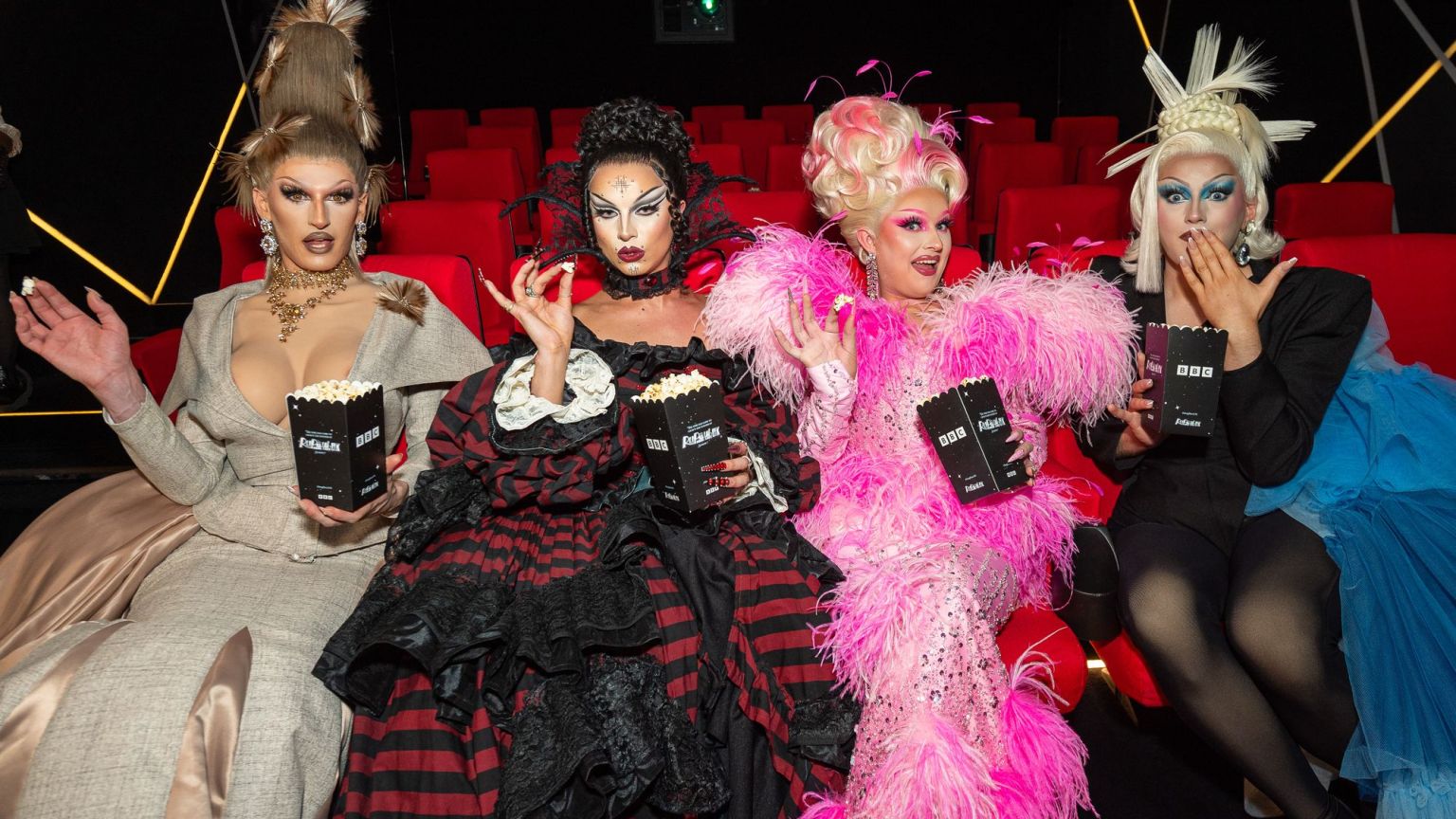
It has now emerged that the BBC has cancelled RuPaul’s Drag Race UK after eight series due to ‘significant financial pressures’. According to the BBC website, after starting in 2019, ‘Drag Race UK brought British drag into mainstream entertainment in the UK, and made household names of drag performers such as La Voix, Danny Beard and Tia Kofi.’ (Never heard of ‘em.)

I’m pleasantly surprised that this chop has happened, as the BBC has been unhealthily obsessed with drag queens over the past few years. Every ‘talent’, cookery and panel show must boast a bloke blind with sparkling eyeshadow; they’re all over Celebrity Mastermind, The Weakest Link, The One Show and Comic Relief (which actually sounds like a drag-queen name – once you look at life in their ceaselessly, and oddly joyless, smutty manner, everything seems like a drag-queen name. I can’t go past my local butcher without making a mental note to avoid Crackling & Stuffing.) As Andy Jones (who worked for the BBC himself) noted starkly in the Spectator earlier this year: ‘And, of course, “because of the unique way the BBC is funded”, the BBC News site also features every crumb of drag news from “Wiltshire locals dress in drag for calendar” to “Drag queens impacted by cost-of-living crisis.” The site ran around 20 separate online stories about the death of drag queen “The Vivienne”.’

Advertisement

BBC News even has a dedicated written section for the creatures – which can often run more stories than the boring old women’s section. BBC News’ top story on International Women’s Day one year was Dylan Mulvaney’s autobiography. Drag queens even have their own alleged sitcom Smoggie Queens, which has been commissioned by the BBC for a third series. I’ll stop here, though there’s masses more, because I’m starting to feel a tiny bit queasy. I’ll just say that it’s amazing there hasn’t been a drag queen reading the BBC News yet, hoiking up her false bosom while recounting some terrible atrocity.

This isn’t a bit of a giggle or pushing the boundaries or ‘being kind’. Drag is womanface, and it’s every bit as bad as blackface. That we don’t see it as such – and that women are among those who cheer these misogynist clowns on – speaks volumes about how we still see sexism as the ‘Yes, but…’ of prejudice, not really serious enough to be up there with racism. It’s ironic that a generation of young, liberal women have proudly freed themselves from being compliant to putative male partners of their own age (see that recent New Statesman poll that found that while only 35 per cent of women under 25 hold a favourable view of men, men from the same cohort hold a 72 per cent favourable view of women), but are fine with being adoring audiences and simpering punchlines for men who want only to mock them. They are accessories and doormats, there to make men dressed as women look acceptable – even if they call themselves names like Cheryl Hole and A’Whora and talk about ‘being fishy’ when they compliment one of their kind for ‘passing’ as a woman. There are drag queens who squirt ‘milk’ out of their fake breasts and drag queens who pretend to have ‘periods’ all over the stage. Is that just a bit of fun, too? But for the kind of woman who is deeply dreary and wants to look edgy, and who has usefully internalised her own misogyny, nothing is too low to get a ‘You go, gurrrl!’.

Some women will even involve their own baffled children in ‘Baby Drag Bingo’ or ‘Drag Queen Story Time’. In 2023, the truly vile-sounding ‘CabaBabaRave’ took place, featuring drag queens in thongs and bondage gear gurning at bewildered babies – it was organised by two women. Such thoroughly castrated females exist only as accessories to befrocked men who, the idiots frequently reassure them, make ‘a better woman than I do!’. In a piece calling the cancellation of Drag Race UK ‘sickening’, the Guardian smugged: ‘A contestant in season one even had a girlfriend at the time – and if that’s not inclusion, what is?’ More fool her. Talk about a female eunuch. Talk about a trans- / handmaid.

Advertisement

Even as a little girl, I knew that blackface was wrong. How stupid must grown women be, how complicit in the contempt which the BBC has been so flagrant in displaying towards them, not to recognise the same thing about womanface?

Source link

Advertisement
Continue Reading

Politics

The miserable legacy of Jamie Oliver’s war on school dinners

Published

on

The miserable legacy of Jamie Oliver’s war on school dinners

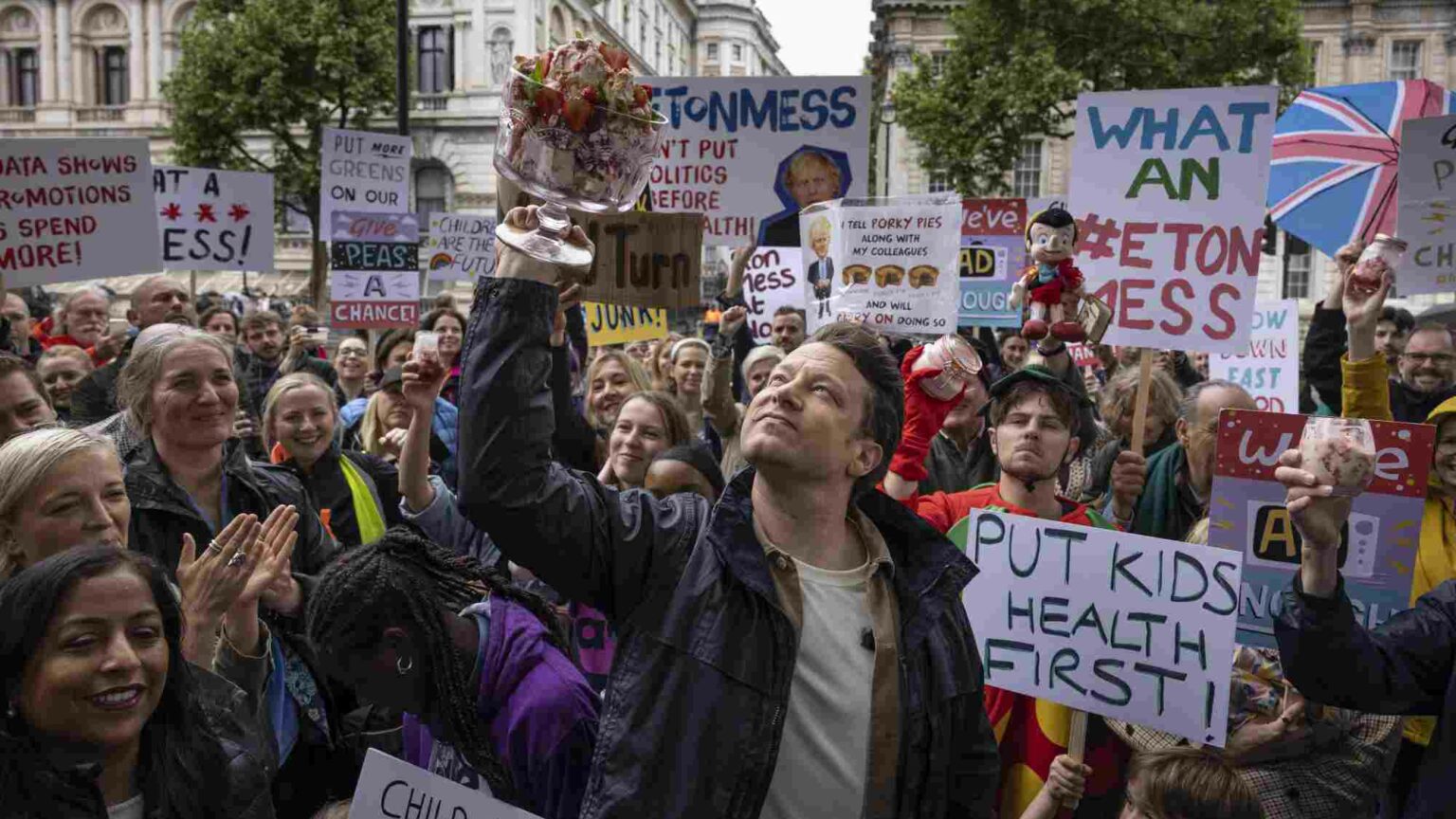
If you want to see how politicians would like to treat the public if they were not constrained by democracy, look at how they treat children. Soon to be banned from using social media and, from 1 January 2027, banned from ever buying tobacco, the under-16s are also about to be subjected to phase two of Jamie Oliver’s assault on school dinners.

It is almost exactly 20 years since a Labour government introduced new food standards in England’s schools after the unbearable celebrity chef made a TV series about it. Budgets were increased and Turkey Twizzlers were banned, but Oliver didn’t stop to catch his breath. He immediately demanded a ban on packed lunches and, in a classic case of projection, described parents who gave their children fizzy drinks as ‘tossers’ and ‘arseholes’.

The new school-dinner rules announced today give Oliver everything he has been lobbying for. Pastries and croissants will no longer be permitted in breakfast clubs. Sausages and bacon are allowed, but only once a week. Fried eggs are banned completely. Only breakfast cereals that are very low in sugar can be served. Teacakes, crumpets and unsweetened pancakes can be served, but only twice a week. Porridge is permitted but only if it is ‘plain’ and ‘unflavoured’ – no sugar, honey, syrups or sweeteners are to be made available.

Advertisement

For lunch, kids can no longer be offered fried chips or any other deep-fried food. Processed meat and ‘foods containing pastry’ can only be served once a week. Meals containing cheese, such as lasagna, are limited to three portions a week. Lentils and chickpeas are to be compulsory at least once a week. No foods containing chocolate are permitted. ‘Sweetened desserts’ can only be served twice a week.

As for the tuck shop, the government has decreed that the ‘only permitted snacks are plain fruits, vegetables, savoury crackers, breadsticks, yoghurt / plant-based versions (as per the dairy food group) and houmous’. Nom, nom!

Advertisement

Enjoying spiked?

Why not make an instant, one-off donation?

We are funded by you. Thank you!

Advertisement


Please wait…

Advertisement
Advertisement

It is not just that the government is being puritanical. The new food regime also reveals a thirst for micromanagement and regulation for the sake of regulation that is quite mind-boggling. No detail is too small for Labour’s Gastronomic Gestapo. No dinner lady is to be trusted and nothing can be left to common sense. Not only will kids be limited to two sweetened desserts a week, but those desserts ‘must include an 80g portion of fruit or vegetables’. Only jam and marmalade with ‘reduced sugar’ can be served, but they ‘must be limited to sachets or portions of no more than 10g or one teaspoon’.

The rationale for many of the new rules is far from obvious. Schools will be allowed to fry sausages but not eggs. If a school serves a food containing pastry and a food containing processed meat, it cannot serve a food covered in breadcrumbs in the same week. Schools cannot serve more than two portions of ‘meat and fish alternative products’ in the same week, but starchy carbohydrates, such as chips, must be available every day. The vegetarian menu must contain pulses at least three days a week. Where have all these numbers come from? Where is the science for any of this?

Advertisement

The new rules go far beyond ensuring that kids have a balanced diet and consume enough calories to get through the day. They are a grab bag of arbitrary prohibitions on random food products and compulsory targets that seem to have been devised by rolling dice. Their only redeeming feature is that they will save the taxpayer money if children decide to eat their breakfast at home and take a packed lunch with them to school.

This is why Jamie Oliver was so keen to ban packed lunches 20 years ago and it is why nanny statists have been echoing his demand ever since. Only last month, the cake-promoting anti-obesity campaigner Prue Leith said the quiet part out loud when she called for packed lunches to be banned because the government ‘can’t police’ what parents put in them. The constant expansion of breakfast clubs and ‘free’ school meals isn’t about preventing children from going hungry. It is about control. The state doesn’t trust parents to follow the latest food fad and it wants to overrule the preferences of not just the child, but also of the child’s family.

The new school-meals regime reveals in absurd detail what a state-sanctioned diet looks like. The government can enforce it on children because children can’t vote. It can’t enforce it on the rest of us for the time being, but through the use of taxes, bans and reformulation, it will do its best to try.

Advertisement

Christopher Snowdon is director of lifestyle economics at the Institute of Economic Affairs and the co-host of Last Orders, spiked’s nanny-state podcast.

Source link

Advertisement
Continue Reading

Politics

England is heading for street warfare

Published

on

England is heading for street warfare

The post England is heading for street warfare appeared first on spiked.

Source link

Continue Reading

Trending

Copyright © 2025