Politics
Introducing the UKICE staircase – UK in a changing Europe
Joël Reland explains the new ‘UKICE staircase’, which outlines the options available to the UK should it seek a different form of relationship with the EU, and the trade-offs they imply.
Ten years after the referendum that David Cameron promised would settle the EU question “once and for all”, we’re still talking about Brexit. And by ‘we’, I don’t just mean the team here at UKICE towers.
Across the political spectrum, few seem satisfied with the status quo. Keir Starmer and Rachel Reeves want more ‘alignment’. The Lib Dems want a customs union. Many backbench Labour MPs want to be like Switzerland. Wes Streeting wants to rejoin “one day”. Meanwhile, Nigel Farage and Kemi Badenoch both say they would rip up Keir Starmer’s EU ‘reset’ and leave the ECHR.
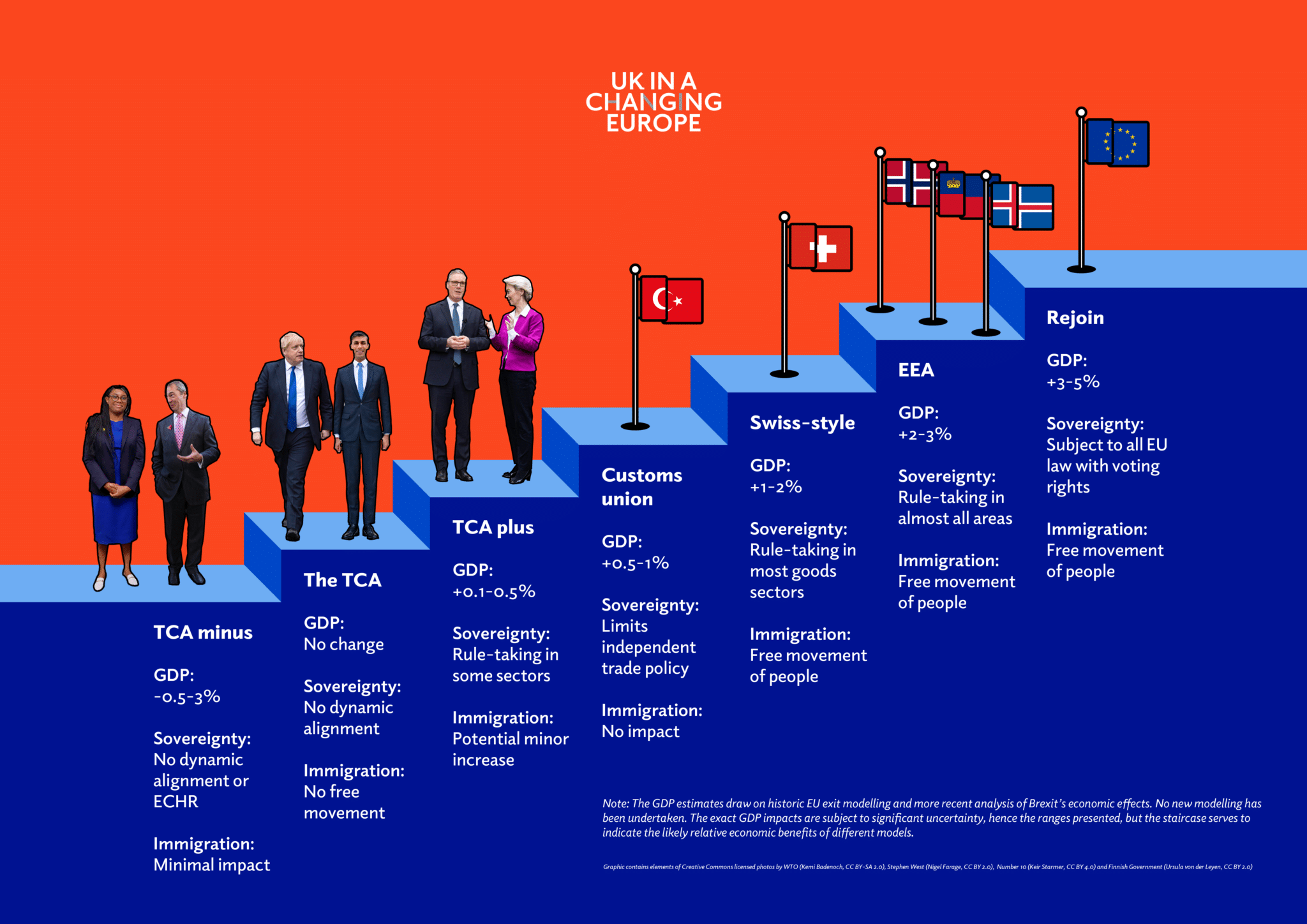
How to make sense of it all? To help, we have just published a new report, replete with a brand-new staircase (a modern, improved version of the Barnier original). It sets out the viable options for the UK should it seek a different model of EU relationship, and the trade-offs they imply. The staircase rests on a clear internal logic: each ‘step’ necessitates greater alignment with EU law (and other obligations) and, in return, is likely to lead to greater economic dividends. Let’s walk you through it.

The TCA
We are currently placed on the ‘TCA’ step. The Trade and Cooperation Agreement (TCA) which Boris Johnson negotiated provides for tariff-free trade with the EU at the cost of paperwork to prove goods qualify and other frictions like customs checks and regulatory compliance costs. It has ended free movement of people with the EU and gives the UK (except for Northern Ireland) the freedom to set its own regulations in most areas. The consensus is that the TCA has reduced UK GDP by 2-6%: broadly in line with pre-Brexit forecasts.
TCA plus
The government is seeking to add a handful of supplementary agreements onto the TCA, deepening economic, security and cultural cooperation (as set out in last year’s ‘Common Understanding’). Almost all of these agreements are still subject to negotiation but, if completed, could add up to half a percent to UK GDP by 2040. The economic agreements entail UK ‘dynamic alignment’ with EU law (meaning being subject to EU rules, as they evolve, with no formal say over them) in the areas of animal and plant health, carbon pricing and electricity. There would be no return to free movement but there could be some increase in EU migration to the UK from a ‘youth experience’ scheme.
TCA minus
Both Nigel Farage and Kemi Badenoch say they will reverse the Common Understanding and take the UK out of the European Convention on Human Rights (ECHR). The former would undo the potential ‘TCA plus’ economic gains. The latter would likely lead the EU to suspend the TCA, putting the UK-EU trading relationship onto ‘no deal’ terms which pre-Brexit forecasts suggest could reduce UK GDP by a further 3%. Reform and the Conservatives argue that leaving the ECHR will enable the UK to ‘secure our borders’ and ‘stop the boats’ by stopping migrants from appealing deportation decisions. But in practice very few extradition decisions are successfully challenged in this way, and exiting the ECHR would make it harder to cooperate with EU countries on small boat crossings.
Customs union
Both the Lib Dems and Greens support a UK-EU customs union. This would see the UK and EU set common tariffs on goods imports and, in return, UK-EU trade would always be tariff-free, with traders no longer needing to complete complex paperwork to prove the national origin of goods. This would remove a significant source of trade friction, and could boost UK GDP by 0.5-1%, with manufacturing sectors feeling the biggest benefits. But the UK would lose a large degree of control over trade policy – it could not offer countries lower tariff rates than the EU and, if the EU imposed major tariffs on others, the UK would have to do likewise. An EU Commissioner suggests the EU is “open-minded” and “ready to engage” about the idea of a customs union.
Swiss model
Some in the Labour Party have suggested that the UK could seek a ‘Swiss-style’ deal with the EU. Switzerland is integrated into the single market in a range of, mostly, goods sectors – and has to ‘dynamically align’ with relevant EU law for the privilege. It also has free movement of people and pays into the EU budget (around £330m/year for 2030-2036). This deeper integration brings bigger economic gains (an estimated 1-2% GDP boost) while maintaining autonomy in services sectors like financial services and AI. It is not certain that the EU would want to engage in talks on a Swiss-style deal: as they have historically found it difficult to manage and it risks derailing the ratification process for the updated EU-Swiss agreement. A senior EU figures has said a Swiss deal is “possible, but it takes time”.
EEA (single market)
Joining the European Economic Area (EEA) would mean full participation in the EU single market. That brings greater economic gains (an estimated 2-3% GDP boost) but requires greater dynamic alignment and budget contributions than the Swiss deal, while also accepting free movement. There are still some barriers to trade because the EEA agreement does not include a customs union. Joining the EEA would be complex: the UK would most likely first have to join EFTA, which the member states (Iceland, Liechtenstein, Norway and Switzerland) might not welcome, and then seek to negotiate an EEA accession treaty. Maintaining widespread dynamic alignment also takes a lot of administrative work. EU officials have suggested EEA membership as a plausible model of UK association.
Rejoin
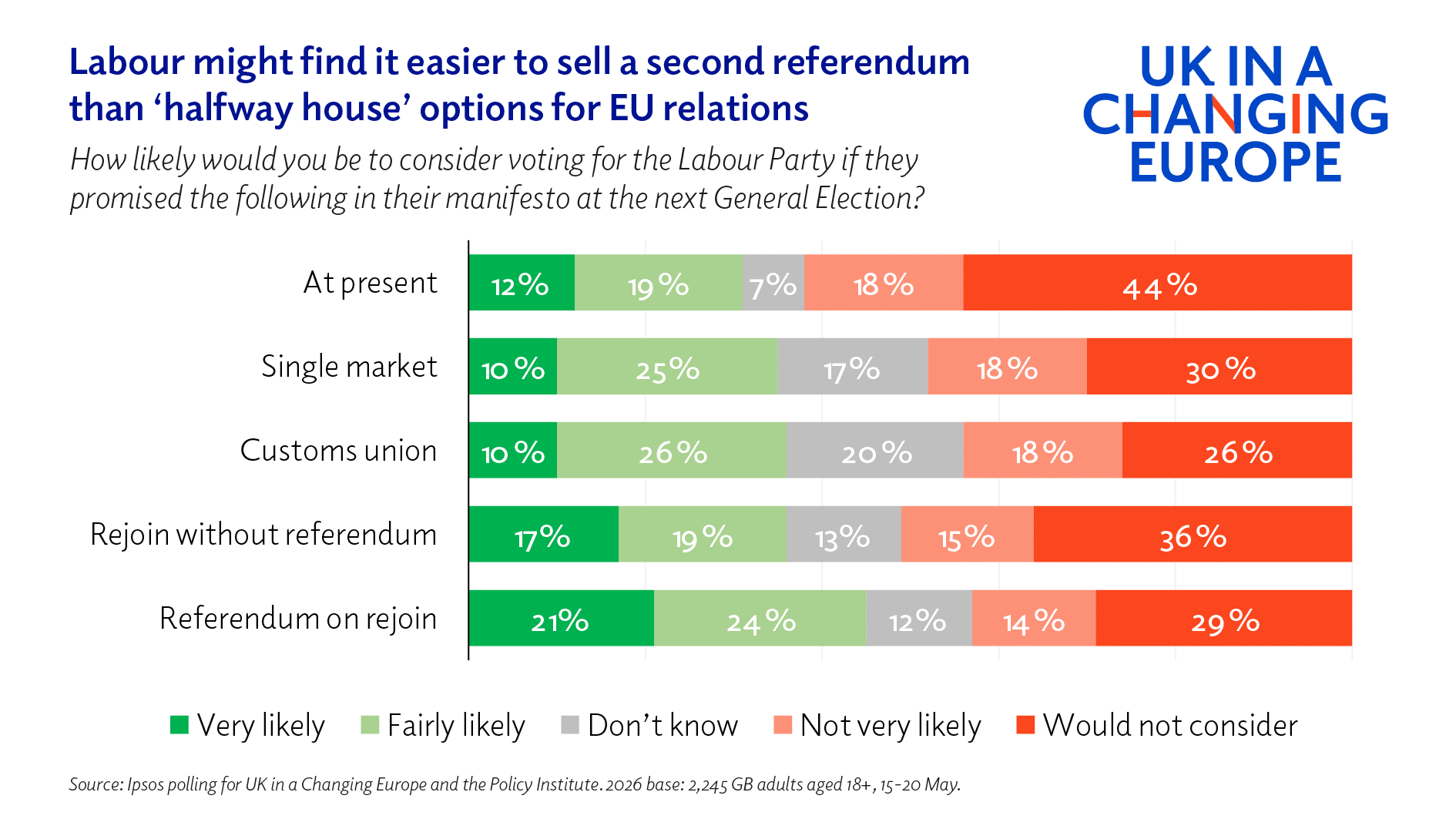
The UK could apply to become an EU member state again. It is reasonable to think this would reverse most of the economic damage Brexit has done. A successful application would mean being bound by all EU treaties and the UK would, likely, have to do without the rebate on its budget contribution which it used to enjoy and make an at least rhetorical commitment to join the euro. Unlike with the Swiss and EEA deals, the UK would have much greater decision-making powers over the EU law to which it is subject, including full voting rights, and the EU would be obliged to consider a UK application according to pre-set criteria. Among voters, rejoining (with a referendum) is the most popular of all options for the future relationship.

By Joël Reland, Senior Researcher, UK in a Changing Europe.
You must be logged in to post a comment Login