Politics
Is a Green wave about to break in local and devolved elections?
Rob Ford analyses the surge in support for the Green Party ahead of the local and devolved elections on Thursday 7 May.
The remarkable rise of Reform has dominated the political narrative of late. However, a new insurgency has started to make waves. The Greens have enjoyed a remarkable surge in the polls since the election of their charismatic and social media friendly leader Zack Polanski as party leader last September. In February, they proved this was no polling phantom by taking the formerly safe seat of Gorton and Denton from Labour in a by-election.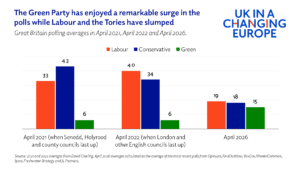

Source: 2021 and 2022 averages from David Cowling, April 2026 averages calculated as the average of the most recent polls from Opinium, FindOutNow, YouGov, MoreInCommon, Ipsos, Freshwater Strategy and JL Partners
Local and devolved elections this week may offer an opportunity to make bigger gains on a broader front. The political landscape has changed dramatically since these areas were last up for election in either May 2021 or May 2022. Then, Labour and the Conservatives still dominated the polls. Both parties’ support has more than halved since, while Green support has more than doubled, putting Polanski’s insurgents in a statistical tie with both traditional governing parties in the current polling.
The Greens have also advanced in Senedd polling, while the Scottish Greens, though a separate party, seem also to be benefitting from the rising tide. The Greens are polling an average of over 10% in the latest Senedd polling, double their showing last time, and potentially sufficient for them to enter government as a junior partner to the first Plaid Cymru lead administration, in a country where they have never previously won a seat. The Scottish Greens have hit the mid-teens in recent regional list polling, nearly double their 2021 showing and potentially a record result. The Scottish Greens could play a pivotal role after May if the SNP fall short of a majority, as they will be the only other pro-independence party in the Scottish Parliament.
The Greens could thus be about to emerge with power and influence in both devolved assemblies, but it is in the town halls of England that they may make the most dramatic gains. The first past the post electoral system used in English local contests, which has in the past marginalised the Greens, may now accelerate their advance. The rising Green vote has a distinctive demographic profile, with the biggest gains coming among students, young graduate professionals and Muslim voters. These groups all tend to congregate in the same urban areas where universities are based, graduate jobs are found and England’s largest Muslim communities live.
The impact could be greatest in London. The capital was already the Greens’ strongest region in 2024, and London’s 32 boroughs elect all the councillors for multi-seat wards simultaneously in ‘all up’ contests – a system which can magnify the impact of polling shifts. Inner London features several Labour dominated boroughs with exceptionally Green friendly social profiles, including Camden, Islington and Zack Polanski’s home borough of Hackney. The Greens, who have never won control of a London borough before, may take charge in several patches of inner London governed by Labour for generations. This would be a seismic shift, and one which may bring broader political aftershocks, given how many Labour MPs (including the PM and many of his senior colleagues) represent London seats.
While London is the biggest prize, the Greens will hope to seize similar opportunities in England’s other big cities. Birmingham also has “all up” elections and a large Muslim community which swung strongly against Labour in Mayoral and Westminster contests in 2024. Meanwhile, in Greater Manchester the Greens will hope to ride the wave of their recent by-election triumph. There are many other opportunities in big urban boroughs such as Sheffield, Leeds and Newcastle with Green friendly demographics, but also in smaller cities and rural areas such as Norwich, Norfolk and Suffolk where the Greens have built up a strong local presence and now stand to benefit from the collapse of the traditional parties.
Success, if it comes, will bring its own challenges. In England, Green councillors with little or no experience of government could soon be running, or helping to run, large city councils burdened with many responsibilities and strained budgets. In Wales, Greens who have never even made it into the Senedd before may soon have a share in a devolved government with even wider responsibilities. As Reform discovered after taking over county councils last year, populist slogans may prove effective on the campaign trail, but they may equally be impossible to deliver on once in charge of the town hall. Many Green voters backing the party’s promise of radical change may find their high hopes are fast disappointed.
Yet the risk of disappointing voters in power is surely one the Greens will be happy to run after decades sat on the margins of British politics. And a big Green wave will have broader implications. As the Liberal Democrats and the SNP have shown before, local and devolved elections can be a springboard to success at Westminster contests. Big council gains will boost the Greens’ profile and organisation even in areas where they don’t win control outright, with local success helping to demonstrate to voters that the Greens are now a viable local option.
Such electoral credibility could be a vital resource in the next general election, when the stakes will be higher, and many progressive voters who take a chance on the Greens this year will be weighing their options more carefully, worrying in particular about the risk of progressive splits helping Reform. The Greens showed in Gorton and Denton that they could overcome such anxieties and triumph even in a Westminster seat where Labour had long been dominant and Reform were a credible threat. A big advance in local and devolved contests will help convince wavering voters that the Greens are a credible option in a much wider range of seats. The Greens still have a long way to go if they want to challenge Labour as the dominant left of centre party at Westminster. But they may take a big step forward next week.
By Professor Rob Ford, Senior Fellow, UK in a Changing Europe and Professor of Politics, University of Manchester.
You must be logged in to post a comment Login